The implant is a flexible polymer electrode and in a recent study was placed in the proverbial three blind mice, (the actual number was seven, three blind males and four females). After a year, the implant has shown that it can deliver electronic vision to the visual cortex. The results have been published in the Journal of Advanced Healthcare Materials. If they can be replicated in humans in the future, this neural implant which is no bigger than a single neuron when combined with others could restore sight to blind people.
Maria Asplund is a Professor of Bioelectronics at Chalmers. She notes that a single implant begins to eliminate the darkness. Multiples could bring back close to normal sight. The more implants, the better the image. But putting more into the brain could be overwhelming. Not so states Professor Asplund.
Each implanted device is called a thread for a good reason. They are very tiny and contain multiple aligned electrodes. An electrode the size of a neuron sounds impossible, yet advancements in nanofabrication have made it a reality.
States Professor Asplund, “Miniaturization of vision implant components is essential. Especially the electrodes, as they need to be small enough to be able to resolve stimulation to large numbers of spots in the brain visual areas.”
Implanting several threads would put thousands of electrodes in contact with the brain’s visual areas. To restore full vision, you would probably need to implant hundreds in the visual cortex of the brain. Each is less than 15 micrometres or 15 millionths of a metre.
The study has demonstrated these implants are proving to be remarkably stable over a year and have stood up to billions of electrical pulses sent to them to train the visual cortex of the mice to see the images produced. Each of the pulses has been between 2 and 20 microamperes, far below the maximum threshold the electrodes can withstand. The natural immune response to their presence has been minimal producing little damage to the surrounding brain tissue.
The Chalmers and NIN invention improves on work previously demonstrated in 2018 by an implant invented by researchers at the John A. Moran Eye Center at the University of Utah in conjunction with Miguel Hernandez University in Spain. A penny-sized visual prosthesis made from silicon was implanted in the brain of a 58-year-old woman named Berna Gomez. She had lost her sight 16 years earlier after developing toxic optic neuropathy, a condition that destroyed her optic nerves. The Utah device allowed her to see two-dimensional shapes and letters but unfortunately degraded over time because it stimulated an immune response. Its size also made it too large to be practical for full-sight restoration.
The threadlike design of the Chalmers invention allows a large number of electrodes to be implanted within the visual cortex without overwhelming the brain. It has produced little reaction from the body’s autoimmune response. It represents a design proof-of-principle.
For more than 1 million Americans and close to 50,000 Canadians, let alone the many tens of millions on the rest of the planet, this technology could give them sight or restore it if once lost.
Testing in human hosts is still in the offing. Should human clinical trials succeed, this invention could become a promising prosthetic therapy for restoring vision through electronic stimulation of the visual cortex.
]]>

His invention cannot make those with no vision see, but anyone with some remaining vision who has been declared legally blind can use these glasses to see nearby objects. For those with tunnel vision from macular degeneration or retinopathy, for those with cataracts blocking the field of vision, for night blindness, smart specs may help.
How do they work?
They combine a 3D camera and built-in software to enhance vision. The software enhances and highlights objects in the foreground while hiding the background (see the four panel image sample below as illustration). The wearer can even pause the visual feed and zoom in for greater detail. The depth camera works in the dark allowing for night vision.

The smart specs can be outfitted with sunglass lenses and with prescription inserts. The battery-powered control box is worn over the shoulder giving the wearer access to the zoom, pause and enhance vision features which include daytime colour, high contrast amplification and low light navigation.
This month VA-ST loaned 300 pairs of its glasses to people with macular degeneration, retinitis pigmentosa and glaucoma. The four week study will record how each of the wearers benefited from using the technology to cope with everyday living.
Plans are to go into production later this year and have VA-ST available commercially early in 2016 for less than $1,000 U.S. per pair.
Future versions of the glasses will focus on design to make them look sexier, shrink the format and reduce the weight. But for now VA-ST could be just what ophthalmologists need to help patients declared legally blind see again.
New Clinical Trial for Treating Multiple Sclerosis Produces Promising Results
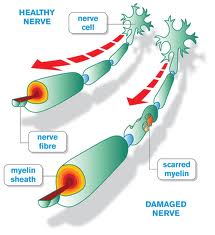
How do you switch off a selective autoimmune response in the body without compromising the entire immune system? That’s what researchers at Northwestern University set out to do in developing a treatment for multiple sclerosis (MS). MS is an autoimmune disorder in which the body’s own immune system attacks the myelin that insulates the nerve cells of the spinal cord, brain and eyes. When the myelin is destroyed those who suffer from the disease experience numbness, potential paralysis, blindness and in extreme cases death.
What the researchers found is that they could deliver billions of myelin antigens by placing them in a patient’s white blood cells and then injecting those cells into the body. In this way the body would recognize the antigens and build a tolerance to them. Current MS therapies tend to suppress the entire immune system leaving those being treated open to opportunistic diseases.
The clinical trial involved nine patients with those receiving the highest dose of white blood cells showing the greatest reduction in autoimmune response to myelin.
If this approach works with MS it may become a protocol for other autoimmune diseases such as asthma and arthritis, and for dealing with allergies that cause anaphylaxis.
New Treatment for Blindness is Noninvasive
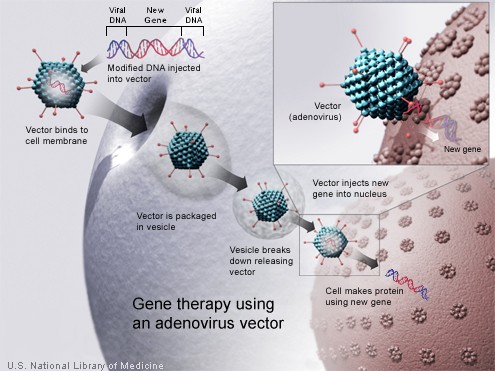
UC Berkeley researchers are inserting normal genes into eyes to help restore sight for diseases such as retinitis pigmentosa and macular degeneration. The team of researchers are using an adenovirus that has had 10 amino acids on its outer shell altered to allow it to pass through retinal cells to reach the eye’s light sensors. The diagram below illustrates how this type of gene therapy works.
Traditionally treatment for blinding diseases involved inserting a needle deep into eye which often lead to retinal detachment. But this new therapy is far more benign. All the doctor does is inject the adenovirus into the liquid vitreous humor behind the lens. The virus then does the rest finding its way through the many cell layers of the retina to replace the defective genes in the photoreceptors.
The therapy may also be used not just to insert genes but also to knock out genes that are causing deterioration in vision such as what occurs with age-related conditions like macular degeneration.
Immune Cells Key to Limb Regeneration in Salamanders
Macrophages are white blood cells that engulf and digest cellular debris and pathogens and stimulate other immune cells in the event of an injury or invasion by a foreign entity. They play a critical role in the immune system. But what role do macrophages play in limb regeneration?
Apparently a significant one according to a study just published in the U.S. Proceedings of the National Academy of Sciences. That is if we are talking about axolotl, an aquatic salamander that is the subject of the study. When macrophages were eliminated from an amputated limb site in axolotl the salamander was unable to regenerate a lost limb. When a small number of macrophages were present the limb regenerated but at a slower rate than normal. So obviously there is something that macrophages do that causes tissue to regenerate.
Salamanders can be a template for limb regeneration in humans if we can reverse engineer what happens when a limb is lost. Instead of scar tissue forming at the wound site researchers hope with the right macrophage responses they can activate limb regrowth.

Is Feeding Nine Billion Humans Even Possible on This Planet?
With over one billion seriously malnourished today in world of 7.3 billion, how will humans cope in 2050 when our population is expected to exceed 9 billion? In this month’s Nature Climate Change, an international team of scientists, members of the Agricultural Model Intercomparison and Improvement Project or AgMIP, shared a study on wheat production involving 27 different crop models and taking into consideration climate change, soil, precipitation patterns, and other factors.
Does the study give us an answer for 2050? Not yet. But it is hoped that by running the simulations and models and sharing the results with the Developed and Developing World countries that policies and procedures can be put in place to impact agricultural production of wheat positively.

China Implementing Carbon Cap-and-Trade in Select Cities Before National Rollout
It’s a well intentioned strategy but China’s first steps into controlling its CO2 emissions is built around intensity rather than total emissions. But before I go into the difference between the two you should know a little bit more about the program.
Beginning on June 18 as reported in Nature, the International Weekly Journal of Science, China will institute a carbon cap-and-trade policy for the city of Shenzhen and its more than 630 industrial sites. Shenzhen is just outside of Hong Kong and one of economic miracles in China’s growth over the last quarter century. Companies in Shenzhen are being given carbon quotas. If they exceed them they can buy credits from companies that are below their quotas. By 2015 China intends to add the cities of Beijing, Tianjin, Shanghai and Chongqing as well as Guangdong and Hubei provinces to the cap-and-trade quota system. That will be followed in 2016 by a national quota system.
So China is committed to cutting its carbon but it is measuring it by intensity rather than total emissions. Intensity is the same measure that the Canadian government uses to show its commitment to reducing carbon emissions. But intensity doesn’t if an economy continues to grow because all it does is reduce the emissions per unit of production. So if production triples and intensity goes down by 40% total emissions continue to grow.
With some of the most polluted cities in the world as seen in the compiled pictures below, China, at least, is making a start. How well will it work? What watchdog will ensure that companies are playing by the rules? Will corruption and government cronyism foul up the results? We will see.

A Postscript
Some of you were kind enough to suggest new stories in the last week. The China story was one of them. I look forward to hearing from more of you and as always welcome your questions and comments. Thanks for dropping by.
– Len Rosen
]]>
