It is likely that within the next two decades, the first human explorers will land on Mars. For humans to survive on the Red Planet, however, it will require more than sending us. We don’t exist in isolation here on Earth and likely cannot survive on Mars without the accompaniment of many friends from our planet. Those friends include plants, bacteria and insects.
Researchers have simulated Martian soil, atmosphere and light conditions to see if Earth-based plants can survive there. But Martian gardens will not thrive without others to help. The plants will need living things that inhabit Earth’s subsurfaces as well as some that live above the ground.
Plants on Earth need pollinators. Plants on Mars will need the same. If not insects, then human settlers will need a suitable substitute.
NASA recognizes the challenge and along with the Canadian Space Agency has launched the Deep Space Food Challenge. Its focus is to come up with new food production technologies or systems for prolonged missions beyond Earth.
The environment of Mars is not Earth-plant-friendly. The atmosphere is extremely thin and mostly carbon dioxide (CO2). Since plants take in CO2, this would seem to be an advantage. But CO2 from ambient Martian air because it is so thin would be minimal.
The Martian surface lacks any protection from incoming solar and cosmic rays because the planet’s magnetosphere is almost non-existent.
Soil toxicity presents further challenges. Landers and rovers on Mars that have sampled the regolith indicate high concentrations of perchlorate compounds which are incompatible with most plant life.
Plants could indeed be grown in Earth-simulating greenhouses, but the infrastructure requirements to build and maintain them would add significantly to settlement costs.
Could Martian soil be conditioned to be plant-friendly? Several species of DPRB bacteria found on Earth tolerate perchlorate. One, Dechloromonosand Azospirause, converts perchlorate into energy molecules and releases chloride and oxygen as waste.
The Chinese space program has experimented with growing plants in simulated lunar soil with some success. They introduced three bacteria, Bacillus mucilaginosus, Bacillus megaterium and Pseudomonas fluorescens. All are phosphorus-solubilizing and allowed the Chinese researchers to grow Benthi, a tobacco plant relative. Could similar results be produced on Mars? If we were to transplant these Earth-based bacteria to Mars, would they be changed and evolve when exposed to space and then the Red Planet?
Another way for Martian soils to become Earth-plant-friendly is through the application of fertilizers. Fertilizers made using sodium molybdate, and molybdenum-bipyridine complex when combined with a hydrogen-activating catalyst made of palladium on carbon would turn perchlorate into water, a welcome outcome for both plants and human settlements.
And what about pollinators? On Earth, insects provide that essential service to help plants propagate. Could we bring bees to Mars to sustain our plants? Bees have been studied on the International Space Station. They don’t like living there. Mars could be equally hostile.
Could another insect friend be a good pollinator substitute, in fact, a friend with added benefits? A recent New York Times article by Sarah Scoles entitled “Mars Needs Insects,” describes introducing the Black Soldier Fly (seen below) to the Martian environment.
The fly could serve three purposes. It could be a pollinator. Its larvae could consume human waste produced by the settlers which would further condition the soil for growing plants.
And the fly could even be a food source. The Canadian government recently invested in a facility to grow Black Soldier Flies for sustainable agriculture use. The plan is to use the larvae as animal feed. It is protein-rich and tastes like nuts. If presented properly, Black Soldier Fly could be the next “beef” patty.

NASA’s Biological and Physical Sciences Division has recommended a new program called BLiSS which stands for Bioregenerative Life Support Systems. The goal is to build sustainable environments independent of Earth. These would be capable of supplying all their food, water, and air needs. They would be circular environments with nothing going to waste.
The Black Soldier Fly right now sounds like the perfect companion to create such environments. It would pollinate the plants, consume human waste, fertilize the soil, and be a food source. They along with various bacteria will be the friends we need to make Mars a second home. Without them or similar friends coming along for the ride, our species will never become interplanetary.
]]>Today almost 2 billion of us humans supplement our diets with insects. That’s not so far fetched when you think about it because here in North America we think nothing of eating lobster and crayfish, arthropods that are distant relatives of the six-legged creatures.
Farm 432 takes 432 hours (18 days) to turn one gram (0.035 ounces) of Black Soldier Fly eggs into 2.4 kilograms (5.3 pounds) of protein-laden food in the form of fly larvae and pupae.
Why these flies? Because they are not the irritating pest flies we hate and because they are great biowaste harvesters who carry no known human pathogens. The adult Black Soldier Fly doesn’t eat and lives for barely an hour just to reproduce. When the eggs hatch the larvae digest any compostable food scraps or biowaste you feed them. An average household can produce a kilogram (2.2 pounds) of food waste every day and when fed to these flies turn that waste into protein.
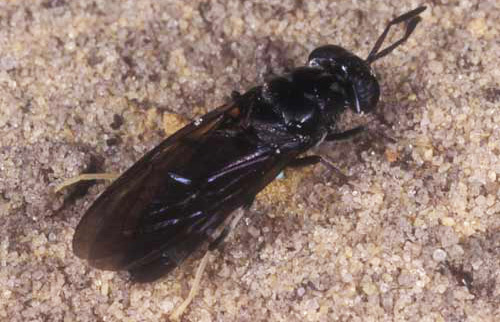
Black Soldier Flies are found throughout North America. They thrive in the presence of salt, alcohol, ammonia and other toxins. They can handle poultry and pig waste. They compete with other flies, the nasty ones we don’t like, and today are even being used to by doctors on patients to clean necrotic human tissue to prevent gangrene. The larvae can survive extreme oxygen deprivation. Immerse them in alcohol for two hours and they don’t die. These are truly remarkable creatures.
Recent studies have looked at Black Soldier Flies as a replacement for fish meal in animal feeds. But Unger goes one better. Why feed the animals when you can feed the humans who eat the animals? So Farm 432 incubates the Black Soldier Fly eggs which take over 4 days (102 to 105 hours) to hatch. The larvae are then fed table scraps and other household compostables. Two weeks later you have ready-to-harvest fly pupae that contain:
42.1% crude protein
34.8% ether extract (lipids)
7.0% crude fiber
7.9% moisture
1.4% nitrogen free extract (NFE)
14.6% ash
5.0% calcium
1.5% phosphorus
As food what would Black Soldier Fly go for? Fresh larvae as an animal food supplement is currently priced from $8.80 to $44 per kilogram ($4 to $20 per pound.) With no price yet announced for a Farm 432 you’ll just have to wait until Unger is ready to go to market. There is nothing strange or quirky about what she has designed. The United Nations, as I have written in the past, envisions humans making insects a good part of our diet in the future as our population grows to 9.5 billion by 2050. Check out the links provided in this posting and the pictures below.
For recipes on eating insects, check out the Eat-a-Bug Cookbook or Creepy Crawly Cuisine, both available through Amazon. Our future may be just a little bit weirder than you think.