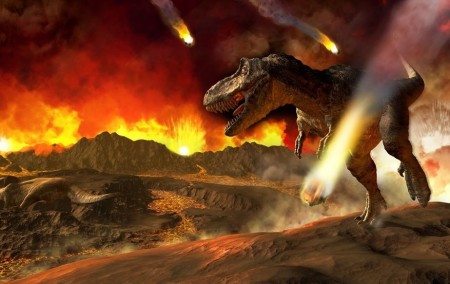
What I’m talking about is the results of a newly published research paper entitled, “Global Climate Change Driven by Soot at the K-Pg Boundary as the Cause of the Mass Extinction.” The story of the end of the age of dinosaurs has become well established in the last several decades as uncovered geological evidence points to a significant asteroid impact occurring near the present-day Yucatan Peninsula in Mexico. The impact is believed to have caused enough ejecta to block sunlight in the atmosphere interrupting photosynthesis in plants and leading to a mass die off. The discovery of a layer of iridium deposited in a thin layer marking the Creataceous/Paleogene boundary has been the smoking gun of this hypothesis.
But the new research adds another factor. The impact site is an oil-rich area and the asteroid’s impact and disintegration not only released vast quantities of its own material but also vaporized enough of the Earth’s crust to introduce sooty aerosols in the atmosphere which spread globally. The presence of particulate matter in significant concentrations caused global cooling, more significant in polar and mid-latitude regions, and milder cooling and drought in lower latitudes. The research hypothesizes that photosynthesis would have ceased on land as well as in the oceans within a few months and persisted for several years. Ocean surface temperatures would have dropped as well. These events induced both terrestrial and marine extinctions with the latter happening later than the former, a matter of just a few years delay.
The study describes a significant increase in infrared radiation as ejecta from the site of impact would have temporarily reached into space before falling back to Earth. This would have ignited fires in the oil-rich strata of the crater and released hydrocarbon aerosols as opposed to what previous paleoclimatologists surmised. The older theory of the extinction event describes the impact causing sulfuric acid aerosols leading to global darkness and an equivalent to a nuclear winter accompanied by acid rain. The new theory of hydrocarbon aerosols, state the researchers, explains why crocodilians, turtles and many other animals, including birds and a number of mammals made it through and soon dominated the land, water and air.
So where is the evidence of a hydrocarbon soot to be found? The scientists found incomplete combusted hydrocarbons in coarse-ejecta beds in Haiti and Spain. These were in proximity and lay above the iridium layer of ejecta from the asteroid itself. The composition of these hydrocarbon sediments forming a black carbon includes coronene, benzopyrene, and benzoperylene (see graph reproduced from the study below).
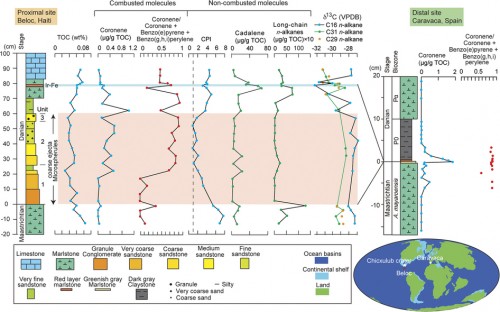
These hydrocarbons are similar to ones found in rock at the crater impact site. The particular hydrocarbons indicate extensive combustion. The depth of the deposits found in association with the iridium layer at one of the sampled sites varies from 2 to 4 centimeters, and at other sites further from the impact crater dissipate. From measuring these sampled sites the researchers have calculated that the total amount of black carbon ejecta amounted to between 500 and 2,600 teragrams which equals between 551 million and 2.9 billion tons. And although the researchers believe the lower figure of ejecta would not lead to a dinosaur extinction event, the upper number when entered into climate models would be consistent with their demise along with significant marine extinctions.
The prior nuclear winter scenario of prolonged darkness, the researchers argue, would have led to much more significant extinctions including crocodilians, birds and mammals. But that didn’t happen. Hence the black carbon soot-aerosol explanation is a better fit for what actually ensued.
Recently I wrote about short-lived climate pollutants of which black carbon was one. The appearance of this research paper in juxtaposition with that posting makes this cause of extinction relevant to us in our contemporary world where we humans are producers of soot-aerosols that are contributing to climate change. So maybe we can learn something from history, after all, even one 65 million years in the past.

Black Carbon – What is it?
When you look at an industrial plant or tail pipe emissions you see smoke. That smoke consists of small particles of which the major constituents are carbon, sulfates and nitrates. Particles vary from as small as 2.5 micrometers (um) to 10 micrometers. If you think about 10 micrometers as a measure that you may better relate to it is equal to approximately 0.00039 of an inch. That’s very small, in fact so small that these black carbon, sulfate and nitrate particles get into our lungs where they can lead to medical problems. In China with its heavy reliance on coal-fired power plants the country faces what has been referred to as an airpocalypse with average lifespans shrinking among its citizens because of respiratory and heart disease attributed to particulate matter.
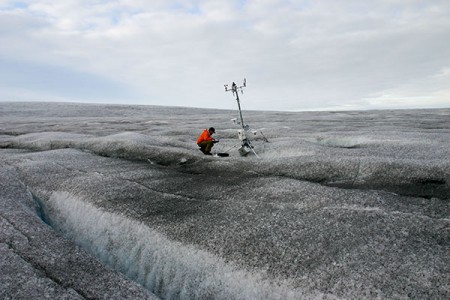
How does black carbon contribute to global warming? Particles as small as 2.5 micrometers strongly absorb light energy from the Sun which then converts to heat in the atmosphere. In addition black carbon gets moved around the world by air currents and one particular vulnerable location is the Arctic. Black carbon along with CO2 is contributing to accelerated glacial and sea ice melt. The Dark Snow project, a crowd-funded study, is gathering evidence of the role black carbon plays in the shrinking of polar ice. The image below illustrates just how extensive black carbon’s reach can go. Normally this ice would be pristeen and white. But as you can see black carbon delivered by air currents even reaches the remote surface of Greenland ice sheets.
Black carbon has another characteristic. In sufficient airborne quantities it alters precipitation patterns working the same way as cloud seeding. In the case of the latter we shoot aerosols, usually silver iodide crystals, into the atmosphere to induce precipitation. The crystals form a nucleus around which water vapour congeals. Black carbon does exactly the same thing.
Methane
We are all becoming more familiar with methane (CH4) as a potent greenhouse gas in recent weeks because political leaders have raised its profile in the fight against global warming. So why is CH4 such a potent greenhouse gas and how does it differ from CO2? It’s potent because the gas molecule is large and when light strikes it, it has a much higher capacity than CO2. And whereas CO2 lingers for centuries in the atmosphere, CH4 has a limited atmospheric lifespan of 12 years before the molecule breaks down.
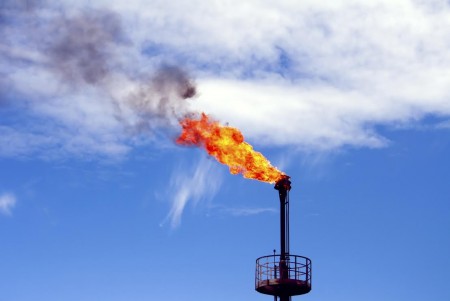
Anthropogenic methane comes from a number of sources including:
CH4 is responsible for about half of observed rise in ozone (O3) within the troposphere. That’s not the O3 found in the stratospheric ozone layer that has been of such concern for several decades because holes have opened. Tropospheric O3 contributes to asthma and respiratory illness. For more on this consequence of CH4 read the section that follows.
Humans and human activities aren’t the only source of CH4. Forests and natural landscapes as they go through seasonal variations contribute CH4 in significant quantity. But before humans started pumping out CH4 there was homeostasis in the environment, in other words, a natural balance that didn’t contribute to global warming.
Another source of CH4 is permafrost which as it thaws releases significant amounts of the gas.
The reason that Three Amigo summit announced targeted CH4 reductions of 40 to 45% by 2025 from the oil and gas sector is simple. Without this initiative anthropogenic CH4 was expected to increase by 25% by 2030. So targeting emissions from fossil fuels makes immediate sense. The real challenge will be CH4 reductions in agriculture.
Tropospheric Ozone
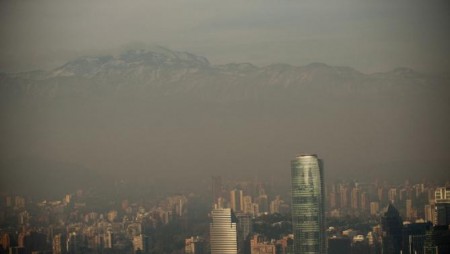
If you live in a city then you have experienced the effects of tropospheric ozone (O3). It is the principle component of urban smog. Also known as ground-level ozone, O3 is the most significant urban pollutant we humans create when we heat our homes, run our smokestack industries and drive our cars.
Have you experienced O3’s impact? You may not realize it but when you walk on a street where the traffic is busy and your eyes start to burn or you nose gets plugged and runny then you are experiencing the O3 effect.
As a greenhouse gas O3 has a short lifetime, lasting no more than a few days to a few weeks. But the damage it does to plants and humans is significant. In plants it reduces their ability to absorb CO2 inhibiting growth as well as interfering with the plants capability to act as a natural carbon sink. And in humans our children experience childhood asthma because of it while adults suffer with lung and cardiovascular complications from it. O3 has been cited by scientists as responsible for an estimated 150,000 premature deaths annually.
Hydrofluorocarbons
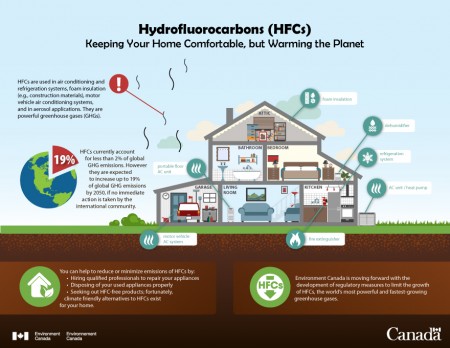
Known as HFCs, these are human-created fluorinated gases that we currently use in air conditioners, refrigerators, insulation materials, solvents, aerosols and fire retardants. Back in 1987, 24 major industrial nations agreed to limit a particular type of HFC called chlorofluorocarbons (CFCs) because of their impact in creating holes in the stratospheric ozone layer. The control of CFCs and their disappearance was a major environmental achievement. But now with HFCs, our replacement for CFCs, we’ve created a new problem.
HFCs represent just 1% of all greenhouse gases we humans produce. They remain in the atmosphere for about 15 years. As small as their volume may be their global warming impact exceeds their footprint dramatically. Scientists forecast that by 2050 HFCs will be a one of the most significant contributors to anthropogenic climate change. Their contribution to warming is forecast by scientists as producing 0.1 Celsius (0.18 Fahrenheit) in overall global mean temperature rise by 2050.
The Three Amigos Agreement on Short-Lived Climate Pollutants
The leaders of Canada, Mexico and the United States when they met agreed to tackle all of the above short-lived climate pollutants.
For black carbon their commitment focused on an industry sector strategy building expertise and sharing information and technology focused on reduction and mitigation. In one specific area they focused on heavy-duty diesel vehicles with a goal to achieve near-zero emissions through adoption of ultra-low-sulphur diesel fuels and improvements in exhaust systems by 2018. The countries also agreed to establish a black carbon inventory with a goal to reduce industrial and domestic emission sources in all jurisdictions.
For CH4 the 40 to 45% reduction target by 2025 will be accomplished through sharing information on CH4 data including transparent reporting on emissions, cooperation on technology development, and an industry sector strategy which not only includes oil and gas but also agriculture and waste management. One goal is to meet the United Nations target of 50% reductions in global food waste by 2030.
For HFCs the three countries agreed to begin a phase-down in use with product-specific prohibitions and adoption of a comprehensive agreement similar to the one established for CFCs back in 1987.
For O3 the focus of all three countries is the promotion of clean and efficient transportation by accelerating government use of zero or near-zero emission vehicles, and by working with both industry (convening a meeting of all players no later than 2017) and consumers to see rapid adoption of clean-air technologies including deployment of an extensive clean refueling infrastructure across North America.
In addition the three countries agreed to begin to tackle maritime and aviation greenhouse gas emissions (particularly black carbon). Both of these sectors were left out of the COP21 Paris Agreement and their contributions to emissions will now be addressed at least by North America’s three nations.
For more details on what was agreed to refer to this weblink.
]]>

