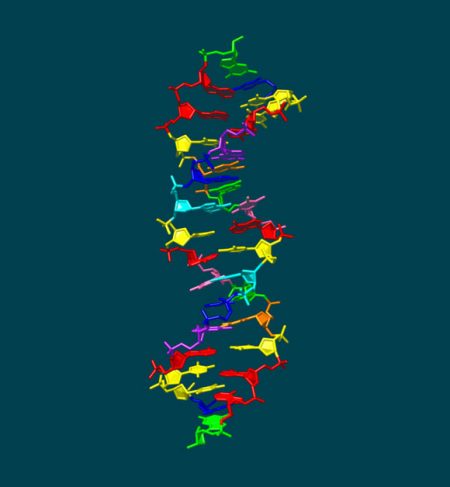
Natural DNA uses four base chemicals: guanine (G), cytosine (C), adenine (A), and thymine (T). These are commonly referred to by their letters only, and in their pairing transcribe the information of life. Natural DNA pairs match up as A to T, and C to G. These are referred to as DNA’s base pairs.
One reason could be to use DNA for other purposes than just creating life.
For example, since DNA biologically is a rich information repository that turns out life in enormous varieties here on Earth, if we increase the number of base pairs we could use its information storing capacity for data storage with pairings acting like the logic gates in computers today.
DNA is a very stable molecule and therefore could make biological computing on a grand scale. Imagine nano-sized computers, smaller and more powerful than anything we have built on silicon.
Natural DNA uses hydrogen-based chemicals for the pairing that occurs in the double helix. The artificial DNA developed by Benner and his team uses water-repelling molecule-based chemicals. They have demonstrated that their synthetic DNA not only replicates just like natural DNA, but also transcribes into RNA, the messenger organic molecule used by our living cells to execute DNA’s instructions.
Not yet. But what the research shows is that DNA doesn’t necessarily have to use the base-pairing chemicals found here on Earth. There could be many other chemical base pairs working with DNA to create all kinds of different life in the Universe.
And adding new chemical base pairs could lead to medical breakthroughs to use synthetic DNA to treat genetic and epigenetic-linked diseases. Conceivably synthetic DNA could lead to new medical diagnostic tools as well.
The answer to the above question is “No.” The Florida research team are looking at adding structures to make DNA work with 10 or 12 chemical bases translating to 5 and 6 base pairings.
What could that mean? DNA that could be put to uses we have yet to even conceive.
The research results appeared in the February 22, 2019 issue of the journal Science in an article entitled, Hachimoji DNA and RNA: A genetic system with eight building blocks. The researchers picked the name Hachimoji for their DNA construct. Hachimoji is a combination of two Japanese words, “hachi” meaning “eight,” and “moji” meaning “letter.”
]]>
In an article published yesterday in Nature Communications, a team of researchers at the Institute for Bioscience and Biotechnology Research, University of Maryland, describe “the utility of using biologically relevant redox molecules in translating electronic signals to changes in engineered bacterial gene expression.”
What does that mean?
That they can genetically induce bacteria to communicate using electronic controls to influence behaviour. This is biomolecular information transfer and is bringing the science fiction future close to a 21st century reality. Not only does it demonstrate the potential to create bio-neural gel packs that can be integrated with silicon or quantum computing devices, it also means we are discovering a way to communicate with the very cells within our bodies and developing tools to potentially manipulate them. The latter has significant implications for curing diseases.
Why redox molecules?
Also known as redox signaling molecules, they are manipulated by the mitochondria within our cells. When mitochondria are healthy and functioning properly redox molecules get produced. They come in two forms, one creates oxidation and the other reduction. The oxidation removes electrons. The reduction delivers electrons. Sounds like an electronic circuit in the making.
The research team at University of Maryland used E. coli to demonstrate the potential of this discovery. They submerged an electrode into a liquid containing E.coli. Applying a positive charge triggered redox molecules and oxidation. The genetic mechanism for the reaction was then isolated so that the researchers could then engineer the bacteria to automatically produce a consistent response to an electronic stimuli. When exposed to electrical input these re-engineered E. coli could be induced to swim or flouresce. The bacteria was also induced to create a signal molecule to transmit to neighbouring E. coli which then responded similarly to electronic inputs. This demonstrated the effectiveness of the process for inducing a group response.
With a little genetic rewiring this research demonstrates that bacteria can be used to both collect and deliver information. It can communicate with diseased and cancerous cells. The bacteria can deliver a message in the form of a drug or molecular kill switch. And maybe very soon E. coli and other bacteria can form those biological circuits science fiction has described.


In Michael Crichton’s sci-fi thriller, “Prey” he described self-organizing nano-sized biological computers breaking out of a high-level security lab and taking over the world. Is this our future or is this pure fantasy?
The search for the ultimate medium upon which to create artificial intelligence appears to be biological. The building blocks of life on Earth all contain DNA. This complex molecule can be found in every living thing on the planet. What if DNA replaced silicon chips? In 2003, scientists in Israel built a computer running on DNA. It could perform 330 trillion operations per second, 100,000 times faster than silicon-based PCs. In addition the DNA computer contained no silicon or the metals and chemicals that make today’s computers quite toxic when recycled.
Using the building blocks of life for computing makes a lot of sense. After all life is really a bunch of biochemical nanocomputers that reside in the nuclei of cells. Our problem in creating biological computers based on DNA is quite simple. We need to be able to control how DNA is used. Right now we are struggling to turn that dream into a reality.
Why would a DNA-based computer be attractive? In previous discussions we talked about how today’s computer chips are approaching the limits of silicon as a medium. You can only pack so many transistors, resistors and capacitors on a silicon chip. A single DNA molecule residing in the nucleus of a cell is a biological powerhouse. A cubic centimeter of the stuff can store the equivalent of a trillion music CDs. A teaspoon has the capacity to equal 15,000 trillion computers. A pound can store more information than all the computers humans have ever built to this day. That’s incredible capability and that is one reason for making computers based on biology rather than silicon.
The other reason is related to energy. DNA computers don’t need a lot of energy to work. In fact they almost need nothing. Put a DNA computing molecule in the appropriate chemical soup and it feeds and supports itself expending less than one millionth of the energy required to run silicon chip technology.
So like the quantum computers we described previously, DNA-based computers are inherently green and far more compatible with our 21st century vision of environmental sustainability.
We can identify immediate application for DNA computers. The fact that they can be very tiny, molecular in size, and that they operate in a self-sustaining way in liquid environments, makes them ideal tools for medicine and the bio-pharmaceutical industry. Imagine molecular-sized computers that can operate inside a living cell to sense problems and correct them. DNA computers can be integrated into our bodies on permanent patrol, sensing changes in blood chemistry, enhancing our defenses against cancer, heart disease and other life threatening conditions.
How does DNA work as a computer. Every DNA molecule contains four sequenced nucleotides that are represented by the letters A, T, C, and G. A is for adenosine. T stands for thymine. C represents cytosine, and G is guanine. These Nucleotides are molecules that when joined together make up the structural units of DNA. Their order and sequence determines our genetic makeup.
In a DNA computer the sequencing of these nucleotides can mimic the control gates that we previously discussed. The sequencing can offer us a range of values that go beyond 0 and 1, very much like the kind of fuzzy logic that quantum computers are capable of using. A single strand of DNA could perform simultaneous calculations performed in parallel, solving problems in micro-seconds rather than the minutes and hours that today’s computing technology requires.
This massive parallel processing capability, performed by nano-sized computers, capable of operating without an electric cord attached, each performing specific tasks, each capable of communicating with others around them, sounds like the work of science fiction. But it is not.
Today’s researchers are creating gene-based computer programs that can be inserted into living cells to replicate. These genetic robots can generate engineered sequences of genetic material controlling the chemicals that our cells use to pass on genetic instructions as they replicate. Genetic robots could act like a permanent team of doctors always on call in your body, correcting problems as they occur.
Other scientists are attempting to marry biology and silicon, uniting living organisms with silicon chips. This research focuses on nerve cell-chip interactions. The potential represented by this fusion of the living with silicon is the creation of human-robot interfaces. Implant a silicon chip integrated with our nervous system and we can operate technology remotely with minimal training or just by thoughts. Recently a British researcher, Professor Kevin Warwick, demonstrated how this cybernetic symbiosis works in a four month experiment. He attached an implanted a computer chip to the main nerve in his arm and operated a robot on wheels remotely.
Ultimately we have the capability in this century to engineer a living organism. SAIC is a Fortune 500 company that is creating neural networks from living nerve cell tissue, a brain in a jar. It is not too much of a stretch to imagine creating a fully-integrated living biological computer which functions independently of its creators and replicates on its own.
There are very good reasons to pursue this line of research. The benefits include:
There are drawbacks to biological computing. One of them is that biological computers by their very nature are as prone to error as our own brains. As we described previously in research being done on neuromorphic chips, fuzzy logic, trial and error, exploring different solutions and finding shortcuts is the way our brain works. That is the way biological computers solve problems. So biology-based computing subjects its users to higher error rates than current silicon chip technology. Are we prepared as a society to accept computers that learn from their mistakes? What if the mistakes these computers make lead to loss of life?
The development of biological computing in this century will raise other fundamental questions related to the definition of life, the ethics of creating artificial intelligence that is self replicating, and ultimately the issue of what rights we as humans are prepared to provide any artificial intelligence that we create.
]]>