The post CRISPR Continues to Revolutionize Genetics and Other Fields of Study appeared first on Techso Mogro.
]]>If you are not familiar with CRISPR, it gives scientists the power to edit DNA to cure diseases, enhance biology, address world hunger, and if desired, alter humanity. CRISPR/Cas9, the Cas9 referring to a particular protein produced in cells, has the ability to excise bad DNA code and replace it with correct or enhanced genetic sequences using a snip and replace technique that can be used over and over again within a single cell. In other words, it’s a tool to reinvent biology. But more than that, it can be a tool to create alternative energy sources to wean us off fossil fuels.
One line of research is using CRISPR/Cas9 to create new microorganisms that produce biofuels. Think algae on super steroids churning out tons of environmentally green fuels to replace oil and natural gas. When biofuels are burned they emit 60 to 90% less greenhouse gas (GHG) emissions than fossil fuels. Enhancements to microorganisms like algae and bacteria could produce hydrogen, bioethanol, and biodiesel, reducing GHG emissions to zero.
The current research is using CRISPR/Cas9 to alter the metabolic pathways within these single-celled creatures to increase lipid content and enhance carbon fixation. The combination not only produces the base product for biofuels but also contributes to carbon capture and storage.
In other research with CRISPR, a University of California, San Francisco team is experimenting with a version 2.0 of CRISPR/Cas9 that not only can correct defective genes in a cell but also pass the improvements on the cell’s descendants. The enhancements to the CRISPR/Cas9 tool, the team has named CRISPRon and CRISPRoff. In other words, the enhanced tool can flip genes on and off without damaging the DNA. In experiments, the team has targeted over 20,000 genes in human kidney cells using the tool like a light switch. When CRISPRoff has been used the team has been able to pass along the genetic mutation through 450 cellular generations.
Practical application of the technology can be used to tackle diseases like Alzheimer’s, stopping the protein associated with the condition from being expressed. But don’t stop there. This discovery could change gene editing forever. How so? We can create synthetic organisms and reprogram them to help us deal with the challenges we face in the 21st century from pandemics to climate change. We can stop mutations in their tracks. Think of all the current COVID-19 variants that are a troubling addition to the global pandemic. Or improvements we can make to food security as we harden crops to withstand the worst that climate change can throw at us. And changes we make using these CRISPR/Cas9 enhancements are not only programmable but also inheritable.
The post CRISPR Continues to Revolutionize Genetics and Other Fields of Study appeared first on Techso Mogro.
]]>The post Energy Update: Solar is Taking Off According to this BP Report appeared first on Techso Mogro.
]]>No less than BP, the company that brought us the Deepwater Horizon disastrous spill in the Gulf of Mexico, is the bearer of better tidings for those who see solar energy and other renewables as the principal source of energy in our future.
From the BP Statistical Review of World Energy, published just last month, we have the following statistics:
The Growth of Solar
Much of the growth in solar came from new capacity coming online in Germany and Italy. Those two countries accounted for 57.1% of the total new global capacity growth.
Today the top four solar power countries are:
As spectacular as these growth results are, solar’s share of global energy capacity stands at 6.5% in 2011, a ten-fold increase in capacity in the last five years and amounting to 70 Gigawatts.

What About Renewables in General?
For renewables in general, defined as energy from biofuels, geothermal sources, solar, wind and tide, the trend is increasing investment by governments and utilities as new technology comes on stream, creating better efficiencies and reliability.
Renewables continue to grow at a double digit growth rate annually over the last decade representing 10% of the total world energy growth in generation capacity. From eight countries in 2010 to fourteen in 2011, renewable sources now represent more than 10% of total generation capacity.
BP’s Forecast for 2030
BP sees renewables continuing to grow as overall energy consumption increases globally with almost all of it occurring in the Developing World. In its crystal ball calculations BP expects renewables, nuclear and hydroelectricity to contribute to 34% of the growth in global energy consumption, displacing coal and oil. At the same time its sees natural gas becoming the predominant energy fuel source achieving 31% of global energy growth and 25.9% of total world energy usage. At the same time BP predicts that renewables will increase by 1,575% in their share of world energy consumption with Europe in the lead generating 26% of its total electricity capacity through wind, solar, geothermal, tide and biomass.
One important thing to note: the BP forecasts for 2030 don’t talk about improvements to storage technologies and the implication this may have for renewable power. Nor does BP consider new technologies such as fusion, or fission-fusion hybrid, or hydrogen as energy sources. So we should take the BP projections and recognize their limitations.

The post Energy Update: Solar is Taking Off According to this BP Report appeared first on Techso Mogro.
]]>The post Agriculture – Part 7: Growing Food, Feed or Fuel on the Farm appeared first on Techso Mogro.
]]>Humanity discovered how to control fire hundreds of thousands of years ago with wood and dung our primary fuel sources. Tens of thousands of years ago our ancestors discovered that wood could be converted to charcoal. Peat fires to this day are still a principle heating source in parts of the world. And animal dung provides humans living in desert regions with an alternative to wood.
Humanity has also grown crops and converted them to fuel. Olive oil lit the lamps of Greek and Roman antiquity.
The age of whaling provided whale oil for lamps burning in the homes of European and North America well into the 19th century.
I found this Henry Ford quote that goes back to 1925.
“There is enough alcohol in one year’s yield of a hectare of potatoes to drive the machinery necessary to cultivate the field for a hundred years.”
In World War II, Germany took Henry Ford’s advice and partly fueled their transportation and industry using alcohol derived from potatoes.
In that same war Great Britain experimented with grain-derived alcohol as a fuel for its war industries.
To this day 9-10% of human energy consumption comes from the burning of biomass for heating and cooking. And the two primary sources remain animal dung and wood.
The Biofuel Dilemma Today

Creating biofuels today Brazil, the United States, and other countries are using soybeans, corn, sugarcane, sugar beets and other crops instead of potatoes and grain (Germany and Britain’s experiment) to create ethanol, an alcohol-based fuel. The harvesting of these crops for fuel is changing the mix of what farmers in the Western World grow today and will be growing in greater quantities for the forseeable future. That’s because in a world where population growth is driving the need for greater food production, and energy demand is driving biofuel development, farmers are finding themselves asking the following question.
“Should I grow more food, feed or biofuel crops?”
The argument for food is obvious. The Developing World lacks the capacity to deliver enough domestically grown food to meet population demand. China, India, most of Africa, Southwest Asia and Russia are net importers of food.
The argument for feed seems obvious as well. The increasing demand for meat and dairy products in the Developing World and the continuing demand in the Developed World represents a thriving export and domestic opportunity for countries such as the United States, Canada, Australia, Argentina and those in Western Europe.
The argument for biofuel is more about geopolitics and security. In the United States and Europe, biofuel production means less dependence on imported oil for energy use. For the United States, corn represents the primary biofuel source. Corn usage for ethanol has increased annually for a number of years at a rate greater than the total national corn yield.
The second largest North American source for biofuel is vegetable oils. One-third of all the Canola grown in Europe and North America is used for industrial lubricants or biodiesel. Soybeans, largely grown for domestic and foreign food consumption, are being converted to oil for industrial use.
In the Farm Foundation Issue Report – What’s Driving food Prices in 2011? it reports on changes in agricultural land use from 2005-2006 to 2010-2011. Most significantly, the top three crops are those being grown for ethanol, biodiesel and industry.
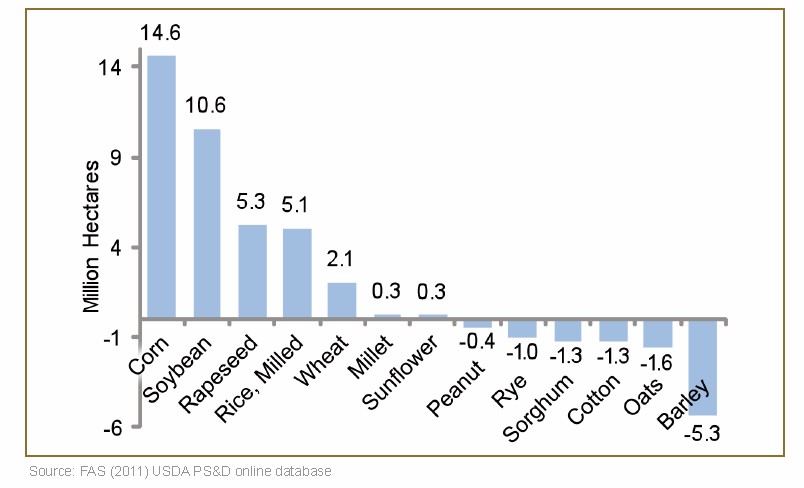
American energy policy contributes dramatically to the growth in demand for biofuels. In 2010 corn-based ethanol production in the United States reached 13 billion gallons. The corn-based ethanol target for 2015 is 15 billion gallons. The U.S. government has set a target of 36 billion gallons by 2022.
A 2009 feasibility study by the Sandia National Laboratories in Livermore, California, looks at achieving a target of 90 billion gallons of ethanol by 2030, of which 75 billion gallons would come from non-food crops and 15 billion from corn, soybean and other food or feed crops. Farm-based biofuel sources included agricultural residue such as corn stover and wheat straw. Farms could also harvest switchgrass and short-rotation woody crops such as poplar and willow.
Biofuel’s Near Future – the Next 20 Years
Cellulosic Ethanol
The Sandia study sees almost all of the capacity for biofuel growth coming from cellulose. Cellulosic ethanol can be derived from low-value residue of industrial processes such as sawdust and scrap wood. Add to this the byproduct residue of farming and the harvesting of woody shrubs and grasses from land not under cultivation. In deriving ethanol from “waste” sources the competitive dilemma for farmers to choose among food, feed and biofuel crop production is mitigated. The pressure to plant more traditional crops on marginal land goes away.
Cellulosic ethanol production has its challenges. Producers need to find an economical way to break down the woody fibres, called lignin, to get to the cellulose to convert it to sugars and ultimately ethanol. By studying the digestive processes of herbivores such as cattle, or studying the way termites break down wood fibre, scientists are developing better conversion processes. The first large-scale cellulosic ethanol plants in North America are expected to come on stream in 2013 able to pump out several million gallons. Getting to 75 billion gallons from this source requires continuous investment.
Algenol
Creating ethanol from algae, called algenol, represents another biofuel option that takes the farm out of the energy production equation. The process involves growing algae in waste water, seawater and brackish water near existing manufacturing or fossil-fuel power plants where CO2 is a byproduct. Capturing and pumping the CO2 into the water along with exposure to sunlight generates algae growth with ethanol the byproduct. Called photobioreactors, these facilities can be located anywhere human activity is generating sufficient CO2 output to justify putting an algae-to-ethanol generator in place. One company in the forefront of commercializing algae-t0-ethanol is aptly named Algenol. Their goal is 20 billion gallons per year of ethanol by 2030.
Biodiesel
Biodiesel is another biofuel that can be produced from soybeans and other agricultural products. But biodiesel can also be produced in very novel ways, from the left over vegetable oil in a deep fryer, from kitchen grease, from rendered animal fats, and what typically is seen generally as waste oil.
Biodiesel has several advantages over other biofuels. It is biodegradable. It helps take care of waste oils that normally get dumped into domestic water supplies or landfill as garbage. It is less toxic and provides fewer emissions than conventional diesel fuel.
Germany and the United States are the world leaders in the production of biodiesel. In 2005 the United States produced 75 million gallons. Comparably Germany in 2006 reported sales figures of 600 million gallons. American output was forecast to reach 1-2 billion gallons by 2010.
Worldwide Biofuel Growth
In 2010 global biofuel production equaled 54.6 million gallons per day. This number is expected to more than double to 113.4 million gallons per day by 2030. Biofuels will generate 8.5% of global energy by 2030, up from 7.7% in 2005.
The post Agriculture – Part 7: Growing Food, Feed or Fuel on the Farm appeared first on Techso Mogro.
]]>The post Agriculture – Part 1: Setting Our Future Food Table in the 21st Century appeared first on Techso Mogro.
]]>1. The cost of energy and the transportation of agricultural products
The rising cost of fuel and energy impacts agriculture many ways. Industrial farms in North America and Europe need to find ways to reduce hydrocarbon energy dependency. The grow local movement is reinventing the very definition of what is a farm.
2. Our changing view on chemicals, fertilizers, herbicides and pesticides.
We have created both a revolution in agriculture and a potential monster in making our crop yields so chemical dependent. In saturating the soil with herbicides and pesticides we have created new varieties of resistant weeds and insects. This ongoing accelerating arms race between our technical fixes and the evolution of pests is one that we could inevitably lose with catastrophic consequences.
3. Bioengineering of crops and livestock
Bioengineering is changing the very nature of what we grow and eat. We have always been in the business of bioengineering ever since humans first changed food sourcing from being hunter-gatherers to farmers. The difference today is our bioengineering is in the laboratory and not through selective fertilization in the fields. We are now inserting genes into the DNA of plants and animals to fundamentally alter the end products. We are growing meat in the laboratory rather than on hoof. We are farming bioengineered fish rather than catching wild varieties in the open seas largely because we have overfished and exhausted natural population regeneration.
4. Climate change
Our fossil fuel dependency is altering the climate raising temperatures, causing prolonged droughts and more severe weather events. The impact on agriculture from environmental change cannot be underestimated.
5. Fresh water availability
Whether we draw water from lakes and rivers or aquifers, cities compete with agriculture for what is becoming a very precious resource. What can we do when we start reaching the limits of fresh water accessibility?
6. Human population growth
Can we continue to grow enough to feed a burgeoning human population let alone our livestock? At 7 billion today and with predictions of 9 billion by mid-century, will agricultural intensification meet our food needs. Considering today that over 1 billion people on this planet are underfed or malnourished, what will that number be at the end of the 21st century?
7. Implication of biofuels on growing food
Do we grow crops to feed our engines or are stomachs? This is a basic dilemma in countries like the United States and Brazil where corn in the former and sugar cane in the latter are both food and fuel crops. Part of the challenge lies with the practicality of moving food from where it’s grown to where it’s needed. The United States has had huge corn surpluses for years. Farmers have been paid to not grow it. A food industry has grown up built around corn byproducts just to suck up the surplus yield. Now the surplus is being used for biofuel rather than being shipped to where it can feed the hungry.
If I have missed any issue please feel free to comment. The subsequent blogs on agriculture will explore each of these topics in greater detail.
The post Agriculture – Part 1: Setting Our Future Food Table in the 21st Century appeared first on Techso Mogro.
]]>