Orbital Sciences Prepares Antares Rocket and Cygnus Spacecraft for ISS Mission
SpaceX isn’t alone in providing a commercial launch service to support the International Space Station (ISS). At least not anymore if Orbital Sciences is successful with its test flight of the Antares rocket along with a capsule that will simulate its Cygnus module and provide telemetry to ground stations while in orbit. The launch is planned for sometime in the next week from Wallops Island, Virginia, not Cape Canaveral, Florida. Orbital was one of three companies originally contracted by NASA to deliver supplies to ISS. If this demonstration flight succeeds and the subsequent real supply mission goes off without a hitch the U.S. will now have two private companies in the launch to low-Earth orbit business.
Antares uses rocket engines developed originally in the Soviet Union for its defunct Moon program. Apparently 50 of these engines were left in storage after the USSR collapsed and Orbital has been buying from the Russians and refurbishing them. The Cygnus capsule, an artist rendition seen below, can carry up to 2,000 kilograms (4,100 pounds) of cargo in its pressurized hold but unlike the SpaceX Dragon, is not designed for re-entry and recovery and will burn up in the atmosphere after making its deliveries to the ISS.

Crowdfunding Becomes a Great Source for New Technology Investment
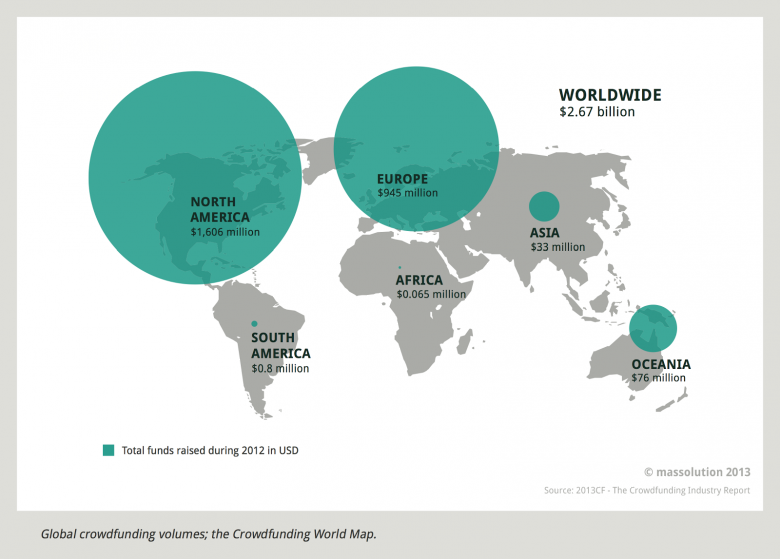
In 2012 crowdfunding platforms raised $2.7 billion for more than one million projects (see distribution map below). Today more than 300 crowdfunding sites exist and forecasts are predicting a banner 2013 with as much as $5.1 billion raised by this no longer novel method for finding investment capital.
Massolution has been tracking crowdfunding and provides an industry report on this financial revolution being fed by global connectivity through the Internet. Crowdfunding models vary. In some cases money is donated in return for t-shirts, baseball caps, or a first cut of the new company’s product. In other cases the money is strictly a loan, or an equity investment. And in some cases new companies pay royalties based on a percentage of every unit sold in proportion to the amount invested.
Global Capacity for Biofuels Growing Rapidly
Many countries around the world, in their desire to lessen dependence on fossil fuels, have turned to biofuels. Conventional biofuels like ethanol and biodiesel have dominated the market to date with the United States, Brazil and the European Union the largest producers.
But now advanced biofuels are starting to appear in commercial volume. These fuels include cellulosic ethanol (not made from food crops but from switch grass and other non-edible growth), biobutanol, green diesel, synthetic gasoline (made from recycled plastic), and green jet fuel. Global biofuels are expected to grow from 127 billion liters (33.6 billion gallons) in 2013 to reach volumes of 231 billion liters (61 billion gallons) by 2023. Compared to conventional fossil fuels it remains only a small percentage of the total amount we humans burn to support our advanced industrial society.

What is V2B, V2H and V2G and Why is it Important?
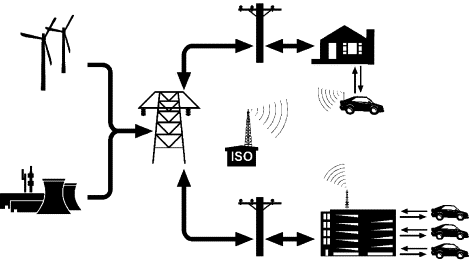
Currently there are only a few plug-in electric vehicles (PEVs) on the market – the Chevrolet Volt, Nissan Leaf and a new model of the Toyota Prius, the most notable. Industry forecasts for 2013 indicate global sales of more than 200,000 vehicles, and the debut of three dozen new PEV models. PEV batteries can both receive and give and that’s what V2B, V2H and V2G is all about.
V2B stands for vehicle-to-building. V2H stands for vehicle-to-home, and V2G stands for vehicle-to-grid. These are technologies that provide energy storage capacity of benefit to vehicles, buildings, homes and the power grid. Numerous pilot projects are testing technology involving the integration of hundreds of PEVs with the energy infrastructure of homes, buildings and smart grids to allow for a two-way exchange. In the event of power outages energy stored in PEVs can keep lights on while repairs are made. And when the grid is working PEVs can plug in to get juiced up for the next day’s drive. Although still at the early stage in its evolution V2B, V2H and V2G technology is expected to continue to grow through the decade reaching $76 million annually by 2020.
Chiplets Provide New Way to Electronic Circuitry
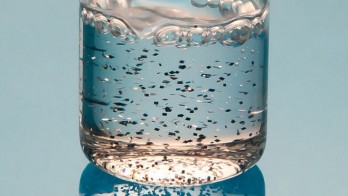
What are chiplets? They are tiny electronic circuits no larger than a grain of sand. You can see them on display at the Palo Alto Research Center in California where the Defense advanced Research Projects Agency (DARPA) is funding research into these tiny silicon microchips. A chiplet on its own can be a transistor, a microprocessor, memory or sensor. When combined together chiplets can create a robot, a computer, a TV display, you name it.
Chiplets are printed to a surface using inkjet-like printers either 2D or 3D. They can be used to manufacture a prototype, custom fabrication or mass customization. Thousands if not millions of chiplets in combination with computer-aided design (CAD) has the potential to revolutionize manufacturing although it will be several years before we see devices made this way.
A Postscript
Every week brings new and exciting technologies and scientific discoveries. I write about them because I find them fascinating. With so many crises happening and so many dire predictions about our future, finding new discoveries and new technology breakthroughs gives me considerable hope that we will rise above the worst in ourselves.
I am glad to have you along as readers in this voyage of discovery and welcome your questions and comments because they add extra value to the content. So please keep coming back and thank you today for dropping by.
– Len Rosen
]]>
Biomedicine Update: Synthetic Life – Are We Unleashing an Evil Genie or Creating a New Eden?
Today we can sequence the DNA of all kinds of life. This sequencing has allowed us to identify traits that we can use to imprint on to new synthetic life forms. Why do we want to do this? Because we can create new medications and vaccines, synthesize biofuels, clean up environmental pollution, and improve agricultural yields to feed humanity. These are noble goals. But many fear we are tinkering in an area of science that could lead to disastrous outcomes. Science fiction novels like John Wyndham’s, “The Day of the Triffids,” come to mind. But synthetic biology has enormous potential. Here’s why:
Pamela Shiver, at Harvard Medical School, is one of a number of scientists developing synthetic biology to detect DNA damage in cells. The goal is to create technology for early screening of cancer and other diseases.
Researchers at the Wyss Institute at Harvard are creating tool kits to create custom-designed plants by introducing new genetic material to enhance flavour, reduce allergens, or create an alternative to photosynthesis for generating energy.
Genome Canada is funding a number of synthetic biology projects at Canadian universities. One of these at the University of Calgary is decoding the DNA of the opium poppy to synthesize pain relievers like codeine and morphine. Another is a project at Concordia University in Montreal where scientists are decoding the genetic information from 75 different medical plant species with the goal to industrially synthesize and enhance these medicines to make them more effective.
Energy Update: New Oil Sands Extraction Technology Being Tested to Reduce Carbon Emissions
The black eye that the oil sands get from environmentalists is well deserved. Bitumen extraction has scarred the landscape of Northern Alberta. It has left immense settling ponds that are laced with chemicals and oil derivatives from creating synthetic crude. Oil sands operations have threatened the downstream communities on the Athabasca River which flows into the Mackenzie, Canada’s longest river system, and the one most vulnerable to environmental degradation because of its sub-Arctic to Arctic locale.
Having said that, what if a technology could be devised that changes the way bitumen is harvested from oil sands? What if that technology didn’t use massive amounts of water? And what if that technology left no open scars on the landscape? Well that is what Imperial Oil is testing right now in a $100 million investment to prove that what works in the laboratory can be transferred into the field successfully. The technology uses solvents instead of steam to inject into subsurface oil sand deposits to get the bitumen to flow. If the field test is successful the industry will be able to access 80% of oil sand reserves this way while dramatically reducing greenhouse gas emissions.
I know many of you are saying but how does that help us move away from fossil fuels as our primary energy source? It obviously doesn’t. But what it does do is deal with our current reality of fossil fuel dependence and the technology and global infrastructure that these energy sources support, something we have to live with for several more decades in the 21st century until we can develop a enough capacity through sustainable renewable energy sources.
Energy Update: A Recipe for Biofuels, Take Water + Sugar + Electricity
Combine a cup of water with a jolt of electricity and add sugar from biomass and voila you have biofuel. That’s what a chemical engineering team from three universities: University of Wisconsin-Madison, University of Massachusetts-Amherst, and Gwangju Institute of Science and Technology of South Korea, have invented. They call it electrofuel. How does it work?
The technology is called biomass-to-biofuel reduction. It begins by reversing a normal fuel cell process. If you remember fuel cells, they have been used as power and oxygen generators on space flights. By reversing fuel cell processes using a proton-exchange-membrane, the team of researchers have demonstrated they they can convert biomass containing acetone into isopropanol, a gasoline additive. This makes it possible to take glucose as a raw material source and turn it into hexanes, the significant components of gasoline. The goal is to commercialize the technology and run biomass-to-biofuel reactors overnight during low demand electricity periods so they can churn out biofuel and oxygen using water and glucose from biomass.

Energy Update: A “Clean Coal” Carbon Sequestration Project Gets the Green Light
In Estevan, Saskatchewan, Canada has added a second major carbon capture and sequestration (CCS) project to its growing list of pilot and funded commercial sites. In a previous blog I reported on the Shell Quest venture. But unlike Quest this project is attached to an existing coal-fired power plant that annually generates 100 Megawatts of electricity. With the CCS “clean coal” technology the plant will capture up to 1 million tons of CO2 each year and inject the gas into nearby depleted oil wells where it should assist in recovering more oil from these sites.
Known as Boundary Dam 3, the plant burns lignite, also known as brown coal, the most highly polluting form of coal. CCS technology will capture the CO2 from the flue gas to reduce carbon emissions from the plant by 90%. The gas will then be compressed and transported by pipeline to the oil wells where it will be injected underground. The plant will also integrate SO2 capture as part of the project.

Energy Update: Liquid Air?
The biggest challenge that solar and wind energy face is the variability in output. The Sun goes down. The wind dies. But if you can store the excess energy produced by both when they are operating then you can create sustainable continuous power. The storage choices that can make this possible include heat sinks using molten salt, large-scale batteries, pumped and compressed storage.
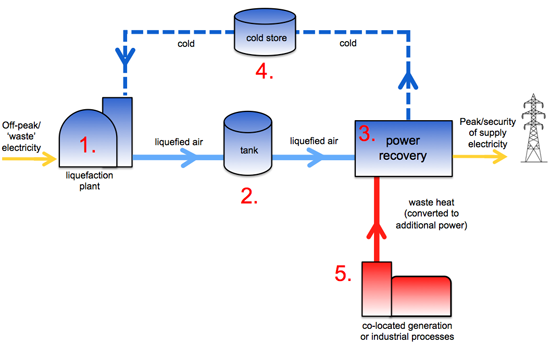
Now add a new technology – cryopower. A United Kingdom company, Highview Power Storage, has developed a proprietary system to store renewable energy by compressing and liquefying air. Since 2010 the company has been operating a 300 Kilowatt pilot plant demonstrating the commercial viability of the technology.
Highview creates liquefied air using recovered power from any source to cool air and store it in liquid state. Liquefied air to gaseous air undergoes a a 700 times expansion rate. In the process of phase change the expansion within a confined space is used to drive a turbine attached to a generator. The result, continuous, reliable power 24/7.
A Postscript
With over 6,500 page views in the last month, the number of visitors continues to grow here at Techso Mogro. And the Techso Mogro Facebook, site broke the magic “like” milestone last week. So I thank all of you who continue to drop by. If you have just arrived here and are not aware you can subscribe to Techso Mogro and get new blog articles sent to your email inbox. Just enter your email address in the box at the top right-hand side beneath the search field and you won’t miss another posting. Once again, thanks!
– Len Rosen
]]>Scientists at Virginia Tech‘s Virginia Bioinformatics Institute have assembled the genome of Nannochloropis gaditana, a marine algae that they believe with genetic modification could produce bio-fuel on an industrial scale.
In the article, Draft Genome Sequence and Genetic Transformation of the Oleaginous Alga Nannochloropis gaditana the researchers describe their work in sequencing the genome for a marine algae that can produce high lipid yields in its natural state and that with a little genetic manipulation can become even more promising in lipid bio-synthesis.
In mapping the genome of N. gaditana the researchers identified 9,052 gene models and analyzed and identified genetic attributes for enhanced lipid bio-synthesis. N. gaditana has been studied for its nutritional value and its ability to produce chemical compounds such as pigments like zeaxanthin and astaxanthin, and polyunsaturated fatty acids. Commercial exploitation however has been limited in the past by low growth rates and small cell size. With genetic modification N. gaditana’s limitations can be overcome and a new source of bio-fuel may soon emerge.

Biomass continues to be a major source of fuel. But the major consumers of energy are fossil-fuel junkies and addicts and it is these economies that are rethinking biomass as a fuel source because oil and fossil fuels like coal are seen as finite and non-renewable energy sources. It’s not just about climate change. It’s about dependency on a resource that is becoming more difficult to access.
If industrial society in the 21st century is to ween itself from fossil-based fuels, then it needs to develop alternatives. What are these alternative biomass fuel sources? How economical will it be to use these to replace crude oil and coal? Do biofuels help us deal with global climate change by lowering our carbon footprint?
Biofuels and Climate Change
What makes biofuels attractive is the fact that one can argue they are carbon neutral. Unlike mined and refined fossil fuels adding carbon to the environment, biofuels are contained within plants that absorb carbon dioxide from the air as they grow and release the carbon when finally consumed as fuel. This means they are carbon neutral. By theoretically not adding extra carbon to the atmosphere biofuels are environmentally sustainable and non contributors to global warming.
But is that truly the case? What about the industrial processes needed to synthesize the fuel from the biomass. What kind of energy is needed for that? If you are burning natural gas or oil to make biofuels then it is hard to claim that biofuels are carbon neutral.
EROEI as a Measure of Biofuel Effectiveness
Any time it requires more energy to produce a source of energy than the energy you get out of it one should pause and consider the implications. EROEI stands for Energy Return on Energy Invested. Here’s a handy chart that was inspired in part from an article I read, “Getting a Decent Return on Your Energy Investment,” written by Dana Visalli in 2006. The list includes conventional and unconventional energy resources and I must add that not all “experts” agree with these EROEI values or even what makes up EROEI calculations.
Food Crops As Biofuel Sources
If this isn’t the craziest of all developments that have occurred in the last 20 years — ethanol and biodiesel from corn is more about subsidizing American farmers to grow far more corn than can be consumed as food within the North American market. The issue is what to do with the surplus? What started off as corn for corn flakes is now a trillion-dollar enterprise churning out corn byproducts in foods, pharmaceuticals, cosmetics, animal feed and industrial chemicals.
Does that make corn a good biofuel source? Let’s look at the numbers.
How far can you go on 1 liter of biofuel? Not very far and considering how many people on the planet ingest less than the 2,000 calories daily it is difficult to rationalize using a food crop for biofuel.
It is another matter if only waste from the plant was used in creating biodiesel. Since 2009 a number of companies and universities started experiments with stover, the name for corn waste. We’ll talk about stover when we address other biofuel plant sources.
Sugar Cane as a Biofuel Source
It would seem that sugar cane makes a bit more sense as a biofuel source than corn kernels. First of all it has a better EROEI. Also, we can all do with a little less sugar in our diets. But let’s take a closer look at this miracle biofuel resource.
Brazil is the largest producer of biofuel from sugar cane. In 2011 Brazil will harvest more than 500 million tons of sugar cane. From each ton of cane the harvesters recover 135 kilograms (60 lbs) of sugar. That same ton of cane can produce 75 liters (20 gallons) of ethanol.
Other than sugar and ethanol, how is sugar cane used as an agricultural product? The tops of the sugar cane plant are used as animal fodder. The fibrous residue, called bagasse, is used as a fuel source in sugar manufacturing, paper and fertilizer. Molasses is a byproduct of the refining process. Molasses derivatives are used in vinegar, cosmetics, pharmaceuticals, solvents and industrial cleaners, and food additives.
Sugar cane, therefore, seems less controversial as a biofuel source than corn kernels. But in Brazil, sugar cane is being produced on land cleared of rainforest, savannas and grasslands usually by slash and burn methods creating huge atmospheric carbon output and contributing to increases in CO2.
Sugar cane plantations in Brazil are large and heavily treated with chemicals to stave off fungi and insect, plant and animal pests. Harvesting techniques involve burning of the cane stalks and the release of more greenhouse gases. Also since the cane is cut to the root, the soil is exposed and subject to erosion with little carbon sequestration. As demand for biofuels increase sugar cane plantings displace food crops. In recent years Brazil has seen corn and black-bean production drop by 10% because of sugar cane. When weighing the pluses and minuses of sugar cane versus corn as a biofuel source all the above has to be considered. And it is not a pretty picture if we are considering this as a resource to reduce carbon emissions while weaning ourselves off fossil fuels.
Other Biofuel Plant Sources that are Not Food Crops
There are many plant sources to consider when looking for biofuel sources. There are always whales and other animal sources but our society generally looks upon such choices as being particularly inhumane.
By no means an exhaustive list, let’s look at 3 biofuel sources that don’t compete with food and may prove to be far less controversial than corn and sugar cane.
Stover
When corn is harvested the remaining stalks, leaves, husks and cobs can be used to produce cellulosic ethanol. There are many challenges to overcome before stover replaces corn kernels as a primary biofuel source but there is promising news on one front, the creation of enzymes that can digest the residue and convert it. In a recent article in Scientific American, Steven Ashley talks about a new fermentation process that renders ethanol from stover.
The good thing about stover is the mass that can be collected from a corn field is equal in tonnage to the yield from harvesting corn kernels. So the resource is quite abundant and inexpensive when compared to a bushel of corn.
The bad news is simply this. The cost of production, the loss of soil nutrients, the added fertilizer requirements, the loss of the resource as animal feed stock, all have to be factored into the overall cost. How does removing stover impact soil retention and quality? What will it do to field runoff and potential erosion? Agricultural researchers are experimenting to find what is just the right amount of stover to remove and when to remove it so that it doesn’t have a negative impact.
And after all of this will the EROEI be worth it even if it matches existing numbers for corn biodiesel and ethanol?
Switch Grass
Since 2008 the U.S. Department of Energy has been funding a number of biofuel pilot projects using switchgrass with a goal to get a better resource than corn for producing biofuels. So far the EROEI for switchgrass is proving to be no better than corn. But it is believed that EROEI can be improved to approach 4:1.
What makes switch grass more attractive as a biofuel resource?
What challenges remain?
Algae
Everything you ever wanted to know about algae can be found at Oilgae, an industry site dedicated to making algae the biofuel resource of choice. Algae is not one type of plant. There are micro and macro algaes. Seaweed is a macro algae but it is micro algaes that represent the greatest potential for energy crops. What makes algae attractive over corn, sugar cane or switch grass?
With all these positive things to say about algae why aren’t we ramping up production? Here are a few of the reasons why we are not.