bio-regenerative systems – Techso Mogro https://techsomogro.com/ Science, Technology and the Future Mon, 28 Apr 2014 20:04:48 +0000 en-US hourly 1 https://wordpress.org/?v=6.8.1 Mars One Advisor Says Martian Soil OK for Growing Crops https://techsomogro.com/mars-advisor-martian-soil-growing-crops/?utm_source=rss&utm_medium=rss&utm_campaign=mars-advisor-martian-soil-growing-crops https://techsomogro.com/mars-advisor-martian-soil-growing-crops/#respond Mon, 28 Apr 2014 20:04:48 +0000 http://www.21stcentech.com/?p=13866 April 28, 2014 – Wageningen University in the Netherlands has undertaken a pilot project to test the viability of Martian soil for growing plants. It has done this on behalf of the Mars One Project, aimed at putting four colonists on the Red Planet by 2024, a decade away.


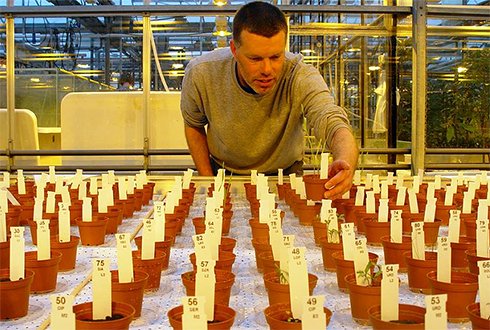
Growing plants on Mars


For soil, NASA has provided the medium made from earth collected in Hawaii on the edge of volcanoes. The plants so far have thrived because we know the Hawaiian and Martian soils are similar containing phosphorus, iron and nitrogen. The experiment involved 14 different plant species over 50 days. The plants germinated and grew. Some even blossomed. So we know the soil is a suitable medium.

But it is what the pilot project cannot tell us that concerns anyone who would consider hopping on a one-way voyage to Mars. Here is a list of Mars challenges that any agricultural enterprise will have to address:

  1. Mars is a low-gravity environment compared to Earth. We don’t know what impact that may have on plant development.The experiment at Wageningen doesn’t address this.
  2. The Mars surface is not shielded from cosmic rays like Earth. What will cosmic rays do to plant development? Wageningen doesn’t address this either.
  3. The thin atmosphere of Mars although almost all CO2 and one would think, therefore, plant friendly, is not dense enough to retain much heat, resembling more Antarctica than any other place on Earth. We know not much of anything can grow there unless contained with artificial lighting.
  4. Water is not free flowing on Mars today although billions of years ago it was. Any water exposed to the surface has little chance of remaining in that state for very long. In addition the low gravity changes the nature of the way water flows.
  5. Solar energy reaching the surface of Mars is a fraction of that which plants get here on Earth. So did Waginingen test plant species more suitable for lower lighting environments and if so were any of these crop-bearing?
  6. The Martian atmosphere is tenuous, equivalent to that found here on Earth at elevations of 30,000 meters (approximately 100,000 feet). Atmospheric pressure at that height is 1,034 pascales (0.15 pounds per square inch.) Nothing here on Earth lives in atmospheric conditions like this.
  7. There are no natural pollinators that we can easily bring to Mars to ensure that plants can propagate. Without bees and other insects how would plants reproduce?


So how do we overcome these challenges?
  1. On the International Space Station (ISS) there are experiments growing plants in micro-gravity conditions. So far the results are acceptable. And in this latest Dragon capsule delivery a vegetable garden has been added to the ISS. If it proves successful we then know that micro-gravity is no impediment. So does that mean the low gravity environment in Mars may not be as serious an issue of concern? Probably.
  2. The cosmic rays exposure, however, is and the way to deal with it is through growing plants in sufficiently shielded containment buildings on the surface or under the surface of the planet.
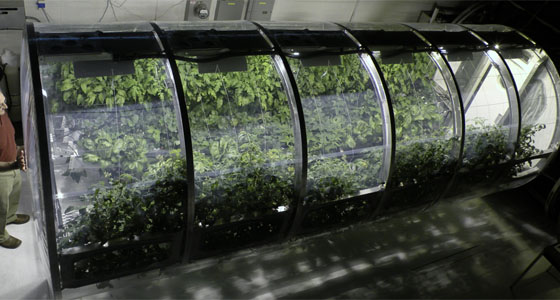
  3. To combat the thin atmosphere plants grown on Mars will be contained in pressurized closed-system environments like the experimental prototype lunar greenhouse, built by University of Arizona, seen in the image below.
  4. Closed-system environments also helps solve the water management issue on Mars. Finding local water remains a bit of an unknown although there is strong evidence of potential subsurface water in the form of permafrost, as well as water ice at the Martian poles. Harvesting Martian water for humans and plants is critical. Getting the water to where it’s needed will require the outfitting of any Martain grow-op with pumps and irrigation tubes. These systems will require a steady power supply.
  5. To combat reduced solar energy any Martian greenhouse will supplement sunlight with grow lights designed to deliver the right lighting spectrum to optimize plant growth.
  6. Closed-system environments will also combat the minimal Martian atmosphere as well as the variable temperatures the planet surface experiences.
  7. And finally, if we cannot bring insects to Mars to help us pollinate plants then we need to emulate them. This can be accomplished through microbots and nanobots that mimic what insects do with no down side. None will eat the crops.


bio-regenerative life support system


It is clear that the life support systems needed on Mars will not only support a breathable environment for the colonists but also that for the plants as well. Today, however, we are more than a decade away from achieving such workable closed-system environments to test in near-Earth space, let alone on the Moon or Mars.

Our experiences here on Earth in places like Biosphere 2 have shown us just how challenging it is to build an ecologically-balanced bio-regenerative system. Biosphere 2 failed here on Earth but at least when it went wrong those inside were able to open a door and leave. That opportunity will not be one to which Mars One colonists can avail themselves. And consider that the ambitious departure date for the first Mars One colonists is tentatively set for 2024 with arrival on the planet early in 2025, even the researchers at Wageningen admit a decade may not be enough time to perfect reliable life support systems that can grow food to sustain human settlement.


]]>
https://techsomogro.com/mars-advisor-martian-soil-growing-crops/feed/ 0
Our Space Future in the 21st Century – Part 4: Humans on the Moon – Why and How Many? https://techsomogro.com/space-future-21st-century-part-4-humans-moon-why-how-many/?utm_source=rss&utm_medium=rss&utm_campaign=space-future-21st-century-part-4-humans-moon-why-how-many https://techsomogro.com/space-future-21st-century-part-4-humans-moon-why-how-many/#comments Thu, 02 Aug 2012 19:57:24 +0000 http://www.21stcentech.com/?p=5472 Why will humans land on the Moon in the 21st century? Will we create permanent habitations there? What are the benefits? How many of us will become lunar citizens?

The Apollo Program developed technology to send two humans to the surface of the Moon for short stays. The technology included temporary habitation and wheels to move around and explore. All the resources needed, from air, water, food and energy had to be transported from the gravity well that is Earth. Flush with funds from Cold War budgets, the U.S. space program headed by NASA, expended the capital to achieve within one decade this amazing feat. But Apollo was unsustainable. So when we return to the Moon in this and the next decade economics will determine how we do it. And we will begin with robotic landers and rovers similar to those we have successfully used on Venus and Mars. And we will be going because the Moon possesses “stuff” we need in pursuing our outward urge to explore the Solar System and beyond. But what we won’t be doing is the “picnic” approach of the Apollo Program. We will need bio-regenerative technology capable of supporting autonomous lunar settlement.

10 Reasons to Go Back to the Moon

  1. The Moon can be a base for exploring the Solar System. The Moon’s gravity well is much less than that of Earth. That means the energy requirements to get to other places from the lunar surface is a fraction of what we would need if we were to launch from Earth or in near-Earth orbit.
  2. The Moon would be a good base for operating mining of near-Earth asteroids.
  3. The lunar environment lends itself to vacuum manufacturing of high-value products that could be imported by Earth.
  4. Humans can do science on the Moon that cannot be duplicated on Earth or in near-Earth orbit.
  5. The Moon’s far side is an ideal radio astronomy site with no noise from Earth to pollute the signal. Optical telescopes much bigger than Hubble can be manufactured and placed on the lunar surface to increase our visual understanding of the cosmos as well.
  6. The Moon is a natural source of Helium-3, an important element needed for nuclear fusion reactors. 25 tons of the stuff could yield enough energy to power the United States for one year. Based on our studies of lunar geology the Moon has more than 1.1 million tons of the stuff deposited on its surface by the solar wind, equal to 10 times the amount of energy we would derive from all the fossil fuels here on Earth. At current valuation, $3 billion a ton, Helium-3 gives us considerable lunar motivation.
  7. The Moon is a great near-Earth environment for building the technologies and self-supporting habitats and infrastructure that we will need when going to places like Mars.
  8. The Moon can be the centre for launching space-based industries. It has the raw materials. It has unfettered access to the Sun for generating solar power which can be transmitted to Earth.
  9. The Moon is an ideal place for doing the kinds of experimentation that would be considered hazardous in the environment of Earth.
  10. The Moon is a great location to study Earth, not just through remote sensing, but also by studying remnants of Earth lying on the surface of the Moon that can give us a better picture of Earth’s beginnings and its remote geological history.
Mining Helium-3 may be the foundation for profitable lunar colonization. The moon has enough of the stuff to power the Earth for thousands of years according to some scientists. Source: NASA

Could much of what is described above be done using artificial intelligence and robots? Yes.

Would it make more sense to dehumanize our lunar presence? Yes and No. Yes in the sense that there would be no human risk, just an investment in technology and the spinoffs that we would derive from innovation. No in that the experience would not be ours. Some argue that virtual presence is almost the same as being there. But there are those being born today who will jump at the chance to become members of lunar colonies in the 21st century.

How Humans Will Live on the Moon

It is important to acknowledge that any permanent human presence on the Moon requires developing closed loop bio-regenerative systems that work autonomously without intervention and resupply from Earth. If this cannot be achieved lunar colonization will fail. To be successful lunar colonies will have to develop:

  • Food production systems – the lunar colony must produce its own food, maximizing the use of the biomass it creates through consumption and recycling
  • Human habitation systems – the housing of humans has to include self-sustaining provision of water, oxygen, nitrogen, and the management and recycling of waste
  • Energy and light systems – must provide efficient photosynthetic lighting, and sufficient heating, cooling and power for lunar habitation, farming and industries
  • Industrial and manufacturing processes – must be developed to provide high-value gainful employment for lunar colonists
  • Government – the lunar colony will not be a national enterprise and will need to become self-governing

Bio-regenerative Earth-based experiments have not been all that successful. Remember Biosphere 2, the self-contained environment built in Oracle, Arizona, that attempted to create a closed-loop system modeled on Earth. Once built, Biospherians entered the complex and sealed themselves off from the outside. Two missions, one in 1991 and the other in 1994, illustrated the difficulties in getting the balance right. But unlike Biosphere 2, rescuing the inhabitants of a failed closed-loop system on the Moon is not a simple question of unsealing the habitat and walking out the door. Getting it right will be critical.

Bio-regenerative systems are closed loop living environments where plants play a role by purifying wastewater, restoring oxygen to the air, and providing food to inhabitants.                Source: University of Massachusetts

So how much edible biomass is required to support one human on the Moon? In terms of plant growing capacity, scientists estimate approximately 50 square meters (540 square feet). Think of an area about the size of large room (27′ x 2o’) and you get the idea. So any habitation we build on the lunar surface will have to accommodate a significant greenhouse for growing edible and non-edible plants. Why the latter? Because some plants may serve a symbiotic purpose to create more healthy edible plants, or be useful in purifying water, or better in absorbing CO2 and generating oxygen. Greenhouses can be tiered to save space with plants on rotational belts to move them for maximizing lighting conditions. And the growing medium for plants will largely be hydroponic. So on the lunar surface farmers will be invaluable.

Waste management will be a science and technology enterprise almost equal in significance to farming. Waste managers in a bio-regenerative environment will look after balancing the recycling of solid and liquid waste, composting and aquaculture to create freshwater and fish as a food source.

In addition lunar habitation will need to be designed to withstand the high radiation hazards of the lunar surface. The Apollo astronauts in their space suits, and the Lunar Excursion Module (LEM) were exposed to cosmic rays throughout each mission. But these missions were picnics – short term outings. Lunar inhabitants will need shielding against cosmic rays, solar storms and the solar wind.

And finally lunar habitations will need to deal with the potential of bacterial and viral pathogens evolving in the new environment of the Moon. So getting a good handle on microbial ecology will be an important job for lunar medical personnel.

So many of the jobs created for lunar colonization will be focused on supporting life in an autonomous bio-regenerative habitat.
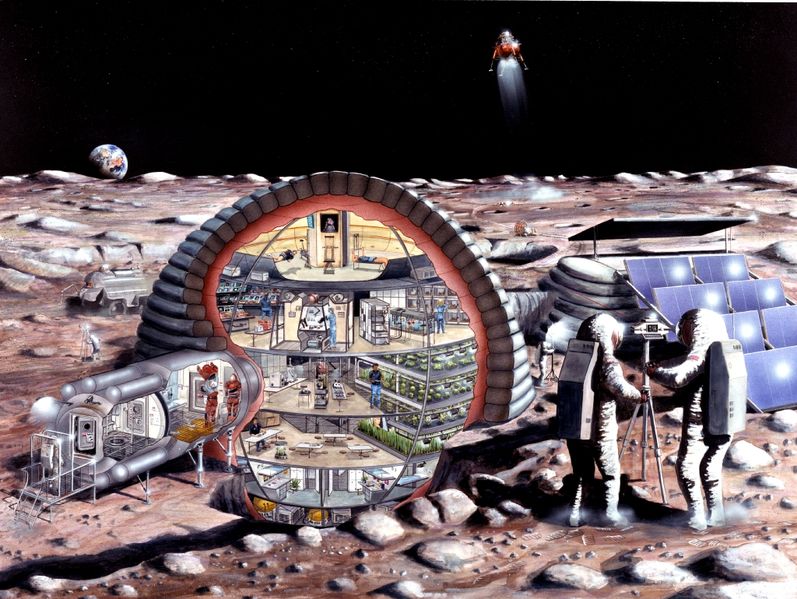
This concept for a lunar habitat uses inflatable bio-regenerative closed loop modules. Although the exteriors would come from Earth, the interior of such habitats could be manufactured using materials on site. Even lunar factories would be operated by robots built and assembled on the Moon.  Solar panels would be constructed in the vacuum of the lunar surface and would keep the colony lit and heated. Inflatable exteriors could be partially buried in lunar regolith for shielding against cosmic rays and solar storms.                         Source: Leif Romcke

Inhabiting the moon won’t be easy. No frontier can compare to the challenges humans will face in overcoming the lunar environment. By 2100 we will see several lunar settlements. The sites won’t be anywhere near where Apollo astronauts landed. The sites will be large because growing food crops will require a considerable amount of space. Fortunately there is no lack of real estate in which to expand. All sites will be modular and individually bio-regenerative so that each can stand alone.

Polar and near polar regions will be the ideal choices for habitation. The South Pole is particularly attractive because of the recent discovery of water ice in deep craters. The presence of water meets key criteria for lunar self sufficiency. Polar locations will also be more easily sheltered from solar storms and the solar wind. Most of the habitation materials including photovoltaics for energy generation could be manufactured at the site and assembled into solar arrays to provide power to the colony. Such a site would be ideal for communication with Earth as well since the signaling system would never disappear behind the Moon during the monthly lunar cycle.

The lunar census of 2100 will have a head count approaching 100,000. Every day as the lunar colonists go about their daily lives they will look up at the inky blackness above them and see Earth. That view will inspire them as it has the generations that followed Apollo.

Earth rise as seen from Apollo-11. Source: NASA
]]>
https://techsomogro.com/space-future-21st-century-part-4-humans-moon-why-how-many/feed/ 5