Back in September 2012, the team at Stanford reported the results of their work in the Journal of Biological Engineering. Using a bacteria the researchers engineered cell-to-cell communication sending genetic messages back and forth.
In the body cells communicate using proteins which are encoded with specific instructions by the cell’s DNA. They deliver the instructions to neighbouring cells when they leave through the cell membrane and cross the inter-cellular space to enter other cells. What the researchers at Stanford were able to accomplish was message transmission without relying on proteins. The advantage, a protein has limited message capacity. It can deliver a single instruction. But with the work done at Stanford, cells can transmit much more data and do it over longer distances. In one experiment DNA messages were transmitted a distance of 7 centimeters ( 2.75 inches). For cells that’s the equivalent of us making a long distance call from New York City to Buffalo.
For biological engineering and biosynthesis communicating messages to a large community of cells could mean significant technological innovation in all kinds of fields from computing to agriculture, chemistry, energy, pharmacology, manufacturing processes, and environmental remediation.
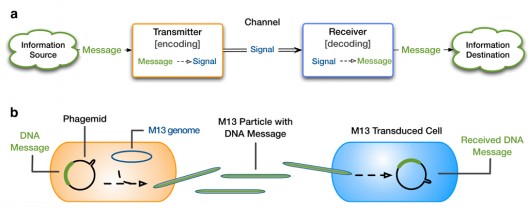
In the diagram seen below, (a) represents the WiFi world of computing, and (b) shows its equivalent in BiFi. As you can see there is little difference between the two.
So what are some of the applications for BiFi?
It is these last two applications that are the ones we most associate with BiFi. And in a sense we are BiFi ourselves, sophisticated, biology based computers. How we differ from electronic computing devices is in the vast amount of data communicated within us that we interpret and process on a massive parallel scale. Our bodies may not possess faster processors than the ones Intel builds, but we efficiently allocate the communication of messages and tasks to diverse communities of cells (our organs and systems), each performing subset tasks, and producing results that are blindingly fast.
So the researchers at Stanford are on to something that may yield a DNA computer in the not too distant future, or an artificial life form engineered from communicating bacterial cell communities.
]]>