Trib Live reports last month that 24 fourth graders at Sloan Elementary School in Murrysville, Pennsylvania, used Hummingbird robotics kits to create automated dioramas. As part of a Carnegie Mellon University project combining STEM education with art, the students used materials to build a range of robots ranging from Iron Man to the Stay Puft Marshmallow. Today robotics kits like this can be found in thousands of classrooms around the world illustrating how robots are becoming a part of everyday life. Many people worry that robots will steal their jobs, but some of these children will grow up working alongside robots, or even working on them in some of the new career options that the robot revolution is creating. Here are some fields where robots are transforming the workplace in potentially positive ways.
Here are some fields where robots are transforming the workplace in positive ways.
Manufacturing Robotics
According to PricewaterhouseCoopers, manufacturing is at the forefront of the robot revolution with 59% of companies in this industry segment already using some type of robot. While some are taking the place of humans, others called “collaborative robots” are safely working alongside humans, increasing productivity and making jobs easier.
Baxter, one of the first collaborative robots, features arms with seven degrees of freedom and an ability to sense force giving it a range of motion and dexterity comparable to those of humans. This makes Baxter flexible enough to use in a wide range of applications. Baxter learns by mimicking human trainers on the job. The robot’s programming adjusts to the workplace. This versatility enables Baxter to be integrated with other automated machinery in the workflow. These qualities make Baxter suitable for repetitive tasks, including loading and unloading, material handling, machine tending, and packaging. Robots like Baxter make workers’ jobs easier and safer, handling monotonous and high-risk tasks while working seamlessly side-by-side with humans. , which will improve workersâ€ jobs rather than replacing them, OTTO Motors argues. Manufacturing jobs will require humans who know how to work alongside robots, leading to a better-educated and higher-paid workforce. In addition to doing components of tasks that robots canâ€t do, manufacturing workers will get paid to supervise and maintain robots, performing tasks such as lubricating them, replacing
New manufacturing jobs will require humans to work alongside robots. That should lead to a better-educated and higher-paid workforce. In addition to participating with robots in completing tasks, manufacturing workers will also supervise and maintain them performing routine maintenance such as lubrication, replacing of O-rings, and electrical repairs. Educational programs, such as RAMTEC, are training the workers of the present and future to be prepared for these new types of manufacturing jobs.
Healthcare Robotics
Another field where robots are making jobs easier is healthcare. One of the most dramatic applications is robotic surgery. Robots such as Intuitive Systems, da Vinci surgical system received approval from the FDA in 2000. Today daVinci is used by surgeons to perform thousands of procedures. It is helping specialists to operate with clearer vision and greater precision than previously possible while making it surgery minimally invasive and safer for patients. Surgeons can use da Vinci to perform procedures remotely guiding the robot over a telecom link.
But robots are also helping healthcare professionals in other ways. For example, Robo Global reports hospital helper robots that deliver messages and samples within medical facilities, freeing up nurses and doctors to spend more time with patients. Other robots assist with elderly, autistic and paraplegic patients. At Georgia Tech specialized programs are being used to train healthcare professionals to work with robots. (See Robots to the Rescue for other biomedical robot systems and applications.)
Robot Operators and Robotics Technicians
Regardless of the job or industry, robots will require human supervision and maintenance creating new career opportunities for operators and technicians. Many robots will require supervision around the clock. If anything needs attention, a robot operator will step in. If a robot needs repair, a technician will have to be knowledgable about the intricacies of both the hardware and software.
Robot operators will require training in related areas of manufacturing, such as welding. According to PayScale, current hourly rates for this line of work average $13.79 U.S. Annual salaries top $47,000. Robot technicians average $18.55 per hour, with annual salaries of 67,000. Organizations such as Yushin University in Rhode Island, and George Brown College in Toronto, Ontario, are helping train robot operators and technicians for emerging career opportunities.

When robots were first introduced into production lines they were single purpose automatons such as those on automotive assembly lines doing spot welding or repetitive builds. These robots were simple servomechanisms programmed to do one thing and do it precisely and repeatedly with no human intervention. But with the onset of robots like Baxter, a multi-purpose, teachable robot, calling the machine a simple servomechanism is no longer apt.
So what is the current and near future state of human-robot interaction in manufacturing and service industries? Professor Thomas Sheridan of MIT addresses this subject in a paper appearing on April 20, 2016 in the journal, Human Factors. Entitled, Human-Robot Interaction: Status and Challenges, it looks at current research from a human factors perspective. In a Kurzweil News summary of the paper it poses the question “Would you trust this robot?” under the picture below showing Baxter working side-by-side with a human.
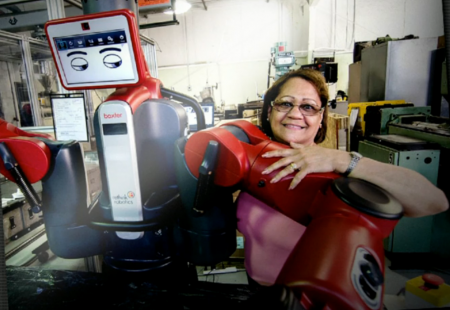
Among the concerns raised when talking about robot-human interaction is safety. Sheridan talks about Baxter, a product of Rethink Robotics, a Boston company. Baxter is designed to work in close proximity to humans. Baxter isn’t going to swing his arms and connect with the head of the human next to him causing damage. But Baxter doesn’t intuitively know how to do a task along with a human laborer. Instead he has to be taught. For this purpose Baxter is mechanically compliant. His display is designed to communicate to the humans with whom he is working. And his co-laborers don’t have to be programmers to teach Baxter. They can show him how to do a task by moving his arms and body to teach the robot a job. As such Baxter represents the leading edge of human-robot interaction a new field where general purpose automata can be trained by human laborers to work with them.
In Sheridan’s paper he covers the full range of robot-human interactions including:
In his assessment of human-robot interactions Sheridan raises the issue that robots may enhance work and not be the dreaded job stealers that are described in the press today. Those headlines that warn us of the millions who will no longer be employable may prove to be fantasy as humans and robots assist each other in the workplace both in the present and near future.
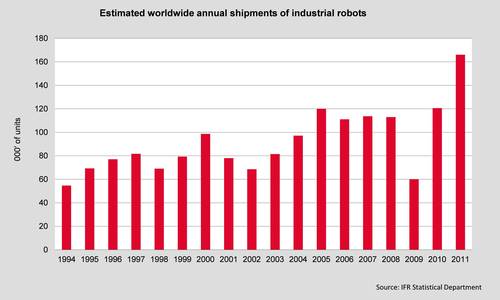
The industrial robots in these statistics cost six figures. But a Boston manufacturer, Rethink Robotics, has introduced a robot capable of performing a wide variety of common, repetitive tasks in the workplace at a fraction of the cost of previous manufacturers. Weighing 75 kilograms (165 pounds), standing 1.8 meters (6 feet), and known as Baxter, this is the first of a new generation of industrial robots that exhibits adaptive skills. Baxter, in a couple of minutes, can be programmed by almost anyone to accomplish new tasks. And unlike other industrial robots Baxter is very affordable at $22,000 U.S.
This is truly disruptive technology. Baxter is designed to do small-scale repetitive applications. Baxter can work beside humans in a facility without extra safeguards. Baxter interacts with humans through its LCD display which features eyes and eyebrows that express emotion. That same graphical display serves as an interactive console for human coworkers to reprogram Baxter. By showing Baxter what to do through manipulating his arms, a human worker can train it to do a new task. No software engineers need apply.
Out-of-the-box Baxter is pre-programmed to perform a wide range of manufacturing jobs including operating machines, materials handling, production line loading, unloading, assembly, finishing, inspecting, testing and sorting. In less than an hour Baxter can be on the job. And Baxter automatically alters its behaviour in response to any environmental change such as production line speed ups or variations in parts placement on an assembly line. Baxter can also adjust when a part is missed or dropped, or the assembly line surface height changes.
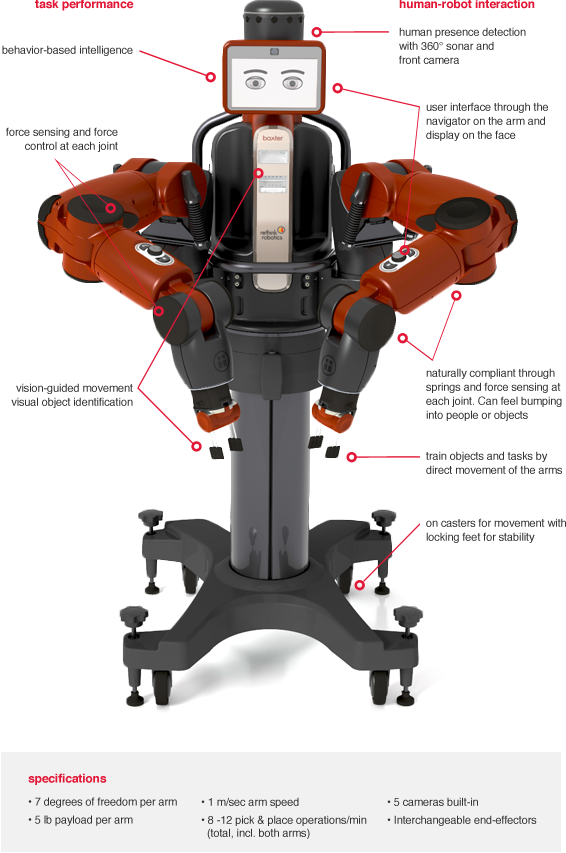
Baxter has no sharp edges or grippers that can inadvertently trap a human coworker. Baxter’s arms move fluidly and easily. Packed with sensors, Baxter can detect human presence nearby and avoid contact or reduce the force of any inadvertent collision.
Baxter as you can see in the image below comes with a mobile pedestal that allows it to be moved easily to different locations in a manufacturing facility. Its two interchangeable grippers can be switched in minutes. The electric parallel gripper features interchangeable fingers of different lengths with multiple grasp widths. The vacuum cup gripper comes with variable cup sizes and is used for hard-to-grasp objects.
In addition Baxter works with manufacturer enhancements from third parties and in 2013 will include a software development kit so users and re-marketers can reprogram the robot for unique tasks.
Baxter’s built-in smarts allow it to work in a number of industries including:
Will deployment of Baxter in small manufacturing cost hundreds of thousands of jobs? Not according to Rodney Brooks, Chairman and Chief Technology Officer at Rethink Robotics. What it has the potential to do is lower the cost of small manufacturing so that it can be competitive with manufacturing overseas. That can impact hundreds of thousands of companies worldwide. And robots like Baxter will make an increasingly smaller workforce more productive as our population ages and the current generation of Baby Boom workers retire.
]]>
