Storing energy is nothing new. From the Neolithic Revolution to the present, humans have attempted to harness the latent power of nature whether it be falling water or fire. In building dams, we created an early form of storage technology. The end goal wasn’t to produce electricity but to use the force generated by water falling from a height to power machinery. In this case, the water wheel which became a common way to power mills for grinding cereal crops. Water wheels were used to power sawmills before we learned to harness electricity. The water wheel’s descendant today is the turbine which in hydroelectric facilities is used to power generators turning the energy of falling water into kilowatt-hours of electricity.
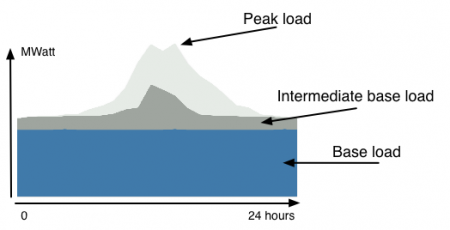
The grids that crisscross continents today are extremely complex. They have been designed for power-sharing and distribution that follows daily patterns. Energy storage currently plays a small part in ensuring power is available where needed at all times. One of the reasons it plays only a small part is because existing power generation and distribution capacity have been built to exceed peak demand.
The pattern of power requirements is a predictable cycle of daily, weekly, and seasonal demand. Matching supply to the need is one of the raison d’etres for continental power grids. The current grid has been built to ensure demand will always be met at the highest peaks unless something not predictable happens. When the unpredictable does occur in one or more utilities that feed the grid, power generation capacity from other sources can meet the emergency. This isn’t always the case leading to brownouts and occasional blackouts.
The U.S. Energy Information Administration describes how power demands change daily and throughout the year. The patterns are consistent:
A pool of water’s latent energy is a form of storage. Today, dams that provide hydroelectric power stations with energy from falling water to continuously produce electricity can take advantage of lower than peak periods to reverse the water flow. By pumping water uphill into reservoirs, they can use the increased water volume during peak demand periods to deliver added kilowatts of power to the grid.
In the United States, the first pumped storage facility opened in 1929 in Connecticut. Since then the growth of energy storage has surpassed 31.2 Gigawatts as of early 2019, a fraction of the more than one thousand Gigawatts of the country’s installed generation capacity. That amounts to 0.3% which sounds absurd considering the balancing act previously described for dealing with peak, shoulder, and low demand electricity requirements.
Globally, elsewhere energy storage for power generation plays a greater role in the mix. In 2018 total energy storage capacity exceeded 175 Gigawatts. In Europe, 10% of the continent’s power came from stored energy, while Japan’s stored energy amounted to 15% of capacity.
California has been the big player in energy storage in the United States. As of 2018, of the 300 energy storage projects there, 220 were grid-connected. The remainder were associated with distributed local energy delivery and off-grid.
The future of energy storage on the planet is likely less and less tied to traditional utilities and the grid as new energy storage materials and technologies emerge. The illustration below shows the range of energy storage technologies present and future.

Beyond pumped hydro, compressed air, different types of batteries using familiar chemistry such as lead-acid, and ones more exotic based on aluminum, sulfur, potassium, that breathe air and don’t require oxidizers, flow batteries, cryogenic storage, flywheels, magnetic energy storage, supercapacitors, and advanced fuel cell technologies, these existing and nascent technologies are ready to play a role in supporting the existing power grid. But more importantly, they are the bridge to solving the intermittency issues associated with the current forms of renewable energy on the planet today: wind, solar thermal, solar photovoltaic, geothermal, wave, and tidal power.
Their application will alter both grid and off-grid power delivery. Storage technologies give utilities greater flexibility in distribution and capacity. Storage technologies can save money and prolong the life of the power grid which has some old-age problems. If you don’t believe me, read the article I posted previously on this website about the long-term survival of the electrical grid.
Just how innovative can we get with energy storage. Carbonate fuel cells are a technology that does not just supplement the energy requirements of a powerplant burning fossil fuels, but also captures and uses the carbon emissions as the material in its fuel cell stacks. In 2016, Exxon installed a pilot project of experimental carbonate fuel cells at an existing coal and gas-fired power plant near Mobile, Alabama. So far so good. If widely adopted, this type of innovation could be a significant gamechanger for both grid and distributed power.
Recently, Tesla built a 100 Megawatt lithium-ion battery for an Australian utility. It is the world’s largest lithium-ion storage system, and one of a number of Australian-based projects slated for completion next year.
And speaking of distributed energy storage, in a recent Navigant Research study entitled “Country Forecasts for Distributed Energy Storage,” it cites the increase in solar and wind power as key to a projected 20 times increase in distributed storage systems by 2028. Research analyst for Navigant, Ricardo F. Rodriguez, sees the growth of distributed energy storage as a panacea for dealing with peak capacity requirements with or off-grid. And unlike reserve gas-fired powerplants that need to be brought online in periods of peak demand, storage systems can release electricity instantaneously with no downtime or ramping up, a distinct advantage over older paradigms.
]]>
Ted Wiley, Harvard Business School, and a founding member of the company, Baseload Renewables, states, “You can currently put batteries next to solar and wind power and create an output for four hours, but we want to develop a battery to shape renewables into a 24-hour block.”
The initial goal has focused on decreasing the cost of energy storage by a factor of five. To do this the company is looking at sulfur which costs less than any other element when used to store electrons. Abundant and ten times more energy dense than lithium-ion, developing sulfur-based battery technology would be a global game changer.
What Baseload Renewables is out to invent is a flow battery using a polysulfide solution containing chains of sulfur atoms. In the MIT patent application that inspired the spinoff, the technology is described as an air-breathing aqueous sulfur rechargeable system.
Flow batteries use two tanks filled with liquids that are electroactive. One is designated an anolyte, the other a catholyte. The two are then pumped into a cell containing a permeable membrane which allows positive and negatively charged atoms to pass through.
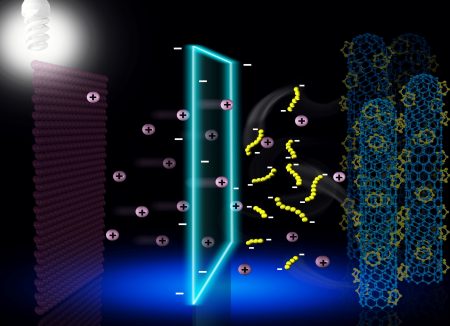
In the patented technology the catholyte contains metal salt dissolved in water. Oxygen gets generated in the catholyte during charging and is consumed when discharging. Getting the chemistry right will make this battery capable of:
Using waste sulfur, a byproduct of current fossil fuel production solves another environmental problem. There aren’t enough industrial uses for the current volume of the stuff from refining fossil fuels and synthetic crude. As a result, it gets stored in vast yellow mounds adjacent to these facilities.
Just how much sulfur comes from petrochemical refining? One example: for every 72 liters (19 gallons) of gasoline produced, a quarter kilogram (half a pound) of sulfur gets left behind.
If Baseload Renewables perfects the battery in the next two to five years, therefore, the company has the opportunity to solve two pollution problems: removing carbon in the air by replacing fossil-fuel generated baseload power and using up the surplus sulfur that today has no industrial purpose.
]]>