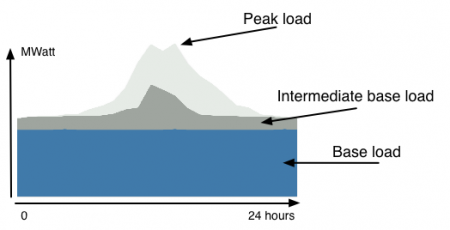
Ted Wiley, Harvard Business School, and a founding member of the company, Baseload Renewables, states, “You can currently put batteries next to solar and wind power and create an output for four hours, but we want to develop a battery to shape renewables into a 24-hour block.”
The initial goal has focused on decreasing the cost of energy storage by a factor of five. To do this the company is looking at sulfur which costs less than any other element when used to store electrons. Abundant and ten times more energy dense than lithium-ion, developing sulfur-based battery technology would be a global game changer.
What Baseload Renewables is out to invent is a flow battery using a polysulfide solution containing chains of sulfur atoms. In the MIT patent application that inspired the spinoff, the technology is described as an air-breathing aqueous sulfur rechargeable system.
Flow batteries use two tanks filled with liquids that are electroactive. One is designated an anolyte, the other a catholyte. The two are then pumped into a cell containing a permeable membrane which allows positive and negatively charged atoms to pass through.
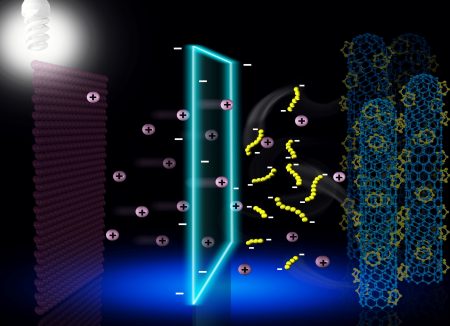
In the patented technology the catholyte contains metal salt dissolved in water. Oxygen gets generated in the catholyte during charging and is consumed when discharging. Getting the chemistry right will make this battery capable of:
Using waste sulfur, a byproduct of current fossil fuel production solves another environmental problem. There aren’t enough industrial uses for the current volume of the stuff from refining fossil fuels and synthetic crude. As a result, it gets stored in vast yellow mounds adjacent to these facilities.
Just how much sulfur comes from petrochemical refining? One example: for every 72 liters (19 gallons) of gasoline produced, a quarter kilogram (half a pound) of sulfur gets left behind.
If Baseload Renewables perfects the battery in the next two to five years, therefore, the company has the opportunity to solve two pollution problems: removing carbon in the air by replacing fossil-fuel generated baseload power and using up the surplus sulfur that today has no industrial purpose.
]]>———-
Remote Australian communities often use diesel generators for power. They’re expensive to run and emit pollution and greenhouse gases. Even people who don’t rely entirely on generators use Australia’s power grid, which is mostly fueled by polluting, climate-altering coal. Now, one company is showing that supplying Australia’s energy needn’t be expensive or polluting.
AllGrid Energy produces 10 kilowatt-hour solar-power batteries [the WattGrid, seen below] that take advantage of Australia’s abundant sunlight and growing demand for solar panels. Their lead-acid gel battery is less expensive than Tesla’s lithium-ion Powerwall solution, also available in Australia. Many AllGrid systems are sold in indigenous communities, providing affordable energy independence.

It’s an example of the rapid pace of renewable energy development — one that clears a hurdle previously confronting many clean-energy technologies: their variable nature. One advantage of fossil fuels is that they’re both source and storage for energy; renewables such as wind and solar are only sources.
Many argue that because solar and wind energy only work when the sun shines or the winds blow, and output varies according to cloud cover, wind speed and other factors, they can’t replace large “baseload” sources like coal, oil, gas and nuclear. But batteries and other energy storage methods, along with power-grid improvements, make renewables competitive with fossil fuels and nuclear power — and often better in terms of reliability, efficiency and affordability.
With storage and grid technologies advancing daily, renewable energy could easily and relatively quickly replace most fossil fuel-generated electricity. In Canada, Ontario’s Independent Electricity System Operator contracted five companies to test a number of storage systems, including batteries, hydrogen storage, kinetic flywheels and thermal systems that store heat in special bricks. Ontario is aiming to get about 50 per cent of its installed generating capacity from renewable sources by 2025.
The main renewable-energy storage methods are thermal, compressed air, hydrogen, pumped hydroelectric, flywheels and batteries. Some are better for large scale and some for small scale. As electric cars become more popular, their batteries could be connected to grids to supply and balance power, which could offset costs for owners. Harvard University researchers have been working on a flow battery that uses abundant, inexpensive organic compounds called quinones rather than expensive metals.
Renewable energy with storage has a number of advantages over fossil fuels. It can discharge power to the grid to meet demand more quickly and efficiently, and it’s less prone to disruption, because power sources are distributed over a large area, so if one part is knocked out by a storm, for example, other parts keep the system running. Many fossil fuel and nuclear power systems require a lot of water for cooling and so can be affected by drought, and nuclear power systems are expensive and take a long time to build. Clean-energy technology also creates more jobs than fossil fuel development.
Because renewables don’t pollute or create greenhouse gas emissions, they also help lower costs for health care and the ever-increasing impacts of climate change. Although every energy source comes with consequences, the damage and risks from mining, processing, transporting and using coal, oil, bitumen and uranium, and from fracking and other extraction methods, are far greater than for clean energy. And fossil fuels will eventually run out, becoming increasingly expensive, difficult to obtain, and ridden with conflict as scarcity grows.
Rapid storage-technology development will place renewable sources at the forefront of the global energy mix in coming years. Many renewables are already being deployed even without storage. A recent report showed the U.S. could reduce CO2 emissions from its electricity sector by 80 per cent relative to 1990 levels within 15 years “with current technologies and without electrical storage.”
The study, by scientists from the National Oceanic and Atmospheric Administration and University of Colorado Boulder and published in Nature Climate Change, concluded that grid improvements, including a new high-voltage, direct-current transmission grid, could deliver low-cost clean energy throughout the country to match supply and demand.
Still, storage offers many advantages. With the urgent need to cut greenhouse gas emissions, governments need to provide incentives for rapid renewable energy development and deployment. Considering how quickly computer technology and other human inventions have advanced, it’s easy to see that barriers to a clean-energy shift are more political and psychological than technological.
]]>