If you are invested in fossil fuel companies then the current news about continued profits, healthy dividends and record incomes will give you comfort. On the other hand, if you are a concerned citizen about climate change the news is foreboding. The industry is making out like a bandit enabled by loans and financial guarantees from banking institutions around the planet while global temperatures and sea levels climb and extreme weather events are more frequent and worse.
Since the Paris Climate Agreement of 2015, the 60 largest private banks have poured US $6.9 trillion into the fossil fuel industry. In 2023 alone, the banks gave the industry $705 billion. It is the behaviour of banks, therefore, that represents one of the largest impediments to achieving net zero emissions for our planet by 2050. Bank behaviour continues to encourage the fossil fuel giants who obfuscate, lie and greenwash the public about being environmentally responsible and committed to net zero.
If banks were to stop handing out money, and if governments were to end fossil fuel subsidies, I have no doubt that funding for new projects would quickly dry up and the planet would begin to move in the right direction environmentally.
Who are the biggest banking offenders? You can find them across the planet. Here is a partial list:
Where banks are professing their desire to cut investments, some have indicated a willingness to stay in the game if the fossil fuel company adds carbon capture and storage (CCS), or hydrogen and ammonia production to its existing projects. For banks committed to pulling their money from the industry, you can count the total using the fingers of your two hands.
So what can you do if you have an account in one of these banks and are concerned with the future health of the planet and the generations of people that follow?
There are several actions you can take but before you do confirm that your bank is vested in fossil fuel projects.
Several conservation organizations monitor the banking and financial industry related to fossil fuels and unethical investments. Among these are The Rainforest Action Network, Bank Track, Oil Change International, and The Sierra Club. These environmental industry watchdogs compile an annual fossil fuel finance report entitled Banking on Climate Chaos.
You can download the 2024 edition of the report to check and see if the bank you use is listed as an offender. Then you can visit, call or email the bank and express your concerns using talking points from sites like Fossil Free Funds.
If feasible, consider switching to a bank the industry watchdog report identifies as environmentally responsible.
If you have retirement investments and mutual funds, check to see if the bank or financial institution managing your money is listed in the report as an offender. Also, check the investment mix in your portfolio. I did this a number of years ago and found several companies on the offender list and asked my advisor to look for alternative investments. Don’t feel intimidated about discussing a switch to fossil-free investment funds. This a relatively new field for the financial industry and your advisor may appreciate the information you provide.
A good reference site to help you learn more is Fossil Free Funds.
]]>How ridiculous.
This may come to an end in 2017 as many banks around the globe adopt Blockchain technology faster than expected according to IBM which has produced a report entitled Leading the Pack in Blockchain Banking: Trailblazers Set the Pace. IBM’s Institute for Business Value combined with the Economist Intelligence Unit did a survey of 200 banks from 16 countries asking them their expectations about blockchains. Currently only a small number of banks have adopted the technology largely in pilot projects. But the survey shows that a number of banks intend to use it for retail payments and consumer lending, trade finance, corporate lending and reference data.
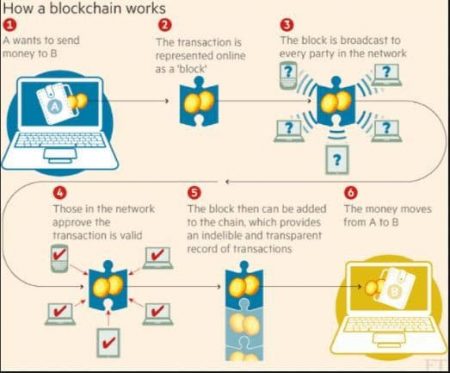
What is blockchain?
Originally designed for the handling of transactions using digital currencies such as Bitcoin, blockchain is becoming an effective way to digitally track all kinds of currencies and other assets. Blockchain is a way of structuring data. Using it you can create a digital ledger that can be distributed across a network of computers. Blockchain provides a secure method for transactions because it uses advanced cryptography.
Blockchain doesn’t require a central authority as a point of validation for any transactions using it. A transaction that gets recorded in the blockchain ledger can be added to by network participants. When added the new information is evaluated and validated by all members. It then becomes an additional block added to the chain.
In a February 2016 article appearing in The Wall Street Journal, Steven Norton describes how a company would use blockchain. He writes:
“Assume an organization has 10 transactions per second. Each of those transactions receives its own digital signature. Using a tree structure, those signatures are combined and given a single digital fingerprint — a unique representation of those transactions at a specific time. That fingerprint is sent up the tree to the next layer of infrastructure, such as a service provider or telecom company. This process happens for every organization in the network until there is a single digital fingerprint that encompasses all the transactions as they existed during that particular second. Once validated, that fingerprint is stored in a blockchain that all the participants can see. A copy of that ledger is also sent back to each organization to store locally. Those signatures can be continuously verified against what is in the blockchain, giving companies a way to monitor the state and integrity of a particular asset or transaction.”
In yesterday’s edition of Fortune, Lucinda Shen, writes that IBM is predicting 66% of banks will be operating using blockchain for commercial operations. She describes successful tests of blockchain for bond transactions and cross-border payments by eight different banks.
The embracing of blockchain by banks is seen as a way of reducing costs and speeding up transactions by cutting down on time to reconcile disparate data such as trying to send a money gift to a couple getting married in France from here in Canada without going through the hoops I described above.
]]>