We have witnessed in the current wars being fought in Ukraine and Gaza the increasing use of drones and uncrewed aerial vehicles. That’s why when the former chair of the U.S. Joint Chiefs of Staff, General Mark Milley told an Axios Future of Defense event that up to one-third of the American military will be roboticized within the next 10 to 15 years, should we be surprised?
Milley described using robots in the military as “a fundamental change” and that “other nations’ militaries are going to be similarly designed.” He believes human troop numbers will fall as autonomous weapon systems are introduced into land, water and air battlefields. From autonomous field artillery and rocket launchers to crewless tanks and pilotless fighter jets, future wars will be fought by fewer humans connected to robots linked together by fast decision-making software.
Does that mean we are entering the age of killer robots? At least for the American military, this is not the case. The U.S. military has a stated policy appearing in a document entitled, Responsible Military Use of Artificial Intelligence and Autonomy. No U.S. robot will make killing decisions when confronting humans. Only a human operator will have the ultimate say in pulling a trigger, launching a rocket or deploying another weapon.
Sooner than the deploying of killing robots will come field support robots. These will ferry supplies to a battlefield and take the injured away for treatment. Big Dog, a robotic pack mule developed by Boston Dynamics is a good example, a robot that can operate autonomously and carry heavy loads across rough terrain.
Military robots today come in many forms:
Boston Dynamics’ Robo-Dog, the quadrupedal robot frequently seen in YouTube videos has been the inspiration for Q-UGVs armed with guns and other ordinances and guided by artificial intelligence (AI), digital imaging systems to detect and track people, drones, or vehicles, and report potential targets to remote human operators located anywhere in the world. The U.S. Marine Forces Special Operations Command (MARSOC) has been evaluating Q-UGVs armed with guns and rocket launchers for future war zone deployment.
Even with human operators, the prospect of deploying armed robots on battlefields raises significant questions about the future of conflicts and the potential risks and ethical implications of autonomous weapons systems. Beyond their military use, it isn’t a a stretch to see these types of robots being deployed by police forces such as what caused an uproar in San Francisco in 2022 when its city Board of Supervisors approved their use in urban conflict zones.
]]>
Of all of these, one stands out as very troubling, robots in the military, because they can use the other technological advances to become machines of war that could disable not just enemy robots, but also kill their human creators. Add to this the potential of human or robotic intelligence hacking into the robots in your military to turn them against you and you can imagine the disastrous implications of such activity.
Hackers have been honing their trade by attacking domestic and industrial robots, altering safety settings, or turning their audio and video capabilities into spying devices. In a 2017 study of robot operating systems and software, hackers identified 50 security weaknesses including:
In an incident in 2011, Iranians claimed they hacked an American drone and redirected it to land in their territory. If that drone had been armed, could the hackers have turned it against its former masters? In a 2015 article appearing in the journal, Communications of the ACM, authors John Arquilla and Duncan Buell asked this very question and then stated, “A coup of this sort would require a high level of technological sophistication and an absolute mastery of the radio-electromagnetic spectrum, but the consequences of one side being able to do this would be catastrophic for the side whose robots were taken over.”
What started off as reconnaissance drones today have become remotely-operated killing machines which are controlled by “pilots” sitting in front of terminals thousands of kilometers away. Imagine if one of these killer drones gets hijacked in a war where it bombs its operators rather than the enemy.
Killer drones are the tip of the military robot iceberg of technology being developed and tested to become the next generation of killing machines. Today the drones are either not autonomous or semi-autonomous. But there is no doubt that military developments will soon make battlefield robots fully autonomous in support of troop deployments.
In a Guardian article published in April of 2018, it reported: “at least 381 partly autonomous weapon and military robotic systems have been deployed or are under development in 12 states, including China, France, Israel, the UK, and the US.” The US is making autonomy a central feature of its military robotics strategy. And others are no doubt doing the same creating an arms race in which countries like Russia and China are at the forefront while lesser regional powers like Iran, Saudi Arabia, Israel, India, and Pakistan are joining in.
The current list of US military robots includes autonomous aircraft, anti-submarines, tanks, and more. Russia’s President recently stated, “whoever leads in AI will rule the world.” Hence Russia has developed its own robot tank, and autonomous gun platforms. Not to be outdone, China is working on semi-autonomous seaborne boat swarms, aircraft, and tanks. And every one of these weapon systems is just as vulnerable to hacks as any other computing platform.
The inanimate machines that these militaries are building around the world could one day be turned on their creators. Noel Sharkey, a professor of AI and robotics, the University of Sheffield, United Kingdom, described what a robot apocalypse of hacked autonomous machines would look like. He is quoted stating:
“Imagine swarms of autonomous tanks and jet fighters meeting on a border and one of them fires…because it has been hacked…This could automatically invoke a battle that no human could understand or untangle. It is not even possible for us to know how the systems would interact in conflict. It could all be over in minutes with mass devastation and loss of life.”
Lots of voices are being raised against what appears to be a common policy direction for militaries in a number of countries across the world. Since 2014, the United Nations has been trying to develop a treaty to regulate military robots and ban killer robots outright. Some 80 countries have been involved in these discussions with little in the way of progress largely because the US, UK, and Russia have been opposed. As a result, nothing is in place to reign in the research and development of these semi to fully-autonomous AI killing machines.


Rigg argued that the futurarmy would still rely principally on humans and not machines. That the soldier will “live, move and fight amid amazing weapons and machines – nuclear-powered helicopters, flying tanks, flying platforms, flying artillery, missiles, drone devices and even mechanical spies.” He describes “basket-sized capsules” dropped into enemy territory to scout out the enemy, make weather observations, locate disposition of troops, and more, transcribing observations into Morse Code and transmitting the gathered intelligence at rates of 17-words per minute. For Rigg the future soldier would be fighting in 1974. The reality of the Vietnam War saw the American military adopt very little of what Rigg envisioned. And, of course, he didn’t see the development of autonomous robots capable of operating on a battlefield.
Enter Mad Scientists

Today the American Army under the Training and Doctrine Command (TRADOC) has launched the Mad Scientist Initiative, an alliance of the military, academia, and business, focused on military operational innovation. Mad Scientist looks at a range of technologies including:
At a recent Mad Scientist conference, the army reviewed the changing landscape of military confrontations and concluded the need to invest in quantum computing, tactical Internet of Things (IoT) systems and devices, and machine-to-machine learning to gain intelligence and combat in the field advantages over enemy combatants in diverse scenarios.
Future armies, stated those attending Mad Scientist, will need to take into consideration the rise of megacities as the likely environment of future wars. These cities would be densely populated and would act as havens and support bases for insurgents, criminal organizations, and terrorists. Engagement in such difficult environments would require better situational awareness, and new technologies of maneuver above and below, within urban areas.
Cyber intrusion would be combatted by advanced computing power, hence development of quantum computers capable of withstanding the most sophisticated hacking efforts.
But like Rigg, who saw the soldier as the central tenet of military operations, Mad Scientist puts the skill of soldiers first as the key asset in achieving dominance over adversaries.
What the Army of the Future Will Look Like Based on What We See Today
On the battlefields of 2030 and beyond expect to see an army with very few human personnel surrounded by a panoply of technology capable of extending the capability of each soldier deployed in the field. Reconnaissance on the ground and in the air, done by robots and drones, will provide unprecedented situational awareness. Delivery drones will keep soldiers resupplied. Drones above the battlefield will not only provide in situ intelligence but be capable of firing on enemy combatants as directed by soldiers. Drones and on ground robots will talk to each other and to the humans they are designed to support. The key to all of this will be the development of software applications and communications technology capable of withstanding enemy technological interference. The U.S. Army is hell bent on developing a robotics operating system to support this vision.
Robert Sadowski, chief roboticist at the Tank Automotive Research, Development and Engineering Center (TARDEC), describes the need to build a comprehensive app store for robots and autonomous systems. He still sees the soldier as central to the plan and when he describes robotic capability states, “We’re always going to have Soldiers involved in the process. You don’t put treasure on the road without some sort of security….We’re not going to have unmanned Terminator robots roaming around on the battlefield.”
What About the Other Side?
Will the enemy be agreeable to limiting its military operations to human controlled weapons only? Both Russia and China may have a different perspective and both countries are making investments in robotics and autonomous weapon and surveillance systems preparing for a future roboticized battlefield. In a 2015 article appearing in Tech Insider, Valery Gerasimov, Chief of the Russian General Staff is quoted stating, “In the near future, it is possible that a complete roboticized unit will be created capable of independently conducting military operations.” Russia has been working on sentry robots charged with protecting missile installations and recently demonstrated. China’s foray into autonomous weapon systems includes tactical missiles with built-in intelligence capable of seeking out targets during combat operations. Will Chinese efforts go further? That remains a big unknown.
Should Autonomous Weapons Be Universally Banned?
In light of the potential threat of killer robots deployed on future battlefields, those in the field of artificial intelligence research have mounted a campaign. In 2015, over one thousand researchers issued a letter calling for a ban on weapon systems that use AI to make killing decisions.
In the letter, the signatories stated, “Just as most chemists and biologists have no interest in building chemical or biological weapons, most AI researchers have no interest in building AI weapons and do not want others to tarnish their field by doing so…..Starting a military AI arms race is a bad idea and should be prevented by a ban on offensive autonomous weapons beyond meaningful human control.” Among those signing the letter is Stephen Hawking, Elon Musk, Steve Wozniak, Noam Chomsky, and Peter Diamandis. Since the letter’s publication 3,105 AI and robotics researchers, and over 17,000 others have added their names. But according to an article that appeared in The Verge, at United Nations-sponsored conferences related to lethal autonomous weapons, only five countries support such a ban.
The justification for not banning the technology is as follows:
The countries that supported the ban in that 2014 conference included Cuba, Ecuador, Egypt, Pakistan, and The Vatican. Since that conference the number supporting a ban has expanded to 19.
This shouldn’t come as a surprise considering the present use of drones by military operators in a number of countries. But to date drones still have human operators and a command hierarchy to make the decision on when to take a shot. The fear in the not-too-distant future is what will happen when military developers decide to give the robots autonomy to make their own decisions on when to fire.
Back in 2013 a group of 1,000 scientists, technologists and prominent media persons led by Steve Wozniak, Stephen Hawking and Elon Musk, drafted an open letter to governments calling for a ban on autonomous weapon systems capable of making independent kill decisions.
The letter which has attracted more than 20,000 signatures, begins by stating that “most chemists and biologists have no interest in building chemical or biological weapons,” and further asserts “most AI researchers have no interest in building AI weapons.”
The signatories call for the same kind of “broadly supported international agreements that have successfully prohibited chemical and biological weapons” to be implemented for robotics and AI. They conclude, “we believe that AI has great potential to benefit humanity in many ways, and that the goal of the field should be to do so. Starting a military AI arms race is a bad idea, and should be prevented by a ban on offensive autonomous weapons beyond meaningful human control.”
Earlier this year at a conference sponsored by the United States Department of Defense this subject was openly discussed. Should the U.S. develop autonomous armed robots capable of fighting alongside human troops and acting on their own. A concept operations document is in the works to be presented to the U.S. military with a stated 2035 deployment goal. The authors of this document are tasked with looking at semi-autonomous weapons similar to the U.S. Marines test robot seen in the image below. To date, no one in the U.S. Department of Defense has indicated an intention to delegate the autonomous right to kill to a military robot. Nonetheless the option is not yet off the table largely because of concerns about what the other guys might do.

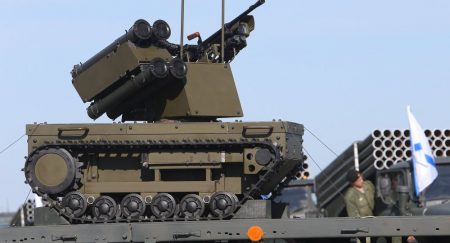
Who are the other guys? The Russians and Chinese for sure. The same thinking about semi-autonomous and autonomous weapon systems is happening in Moscow and Beijing. The Russians in the last month displayed their latest killing machine capable of being human-controlled or making autonomous firing decisions. Built for the Russian Strategic Missile Force to protect launch silos, it resembles a small tank (see image below) and has the capability of detecting enemy movement up to 10 kilometers away, and can fire with lethal accuracy at distances of 400 meters. And China just announced their intention to incorporate AI into military drones.

Weapons such as the marine and Russian prototypes seen above are not the sole concern of those fearing the spread of autonomous robotic systems in the military. Robots don’t have to come in big packages. A malevolent AI deployed within communicating microrobots that display swarm intelligence could be unleashed on an unsuspecting population. Such a weapon could be self-replicating using resources by living off the land and spreading through an entire nation. Swarm intelligent weapons don’t have to be lethal to human lives. They can be used to attack and destroy infrastructure and thus be just as effective in grinding an entire country to a halt.

It is no surprise, therefore, that the United Nations is being tasked to seek international agreement on such weapons. Under its Institute for Disarmament Research (UNIDIR) is hopes to come up with a global ban on lethal autonomous weapons technology. The most recent step in this direction occurred on December 16th in Geneva, with 123 participating nations voting to create an expert committee to work towards that goal. To-date only 19 countries have called for an outright ban. The United States, Russia and China are not among these.
]]>