The post How Technology Companies Are Using Technology to Protect Their Workers appeared first on Techso Mogro.
]]>Workplace safety technology continues to transform every industry. Tech companies are
building tools to increase productivity and leveraging advanced systems to reduce risk, prevent
accidents and protect workers. This is particularly prevalent in high-stakes environments, such
as manufacturing, construction and engineering.
From intelligent sensors to AI-driven monitoring systems, modern safety solutions are becoming more proactive, data-driven and adaptive.
One of the most significant advancements in workplace safety technology is the integration of
smart sensors through the Industrial Internet of Things (IIoT). Sensors are embedded into
machinery, wearable devices and infrastructure to monitor conditions in real time.
In manufacturing environments, IIoT sensors can detect anomalies such as gas leaks,
overheating equipment or unusual vibrations that may indicate mechanical failure. This
continuous collection and analysis of data enables predictive maintenance and allows
companies to fix issues before they escalate into dangerous situations.
Wearable sensors can track workers’ physical conditions, including heart rate, fatigue levels and exposure to hazardous substances. If a worker enters a restricted area or experiences signs of heat stress, alerts can be triggered immediately to reduce response times and prevent injury.
Interlock systems remain a cornerstone of safety in industrial and electronics manufacturing
environments. They can prevent accidental exposure to hazardous voltages and promote safer testing environments. Interlocked safety mechanisms instantly disconnect power when a
worker opens an enclosure or access panel. This process makes the device safe to touch and
removes the risk of human error.
Modern interlock systems are increasingly integrated with digital control systems, allowing for
real-time diagnostics and remote monitoring. They can also ensure compliance with safety
standards and greater operational transparency.
Cameras equipped with artificial intelligence (AI) algorithms monitor environments and
identify unsafe behaviours or conditions in real time. For example, at a construction site or in a factory setting, computer vision systems detect whether workers are wearing proper personal
protective equipment (PPE). If the AI identifies a violation, it can issue alerts to supervisors or
even halt operations.
AI systems can analyze patterns over time to identify recurring risks. This workplace safety
technology enables organizations to shift from reactive safety measures to proactive risk
management strategies that address hazards before they lead to accidents.
Collaborative robots, or cobots, have been designed to work beside humans, taking over
dangerous or physically demanding tasks. This reduces injury rates and allows workers to focus on higher-level tasks requiring critical thinking and leadership.
In manufacturing, cobots can handle tasks that could pose dangers for human workers,
such as heavy lifting, precision welding or hazardous material exposure risk. Cobots with advanced sensors and machine learning (ML) algorithms detect human presence and adjust their movements accordingly.
Training is a critical component of workplace safety, and augmented reality (AR) is transforming how it is delivered. AR enhances training by overlaying digital information, such as 3D models, checklists and IoT data, onto the physical world through smart glasses or headsets, providing workers with real-time guidance and instructions.
In complex engineering environments, AR headsets can guide technicians through maintenance procedures and provide step-by-step instructions, reducing the likelihood of errors. New employees can also benefit from immersive training simulations that replicate hazardous scenarios without exposing them to actual danger.
Drones are increasingly being deployed to inspect hazardous or hard-to-reach areas, such as
tall structures, confined spaces or disaster zones. Equipped with high-resolution cameras and
sensors, drones can gather detailed data without putting human inspectors at risk.
In the oil and gas industries, workers today are using drones to monitor pipelines and offshore
platforms and identify issues such as corrosion or leaks. In construction, drones survey sites and assess structural integrity from safe distances. Their deployment is improving safety and efficiency by reducing the time and cost of manual inspections.
Digital twin technology creates virtual replicas of physical systems. It simulates real-world
environments, allowing companies to test different scenarios and identify potential risks before they occur in the real world. This predictive capability allows organizations to design safer systems from the outset, rather than retrofitting solutions after problems arise.
For example, a digital twin of a manufacturing plant can be used to simulate equipment failures or emergencies. Engineers can analyze how these scenarios would impact worker safety and implement preventive measures accordingly.
Personal protective equipment (PPE) has evolved significantly with the integration of smart technology. Modern PPE is especially useful in high-risk industries and environments.
Smart PPE include built-in sensors, internet connectivity and real-time feedback
mechanisms. Helmets come with augmented reality displays, communication tools and environmental sensors. Connected safety vests monitor worker location and send alerts in case of falls or accidents.
The post How Technology Companies Are Using Technology to Protect Their Workers appeared first on Techso Mogro.
]]>The post GridRaster Uses the Metaverse to Build High Tech Prototypes and Finished Products appeared first on Techso Mogro.
]]>He stated, “What the metaverse is to us at GridRaster is an augmented space that can be overlayed on the real world to create close cooperation between humans and machines to help build and maintain almost anything. It could be a metaverse that lets humans work through robots in remote places like Mars or the Moon, or on a factory floor, skunkworks, or design studio.”
This is far from my initiation to Second Life, the first metaverse experience I ever tried. At the time after virtually flying and interacting with other avatars, I was largely unimpressed. There was a potential to use the metaverse environment to enable people with disabling physical injuries, but for the average person, I saw it as being more of a gaming platform for those with too much time on their hands.
But as Dijam and I talked he explained how the convergence of a range of 21st-century technologies was going to make the metaverse a powerful tool for companies. He was talking about combining artificial intelligence (AI), robotics, augmented and virtual reality (AR/VR), and additive manufacturing (3D printing). He believed that the impact of all of these under the metaverse umbrella would be felt in every business operation from design to the factory floor, to warehousing and to logistics. The metaverse, he stated, was going to overlay our physical world in ways never contemplated before.
Why is Dijam such a metaverse believer?
Let’s start by describing what GridRaster has developed. Go to the website and it describes the technology as follows:
“a unified and shared software infrastructure to empower enterprise customers to build and run scalable, high-quality eXtended Reality (XR) – Augmented Reality (AR), Virtual Reality (VR) and Mixed Reality (MR) – applications in public, private, and hybrid clouds.”
What does that all mean?
Simply, GridRaster creates spatial, high-fidelity maps of three-dimensional physical objects. So if you plan to build an automobile or aircraft, use the software to capture an image and create a detailed mesh model overlay that can be viewed using a VR headset. The mesh model can be shared with robots and other devices.
GridRaster software integrates wirelessly and through the Cloud which means it can be used anywhere. A human user on Earth could work with a robot on the Moon to build a lunar base.
The software’s XR capability allows for rapid prototyping throughout the design and engineering phases of new product development. Dijam told me that 70% of manufacturing issues can be handled at the design phase which means incredible time savings.
Another feature produces photorealistic visualizations for technicians to use to train or do maintenance and repair.
And its mixed reality simulation capability allows product developers to do continuous testing throughout the design process.
I asked Dijam for examples of clients using GridRaster. He mentioned Boeing which is working to design a new aircraft in the metaverse. Two other manufacturers, Hitachi and Volkswagen, are using the metaverse the same way.
Another client, the US Department of Defence (DoD) is using the metaverse to help with its aircraft maintenance depot operations. DoD is deploying robotic arms at these depots. Using GridRaster, what used to take hours to program a robot now takes 15 minutes.
GridRaster works with off-the-shelf VR headsets like the Microsoft Hololens. With the headset, the user sees a detailed mesh model that serves as a virtual 3D map. Users can instruct or guide a robotic arm to complete a task. In the case of the DoD depot application, the robots are doing painting, grinding, and swapping out and replacing defective or damaged parts for aircraft.
The mesh model using Hololens provides millimetre-scale accuracy. For surgical and medical laboratory applications, the software can visualize at a micrometre scale.
The last example Dijam shared was the US Space Force (USSF) which is using GridRaster with its project to build and deploy space robots to deal with the problem of orbital debris. USSF’s goal is to have human operators on Earth work with robots in orbit to target trash and give it a deorbiting push so it burns up in the atmosphere rather than continue to be a potential hazard to working satellites and low-Earth orbit human missions.
The post GridRaster Uses the Metaverse to Build High Tech Prototypes and Finished Products appeared first on Techso Mogro.
]]>The post What’s Happening in the World of Printed Circuit Boards appeared first on Techso Mogro.
]]>What are some of these advances?
Also known as additive manufacturing, 3D printing is allowing developers to do custom-built electronics including specialized PCBs. Today there are purpose-built 3-D printers that specialize in PCBs. But even off-the-shelf, generalized 3D printers can be used by hobbyists custom boards using silver-based filament inks.
High-Density Interconnector or HDI refers to PCBs with higher wiring density per surface area than typical PCBs. They are designed for more complex tasks and built to handle greater voltage. They feature high-performance substrates and laminates and densities of lines smaller than 65 microns (2.559 mils) and spaces that are less than or equal to 100 micrometres. HDI PCBs are harder to build using traditional etching manufacturing processes because the lines are so close together. As a result lasers end up being used in the builds.
If you are unfamiliar with the term “impedance,” it refers to the total opposition to an alternating current (AC) by an electric circuit. Measured in “ohms” which are units of electrical resistance, a little in the right place can be a good thing.
When dealing with high-speed communication, uncontrolled impedance distorts signals, corrupting them or cutting them off altogether. Designing circuits that account for minor resistance within highly delineated parameters, means signals can be delivered clearly. With demands for higher and higher speeds, controlled impedance has become a prerequisite for PCBs used in cutting-edge applications.
It’s not easy to design a PCB that fits into an odd-looking pair of glasses or a headset, but that’s the challenge facing PCB manufacturers in delivering augmented and virtual reality applications. To do this manufactures are building moulded boards that can fit with near-eye display technology, giving viewers access to supplemental information while they navigate a real or virtual world.
Wearable technology is becoming more than just the donning of a virtual or augmented reality headset. Now it is PCBs that are in clothes and gloves, that track a wearer’s movements and quantify and analyze his or her activity. This is a technology designed to bend but not break.
DuPont’s Pyralux material is an all polyimide double-sided copper-clad laminate for use in the design of flexible PCBs. The growth in wearable haptic technology for use in gaming, recreation, military, medical and scientific applications is exploding creating a market for this new generation of PCBs.
The post What’s Happening in the World of Printed Circuit Boards appeared first on Techso Mogro.
]]>The post In the Category of Gadgets: New Augmented Spectacles and Stereoscopic 3D for Your Computer appeared first on Techso Mogro.
]]>Augmented reality meets Spectacles 3, a technology you wear that looks like a cool set of glasses and gives you an immersive augmented reality (AR) experience. A product developed by Snapchat, the social media company, Spectacles is now in its third edition but not yet for sale. Instead, Snapchat is releasing it to the Snap community of partners and developers along with a new set of tools.
Spectacles immersive AR lenses deliver overview displays when looking through them. The eyeglass stems contain two 2 RGB cameras and 4 microphones, and unlike virtual reality headsets, Spectacles doesn’t look “uncool.”
Deconstructing the product as seen in the image below gives you a sense of the layers of complexity built into the product.

How fast does the AR come up when viewing an object? There is a mere 15 milliseconds of latency between what you see, and what the AR overlay delivers. That is virtually instantaneous. And even better, this edition of Spectacles weighs only 134 grams (4.7 ounces). Compare that to popular VR headsets like Oculus Rift, which comes in at over 470 grams (more than one pound).
Snapchat has developed Lens Studio for Spectacles, a software application that allows developers to create augmented reality overlays. It has been designed to make endless custom AR possibilities. It comes with a premade Materials Library for creating overlays, a Script Graph Editor or Behavior helper script for building interactive experiences without having to write code. But if you know JavaScript, you are ahead of the game. With SnamML you can use machine learning to make your AR overlays more intelligent. And if you prefer to use your own 2D or 3D software, Lens Studio lets you import your artwork directly into the AR display.
Anything you create for Spectacles, once submitted, is published for the Snapchatter community which in 2021 has reached over 280 million people worldwide.
Spectacles 3 can be ordered online and is selling for $500 US.
Acer, the Taiwanese-based computer hardware manufacturer, has developed SpatialLabs, a full 3D immersion technology that creates 3D stereoscopic images when looking at your computer screen. You don’t need special glasses to get the full 3D experience.
SpatialLabs comes with developer software, and Model Viewer, a professional design tool for showcasing 3D images. It allows users to edit and produce objects in 2D and display them in 3D. And to see the results, Acer has built a new computer called the ConceptD.
This laptop combines a stereo camera (two built-in image sensors) with a high-powered processor and built-in graphics card plus 32 Gigabytes of RAM. The cameras track the viewer’s eyes and head. A built-in optical lens projects the camera’s images to the viewer’s eyes. The 3D processing of the image happens in the viewer’s brain just the way our two eyes combine what we see to render our world in 3D.
The limitation of the technology, only one viewer at a time can use it. But The ability to manipulate 3D objects is quite impressive according to Monica Chin of The Verge, who was given the opportunity to see and play with it. She used SpatialLabs Model Viewer to alter animated 3D objects. When the object rotated the lighting and shadows automatically changed using an adjustment tool. She could pull objects towards her or push them away.
SpatialLabs comes with a Player which allows a viewer to watch videos in 3D, a similar experience to wearing those funny glasses in movie theatres. The technology can even be used to create virtual showrooms and games all viewed in 3D.
No pricing or date of release as of yet has been announced for when this technology will move beyond concept to commercial product. It won’t be cheap, but when you consider the tens of thousands of dollars spent on professional graphic design workstations, Acer’s product will come in well under that. Chin used an Acer ConceptD 7 Pro to test the software. The price tag on it without all the extra SpatialLabs software tools came in at $2,899 US.

The post In the Category of Gadgets: New Augmented Spectacles and Stereoscopic 3D for Your Computer appeared first on Techso Mogro.
]]>The post How the Internet Killed the Media Advertising Model in 15 Years appeared first on Techso Mogro.
]]>In this posting, Peter talks about the level of disruption that is occurring in the world of print as well as how augmented reality is altering how we receive and digest advertising. I have edited some of the original content but the substance is very much kept intact. Enjoy the read.
Today, less than two decades after the arrival of the Internet, Google and Facebook together command more advertising dollars than all print media on the planet.
In 2017, Google’s advertising revenue totaled over $95 billion, while Facebook reached more than $39 billion. Taken together, this number represents roughly 25% of all global advertising expenditure.
Fueled by open source e-commerce platforms, mobile devices, and advances in online payment infrastructure, social media marketing has replaced virtually the entire traditional advertising industry in fewer than 15 years. And the numbers are huge. In 2018, global advertising surpassed $550 billion, driving Google’s valuation above $700 billion and Facebook above $500 billion, all fueled by our searches, likes, dislikes, what we desire, who our friends are, and what we (and they) are clicking on these days.
But with a blitzkrieg of technologies converging on the industry, advertising will continue to change, first, by getting more invasive and a lot more personal, and then by vanishing entirely. How long will it be before the latter? Give it 10 to 12 years at the most.
Because of the convergence of high-bandwidth 5G connectivity, augmented reality eyewear, our emerging trillion-sensor economy, and powerful AI, we have gained the ability to superimpose digital information atop physical environments, freeing advertising from the tyranny of the screen.
Imagine stepping into a future Apple Store. When you approach the iPhone display, a full-sized AR avatar of Steve Jobs materializes to give you a tour of the product’s latest features. Avatar Jobs is a little too much, so with nothing more than a voice command, he’s replaced with floating text and a list of phone features hovers in the air in front of you. After you’ve made your selection, eschewing the iPhone for a new pair of AR iGlasses, another voice command is all it takes to execute a smart contract.
Next, glasses on, you head over to a friend’s house. While chatting in her kitchen, you gaze at her new cabinets. Sensors in the glasses track eye motion, so your AI knows your focus has been lingering. Via your search history, your iPhone knows you’ve been considering remodeling your kitchen. Because your smart recommendation preferences are turned on, cabinet prices, design, and color choices fill your field of vision. It’s a new form of advertising: either an extension of frictionless shopping or a novel type of spam.
The early version of this reality is already here. Known as visual search, the feature is currently available from a number of companies. Here are some examples.
All this visual search competition has kicked development into overdrive, spiking consumer adoption rates. And as more people use these systems, more data gets fed back to the AI running them. By the fall of 2018, this feedback loop pushed visual searches above a billion queries a month for the first time.
Pretty much every global brand is preparing for a world of point, shoot, and shop.
But it could get even creepier.
You’ve been spotted. You’re just out for a casual stroll through a department store, and their facial recognition system has you in its sights. Your AR glasses light up: “Hi Sarah, great to see you. . . . That’s because you forgot to change your preferences to Do Not Disturb. A microsecond later, the store’s TV monitors have got you. Maybe it’s a hologram or the President of the United States calling out your name, “Sarah, just one second. Your pores are a matter of national security. I want to tell you that your genome sequence matches a new line of L’Oréal skincare products.” If you don’t respond to POTUS, the AI switches tactics. Now it’s Mom. You flinch, involuntarily. Her voice is deeply imprinted on your brain. But you know better, and just keep walking. Sometimes it could be your favorite movie stars (based on data from your Netflix account), or your favorite sports star (based on Internet searches).
Does this sound like a far-off fantasy? Guess again.
From the Mad Men of old to the Madder Men of today, the purpose of advertising hasn’t changed: to sell you stuff. So ads extol benefits: Buy X because it’ll make you Y—sexy, successful, shiny, whatever. But what happens when you are no longer the one making the buying decisions? That’s when Shopping JARVIS comes to the rescue.
Imagine a future when you simply say: “Hey JARVIS, buy me some toothpaste.” Does JARVIS watch TV? Did he happen to catch those late-night ads filled with bright-white smiles? Of course not. In a nanosecond, JARVIS considers the molecular formulations of all available options, their cost, the research that supports their teeth-whitening claims, published client-satisfaction reports, and evaluates your genome to determine the flavor formulation most likely to tingle your taste buds. Then it makes a purchase.
Taking it a step further, in the future, you’ll never actually have to order toothpaste. JARVIS will be monitoring your supply of regularly consumed items, from coffee, tea, and almond milk to toothpaste, deodorant, and all the rest, and will order supplies before you realize what needs restocking.
How about purchasing something new? That drone your son wants for his birthday? Just specify functionality. “Hey JARVIS, could you buy me a drone for under $100 that is easy to fly and takes great photos?”
What about fashion decisions? Will we trust our AIs to choose our clothes? It seems unlikely until you consider that AIs can track eye movement as we window-shop, listen to our daily conversations to understand likes and dislikes and scan our social feeds to understand our fashion preferences as well as those of our friends. With that level of detail, Fashion JARVIS will do a pretty accurate job of selecting our clothing, no advertising required.
In the next decade, expect advertising to get far more personalized learning from an explosion of layered data and expanding into new surfaces of our digitally superimposed world.
Next, we’ll head towards a future in which AI will take over the majority of our buying decisions, continually surprising us with products and services we didn’t even know we wanted.
Or, if surprises aren’t your thing, you’ll just turn off that feature and opt for the boring and staid. Either way, it’s a shift that threatens traditional advertisers, while offering consumers a very different view of the material world around them.

The post How the Internet Killed the Media Advertising Model in 15 Years appeared first on Techso Mogro.
]]>The post Will 2020 Be a Virtual or Augmented World? appeared first on Techso Mogro.
]]>You can find lots of postings on virtual and augmented reality here at 21stcentech.com and I encourage you to use the search window using those two terms to explore the content further. There is no doubt that the 2020s will see the emergence of augmented reality into mainstream applications impacting our daily lives, and virtual reality becoming much more than a gaming interface.
Let me know what you think of the infographic.

Source: History Degree
The post Will 2020 Be a Virtual or Augmented World? appeared first on Techso Mogro.
]]>The post How Augmented Reality Will Change The Way We Interact, Work, Travel, and Play appeared first on Techso Mogro.
]]>Augmented Reality (AR) today has led to the appearance of more than 2,000 apps and over 1.4 billion active iOS devices. Even at this early stage of its evolution, AR is now permeating the consumer products space. In just the next four years, the International Data Corporation (IDC) forecasts AR headset production will grow by 141% annually, reaching 32 million units by 2023. Where will all these AR headsets be used?
Whether through detailed and dynamic anatomical annotations or visualized patient-specific guidance, AR will soon augment the work of every medical practitioner. Today it is already being used as a diagnostic tool. Magic Leap recently hired SyncThink, a company that uses AR for eye-tracking to diagnose concussions and balance disorders. Another startup, XRHealth, has launched ARHealth on Magic Leap, a tool to aid in rehabilitation, pain distraction, and psychological assessment.
Surgeons at the Imperial College London are using Microsoft’s HoloLens 1 in pre-operative reconstructive and plastic surgery where they would normally use CT scans to map blood vessels that supply vital nutrients during procedures. Dr. Philip Pratt, the Imperial College project’s senior researcher, states, “With the HoloLens, we’re now doing the same kind of [scan] and then processing the data captured to make it suitable to look at. That means we end up with a silhouette of a limb, the location of the injury, and the course of the vessels through the area, as opposed to this grayscale image of a scan and a bit more guesswork.” This can dramatically lower surgical risks by helping surgeons visualize the depth of vessels and then choose the optimal incision location. And while HoloLens 1 has only been used for pre-op visualizations, the HoloLens 2 is on track to become part of the operating theatre. The Philips’ Azurion image-guided therapy platform is built specifically for HoloLens 2, providing surgeons with real-time patient data and dynamic 3D imagery as they operate.
AR headsets with their virtual overlays can also be used to improve the sharing of expertise across hospitals and medical practices. In this way, medical specialists with unique skills can be used to offer advice or direct surgeons through complex procedures remotely from anywhere on the planet. Today, Brainlab, a German company, is collaborating with Magic Leap to create a 3D spatial viewer to allow clinicians to work together in surgical procedures across disciplines.
(Editor’s Note: When my brother, a family physician working for the Moravian Mission in Nicaragua many years ago needed to consult the expertise of a surgeon to deal with a complicated procedure, he had to be hooked up through a ham radio operator to an expert in the United States. The remote consult worked but it was fraught with loss of signal from time to time, and the many garbled transmissions that impeded the communication. You’ll be happy to note that the patient lived. AR and the Internet, as my brother would attest, represents a dimensional leap for telemedicine.)
Beyond democratizing medical expertise, AR can even provide instantaneous patient histories, gearing doctors with AI-processed information for more accurate diagnoses in a fraction of the time. By saving time, AR frees doctors to spend a greater percentage of the day engaging in face-to-face contact with patients, establishing trust, compassion, and an opportunity to educate the healthcare consumer rather than merely treating him or her. And when it comes to digital record-keeping, doctors can use the voice control interface to transcribe entire interactions with patients vastly increasing the amount of healthcare delivered daily.
Today, over 3.4 million visually impaired individuals live in the U.S. alone. But with the development of AI-integrated smart glasses the severity of visual impairment may be dramatically eased. As new companies enter the market such as NavCog, Horus, AIServe, and MyEye, they are joining Microsoft and other name-recognized vendors in changing the world for those who are blind. Microsoft has begun development of a “Seeing AI” app which translates the visual world into audio descriptions for the blind using a smartphone camera lens as eyes.
During the Reality Virtual Hackathon in January, hosted by Magic Leap at MIT, two of the top three winners had developed applications for those with disabilities. CleARsite was developing environment reconstruction, haptic feedback, and Soundfield Audio was using sound to enhance a visually impaired individual’s interaction with the world. HeAR, another developer, is using Magic Leap 1 headsets to translate vocalizations and sign language into readable text in speech bubbles that appear in the user’s field of view.
In biometrics, cyclist sunglasses and swimmer goggles have evolved into the perfect medium for AR health metric displays. Smart glasses like the Solos ($499 USD) and Everysight Raptors ($599 USD) provide cyclists with data on speed, power, and heart rate, along with navigation instructions. Meanwhile, Form goggles ($199 USD) display a swimmer’s pace, calories burned, distance, and stroke count in real-time to a depth of 9.75 meters (32 feet) underwater. With AR applications like these, it will shift accessible health data from our wrists into our field of view.
In the year 2030 when we walk into any store it will be retrofitted with AI and sensors to interact with us. Every mannequin will wear a digital design customized to our preference. Forget digging through racks of garments or hunting down your size. With cross-referencing to our personal purchase history, gaze patterns, and current closet inventory, AR-AI displays will be tailor-made for our wardrobe and adjusted to our individual measurements.
Why can I say this? Because Google Lens, an app available on most Android smartphones is already leaping into this marketplace, allowing us to scan QR codes and objects through the smartphone camera. With the Style Match feature, it already can give us some of the capability described in the previous paragraph by identifying pieces of clothing or furniture and viewing similar designs available online and through e-commerce platforms.
AR features are quickly encroaching into ads as well. In July, the New York Times debuted an AR ad for Netflix’s “Stranger Things,” guiding smartphone users to scan the page with their Google Lens app and experience the show’s fictional Starcourt Mall come to life.

Immersive AR advertising in the future won’t all be unsolicited and obtrusive. Many will prove helpful. For example, as you walk down a grocery store aisle, discounts and special deals on your favorite items will populate your AR smart glasses. Or if you find yourself admiring an expensive pair of pants, your headset might suggest similar items at a lower cost, or cheaper distributors with the same product. Passing a stadium on the way to work, you may learn about next weekend’s best concert ticket deals and your AR-AI may remind you that a friend with an upcoming birthday might like to join you at this event. You won’t be bombarded with these messages if you choose not to be by simply toggling them off.
The convergence of today’s AI and AR will give us the ability to create individual learning environments. Students will be empowered to learn as sensors track neural and physiological data and provide instant feedback to nurture the process. It is this convergence of AR with biometric sensors and AI that has the potential to alter education making it delocalized, customizable to every individual, responsive, and a means to accelerated learning achievement.
Already today within classrooms, Magic Leap One’s Lumin operating system allows multiple headset wearers to share a common digital experience, such as viewing a dissection or studying a historical map. The Magic Leap CAD application can assist students in collaborating on design projects.
Learning in the classroom, however, may become a thing of the past. Already, numerous AR mobile apps can be used to identify objects in a user’s visual field, instantaneously presenting relevant information. And as user interface hardware undergoes its own product evolution so will the software which will make gazing out a window at a cloud an interactive information experience in which the wearer will learn about the water cycle and climate science, while walking past an old building, will mean you learn about its history. It is this innovation that will lead to explosive knowledge abundance.
AR will enable on-the-job training at far lower costs in almost any environment, from factories to hospitals. Smart glasses are already beginning to guide manufacturing plant employees to learn to assemble new equipment. Smart glasses in retail will mean new employees will be able to take an AR tour to learn their jobs.
Today, at Jaguar Land Rover, automotive technicians can better understand the internal components of a vehicle without dismantling it using Bosch’s Re’flekt One AR solution giving them X-ray vision to visualize the internal components of a vehicle without removing a dashboard.
In healthcare, AR solutions will train medical students using hyper-realistic artificial cadavers which will facilitate rapid learning for honing for surgical skills in numerous specialties.
And in sports training, simulators with AR headsets will vastly improve athletic performance, while those who practice chess or play the piano will be given a virtual interface to perfect their skills anywhere they can find a flat surface.
The convergence of AR glasses combined with AI will make decision-making on trips much easier. For example what hotel or what restaurant to choose. But perhaps even more exciting is one of AR’s more sophisticated uses, instantaneous translation. Whether you need to decode a menu or access subtitles while conversing across a language barrier, instant translation is about to improve exponentially with the rise of AI-powered AR glasses. Even today, Google Translate in your smartphone is already helping to convert menu text and street signs in real-time. AR will mean you will no longer have to deal with the latency of waiting to figure out what is written in a language you don’t speak.
To start, Nvidia’s Drive platform for Level 2+ autonomous vehicles is already combining sensor fusion and perception with AR dashboard displays to alert drivers to road hazards, to highlight points of interest, and to provide navigation assistance.

In the current transition phase to autonomy, AR integration will allow drivers to better monitor road conditions. That why Volkswagen is already partnering with Nvidia to produce I.D. Buzz electric cars, set to run on the Drive OS by 2020. Nvidia is also partnering with Toyota, Uber, and Mercedes-Benz to make AR displays commonplace in their vehicles in the near future.

We’ve all seen (or been) that someone spinning around with their smartphone to decipher the first few steps of a digital map’s commands. But AR is already making everyday navigation intuitive and efficient. With the Google Maps AR feature already being demonstrated on Pixel phones, instead of staring at a map from a bird’s eye view, you will be able to direct the smartphone camera at the street superimposing directions virtually layered on top of the image. Not only that but as the AI identifies what you are seeing, it can instantaneously communicate with your GPS to pinpoint location and orientation. Although a mainstream rollout date has not yet been announced, this Android feature will likely make it on many smartphone models in the very near future.
We got our first taste of AR’s real-world gamification in 2016, when Nintendo released Pokémon Go. And today, the gaming app has now surpassed 1 billion downloads. But by contrast to VR, AR will increasingly be seen as the medium for bringing gamers together in the physical world, encouraging outdoor exploration, activity, and group collaboration.
AR is expected to make eSports a growing collaborative experience, turning player’s visual displays into live-action stadiums. This year, the market for eSports will exceed $1.1 billion USD.
Many of today’s most popular AR apps allow users to throw dinosaurs into their surroundings, i.e., Monster Park, learn how to dance, i.e., Dance Reality, or try virtual tattoos, i.e., InkHunter. As high-definition rendering becomes more commonplace, art, too, will grow more accessible. Magic Leap aims to construct an entire “Magicverse” of digital layers superimposed on our physical reality. Location-based AR displays, ranging from art installations to gaming hubs, will be viewable in a shared experience across hundreds of headsets. Individuals will simply toggle between modes to access whichever version of the universe they desire. Endless opportunities to design our surroundings will arise.
Apple recently announced the [AR]T initiative consisting of floating digital installations viewable through [AR]T Viewer apps in Apple stores. These installations can also be found in [AR]T City Walks guiding users through popular cities, and [AR]T Labs, which teach participants how to use Swift Playgrounds, an iPad app, for creating AR experiences.
At the recent Siggraph Conference in Los Angeles, Magic Leap introduced an AR-theater hybrid called Mary and the Monster, wherein viewers watched a barren “diorama-like stage” come to life in AR.

While audience members shared the common experience like a traditional play, individuals could also zoom in on specific actors to observe their expressions more closely. So say goodbye to opera glasses and hello to a future of AR headsets when you go to a Broadway show, opera, orchestra or rock concert.
While AR headset manufacturers and mixed reality developers are racing to build enterprise solutions in numerous business sectors, consumer use is following close behind. Magic Leap is leading the way with its “Magicverse” of localized AR displays in shared physical spaces. And as AR-supportive hardware gets integrated into our smartphones, businesses will have an invaluable opportunity to gamify products and immerse millions of consumers in service-related AR experiences. Even beyond the most obvious first-order AR business cases, new industries to support the augmented world of 2030 will soon create a market surge in headset hardware, data storage solutions, sensors, holography and projection technologies.
The post How Augmented Reality Will Change The Way We Interact, Work, Travel, and Play appeared first on Techso Mogro.
]]>The post How Augmented Reality Will Play Out in the Web 3.0 World appeared first on Techso Mogro.
]]>Today I have interpreted the words of Peter Diamandis, in this his third contribution in a series on the subject of augmented reality (AR) which looks at converging technologies in the world of Web 3.0. I apologize for the length which I have considerably pared down and edited with the hope that you find the information of value. As always I welcome your comments.
How each of us sees the world is about to change dramatically. For all of our human history, looking at the world was roughly the same for all of us. But now the boundaries between the digital and physical world are beginning to fade. Today we have a world layered with digitized overlaid information that is rich, meaningful, and interactive. As a result, our experiences in perceiving the environment around us are becoming vastly different, personalized to goals, dreams, and desires.
Welcome to Web 3.0, also known as The Spatial Web. Web 1.0 featured static pages and read-only interactions limited to one-way exchanges. Web 2.0 provided multimedia content, interactive web pages, and participatory social media, all of this mediated by 2D screens. But today we are witnessing the rise of Web 3.0, riding the convergence of high-bandwidth 5G connectivity, rapidly evolving AR eyewear, an emerging trillion-sensor economy, and ultra-powerful artificial intelligence (AI). The result is we will soon be able to superimpose digital information atop any physical surrounding, freeing our eyes from the tyranny of the screen, immersing us in smart environments, and making our world endlessly dynamic.
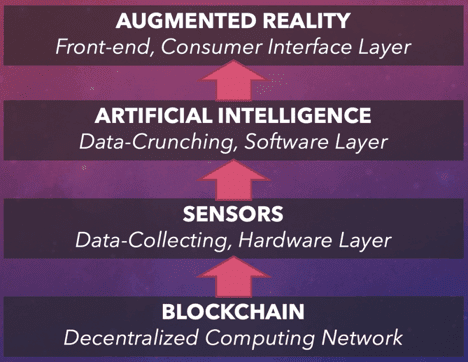
Let us explore this world further by looking at how all of these technologies will lead to an amazing convergence among AR, AI, sensors, blockchain, and other innovative technologies that are the world of Web 3.0.
Let’s deconstruct everything beneath the sleek AR display. It begins with the Graphics Processing Unit (GPU), an electric circuit that performs rapid calculations to render images. GPUs today are found in mobile phones, game consoles, and computers. Because AR requires significant computing power, a single GPU does not suffice. Instead, using blockchain we can enable distributed GPU processing power. As a result, blockchains specifically dedicated to AR holographic processing are on the rise.
Other features include:
AI in retail AR applications will use your purchasing history, current closet inventory, and possibly even mood indicators to display digitally rendered items most suitable for your wardrobe, tailored to your measurements.
In healthcare, AI built into AR glasses will provide physicians with immediately accessible and maximally relevant information parsed from a patient’s medical record and the current state of research relevant to him or her, to aid in accurate diagnoses and treatments, freeing doctors to engage in improving bed-side manners and the education of patients.
How will AR and the Web 3.0 world impact manufacturing?
Looking at large producers, it appears highly likely that over the next ten years, AR along with AI, sensors, and blockchain will multiply manufacturer productivity and vastly improve employee experiences.
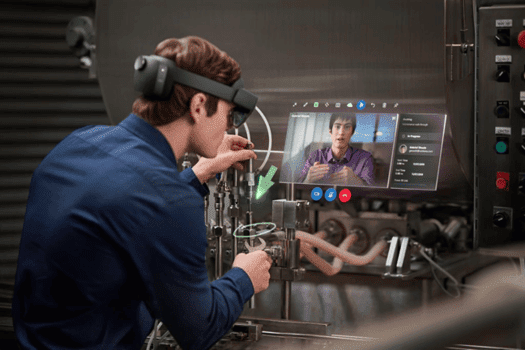
In the initial application, digital guides superimposed on production tables can vastly improve employee accuracy and speed, while minimizing error rates.
Already, the International Air Transport Association (IATA), responsible for 82% of global air travel today, have implemented the use of Atheer AR headsets in cargo management reporting a 30% improvement in cargo handling speed and no less than a 90% reduction in errors.
A similar success is occurring at Boeing which has brought Skylight AR glasses to the production line with the company experiencing a 25% drop in the time needed to produce an aircraft and near-zero error rates.
Beyond air travel, and aircraft manufacturing, smart AR headsets can be used for on-the-job training without reducing the productivity of other workers. Land Rover, for instance, has implemented Bosch’s Re’flekt One AR solution to give its technicians the vision to see the inside of Range Rover Sport vehicle without removing the dashboard.
And AI will soon provide go-to expertise to workers on other assembly lines providing instant guidance and real-time feedback to reduce production downtime, boost overall output, and even assist customers at home in do-it-yourself assembly (think IKEA).
AR guidance to mitigate supply chain inefficiencies is perhaps one of the most profitable business opportunities for implementing AI and AR together. Coordinating moving parts, eliminating the need for manned scanners at checkpoints, and directing traffic within warehouses, AR systems with AI should vastly improve workflow and quality assurance. A case example is DHL which initially implemented AR “vision picking” back in 2015. Now the company has expanded the scope using Google’s newest smart lens in warehouses across the planet and has noted a 15% jump in productivity. The DHL investment amounts to $300 million USD.
Ash Eldritch, CEO of Vital Enterprises, describes the convergence of these technologies and their ultimate impact stating, “All these…coming together around artificial intelligence are going to augment the capabilities of the worker and that’s very powerful. I call it Augmented Intelligence. The idea is that you can take someone of a certain skill level and by augmenting them with artificial intelligence via augmented reality and the Internet of Things…elevate the skill level of that worker.”
Eldritch’s point is well made by companies like Goodyear, ThyssenKrupp, and Johnson Controls who have adopted Microsoft HoloLens 2 in their manufacturing and design operations to elevate workers’ skills. What is most heartening in all of this is that AI isn’t taking away human jobs, but rather through an AR interface and collaboration, enhancing them.
On the hardware front, AI-enhanced AR systems will see a mass proliferation of sensors which will be used to detect what’s happening in the environment and through the application of computer vision be able to contribute to decision-making.
The current technologies used to sense the environment measure depth using scanning sensors to project a structured pattern of infrared light dots onto a scene, and generating 3D maps from the input. Or technology using stereoscopic imaging deploying two lenses produces equally accurate measurements.
But there is a new method being used by Microsoft’s HoloLens 2 and Intel’s RealSense 400-series camera, a process called “phased time-of-flight” (ToF). How does it work? The HoloLens 2 is equipped with numerous lasers, each with 100 milliwatts (mW) of power that fire in quick bursts. A wearer can automatically measure the distance between nearby objects because the headset callibrates the amount of light coming from the return laser beam which experiences a slight phase shift from the original signal. The phase difference creates an accurate reconstruction of what lies in front of the AR headset wearer. The advantage of phased ToF sensors is they are silicon-based, cheap to produce, and require far less computing overhead.
Other features in the HoloLens 2 include a built-in accelerometer, gyroscope, and magnetometer which can be applied to inertial measurement typically used by navigation systems in airplanes and spacecraft. With its four “environment understanding cameras” HoloLens 2 can track head movements while its 2.4 MegaPixel high definition video camera and ambient light sensor produce advanced computer vision. This is pretty neat stuff!
But Microsoft isn’t the only one pushing the technology envelope for digital displays. Nvidia is working on Foveated AR Display which brings the primary foveal area of the eye, the part of the retina that permits 100% visual acuity, letting peripheral regions fall into softer background images which mimicks natural visual perception.
Then there are gaze tracking sensors that grant users control over their screens without touching or hand gestures. Through simple visual cues such as staring at an object for more than three seconds, the technology can activate commands.
In other applications and industry niches, stacked convergence of blockchain, sensors, AI and AR will prove to be highly disruptive. A case in point is the field of healthcare where biometric sensors will soon give users a customized AR experience. Already, MIT Media Lab’s Deep Reality group has created an underwater VR relaxation experience that responds to real-time brain activity detected by a modified version of the Muse EEG. The experience even adapts to users’ biometric data, from heart rate to electro-dermal activity which is picked up through an Empatica E4 wristband.
Sensors converging with AR will improve physical-digital surface integration, intuitive hand-and-eye controls, and increasingly personalize the user’s augmented world. Companies to watch include MicroVision, making tremendous leaps in sensor technology.
Because AR requires much more compute power than the typical 2D experience, centralized GPUs and cloud computing systems are needed to provide the necessary infrastructure. The workload requirements are taxing and that’s where blockchain may prove a good solution.
Otoy is a company aiming to create the largest distributed GPU network in the world which it calls the Render Network or RNDR. It has been built specifically on the Ethereum blockchain for holographic media and is currently being Beta tested. This network could revolutionize AR deployment accessibility. One of Otoy’s investors is Eric Schmidt, former Chairman of Alphabet. Schmidt states “I predicted that 90% of computing would eventually reside in the web-based cloud… Otoy has created a remarkable technology which moves that last 10%—high-end graphics processing—entirely to the cloud. This is a disruptive and important achievement. In my view, it marks the tipping point where the web replaces the PC as the dominant computing platform of the future.”
RNDR allows anyone with a GPU to contribute their power to its network earning a commission of up to $300 a month in RNDR tokens, a cryptocurrency. These can be redeemed in cash or used to create AR content. In this way Otoy’s blockchain network allows designers to profit when not using their GPUs, and further democratizes the experience for newer members to enter the field. Beyond these networks’ power suppliers, distributing GPU processing power will allow manufacturing companies to access AR design tools and customize learning experiences. In this way deploying AR using blockchain will boost usage and deployment across many more industries.
For consumers, a new startup Scanetchain is also entering the blockchain-AR space to allow users to scan items using a smartphone. The app then provides access to a trove of information from the manufacturer including price, origin and shipping details. Based on NEM, a peer-to-peer cryptocurrency that implements a blockchain consensus algorithm, the Scanetchain app aims to make information far more accessible and, in the process, create a social network of purchasers. Users earn tokens through watching ads, and all transactions are hashed into blocks and securely recorded. For brick-and-mortar stores, the writing may be on the wall, as blockchain becomes the glue for cloud-based retailers.
Integrating AI into AR creates an “auto-magical” manufacturing pipeline that will fundamentally transform our industries, cutting down on marginal costs, reducing inefficiencies and waste, and maximizing employee productivity. Bolstering this will be sensor technology which is already blurring the boundaries between our augmented and the physical world. And while intuitive hand and eye motions will dictate commands using hands-free interfaces, biometric data is poised to customize each of our AR experiences to be far more in touch with our mental and physical health. And all of this will be underpinned by distributed computing power with blockchain networks.
This is the promise of AR in the Web 3.0 world. Whether in retail, manufacturing, entertainment, or elsewhere, the stacked convergence described above will receive significant investment in the next decade. The evidence is already present with 52 Fortune 500 companies beginning to test and deploy AR/VR technology. And while global revenue from AR/VR stood at $5.2 billion USD in 2016, IDC, the market intelligence firm, predicts that number will grow to $162 billion in value by next year.

The post How Augmented Reality Will Play Out in the Web 3.0 World appeared first on Techso Mogro.
]]>The post Peter Diamandis Looks at Augmented Reality Applications and Hardware appeared first on Techso Mogro.
]]>Americans today spend over nine hours per day looking at screens. That amounts to more than a third of our livelihoods. Because this screen exposure serves as a portal to 90% of the media we consume, it continues to define and constrain how and where we consume content. But soon this may all become obsolete.
With new advancements in hardware and connectivity, augmented reality (AR) is set to replace the two-dimensional interface upon which we have become dependent. Instead, we will see and interact with the world through a digital information layer with AR headsets ultimately immersing us into dynamic stories, learn-everywhere education, and even gamified work tasks.
We got our first taste of AR’s real-world gamification in 2016, when Nintendo released Pokemon Go. Thus began the greatest cartoon character turkey shoot in history. With 5 million daily users, 65 million monthly users, and over $2 billion in revenue, the virtual-overlaid experience remains one for the books.
In the years since similar AR apps have exploded. Once thick and bulky, AR glasses are becoming increasingly lightweight, stylish, and unobtrusive. And over the next 15 years, AR portals will become almost unnoticeable, as hardware rapidly dematerializes.
Companies like Mojo Vision are even rumored to be developing AR contact lenses, slated to offer us heads-up display capabilities — no glasses required.
So let’s look at what else is happening to the technology and its projected growth.
We have already begun to sample the extraordinary functions of AR through smartphone apps. Snap recently announced it is raising $1 billion in short-term debt to invest in media content, acquisitions, and AR features. Both Apple and Google are racing to deploy mobile phones with requisite infrastructure to support hyper-realistic AR. And in the iOS space, developers are using the ARKit in iPhone software to bring high-definition AR experiences to life to a range of iPhone models. Apple’s CEO Tim Cook has repeatedly emphasized his belief that AR will “change the way we use technology forever.”
While recent rumors reveal the company’s AR glasses project has been discontinued, Apple’s foray in AR is far from over. Just recently, the company announced a large number of job postings for AR and VR experts. And although somewhat speculative, Apple is likely waiting for the consumer market to mature before releasing its first-generation AR glasses, or its pivot to an entirely new line of AR hardware products. For now, however, Apple seems to be promoting extensive hardware advancements showcased by its A12 bionic chip, not to mention the variety of AR apps available in its App Store including:
Android users have options just as varied, based on the Android software-compatible ARCore being used by developers. While the recently announced Google Glass Enterprise Edition 2 aims to capture enterprise clients, Android smartphone hardware provides remarkable AR experiences for everyday consumers including:
There is an increasing number of AR headsets in the market. A few of them are pushing the envelope to allow wide field-of-view (FOV) immersion for enterprise applications. The following list highlights key features:
DreamGlass: Connected to a PC or Android-based smartphone, DreamWorld’s headset offers 2.5K resolution in each lens, beating out Full HD resolution screens but in AR. Resolution improvements minimize pixel size, reducing the “screen door effect,” whereby pixel boundaries disrupt the image like a screen’s mesh. Offering unprecedented levels of hand-and-head-tracking precision, the headset even features 6 degrees of freedom (i.e. axes of directional rotation). With a flexible software development kit (SDK) supported by Unity and Android, the device is highly accessible to developers, making it a ready candidate for countless immersive experiences. Currently, at $619 USD the DreamGlass and comparable technology is continuing to fall in price.
Google Glass Enterprise Edition 2 is a major upgrade that includes an 8-megapixel camera, detachable lens, vastly increased battery life, faster connection, and ultra-high-performance Snapdragon XR1 CPU. Already, the Glass has been sold to over 100 businesses, including GE, agricultural machinery manufacturer AGCO, and health record company Dignity Health. Using the Glass, GE has increased productivity by 25%, and DHL has improved its supply chain efficiency by 15%. While currently only available for business customers, the new-and-improved Google Glass at $999 USD is expected to decrease in price as production costs plummet.
Vuzix Blade resembles chunky Oakley sunglasses. These smart glasses are extraordinarily portable, with a built-in Android OS as well as both WiFi and Bluetooth connectivity. Designed for everyday consumer use at a price point of $700 USD, these glasses are slowly chipping away at smartphone functionality. For easy control of an intuitive interface, a touchpad on the device’s temples allows consumers to display everything from social media platforms and user messages to “light AR” experiences. Meanwhile, an 8 Megapixel HD camera makes you no longer need your smartphone camera so that you can remain immersed in the AR experience while digitally capturing it at the same time. The glasses include built-in Alexa capabilities and vibration alerts which extends the wearers’ experience beyond pure visual stimulation.
Microsoft HoloLens 2 is the conpany’s newest headset providing an industry-leading FOV of 43° x 29°. That’s more than double the 2016-released version. FOV enlargement is not the only improvement. The headset’s center of gravity now rests on the top of the head rather than the typical front-loading of other headset models. In addition tiny cameras on the nose bridge verify a user’s identity by scanning the wearer’s eyes and customizing the display based on distance between the pupils. Once accompanied by emotion-deducing AIs which are now under development, this tracking feature could evolve to intuitively predict a user’s desires and emotions. Geared with a Qualcomm 850 mobile processor and Microsoft’s own AI built-in engine, the Hololens appears to have limitless potential.

Magic Leap One weighs 360 grams (less than 0.8 pounds) and provides one of the most lightweight headset experiences available today. Its 40° x 30° FOV is barely eclipsed by Microsoft’s HoloLens 2. A small “Lightpack” attachment connected by cable to the goggles can be placed in a wearer’s pocket to enhance the AR experience with a handheld controller containing a touchpad, haptic feedback, and 6 degrees of freedom motion sensing. Meanwhile, light sensors make the digital renderings even more realistic reflecting physical light into the viewer’s space. Magic Leap even features a virtual human called “Mica,” that provides AI-drivesn responses to the wearer’s emotions through eye-tracking detection.
As headsets plummet in price and size, AR will become ubiquitous in the next decade. Once we have mastered headsets and smart glasses, AR-enabled contact lenses will make our virtually enhanced world second nature. And ultimately, brain-control-interfaces (BCIs) will directly communicate with our neural signals to provide an instantaneous, seamlessly intuitive connection, merging minds with limitless troves of knowledge, and never-before-possible experiences. While only approaching the knee of the curve, these pioneering mobile apps and novel headset technologies as described above will begin a fundamental transformation of our lives.

The post Peter Diamandis Looks at Augmented Reality Applications and Hardware appeared first on Techso Mogro.
]]>The post Peter Diamandis Takes A Look at the Augmented World appeared first on Techso Mogro.
]]>So let’s begin.
AR superimposes digital worlds onto physical environments (by contrast to VR, which completely immerses users in digital realities). In this way, AR allows users to remain engaged with their physical surroundings, serving as a visual enhancement rather than replacement. As AR hardware costs continue to plummet — and advancements in connectivity begin enabling low-latency, high-resolution rendering — today’s AR producers are initially targeting businesses through countless enterprise applications. And while AR headsets remain too pricey for widespread consumer adoption, distribution is fast increasing. Roughly 150,000 headsets were shipped in 2016, and this number is expected to reach 22.8 million by 2022.
Meanwhile, AR app development has skyrocketed, allowing smartphone users to sample rudimentary levels of the technology through numerous mobile applications. Already, over 1 billion people across the globe use mobile AR, and a majority of mobile AR integrations involve social media (84%) and e-commerce (41%). And while well-known players like Microsoft, Apple, Alphabet, Qualcomm, Samsung, NVIDIA, and Intel have made tremendous strides, well-funded startups remain competitive including:
And as of this writing, nearly 1,800 different AR startups populate the crowdfunding site Angel’s List.
While AR isn’t (yet) as democratized as VR, $100 will get you an entry-level Leap Motion headset, while a top-of-the-line Microsoft HoloLens 2 remains priced at $3,500. Heads-up-displays in luxury automobiles — arguably the first AR applications to go mainstream — will soon become a standard in economy models.
And as corporate partnerships with AR startups grow increasingly common, the convergence of augmented reality with sensors, networks, and IoT will transform almost every industry imaginable.
AR’s most notable implications across a range of sectors include:
Reaching for your AR-enabled glasses upon waking up, your Jarvis-like AI will populate your visual field with any new updates and personalized notifications. You will begin your day with a new pancake recipe, directed seamlessly by a cooking app as seen through your AR glasses. The ingredients will be tailored to your dietary preferences. Glancing at your plate, your glasses will inform you of the meal’s nutritional value, and track these metrics within your online health monitoring app.
As you prepare to fly cross-country, your AI will hail an autonomous shuttle to take you to the airport. Along the way, you will switch glasses to create mode, allowing you to populate entire swaths of the city with various art pieces friends have created in the virtual world. You will drop your own 3D designs into the picture and even turn your vehicle floor into a virtual pond as you glide along a smart highway equipped to automatically charge your vehicle as you ride. Upon arriving at the airport, your AR glasses will switch gears to navigation mode, displaying arrows to direct you to your boarding gate. And when you get to your hotel, you will activate tourist mode which will offer you a number of facts and relevant figures about nearby historical buildings and monuments. When you toggle to restaurant mode the AR will give you a review of nearby eateries tailored to you and the with whom you will be dining. When ready to wind the evening down, your AR will give you the ability to scroll through pictures captured by your glasses throughout the day and controlled by eye movements, and you will be able to share them with family.
Does this sound like a world you would like to experience?

The post Peter Diamandis Takes A Look at the Augmented World appeared first on Techso Mogro.
]]>