When I arrived they took a new swab for testing, as well as blood work, and a chest X-ray. I will know the COVID-19 test results in the next few days. But it was the blood work that set me on a strange new path of life-changing proportions.
My first blood work showed normal with one exception, Troponin, a complex of proteins that show up in blood when there is a heart injury. This was something that needed investigation.
Before I continue yesterday’s saga, some of my readers know that I had been scheduled for knee replacement surgery at the end of April of this year. In preparation for the operation seven weeks earlier I had a complete medical assessment. I aced all the lab tests and physical examination, my x-rays were clear, my heart function normal, my electrocardiogram textbook, and my blood pressure, the same.
Because of COVID-19, however, all elective surgery across the country was canceled. It will be months before they catch up with the tens of thousands of canceled procedures. I suspect I won’t be in an operating room until 2021.
But let’s get back to yesterday.
What would have triggered a sudden Troponin elevation in my blood? These proteins indicate a potential stroke or cardiac event. But I had felt nothing. I never was light-headed, never in distress. All I had was hoarseness, not even a sore throat, and I had occasional coughing. It turns out that COVID-19 was the likely culprit triggering elevated Troponin and that the virus had attacked my heart muscle leading to atrial fibrillation (aFib).
In the ER, I had completed the three reasons for coming and was getting ready to leave when I was asked to hang around. I was told they wanted to do an electrocardiogram. So they hooked me up to some leads and did a tracing. With that complete I figured, okay, now I can leave. But that’s not what happened. I was suddenly told I was being moved to a stepped-up unit in the ER, placed in an isolation room, and hooked up to a heart monitor. The nurse in attendance after getting all the leads attached turned on the monitor and said, “Oh boy, you are in aFib. Don’t look at the monitor!” I tried not to but it was pretty clear when I did that something bizarre was happening to my heart.
The doctor who admitted me came in and told me I needed a chest ultrasound to get a better picture of my lungs and heart. By that time the second blood test that had been ordered would show them definitively if Troponin levels were rising, a sign of a potential cardiac event. Six hours later, the Troponin levels had risen only slightly. That meant I would be going home that day eventually and not staying in the hospital. Instead, I would be referred to a cardiologist. At that moment I realized that the entire medical regimen of my last fifteen years was coming to an end. I would now have to adjust to a whole new panoply of drugs to help me manage my new state of health.
COVID-19 had now become personal. I had been writing about it since the early onset in Wuhan, and now it had reached my door. No longer an observer, I was very much one of its victims. It was COVID-19 that likely was producing elevated Troponin levels in me just as it was doing in a large number of patients whose hearts were being damaged by the virus.
Going forward for the next few weeks, I expect I will be seen by a cardiologist. For now, I am on blood thinners to ensure I don’t shed clots and end up having a stroke. At the same time, I am on a low-dose beta-blocker to control my aFib. I need to manage my osteoarthritis with alternate pain medication. And if I can get my aFib stabilized, maybe the cardiologists can do cardioversion to shock my heart back into its normal rhythm. Needless to say, when I left the hospital ER after 3:30 p.m. yesterday, I was in a very different headspace. My once dependable heart, so reliable for my first 71 years, was now life-threatening, and the likely cause was this virus that no one had heard of six months before.
Looking back, my wife and I had done everything right.
We had practiced social distancing. We had worn masks anytime we were outdoors. We wore gloves always, washed our faces and hands with religious zeal, and tried not to touch our faces, and we even used separate towels and washed them frequently. This was a discipline that came naturally to us having raised a daughter with congenital heart disease. But it didn’t matter that we had been cautious and followed the recommendations of Health Canada. The virus had penetrated our shields and practices, and now we were living with the consequences.
If you are reading this blog posting, consider this virus as far more than an upper respiratory health threat. If you are not practicing social distancing, please do. If you don’t wear a mask when outside, please do. We probably picked up COVID-19 while shopping, she at a drugstore, and me at a grocery store. In such confined spaces, social distancing is harder, and shelved items and surfaces can be viral hotbeds. Now we shop online and, if we can, have stuff delivered or arrange for curbside pickup.
COVID-19 got us and it can get you in ways you never imagined. You need to have a healthy respect for this new infectious agent which will be with us from now on, and it won’t be the last pandemic we face. Others will follow as we continue to impinge upon the natural world, the source of potential trans-species viruses and bacteria that are waiting there to make the leap to 7.75 billion of us.

]]>
Two large studies done in Hong Kong, one at the Chinese University of Hong Kong including 12,000 participants, and another study at Hong Kong’s Princess Margaret Hospital involving over 10,000 participants, yielded accurate detections of AFib and even detected the condition in those previously undiagnosed. The company is more than ecstatic about the results and not surprisingly describes Kardia as the most clinically validated EKG solution on the market.
How does it work?
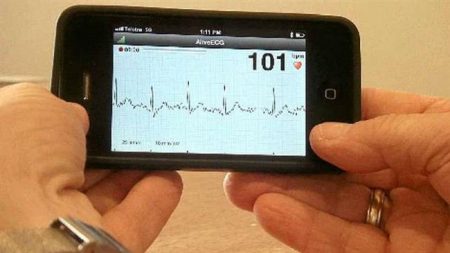
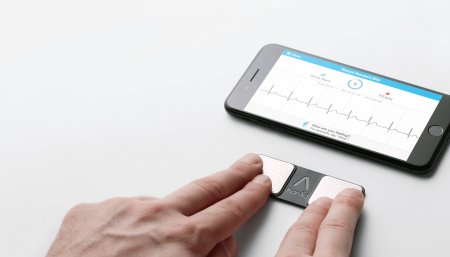
There are two components to Kardia: the app running on an Android or Apple smartphone, and a single-lead rhythm strip that can slip into a pocket or wallet. When a user detects something odd in their heart rhythm they can sit down, take out the strip, open the app, and place two fingers from each hand on the strip keeping them there for 30 seconds.
The mobile app wirelessly picks up the users heart rhythm with the single-lead rhythm strip working like the leads found in standard EKG machines. The information detected is transmitted to the app containing an algorithm that presents 98% accuracy in reading heart rhythm and 97% effectiveness in detecting AFib. The results compare favourably to wearing a Holter monitor or using a portable device for monitoring and recording heart rhythm over several days.
Kardia gives its users the ability to monitor their hearts any time they think something could be wrong. The app keeps a personal heart profile which can be shared with doctors.
The company’s literature contains two user quotes that are worth sharing. States one, “Several times when I was in atrial fibrillation, I was able to talk with my doctor by phone and adjust medication and avoid a trip to the ER.” And another, “I went years without a diagnosis. With Kardia I had the ability to take an EKG whenever I felt anything unusual. After only two readings I had a conclusive diagnosis….Now I use it to track my AFib events and discuss treatment options with my doctor.”
And at $99 U.S., anyone who has experienced or been diagnosed with AFib may want to consider making the investment. You can download the app from the App Store and Google Play. It runs on iPhone models from the 4s to the 7 Plus, and on Samsung Galaxy Note and S3, 4, 5, 6 and 7 models plus the LG Nexus 5, HTC One M7, Jitterbug Touch 3, and Google Pixel and Pixel XL. AliveCor notes that if you do not have one of these devices it cannot guarantee compatibility.
Atrial fibrillation or A-Fib occurs in 2% of the population and causes seven million strokes globally per year. Pre-emptive diagnosis and treatment could eliminate 70% of these A-Fib-caused strokes.
Other ways to detect A-Fib include a visit to the doctor and being hooked up to an electrocardiogram or ECG. But an A-Fib event may not happen over the short duration of an office visit. Cardiologists today also can use a device called a holter monitor, which is portable and battery-powered. It is worn by the patient and involves attaching electrodes to the chest. Typically the patient uses the device for 24 to 48 hours while it records heart rhythm. There is no guarantee that during the period warn a holter monitor will capture an A-Fib event.
The use of a smartphone and app is a far simpler detection method. If a person is feeling odd and wants to check his or her cardiac status all they do is lie down with the phone placed on the chest. The app will provide a “yes” or “no” result in a matter of a minute.
Tero Koivisto, Vice-Director of the Technology Research Centre at University of Turku, Finland, and a lead author in the publication of the app study, states “this is a low cost, non-invasive way to detect atrial fibrillation that people can do themselves without any help from medical staff. Given the widespread use of smartphones, it has the potential to be used by large populations worldwide. In future, a secure cloud service could be created to store and analyze larger masses of data.”