One reason Rosetta went in search of this particular comet was to probe into the early history of the Solar System to better understand Earth’s past. 67P, at the time, was considered a Kuiper Belt object that formed during the same period as the first protoplanets. It was thought, therefore, that the water ice it would contain would pretty much match that of Earth. But based on Rosetta findings 67P bears little resemblance to Earth when one looks at its water signature obtained by the spacecraft’s instrumentation.
67P it turns out has a water signature ratio of deuterium to hydrogen three times greater than the ocean water found on our planet. And its signature differs from other comets that fly within the same regions of the Solar System which may suggest that it did not originate in the Kuiper Belt at all. You can see the results plotted on the graph below. 67P stands far to the right (in yellow) while other Kuiper Belt comets (in purple) can be seen to be closer in affinity to Earth’s water signature.

What this tells us is that 67P may be an Oort Cloud object having originated from even further out on the very edge of the Solar System. Somehow its orbit was disrupted and it set off on a trip to the inner Solar System where influenced by Jupiter, it established an orbit that mimics those periodic comets originating from the Kuiper Belt.
The graph also shows that objects with water signatures closest to Earth appear to be asteroids. But the asteroids we see in the Solar System today, say scientists, are not that water rich. Kathrin Altwegg, at University of Bern, one of the project leaders on Rosetta, believes that in fact early asteroids contained much more water than what we find out there in the Solar System today. It was these asteroids that bombarded our planet some 3.8 billion years ago helping to form our oceans. So maybe life on Earth hitched a ride and came here from one or more of these space rocks.
The European Space Agency (ESA) team are hoping they can corroborate these early values when Philae recharges its batteries. A second instrument on board the lander has the ability to study the water signature and give us readings. If this doesn’t happen than ESA will fly Rosetta through a jet of tail debris as the comet’s orbit brings it close enough to the Sun to sufficiently warm it so that material from the surface gets jetted into space. Then we will no for sure just how far out of this world 67P really is.

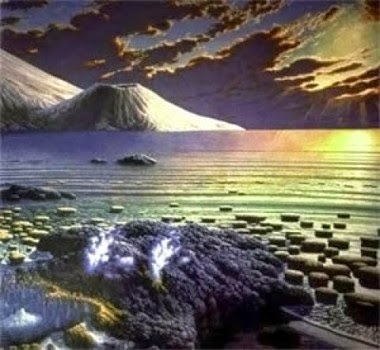
Recently there have been two studies of Earth’s early atmosphere. One study uses evidence from rock samples collected deep in the ground in South Africa and suggests an early oxygenation event occurring around 3 billion years ago. Another records a second spike in atmospheric oxygen dating to 2.3 billion years ago.
Now we normally think of oxygen as a byproduct of single-cell plant life emerging in Earth’s primordial past. But what would explain a sudden influx of oxygen, a 1,000-fold increase in fact, followed by a precipitous drop 2.3 billion years ago. And what would explain the earlier spike?
In the 2.3 billion year-old atmosphere the deep-ocean sediment cores indicate an atmosphere containing 40% oxygen, more than twice today’s atmosphere (20.95%). And in the period following a drop off in oxygen levels to as low as 0.1%. So much for our steady-state, slow growth models of atmospheric evolution based on our notions that primitive biology created the oxygen we breathe.
So where could the oxygen have come from? Would a sudden out-gassing event from prolonged vulcanism explain it? Would oxidation of surface rocks suddenly release a large amount of oxygen into the atmosphere? Could our early oceans have contributed significant amounts of water to the atmosphere causing weathering rainfall to release oxygen from eroding continental land masses?
The scientists who studied the 3 billion year old oxygen event believe that primitive bacteria were responsible for the free oxygen build up. But they ascribe to the linear notion that correlates our existence today to the oxygen that began then and has continued to build to today’s close to 21%. We know from the 2.3 billion year-old spike, and from further evidence in the geological record that oxygen levels have fluctuated dramatically over time. For example in the Carboniferous and Permian oxygen levels exceeded 35% and this has been associated with the emergence of giantism in the insect fossil record (see below the image of a dragonfly fossil as big as a seagull). At the end of the Permian the Earth witnessed its greatest mass extinction with oxygen levels dropping to as low as 15%. And declining even further around 200 million years ago to 12% (equivalent to living in an atmosphere today at 2,750 meters (9,000 feet) above sea level).

So oxygen events at 3 billion and 2.3 billion years ago aren’t unique to Earth’s history. But we can rule out volcanism as a source. Volcanoes may produce compounds in which oxygen resides (water vapour, carbon dioxide, amd sulphur dioxide) but no free oxygen. So more than likely oxidation on a massive scale is the contributing source to these geologically historic oxygenation episodes.
What about an off planet source for these sudden oxygenation events? Could a water-rich asteroid in collision with Earth have led to an influx of oxygen? Could this have happened twice in Earth’s early history? Many Earth scientists believe that the source of our oceans comes from comets and icy asteroids that collided with our planet in its early history. So why not oxygen as well? No doubt if comets and icy asteroids were striking the Earth they were bringing water to the planet and, therefore, oxygen. After all water is composed of hydrogen and oxygen. As a reactive gas, however, that early oxygen might have been briefly free before bonding with iron and other elements found on the Earth’s emerging continental surfaces. Some of that oxygen may have migrated into the early stratosphere to begin forming the ultraviolet radiation shield that made it possible for life to evolve.
The geological record does show us that life began to emerge on Earth as early as 3.5 billion years ago. But our old ideas about the emergence of oxygen in lock step with life no longer holds water. Early oxygenation events at 3 and 2.3 billion years ago may have no biological correlation whatsoever.
But this story isn’t about the assassination but rather reports a story that purportedly appeared recently in the Voice of Russia stating that Sergey Antonenko, head of the Khrunichev State Space Research and Production Center, (the builders of the Proton rocket and the Zarya module that was the first piece of the International Space Station) believes that colonizing asteroids, hitching a ride on them, and using them as closed ecosystems for human habitation may be the smartest way for us to become a space faring species.
In his comments he argues that there are at least 10,000 near-Earth asteroids (NEOs) and over 2 million in the Asteroid Belt. The total mass of all of these space rocks equals more than three Earths so that means lots of material to exploit. And many of the NEOs follow long elliptical orbits that take them outward to the proximity of Mars and Jupiter which means we can ride them to other places in the Solar System.
Antonenko believes we can inhabit some of these space rocks and build closed-cycle ecosystems where humans could live quite comfortably. Today the United States, Russia and China are attempting to develop closed-cycle environments that are self sustaining, a necessary step for any successful long-term habitation of Deep Space, the Moon and Mars. Antonenko sees asteroids as the most suitable candidates for our long-term colonization of space beyond Earth orbit.
There has been lots of talk about mining asteroids and using the materials to support space habitations. But less has been said about inhabitin one of these rocks to make it a home in space. The idea has lots of merit when you consider the challenge of cosmic radiation and how an asteroid could effectively provide the type of shielding needed for our long-term space survival.
Of course NASA has an asteroid capture mission on the drawing boards but the goal there is to study and test mining technologies to see if we can use these rocks to build space infrastructure. What Antonenko has in mind goes much further.

This week I have picked a whole bunch of new stories to share with you. The first describes how the State of Florida is fighting mosquitoes using drones. The second story is a follow up to NASA’s plans to capture a near-Earth asteroid with 12 candidates identified. The third is about Elon Musk who I call the 21st century Edison. He announced ideas for a pneumatic train called the Hyperloop while his rocket company, SpaceX, announced a successful firing of the Grasshopper with the rocket doing a controlled ascent followed by a lateral move and then a return to the launch pad. The fourth headline is about new materials that can make solar panels even cheaper. And finally, the last story features devices without batteries that draw power from ambient radio waves.
Florida to Use Drones to Eradicate Mosquitoes
Drones have become part of the arsenal in the war against terror and are somewhat controversial. But the Maveric drone (seen below), a product of Condor Aerial, is seen as a powerful helper in the war against the mosquito.It isn’t used to bomb the biting pests. Instead the Maveric is sent out on a search mission to find the pools of water where mosquito larvae thrive. It does this because it is equipped with a shortwave infrared camera that can relay information back to its operator. Then helicopters come in and drop a larvicide (either biological as in a fish that eat the larvae, or chemical) on the discovered sites. At some point Maverics may be equipped not just to search but also to destroy the mosquito breeding grounds. It’s only a matter of time.

12 Near-Earth Asteroids Identified as Candidates for Capture
If NASA and companies like Planetary Resources are serious about capturing or mining asteroids then the first step is to identify candidates. Of the nearly 9,000 known near-Earth asteroids (NEO) which are the ones deemed most suitable? A team of researchers at the University of Strathclyde in Glasgow, Scotland, have written a paper in which they have identified what they describe as 12 Easily Retrievable Objects or ERO asteroids.
By definition these 12 orbit around two Lagrangian points (L1 and L2), about one million kilometers (620,000 miles) from Earth (approximately 2.5 times the distance of the Moon). This means they can be reached by existing space technology whether robotic or human crewed. What we would do upon rendezvousing with any of these 12 depends on who is visiting.
Planetary Resources wants to mine suitable ones for rare minerals and for constructing a space infrastructure. NASA wants to capture one of them and bring it into Earth orbit where it can be more easily studied. In any case these 12 are the tip of the iceberg. There are probably a million NEOs yet to be discovered that are smaller and therefore harder to detect but advances in finding space objects should soon increase the inventory of ERO asteroids that qualify for study.

Elon Musk Keeps Inventing and Advancing
A modern day Edison, Elon Musk continues his efforts to make electric vehicles (EV) the choice of motorists, is building an EV infrastructure throughout North America, and is making Buck Rogers spaceflight in the near future a reality. And if that is not enough, in the last week he has shared his ideas for a high-speed transportation system using pneumatic tubes.
Musk’s idea is not original but neither were many of Edison’s. I have written about a pneumatic high-speed rail concept called the VacTrain in a previous posting. And a New York City inventor demonstrated a prototype in the post-Civil War era.
So what has Musk brought that is new to this concept? Besides the name, Hyperloop, Musk’s pneumatic train would be solar powered and would run on an elevated track encased in a tube resting on telescoping pylons (to deal with settling and earthquakes). The train in the form of many individual pods would travel a continuous loop between two fixed urban points. He proposes Los Angeles and San Francisco.
Each pod would include an electric compressor that would transfer air in front of the vehicle to the rear, creating a cushion upon which it would whisk passengers at speeds exceeding Mach 1. To keep the compressor operating on nominal power the pneumatic tube would be outfitted with linear electric motors approximately every 110 kilometers (70 miles) that would receive energy from solar arrays and battery storage. Read a detailed conceptual paper on the Hyperloop here.

And to make the week even more interesting Musk’s SpaceX showed off the latest test flight of the Grasshopper, a 10-storey, Falcon 9 reusable test rocket that has flown up 325 meters (approximately 1,066 feet) in the air on previous flights. In this latest launch on August 13, the Grasshopper not only flew 25o meters (820 feet) into the air but it also flew horizontally 100 meters (328 feet). Then it returned to its original launch point. The total flight lasted over a minute and with this test SpaceX demonstrated that it is one step closer to delivering a reusable launch vehicle. So kudos to Musk who continues to amaze.
New Material to Make Solar Panels Even Cheaper
A researcher at the University of New South Wales in Australia is lauding a cheap technology that can replace silicon based solar cells, dramatically improving performance and making the technology cost competitive with fossil fuel energy production. The material is a mineral called Perovskite. Currently an electrolytic material for use in solid oxide fuel cells, Perovskite has application in semiconductors. It exhibits permanent polarity within an electric field, a ferroelectric property that makes it highly attractive for use in electronics. And although you have probably never heard of it, the mineral is abundant and cheap.
Solar cells made with Perovskite can be much thinner than silicon-based product. The comparison, 1 micrometer for the former and 180 micrometers for the latter. Current protoypes have been built by spraying the Perovskite in a liquid medium on to a sheet of glass or metal foil. The resulting solar cells demonstrate 15% energy conversion efficiency. Researchers believe they can easily achieve 20 to 25% efficiency equaling the best performance of existing non-commercial lab-based solar technology. A commercial start up, Oxford Photovoltaics has raised $4.4 million U.S. to bring the technology to market.
A down side to Perovskite – the mineral contains a small quantity of lead (see picture below and its eerie resemblance to galena, the mineral form of lead). So like lead-acid batteries, Perovskite solar cells will have to come with some form of a material recycling program.

Mobile Devices Will Soon Be Powered Without Batteries
According to University of Washington engineers ambient backscatter from TV, radio and cellular transmissions presents a new energy source for smart devices with on board antennas attuned to various wavelengths. These devices with no battery will have many commercial applications including warehousing, assembly-line manufacturing, commercial retail and financial transactions. An array of smart sensors fully charged and operational would require no additional power other than what could be harvested out of thin air.
What this discovery means is the potential to construct smart buildings, roadways, bridges and homes, all containing embedded sensors that communicate their structural health continuously. Even devices with batteries could still operate if they contained this technology, leveraging the power from the backscatter.

Postscript
So that’s it for this week. Hope you found the range of subject matter interesting. Please come back for more and let me know if you have found an interesting story that we can research and talk about here at Techso Mogro.
– Len Rosen
]]>What if we were to transfer our behaviour to Mars?
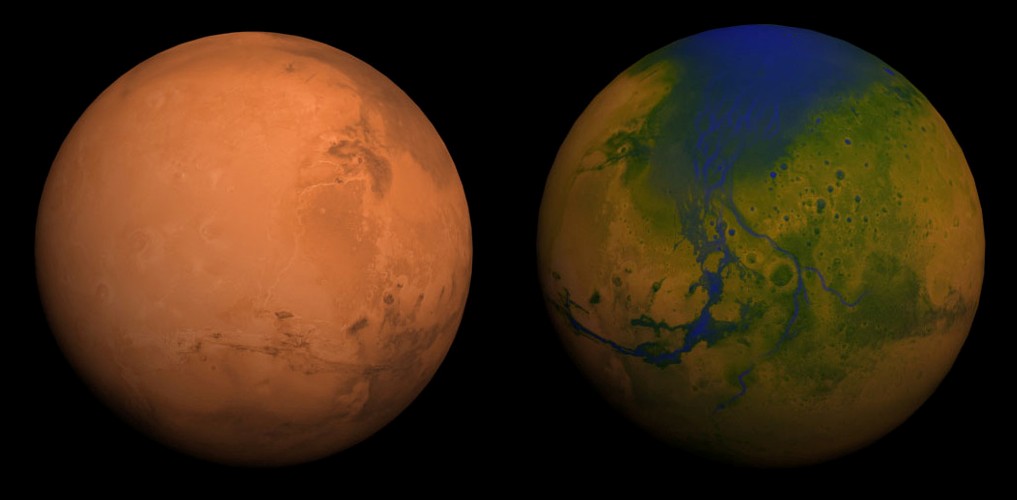
We can transfer our greenhouse gas emitting technologies to the planet surface and start pumping out more CO2. Instead of coal, natural gas or oil, we could use solar arrays and materials from the Martian surface, setting up hundreds of factories to generate huge amounts of gas.
And we could do something else we have been really good at here on Earth, that is, introduce alien life (sort of like rabbits to Australia, or the lamprey to the Great Lakes) in the form of airborne and soil borne bacteria to take in some of that CO2 and start pumping out oxygen.
To our CO2 factories and bacteria farms we can add something that we, that is NASA and a few private companies, are currently considering, catching an asteroid and taking control of it. For Mars instead of mining the asteroids we capture we would just haul them close to the planet and let them plunge into the Martian atmosphere releasing water and heat. That should instantly raise the temperatures on Mars and add more water vapour to the atmosphere.
I figure within five centuries we could have Mars ready for Earth life just at the moment when we have made our planet here totally untenable.
Of course none of this would be in time for the Mars One colonists who currently are applying to leave Earth on a one-way trip to arrive at the red planet in 2023.
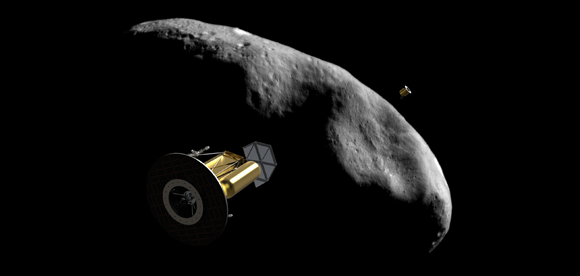
]]>They plan to provide a year in review, current developments of their Arkyd series of spacecraft, (telescopes, interceptors, prospectors and extractors) and future plans for exploring, prospecting and mining.
Planetary Resources intends to exploit what it calls the “low-hanging fruit” of the Solar System. The “fruit” are the Near Earth Asteroids or NEOs. There are close to 9,000 known NEOs with 1,000 new ones discovered every year. Using low-cost robotic spacecraft the company intends to assess NEOs for composition and accessibility and then begin to visit, with robotic mining technology, those deemed commercially viable.
Mining in space will be a lot different from mining here on Earth. For instance the most precious resource the company will seek immediately is water. Water in the form of ice is abundant in asteroids. For example, Ceres, the largest of the asteroids in the Asteroid Belt is almost certainly almost entirely ice. But although the Dawn spacecraft may go and study Ceres, Planetary Resources isn’t interested that much in the science associated with such an asteroid mission. Instead its goal will be to turn smaller icy NEOs it assesses and visits into life supporting materials (water and oxygen) as well as hydrogen fuel for future missions. And for stony, metallic NEOs it assays, it plans to use the materials and precious metals it extracts to fund its operations and build a space infrastructure, and do it all at a handsome profit.
So if you want to hear first hand from Planetary Resources on their first anniversary send your RSVP and listen in on Wednesday.
]]>
One justification comes from a NASA spokesperson who has wrapped this mission in the sacred cloak of saving civilization from near-Earth objects that could collide with the planet such as the one over Chelyabinsk on February 14 of this year. The rationale would be to build and demonstrate a technology solution for identifying, targeting and capturing Earth-threatening space rocks and moving them out of harms way.
What are we expecting in terms of new technology from such a mission? NASA intends to build what they are calling high-powered solar-electric propulsion (SEP) for the purpose of achieving rendezvous, capture and redirect, and state that without this technology the mission would not be possible. Once demonstrated SEP would be used for future telecommunications satellites and other Deep Space mission objectives.
So what is SEP? You may know it by its other name, ion propulsion, a system that NASA has successfully demonstrated with Dawn, the robotic spacecraft that recently visited Vesta and is now on its way to Ceres in the Asteroid Belt. So if we have already shown that ion propulsion works what needs further testing? Is there something different about the SEP planned for the mission to capture an asteroid?
It appears there is because calling it just SEP is actually a misnomer. What NASA intends to deploy is a hybrid chemical-SEP system. Chemical rockets would lift heavy payloads of components from the gravity well of Earth to low-Earth orbit. You couldn’t use SEP to do that. Once fully assembled and fueled SEP would be deployed to push the spacecraft into higher and higher orbits. This would be a slow process that would take several months. Once the spacecraft reached its destination point in Deep Space a chemical rocket with capsule and humans aboard would set off from Earth to rendezvous and dock. There are several potential scenarios that might ensue. The SEP robotic spacecraft could capture the asteroid on its own and bring it to the rendezvous point. Or the two together could use chemical thrust combined with SEP to set off for a rendezvous and capture of the asteroid. Return to Earth would involve an initial chemical rocket burn plus SEP to generate additional thrust. Will the SEP used for this mission differ from Dawn? Quite significantly! It will be much larger using more efficient solar panels and ion thrusters capable of putting out hundreds instead of tens of kilowatts.
What advantage will be gained by developing the chemical-SEP hybrid? The use of chemical rockets to get to low-Earth orbit will give NASA the best bang for the buck, while the deploying of SEP once in orbit will eliminate the need to carry large payloads of chemical fuel for use in spaceflight. This should save a considerable amount of money.
In addition assembling spacecraft for human occupation in low-Earth orbit rather than launching them fully assembled from the Earth surface will give NASA the capability to build heavier, better shielded human space habitats that can initially exploit SEP technology for travel, and later on magneto-plasma or even nuclear-powered propulsion systems.
So “catch a falling star” or in this case “asteroid” may help NASA catapult human voyagers to Mars and the Deep Space beyond. Let’s see if they get the money from Congress to move ahead.

]]>
After the successful landings on the Moon NASA went on to develop the Space Shuttle, a space truck that became the equivalent of a gas guzzler eating up much of the organization’s annual budget. NASA’s old rivalry with the Soviets and its successor Russia’s Roscosmos, both beset by severe budget cuts, by necessity turned into a collective venture focused on building a permanent orbiting space station, the International Space Station (ISS) that orbits the Earth today. Deep Space human missions that were envisioned by both countries in the latter part of the 20th century ended up on the back burner with the entire program focused on activities in support of the ISS.
Other countries soon joined the partnership making their contributions to the ISS and its completion. It remains the principal human space destination, that is, until recently when China established its own human space flight program and announced its objective to duplicate what the United States and Russia have done in low-Earth orbit. China also has announced its plans to send their own human missions to the Moon. What China is doing is not original but it at least has an objective for its human space program.
That really cannot be said about NASA which seems to have lost its way with human space flight and is feeling cash constrained to the point that it is cutting back on essential space infastructure missions. The same could be said about Roscosmos. There seems to be no firm direction and funding driving NASA beyond the ISS. There certainly is a lot of talk about ideas for human space flight but these missions go beyond the end date of the current administration and could be rewritten by the next President, and the next after that, who may have entirely different priorities. And that’s the problem in a nut shell. NASA’s direction remains politically driven subject to a dysfunctional budgetary process and the American debt “crisis.”
So what has NASA got planned for human space flight over the next two decades? Three objectives have been announced by this current administration. They are:
Can NASA achieve any of these with current budgets? No!
These are objectives largely unfunded. For them to happen will require the agency to either see dramatic increases in U.S. federal money or find partners, both nations and private enterprise. Potential partners already exist with Japan’s JAXA, Europe’s ESA, a growing number of other nations launching space agencies and programs, and three private companies SpaceX, Boeing and Sierra Nevada, all currently under contract to NASA to resupply the ISS, let alone other companies that are looking to space to turn a profit. Even China could abandon its go-it-alone effort and become a participant. With the objectives no longer politically mandated, NASA could be a leader among equals in a global enterprise, a partnership of nations and companies reaching for the stars.
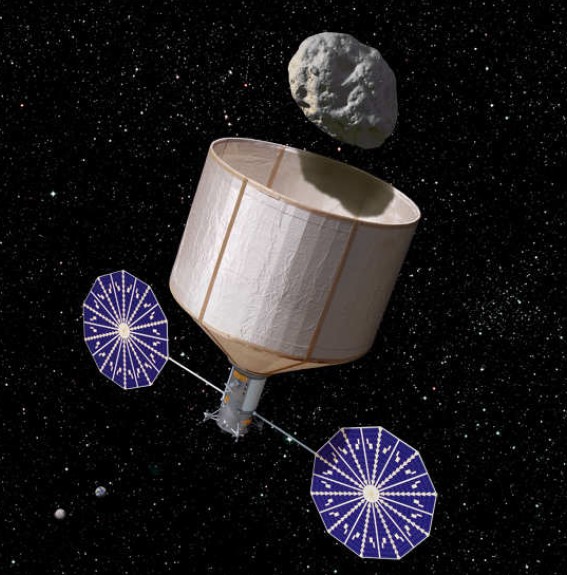
This week NASA announced that it had been “mulling over a plan” since last April to launch a robotic spacecraft with an objective to “grab an asteroid” and place it in lunar orbit at a cost of $2.6 billion. The mission timetable would be sometime in the 2020s and the thinking is that such an activity would be more attractive than a human mission to an asteroid and would certainly be less risky.
What is a suitable asteroid target?
First NASA would have to identify suitable Near Earth asteroids (NEAs). The ideal size would be around 500,000 kilograms (1,200,000 pounds). The type of asteroid most desired would be volatile rich, that is, one that was carbonaceous and contained water in the form of ice.
How would this be accomplished?
If the mission were solely robotic, the devices would first capture the NEA, then attach solar electric propulsion systems to it and move it into position in space where the Moon’s gravity would capture it just enough to place it into permanent lunar orbit.
Would there be a need for human presence to accomplish the goal?
The mission to capture and move the NEA would not require a human mission. But the exploitation of the resource would suggest a human presence at some future date.
What would we gain from such a mission?
Some would argue that by capturing NEAs we will be able to demonstrate an ability to save Earth from a future collision with one.
Certainly the raw materials in a NEA could be used by a permanent occupied space station at a Lagrange Point behind the Moon. The regolith could serve to shield the human habitat from cosmic rays. The ice could serve many needs including providing oxygen for breathing, hydrogen for fuel, and liquid water for consumption. The minerals in the NEA could be refined and used to expand the existing station. Minerals extracted could even be transported back to Earth. Such an expedition could be just the thing to stimulate international cooperation in human and robotic space missions with collective minds focused on developing the technology necessary to capture, transport, and exploit NEAs. And the public relations value, according to a Caltech study states:
The excitement of changing the orbit and harnessing the resources of a celestial object for space exploration is obvious. A mission like this even decoupled from human exploration would engage a whole new generation of space interested persons, and coupled to the goal of enabling sending humans further than ever before in space it would inspire even more public interest. Beyond the excitement is the wide range of educational goals that would accompany this venture: knowledge of Earth’s celestial environment, the engineering and mathematics of asteroid orbit modification, the science of solar system resources and the exploration into the solar system. Apollo was based on a cold-war rationale and ever since an over-arching geo-political rationale has been lacking from space ventures. Retrieving an asteroid for human exploration would provide a new purpose for global achievement and inspiration.
A final word!
Nowhere in any U.S. government document on space policy is there any mention of this type of mission. So is this wistful fantasy or something to seriously consider versus the “pie-in-the-sky” unfunded plans of the current administration? One thing for sure, NASA needs a purpose and direction for its human flight program beyond the ISS.
]]>Russian, British and American scientists are drilling into other Antarctic sub-glacial lakes, the deepest being Lake Vostok, sitting under 3,770 meters (12,370 feet) of ice . Lake Vostok has been buried in ice for millions of years. When scientists begin sampling the lake water in December we will find out if even in this frozen under-ice world life exists. If so it may give us insight into the potential for life to exist off the planet on icy asteroids or several of the moons circling Jupiter and Saturn. Far from our traditional Goldilocks habitable zone models, cryo-ecosystems may exist in these frozen off-world environments. And exobiologists see a parallel exotic world in Antarctica’s sub-glacial lakes, a model that might very well be duplicated elsewhere in the Solar System.

A List of Likely Candidates for Cryo-Ecosystems

]]>
Why Our Solar System Has An Asteroid Belt
The Asteroid Belt consists of rocky debris unevenly distributed in the zone between the planets Mars and Jupiter. This is not the only place where asteroids exist. Asteroid clusters can be found along both Jupiter and Mars’ orbital plane in front and behind the planets at specific points far enough away from them to remain reasonably stable. These asteroids are called Trojans. Other asteroids can be found at similar points along the orbital plane of Neptune. And some asteroids have odd orbits that take them near Earth. In fact scientists estimate neary 9,000 asteroids larger than 50 meters (over 150 feet) cross the orbit of our planet. These are the type of asteroids that pose a potential collision threat with our planet, the type of asteroid that has been associated with the mass extinction event of 65 millions year ago.
Why did asteroids form? Scientists theorize that the Asteroid Belt and Trojans represent the debris of the early Solar System. The Belt itself is believed to represent a zone within the Solar System that failed to form a planet because of the proximity of Jupiter with its massive gravitational pull. The normal gravitational accretion that led to Mars and Earth was stopped by Jupiter.
The Asteroid Belt itself is very thinly populated even though there are millions of these rocky chunks. We have discovered 220 larger than 100 kilometers (62 miles) in diameter of which the largest is Ceres, with a diameter of approximately 1,000 kilometers (620 miles). Total mass of all of the asteroids in the belt is estimated to be about 4% of our Moon with Ceres accounting for 1/3 of the total. Asteroids are unevenly distributed through the Belt. This was first observed in 1886, caused by resonances with Jupiter’s orbit, and named Kirkwood Gaps after the discoverer of the phenomenon. This uneven and thin distribution has made it much easier to launch missions to the outer planets with little in the way of actual debris posing a hazard to spacecraft.

In one mission, Galileo, the spacecraft actually rendezvoused with two asteroids, Gaspra and Ida, while on the way to Jupiter. Gaspra was potato shaped, riddled with craters and 19 kilometers (approximately 11 miles) in length. Ida looked similar and was 52 kilometers (approximately 33 miles) in length and even had its own moonlet named Dactyl, a fragment 1.5 kilometers (less than a mile) across. Dactyl circles Ida at a distance of 100 kilometers (62 miles). The two moons of Mars, Phobos and Deimos, (see image of Phobos below) appear to be asteroids captured by that planet’s gravity in the distant past.How long have asteroids been around? 4.6 billion years, as old as the Solar System itself. We have been observing them through Earth-based telescopes since the early 19th century. William Herschel was the first to coin the word asteroid to describe them. Spectroscopic analysis allows us to remotely determine their composition. Three-quarters of asteroids are carbonaceous chondrites, that is they are carbon-rich. The majority of the remainder are stony and metallic with many reddish in colour indicating the presence of large deposits of iron.
We Send Robot Spacecraft to Visit Asteroids
NEAR
In 1996 NASA launched the NEAR (Near Earth Asteroid Rendezvous) mission, a robotic spacecraft programmed to rendezvous with two asteroids, the first Mathilde, and the second Eros. In 1997 NEAR made its closest approach to Mathilde, viewing it from about 1,200 kilometers (750 miles). This provided scientists at John Hopkins University with a first close up look at a carbonaceous asteroid. Mathilde appeared as black as soot in images transmitted to Earth.
In February of 2000 NEAR rendezvoused with Eros, a 34 kilometer (21 miles) long asteroid and began a a year-long orbit around it at altitudes that varied from 3.2 kilometers (2 miles) to 52 kilometers (35 miles). In February 2001, although not a lander, NEAR descended to the surface of Eros providing detailed images of the asteroid’s surface.

Before NEAR it was thought that asteroids were metallic or carbonaceous rubble. Eros turned out to be neither. It’s rocky composition was similar to the Earth’s crust. It was geologically active with more than 100,000 craters wider than 15 meters (50 feet), many filled with rocky debris and dust to a depth of more than 90 meters (300 feet).
Hayabusa
In 2003 the Japanese Space Agency (JAXA) launched Hayabusa, a research spacecraft designed to rendezvous with an asteroid and return samples from its surface back to Earth. Hayabusa used an experimental ion propulsion system similar to the one deployed by Deep Space 1 in 1998. NASA developed and tested this technology in space for the first time in a mission to a comet in 1998. An ion propulsion system provides pretty tenuous power. In fact, if you were to use it to power a car it would take four days to accelerate from 0 to 100 kilometers (60 miles) per hour. But in space this type of engine creates a steady incremental push to a spacecraft and when operating over months and years provides a very effective propulsion system.
Hayabusa’s target was the near-Earth asteroid, Itokawa. It took two years and one gravity-assisted pass of Earth for Hayabusa to reach the asteroid, travelling over 2 billion kilometers (1.2 billion miles) to its target, 300 million kilometers (180 million miles) from Earth. Once there it studied Itokawa from altitudes between 3 and 20 kilometers (1.8 to 12 miles) touching down twice on its surface in November 2005 to take samples. Hayabusa then began its return to Earth in April 2007 with samples on board. Hayabusa’s sample was retrieved from a reentry capsule in June 2010.

Dawn
The Dawn spacecraft, launched in September 2007, today is orbiting Vesta, the first of the two asteroids it intends to visit between now and 2015. The spacecraft took four years to reach Vesta using a Martian fly by in 2009 to provide gravity assistance in accelerating the spacecraft on a trajectory to the asteroid. Upon arrival at Vesta, Dawn entered into orbit.
Dawn deploys a solar array that extends 19.7 meters (65 feet) to capture the much more tenuous light energy available to it at the distances it is operating in the Solar System. That same solar array provides the power to drive the xenon ion propulsion system, the third time this technology has been successfully deployed.
Dawn’s other technologies include: two framing cameras to provide detailed imaging in visible and infrared light, a gamma ray and neutron detector to measure the composition of each asteroid, a visble and infrared mapping spectrometer to work in association with the cameras to get accurate elevation reads and determine the minerals on each asteroids’ surface, and radio transmitters for sending signals to Earth and detecting gravity field variations.
In July of 2011 Dawn transmitted the first close- up images of Vesta (see the picture of the Snowman craters in the composite image of asteroids above). What it has discovered so far about this asteroid has revised our thinking about the geology of Asteroid Belt objects. For example there is evidence that Vesta first formed in a molten state as evidenced by its iron core. Vesta also has mountains, the largest more than twice the height of Mount Everest. Vesta also has dark, sooty deposits on its surface which appear to have arrived after the asteroid formed, probably delivered by collisions with carbonaceous Asteroid Belt objects. Like Eros, Vesta remains geologically active with its surface constantly being reworked over time as these collisions create debris and dust that settles into craters and narrow gullies that form ridge and valleys across parts of the asteroid.
When Dawn finishes its assignment at Vesta it will move on to its second objective in the Asteroid Belt, Ceres. Arrival is planned for August 2015 where Dawn will take up orbit to study the asteroid the same way it currently is studying Vesta. Ceres will be very different from Vesta. It’s larger and much further out in the Asteroid Belt. Earth observations indicate that it is composed of at least 25% water ice. So in its visit Dawn will give us an entirely different perspective on the composition of asteroids within the Asteroid Belt.
Why Mine Asteroids?
So we know that asteroids come in all shapes and sizes and are composed of everything from ores to ice. Which may explain why a wealthy group of entrepreneurs want to exploit asteroids as resources. A single asteroid could be worth billions of dollars if it were to be mined. And it will require billions of dollars in investment to succeed. The company plans to launch up to five space telescopes within the next two years to search for and identify asteroids of commercial value. Prospecting robotic spacecraft will follow within five to years. These robots will sample and assay target asteroids in preparation for a subsequent mission of robot miners and refiners who will then bring their precious cargo back to Earth. The economics of such a venture requires further study.
But it is far more likely that Planetary Resources will end up creating way stations in space by finding asteroids that are largely made of water, like Ceres but not as big. Water is the commodity that can become a precious resource when broken down into its constituent elements, oxygen and hydrogen. In addition water is life sustaining for any human presence in space. Water harvested in space can lead to Deep Space habitation where humans can provide a string of stops along the way to other destinations in the Solar System and beyond. But there will be many hurdles to overcome for this commercial plan to succeed including issues of legality and the development of whole range of new technology. We’ll explore the topic of the commercialization of space in subsequent blogs. So keep on reading and send me your questions.
]]>


