The implications are obvious. If you warm the water below pack ice you will see it melt leading to thinning. Over time this changes the dynamics of sea ice. The thinner the permanent sea ice, the more likely it can be impacted by underlying warming as well as by wind and wave action along its edges.
The study comes from Yale University where lead author Mary-Louise Timmermans, Professor of Geology and Geophysics, describes the area of focus being the Canadian Basin of the interior Arctic Ocean. She is quoted stating, “the effects of sea-ice loss are not limited to the ice-free regions themselves, but also lead to increased heat accumulation in the interior of the Arctic Ocean that can have climate effects well beyond the summer season.” She further points out that “there is enough heat to entirely melt the sea-ice pack that covers this region for most of the year.”
In the study, it reports that before the 2000s, heat content of Arctic Ocean water was half the value it is today. The Beaufort Gyre, a wind-driven ocean current that is responsible for moving both seawater and ice across the Arctic Basin is the mechanism for heat transfer. The amount of heat being pushed under the Arctic sea ice “equates to a change of about 0.8 meters (2.6 feet) in thickness.
What the study further points out is there has been a marked change in the defined area of the Arctic Ocean separating warmer water from the south from the cool water of the Arctic Basin. That warmer saltier water, as it moves north, is pushed down by the less saline colder Arctic Ocean water. The motion of the Beaufort Gyre is then transferred below the surface with the warmer water migrating under the sea ice where it does what warm water does when exposed to ice. It melts it.
The discovery of this mechanism explains to some degree why surface sea ice in the Arctic has been decreasing over the last three decades. But it is not the only mechanism at work because once sea ice disappears, solar heating in the summer impacts Arctic Ocean surface waters even more which then further contributes to seasonal sea ice loss.
This study, along with another done by the National Snow and Ice Data Center and University of Colorado, which I wrote about just a little more than a week ago describing the appearance of open water north of Greenland this year, point to an Arctic Ocean that could become ice-free at the North Pole by 2050.

]]>

Why are scientists doing this?
Climatologists want to get a better handle on what is happening with Arctic sea ice. Satellite observations are showing a faster melt than what climate models are projecting. An expedition in the ice will produce the kind of data to improve the climate models.
States Professor Markus Rex, the lead MOSAiC scientist, “there is a potential that in a few decades the Arctic will be ice-free in summer. That would be a different world and we need to know about that in advance.”
MOSAiC is an acronym for Multidisciplinary drifting Observatory for the Study of Arctic Climate. The project budget is $67 million U.S. The European Union, United States, Russia and China are all participants.
Once trapped in the ice, the researchers intend to set up camps on the frozen ocean surface as much as 20 to 30 kilometers (12 to 18 miles) away from the ship, taking water, air, and ice samples. Runways on the sea ice will allow for resupply air missions to reach the ship and crew.
The proposed route can be seen on the map below.

For passengers on the Polarstern the biggest challenge may be surviving the midwinter continuous darkness. Only the hardiest of voyagers need apply for a berth on this ship. But what a story you’ll tell once the voyage ends.
So what’s weird? Well the Arctic above 80 degrees north is now dark 24 hours a day. This should be deep freeze time but strangely it isn’t. Take a look below at the temperature graph recorded Tuesday, November 15th by the Danish Meteorological Institute. The Danes who own Greenland are leaders in studying changes to the Arctic.
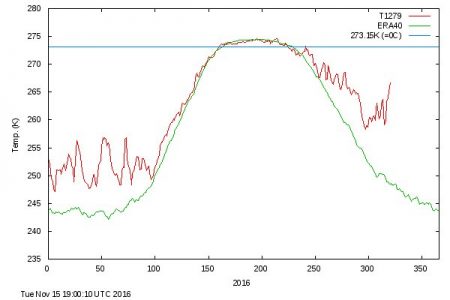
The red line traces daily mean temperatures. Note the unusual nature of the plot line when compared to the green line beneath which represents mean historic temperatures plotted over a 45-year period beginning in 1957 through 2002. Daniel Swain, climate scientist at UCLA describes what is being observed as “extraordinary.” Temperatures are 20 Celsius (36 Fahrenheit) warmer than normal over most of the Arctic Ocean. A similar spike was observed in 2015 but this one is even more extreme.
What could be the cause?
Speculation is low sea ice, thin sea ice, and a jet stream that no longer acts the way it has in the past. Low sea ice exposes more ocean water to the air above it acting as a heat exchange. Thin ice absorbs more solar energy when the Arctic is in daylight because it is more transparent. And less ice means greater ocean turbulence which further depletes ice coverage.
The excessive warmth in the Arctic combined with the jet stream oscillations is causing extreme cold in Siberia. Meanwhile Canada’s northern archipelago is seeing warm air sweep northward. The pattern has been continuous since October. On Alaska’s North Slope average temperatures are 2 Celsius (3.6 Fahrenheit) above records previously set in 1998.
The October warmth which was considered unusual is now being matched by even greater warmth in November during the season of darkness. Some areas of the Arctic Ocean are experiencing temperatures 14 Celsius (25 Fahrenheit) higher than normal.
The University of Maine has created a global view of the wacky weather we are experiencing in the Northern Hemisphere. The image below shows temperature departures from the norm for Thursday, November 17. The scale on the right displays the delta from the daily average. Note the amount of red over the Arctic Ocean and the purple over Siberia, two very different extremes.
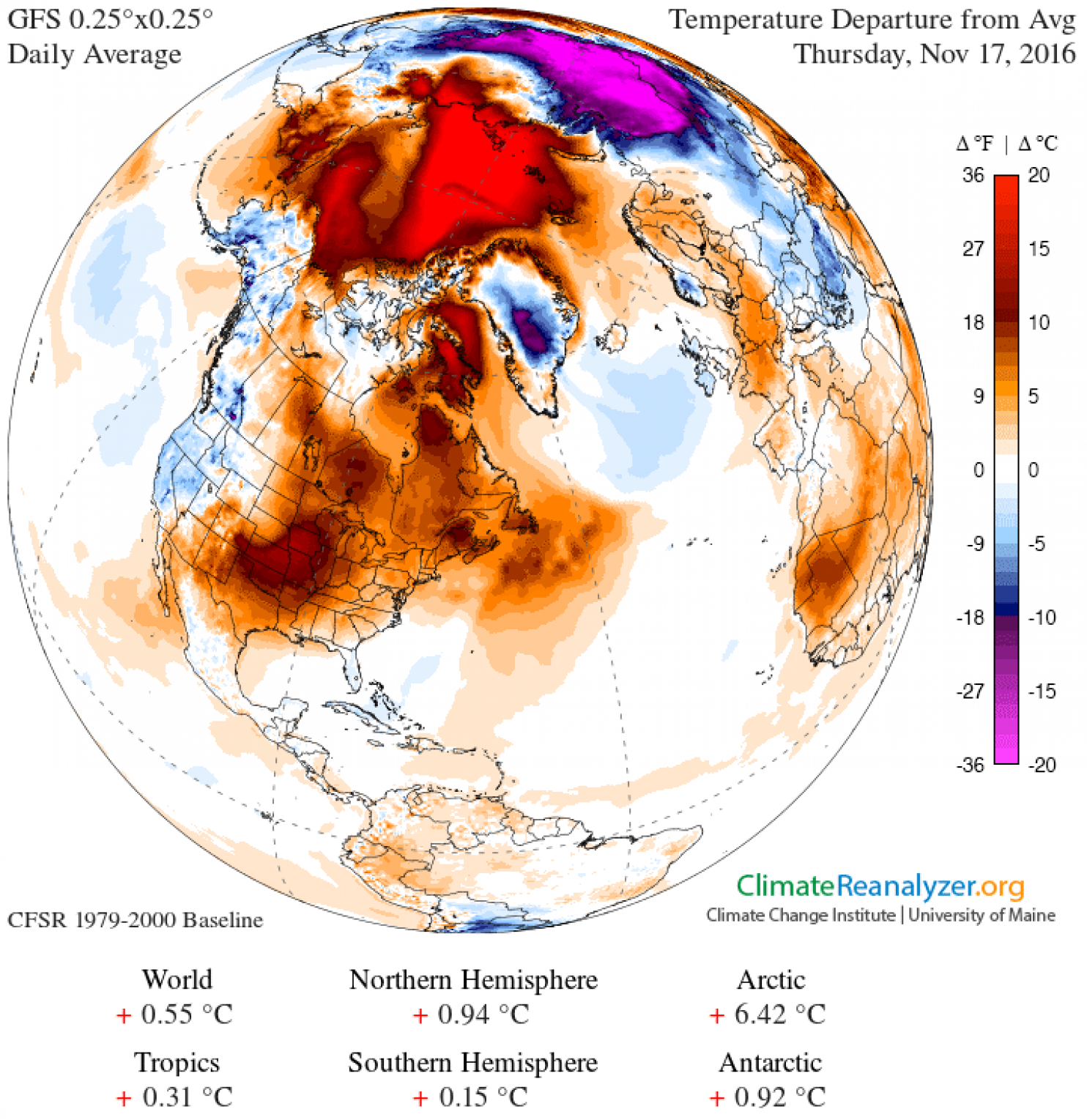
The weirdness may continue because the longer it takes for the sea ice to reform the more likely temperatures will stay well above normal. This could set up the Arctic in 2017 to sea even more spectacular drops in sea ice coverage. Of course we could see the whole thing reverse but the trending is pointing to a very different scenario of increasing warmth and diminishing sea ice down 7.4% per decade since 1980.
For those of you in eastern North America wondering what that will mean for our winter. The El Nino is no longer a factor this year so the warm and dry winter that the Great Lakes experienced is probably not going to happen. In February last winter we saw what a wobbly jet stream does drawing down a fearsome blast of Arctic cold to the northeast. Climate projections suggest we may see a repeat of these polar vortices this winter with pulses of cold air similar to what Siberia is currently experiencing.
One of the indicators of a warming atmosphere is that weird becomes the new normal.
Ice mass records show the lowest increase for a January in the last decade. Normal ice volume growth associated with winter was lowest on record as well. The likely result will be the smallest sea ice pack ever recorded by the end of this summer.
At some Arctic Ocean sites the ice-free season has increased by more than 30 days over the last three decades with climatologists expecting this trend to continue to accelerate with loss of summer ice cover by mid-century.
The news is “good” if you are thinking of taking a cruise through the Canadian Arctic this summer. Last month operators of a luxury cruise ship, Crystal Serenity, announced August plans for a Northwest Passage cruise starting from Seward, Alaska and ending in New York City. The 32-day voyage would give 1,700 passengers and crew the opportunity to experience something that has been rare until recently, an unencumbered sail through the Canadian Northwest Passage.
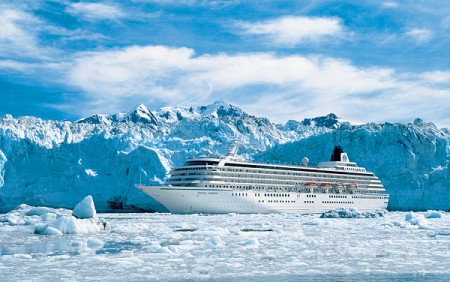
Arctic cruises are becoming more common these days with 17 ships going through the passage in 2015. But most of these vessels were much smaller. The Crystal Serenity, already sold out, will be the first 14-deck luxury liner to transit the exact route first navigated by Roald Amundsen at the beginning of the 20th century. When Amundsen navigated the Passage he and his crew wintered for two years because back then it was ice bound and impassable the majority of the year. But no longer. Now the Passage remains open from mid-summer through mid-fall.
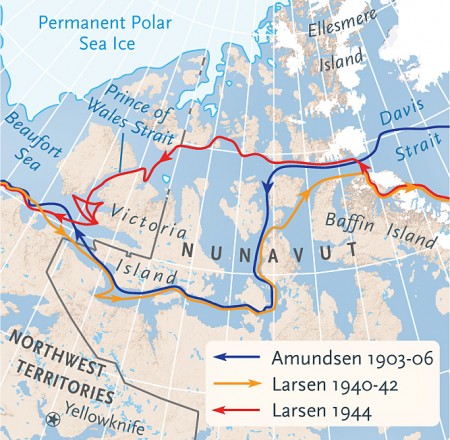
When the Crystal Serenity embarks on its cruise it will be escorted by an icebreaker and two helicopters. In its traverse the ship will make stops at Ulukhaktok and Cambridge Bay on Victoria Island, and Pond Inlet on Baffin Island. Cambridge Bay and Pond Inlet, the two largest communities have fewer than 1,600 residents, 100 less than the passengers and crew on the ship.
So what kind of impact will a ship and its population have on these ports of call? In one article appearing in The Guardian, the author describes it as “a new Titanic,” a catastrophe waiting to happen. How will isolated northern communities manage their own logistics and supply needs while catering to more visitors than they have ever seen? And what happens in the event of an accident or a bunker fuel spill?
The owners of the Crystal Serenity consider this maiden voyage to be the first of many. They intend to have two ships traversing the Passage in 2017. And where these cruise ships go other marine traffic is bound to follow.
But even more impactful than the opening of marine traffic in the Arctic is the change that melting sea ice is making to the physical characteristics of the ocean. Open water means more waves, more storm surges, and greater impact on coastlines. In a report entitled, Canada’s Marine Coasts in a Changing Climate, published by Natural Resources Canada, it describes how the decrease in sea ice is leading to increased coastal erosion. It further states that sea ice has been the defining feature of the Arctic coastline and has dictated the lifestyle and economic climate of the cultures that live along its shores. It goes on to describe how warming is disrupting that way of life and the ecosystems and fragile natural and human infrastructure. As warming increases species migrating north are impacting native flora and fauna. Rising sea levels are inundating coastal communities.
Of course some see benefits in all of this “bad” news. In the Natural Resources report you read comments like “reduced sea ice and deeper waters in many harbours present potential opportunities for shipping.” The corollary to this is “rising sea levels will threaten the viability of some low-lying communities (e.g., Tuktoyaktuk, NT) and increase the risk of flooding and inundation of others.”
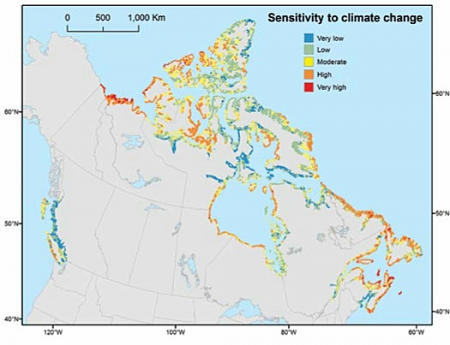
The map below is built from an extensive database called CANCOAST. It projects sea level changes to 2050 taking into consideration a large number of data points including tidal ranges, wave heights and sea ice concentrations. Note the areas marked in yellow, orange and red. These are the ones most sensitive to climate change and the vast majority lie along the northern Arctic coast and within the Arctic Archipelago.
And what about oil exploration and mining development? The temptation presented by an ice-free Arctic Ocean has brought oil and natural gas rigs to this part of the world. Depressed oil prices and a fossil fuel energy glut may be one of the only inhibitors to seeing a major effort by companies to drill. When you consider the recent Royal Dutch Shell accident in which its Arctic drilling rig became incapacitated and had to be abandoned, one can only imagine the potential harm that may come from exploration of this type in the future.
The second story involves a statement based on a report to the International Monetary Fund (IMF) that bluntly admonishes countries for not setting energy prices at the right level to reflect their impact on global warming. In other words, the IMF in this study was telling countries to put a price on carbon.
Arctic Seas Are Seeing Waves Like Never Before
There are waves out there on the Arctic Ocean these days.
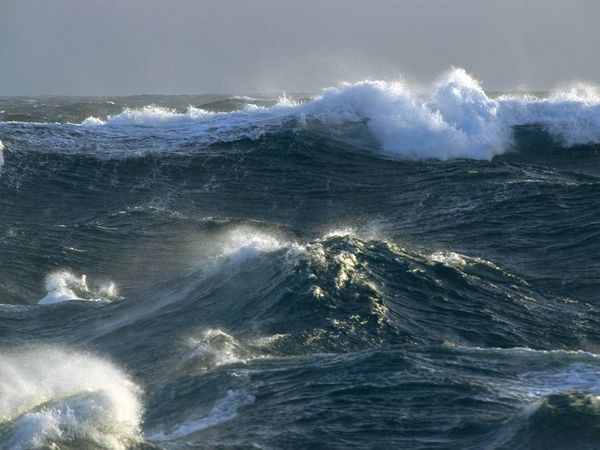
Why should this be a surprise? Because waves indicate a lot more open water than previously seen and another indicator that climate change from global warming is having a profound impact on polar regions.
Scientists recently measured during an Arctic storm waves just under 5 meters (16 feet) in height on the Beaufort Sea, an area that in the past has seen little wave activity because of ice cover. But in today’s Arctic less ice means the ocean is subject to winds which average 20 kilometers (12 miles) per hour throughout much of the year with average wind speed highest in the summer and lowest in winter. Wind over open water, even at 20 kilometers per hour will create waves. And storms will make those waves much bigger.
What does this mean for the Arctic?
In the Beaufort sea ice reaches its maximum in April and minimum in September. See the United States Geological Survey satellite images below taken in 2001 and 2007. The one on the left shows 2001 sea ice minimums. The one on the right was taken of the same area in 2007. This trend to accelerated sea ice loss continues to this day. And with the loss climatologists now have to consider waves and their potential to accelerate climate change even further.

International Monetary Fund Tells Nations to Get Real on Energy Pricing
The IMF is blunt in its recommendations. In a 189-page report entitled Getting Energy Prices Right: From Principles to Practice, it advises countries to start taxing fossil fuels at much higher rates and use the money collected to harden infrastructure as a way of mitigating the consequences of climate change. The taxes would also serve a second purpose, discouraging the burning of fossil fuels.
In the report energy pricing within 150 countries is analyzed and recommendations are made on how much tax should be added to existing fossil fuel charges.
The IMF’s Managing Director, Christine Lagarde, in remarks this week talked about “smarter taxes rather than higher taxes.” The tax on energy could be offset by reductions in personal income tax, or could be used to pay off public debt. In her remarks on the continued use of coal for power plants, Lagarde stated, “This is about the dirtiest of all fuels, yet almost no country imposes meaningful taxes on its use. Our work suggests that, to reflect the carbon damages alone, a reasonably-scaled charge would amount, on average, to around two-thirds of the current world price of coal. In countries where a lot of people are exposed to air pollution, the coal charge should be even higher—several times higher in some cases.”
The main report recommendations include:
If all countries studied were to participate the IMF forecasts reduced carbon emissions by 23%, and lower rates of deaths from smog and air pollution by 63%. The latter point cannot be emphasized enough. The health issue alone is justification enough to raise taxes on energy. Climate change reinforces the urgency to act.


But it is the issue behind Greenpeace’s action that should be of great concern to all of us on the planet. Russia has started shipping oil from Arctic Ocean oil wells. The Russians may soon be joined by American, European and Canadian companies with similar plans to exploit oil and natural gas deposits under that same ocean and ship them south by tankers to refiners.
What’s wrong with this picture? The potential for an accident in the Arctic Ocean is one that makes environmentalists shake in their boots. Today there is no adequate technology or infrastructure in place to clean up an oil spill in the Arctic. And once a spill occurs because of this any response would come from remote ports to the south taking weeks. Add to this the kind of conditions found in the Arctic Ocean with broken sea ice, oil trapped under sea ice, the oil impacted by the cold water so that it doesn’t evaporate to the same extent it would in more southerly spills, and the potential for the oil to linger for decades in icy, subzero conditions, and you have an environmental disaster.
For the people and wildlife of the Arctic it may mean a sentence of death. Marine mammals and birds will suffer from oil contamination. Arctic land animals that rely on food from the sea will face starvation, and when they do find a meal it may be contaminated by the toxins in the oil. The human communities of the Arctic will lose the sea resource on which they are so dependent.
The Exxon Valdez oil spill in Prince William Sound in 1989 is the closest approximation we have today to an Arctic Ocean oil spill. That ship killed 250,000 sea birds, 22 killer whales, 2,800 sea otters, 300 harbor seals and thousands of fish. And the killing continues 25 years after the spill with bottom-forages like the sea otters ingesting oil that remains in the seabed.
So Greenpeace, whether you like the tactics or not, has a point. If fossil fuel companies are hell bent on finding and pumping oil out of the Arctic Ocean basin then doesn’t it make sense that before they do this they have the infrastructure in place to deal with the potential for an oil spill?
Today we know that Russia pays little attention to oil spills. Back in October of last year I wrote a post entitled, “Russia and Arctic Oil Exploration – An Accident Waiting to Happen.” In it I described how Gazprom, the operator of the Mikhail Ulyanov, lost an oil rig in the Arctic Ocean in 2011, and in 2012 reported over 2,600 land-based oil spills in its extensive network of refineries, wells and pipelines. Its closest response vessels to its Arctic rigs are a three-day sail away.
Imagine the damage done by the 2010 blowout that occurred with BP Deepwater Horizon that gushed oil into the Gulf of Mexico for 87 days before being capped. The oil is still washing up on shore four years later. Now imagine something similar happening in the Arctic Ocean with no immediate response and the oil becoming trapped under sea ice and coagulating into thick globs. Imagine skimmers trying to work to get the oil off the ice-filled surface of the Ocean. And imagine the accumulation of the oil on the seabed where we humans can do little to remediate what collects there. Some 30,000 people responded to BP Deepwater Horizon. How many would be available to deal with a remote Arctic Ocean oil spill even of lesser magnitude?
North American and European fossil fuel companies are in no better shape than the Russians in dealing with the potential of an Arctic Ocean oil spill. Back in January of this year Royal Dutch Shell announced it was cutting exploration and development of its drilling plan in the Arctic Ocean. It did this because environmental groups and Arctic indigenous people filed a lawsuit to prevent drilling based on the argument that the company lacked the capacity to deal with a potential oil spill. Shell gracefully retreated rather than contest the argument and has put off its drilling for at least one more year.
But that’s not stopping Gazprom and the Russians. So maybe Greenpeace is making all the rest of us sit up and take notice.

The global climate models that scientists have been using had not predicted such significant swings in temperature as discovered within the data coming from this research. And that is of concern to scientists studying the impact of climate change on the Arctic. The models right now predict an ice-free Arctic Ocean by 2100. But this data may point to a much earlier ice-free date.
This is a big deal for the indigenous peoples of the region. the Polar Bear and other Arctic wildlife.

Here are some interesting facts about Russia’s oil record.
Gazprom is one of two Russian companies with drilling rights in the Arctic Ocean. This company in 2012 reported 2,626 oil pipeline leaks. That was down from 2011 when they reported 3,257. The year 2011 also saw the company lose the Kolskaya maritime oil rig off the Siberian coast in the Sea of Okhotsk. Two weeks ago the company announced that it was “on track” to start producing oil from the Prirazlomnoye Arctic oil project before year end. It was this drilling platform that Greenpeace protestors commandeered. The protestors who were arrested have been charged with piracy. The company on the other hand continues to disregard what most other oil companies would consider standard safety practices. In fact its oil exploration rigs in the Arctic still appear to be vulnerable in the event of an emergency with the closest response vessels as much as three days away should an oil spill occur.
Rosneft is described as Russia’s leading petroleum company. State controlled, to date, Rosneft has the worst record for oil spills of any Russian producer. For example the company was responsible for 75% (2,727) of all oil spills in just one producing region, the Khanty-Mansiisk autonomous district, in 2011. Since then the company has achieved a 20% reduction in the number of spills, hardly a stellar record for managing its drilling and pipeline infrastructure.
Russia continues to lead the world in oil pipeline breaks. Why? Because the country has an aging oil infrastructure and lax regulation of the industry. Back in June of this year Russia’s President, Vladimir Putin, pledged to invest $43 billion U.S. to improve Russian infrastructure. This included investments in roads and railways but said little about pipelines. But see for yourself from the image below. This is a picture of a pipeline crossing permafrost being subjected to the stresses of changing climate. It seems accelerating permafrost thaws are wreaking havoc with Siberian-laid pipelines. Now apply what you see here to Russia’s current activity in the Arctic Ocean and we can truly say, “Moscow, you have a problem!”

The actual numbers:
For climate change skeptics the Antarctic statistics support their belief that global warming is nonsense while Arctic results give global warming champions the smoking gun evidence that something needs to be done by all of us.
Sorry to disappoint the skeptics but geography plays a key role in the differing results at the two poles. The Arctic is far more susceptible to global warming than the Antarctic because the Arctic is a sea surrounded by land whereas the Antarctic is an isolated continent surrounded by sea. These two opposite features play a significant role in why one has shrinking ice while the other continues to see the growth in sea ice. Air currents and ocean currents are very different at our two poles. Warming continents impact the Arctic raising surface temperatures and the air above. As summer sea ice melts more ocean is exposed absorbing heat rather than reflecting it back into space. As a result the Arctic is experiencing the global heating effect much more than its polar opposite.
The Antarctic has been an isolated continent at the southern pole for 30 million years. Surrounded by cold ocean currents, uninfluenced by the warming of other land masses in its isolated state, and battered by unimpeded sea winds, it is a natural refrigerator that reinforces the cooling of the ocean surfaces that surround it. The ozone hole over the Antarctic may be contributing to this cooling as well affecting ultraviolet light absorption which in turn impacts atmospheric circulation contributing to cooling over the southern pole.
So while the thermometer rises over most of the continents and oceans of the planet the Antarctic, in isolation, remains in a deep freeze. Scientists, however, project that this lag by the Antarctic will come to an end before the close of the 21st century if we continue to see the Earth continue to heat up.


