What happens when you have an accident and oil spills in the most extreme conditions of this environment?
What happens when oil gets trapped in and under an ice pack that spreads it throughout the Arctic?
What happens to the wildlife and the native people of the region under these conditions?
As I read the Royal Dutch Shell oil spill response plan and watched their video describing what they would do there were no answers to these questions and yet President Obama has given the company the green light to send its rigs out to drill.
A drilling disaster in the Arctic similar to the one that happened to BP in the Gulf of Mexico in 2010 would in no way resemble the scenario that played out there. The immediate reason is obvious. An Arctic spill involves ice. This is not ice that remains in place. This is ice that moves as much as 50 kilometers (32 miles) a day. This is ice that goes through a seasonal melt for a few weeks each summer and then reforms.
Global warming further complicates things in the Arctic making the sea ice thinner and even more mobile. And when the ice disappears for a few weeks the liberated Arctic Ocean is no longer passive but an active sea that because of polar warming is experiencing increasing wave intensity as polar winds stir it up.
Shell has committed a lot to its Arctic exploration play. It will have a number of support vessels assigned to the drilling rig. It promises to deploy a second rig near enough to bring to bear should a blowout happen and use it to drill a relief well. It promises to deploy booms and skimmers and other containment technology to pick up the oil and eventually plug the leak.
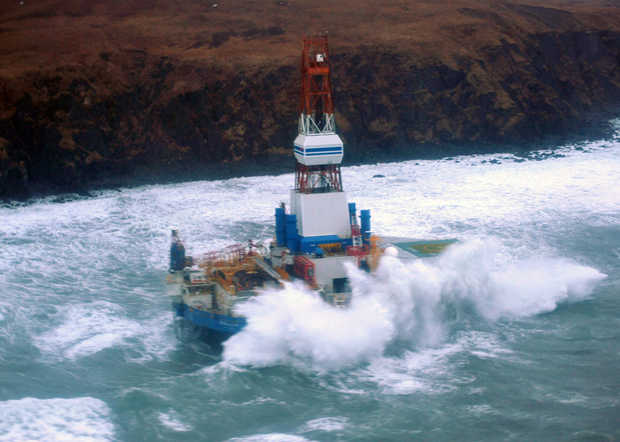
But Shell has never experienced conditions like the ones it will face should a spill occur. Remember Shell is the company that watched its Kulluk rig cast adrift and run aground the last time it made the attempt to drill for oil in this hostile environment.

What would happen if we had an Arctic Ocean oil spill?
1. If it happens when the ocean is at low sea ice levels, the summer, conventional technology such as Shell describes in its clean up plan, could be deployed for the few weeks when pristine conditions exist. This is the ideal and Shell’s containment plan would probably work.
2. Change the season when the ice is reforming or expanding as winter approaches and that containment can be thrown out. Oil spilled would become embedded in new ice (see illustration below). It would travel as much as 2,000 kilometers (1,200 miles) through the winter as the ice pack moves and until the next spring melt starts. The oil could end up anywhere throughout the Arctic Ocean. Shell could put sensors on ice embedded with oil to know where it goes. But sensors can be covered by winter snow and become ineffective. And even if they continue to work when the ice starts to melt Shell would have deploy equipment immediately to numerous locations to collect what they could. This would be a logistical nightmare.

3. You can always hope that when the oil spill occurs it happens in the 24 hour daylight conditions of the Arctic summer. But should it happen in the darkness of winter managing containment in the dark and cold will be a life and death struggle for the crews assigned the task.
4. Since oil spills disperse laterally and vertically the oil would spread to areas that skimmers and booms would not reach. It is highly unlikely that dispersant in the cold Arctic Ocean would sufficiently break down the oil to microscopic droplets. So the dispersant may make the oil sink but it would end up coating the local sea bed or remain suspended in the water column where it would interact with sea life. When trapped in ice the oil would drop anywhere the ice takes it when it melts. What technology does a company like Shell have to deal with a spray pattern of vertical and lateral distribution like that? This isn’t the Gulf of Mexico where chemical dispersants applied atomized much of the oil and where evaporation allowed some of it to escape into the atmosphere. Even dispersants in the Gulf couldn’t adequately remove the oil from the water column above the well head. As a result the Gulf seabed near the blowout remains covered with a significant amount of oil. In the Arctic that blanket would be more widely distributed, harder to get to, and a source of pollution for decades if not centuries.
5. Oil congealed in ice and wildlife don’t mix. That’s because the Arctic ecosystem from phytoplankton all the way up the food chain is tied to the seasonal ice melt. From crustaceans to fish, to seals, to polar bears, and to the native peoples of the Arctic, all will experience negative spill impacts.
Finally, the rationale for searching for oil in the Arctic in light of what we now know about carbon dioxide emissions and global warming defies any reason.
What justifies a strategy to look for more oil in light of the growing evidence of greenhouse gas impacts on rising sea levels and extreme weather events?
How can we be seeking more extractive capacity to increase fossil fuel supply while advising people to move away from gasoline burning engines to hybrids and electric vehicles because we have to combat global warming?
How can we tell oil companies that their balance sheets contain stranded assets when we give them the green light to go find more of the stuff?
How can we seriously transition to a low carbon future by exploring for more of the stuff that puts carbon into the air?
How can any other nation in the world take seriously the commitment made by the United States, the world’s largest emitter, to reduce its carbon footprint, when the government okays expanding the search for even more carbon-based energy?
Related articles across the web
]]>As I opened my morning newspaper today buried at the back of the first section was just the kind of story that environmentalists have been warning us about since oil exploration began in the Arctic. In September Shell Oil stopped prospecting in the Chukchi Sea with its rig, named Kulluk, because of equipment failures, and unexpected ice build ups. The operation to bring the rig south to a winter refit at a shipyard in the state of Washington required the use of tow ships. In weather described as horrendous, the rig broke free of its towing vessel, the Aiviq, which experienced repeated engine failures. A second emergency vessel, the Nanuq, attempted to re-establish a tow line but was unsuccessful in the stormy seas. The drifting rig eventually ran aground on the coast of Sitkalidak, an uninhabited island near the community of Old Harbor situated on Kodiak Island where there is a major Coast Guard station. The strait in which it ran aground is home to a threatened species of sea lion. The attempts to re-establish a tow line were hampered by winds of 70 knots and 15 meter (50 foot) waves. The 18-member skeleton crew (the rig in operation has as many as 130 on board) had to be removed by the U.S. Coast Guard before the rig broke free and ran aground.
The current problem is one of salvage and to ensure that the 541,000 liters (143,000 gallons) of diesel fuel and 45,000 liters (12,000 gallons) of hazardous lubricants on board remain there. The Kulluk at last report is upright and stable. But should it continue to be subject to rough pounding from ocean waves its hull could breach unleashing a chemical disaster.
The Kulluk is a rig rated to work in water depths of up to approximately 120 meters (400 feet) and capable of drilling to depths of greater than 6,000 meters (20,000 feet) below the ocean floor. Built by Mitsui and commissioned in 1983, its hull is ice-strengthened and when positioned for drilling has 12 anchor lines to keep it in place. It is also equipped with a survival anchor. With no propulsion system of its own the rig relies on tow vessels for propulsion. It is not certain after it broke away from the tow if the survival anchor was deployed. This if deployed may have stopped it from running aground. But we don’t know if the anchor was used or if it malfunctioned. In hindsight, choosing an unpowered rig incapable of navigating on its own in an environment known for rough sea conditions may have been a big mistake because ultimately a rig like this turns into a big floating piece of steel that when out of control can do a lot of damage.
This isn’t Shell’s first mishap in its Arctic deep water drilling venture in 2012. Thick ice delayed operations in the spring. Then an accident happened with a second drilling ship that nearly ran aground. When deploying an oil spill containment dome the operation failed during testing and the dome sustained considerable damage. And in September when finally Shell was ready to go, after one day it was forced to abandon its test well operation because of unusually heavy sea ice in the area.
The current operation to salvage the rig is being frustrated by high seas and Arctic darkness, just two of the natural challenges of the extreme polar environment at this time of year. Shell was being watched by other oil companies who were going to start their own operations based on Shell’s expected success. That apparently is not in the cards now and critics of Arctic oil exploration can point to Shell and say “We told you so.”
For Arctic oil exploration the Kulluk and other mishaps that Shell has experienced raise some questions: