Is CRISPR/Cas9 the only gene-editing protein in today’s genetic toolbox? Since its release, researchers have found others to slice and dice our genes and those of other animals and plants.
CRISPR/Cas12 is another protein that appears to be effective in re-engineering immune response cells. CRISPR/CasX is another that is smaller. It is a protein derived from a bacteria not found in humans and is easier to use than Cas9 or 12. Geneticists believe small is good for therapeutic applications, making the protein more manageable as a generalized gene-editing tool.
Besides curing human diseases, gene editing represents a revolutionary technology for agriculture. Unfortunately, many see gene-editing as voodoo and the result has led to the rise in opposition to anything genetically modified and foods getting labelled as GMO. The European Union bloc of countries has regulated a ban on GMO food imports.
This anti-GMO perception is fuelled largely by what is perceived as the unnatural mixing of genetic materials from one species to another. In nature, particularly in plants, however, this happens regularly when soil bacteria enter root systems and the DNA gets copied and transferred from the former to the latter. No protest signs go up, nor are any bans enacted to deal with the pesky, genetic-interfering bacteria.
Climate change is taking it out on plants and the animals who rely on them for food. With global warming altering precipitation, causing droughts, floods, extreme heat and cold, and seawater coastal inundations, farmers are facing new challenges and nations are experiencing growing food supply insecurity. Gene editing and GMOs could be the solution.
A new gene editing technology called Cas-CLOVER was discovered a few years ago by Hera BioLabs. Cas-CLOVER uses a different protein than CRISPR’s suite of tools. It is a nuclease protein called Clo51. Nucleases play a crucial role in various biological processes, including DNA replication, transcription, translation, DNA repair, and gene regulation.
In studies, Cas-CLOVER has proven to be more precise than Cas9 with less likelihood of cut-and-replace errors leading to off-target mutations. It is functionally similar to CRISPR gene-editing tools and demonstrates comparable efficiencies to Cas9 for targeting and replacing defective genes. However, it may prove to be a more focused and specific gene-editing tool based on some recent studies.
One of those studies appeared in the September 2023 issue of Plant Biotechnology Journal, describing how Cas-CLOVER was used to alter the banana genome. Albino banana shoots were generated from embryogenic cell suspensions. Instead of CRISPR/Cas9, Cas-CLOVER created the genome deletions with greater efficiency and fewer errors than the former. The study concluded that Cas-CLOVER had the potential to make edits in the genome of crops without causing off-target mutations and damage to the remaining DNA. The researchers were impressed with its efficiencies over CRISPR/Cas9.
Genetic-editing natural tools cannot come soon enough considering the agricultural challenges the planet faces from rising global temperatures and their impact on growing food. At the same time, Cas-CLOVER should prove equally useful as a new member of the CRISPR/Cas9 toolkit, revolutionizing how we tackle genetic-caused diseases.
]]>One of the consequences of the Neolithic Revolution was the massive alteration of natural landscapes. Growing crops required the cutting down of forests and plowing of grasslands. Once these natural carbon sinks started to disappear, the path to anthropogenic climate change began. Clearing the land not only contributed to global warming, it also changed groundwater aquifers. Our technology allowed us to engineer rivers, build irrigation canals, create artificial lakes and ponds, and inadvertently lead to the spread of diseases like malaria. We domesticated cows, pigs, sheep, goats, camels, llamas, alpacas and horses. By turning wild animals into providers of meat and dairy, we created a methane (CH4) bomb that further contributes to global warming. The greenhouse gas (GHG) these animals produce today accounts for 14 to 18% of global emissions. Our exposure to domesticated animals has also caused pathogens inherent in them to leap into us.
Selective breeding was the accepted traditional way to perfect crops and domesticated animals. Beginning in the 1970s, however, scientists started to experiment with deoxyribonucleic acid (DNA) and gene expression. This led to a new scientific field of study: genetic engineering.
Genetic engineering has proven to be revolutionary. It has helped to create antibiotics and antivirals to fight diseases. It has led to new varieties of crops that can live in environments to which they were never adapted. We now grow GMO crops that can tolerate saline soils and withstand prolonged drought. The speed advantage of creating these new plant varieties through genetic engineering versus selective breeding has become increasingly important as global warming impacts life on Earth in the 21st century and beyond.
The first GMO foods began appearing in the 1970s. They didn’t cause environmental disruptions. They didn’t make people sick. They didn’t get labelled. They were found in the produce departments of grocers and were ingredients incorporated into hundreds of different foods, This wasn’t to last.
Conspiracy theories are not new to the 21st century although it seems we live in an age rife with them. Near the end of the 1970s, in the absence of an open public discussion regarding the science, the fearmongers began to spread disinformation, sowing the seeds of doubt and fear and lobbying governments to ban GMOs.
Genetic engineering has been critical to the development of vaccines that have limited the number of people who died from COVID-19. Without genetic engineering along with over more than two decades of scientific research, we would never have developed and clinically tested the new mRNA and adenovirus-based vaccines that are seen as revolutionary.
Genetic engineering has been critical to the development of GMOs. Scientists have learned to combine DNA from different species to borrow traits that make domesticated animals and plants more resilient. Every GMO created involves laboratory experiments with the research published and peer-reviewed. Then the research has to be turned into a crop or product and tested. Government agencies are involved in the process which can take years before a GMO crop is released to farmers to plant, or a food product containing GMOs gets put on grocery shelves.
Consumer products can potentially pose safety risks. They go through a similar process of testing and government agency oversight. The precautionary principle looks at proportionality and risk for any new product introduced into the marketplace. That includes GMOs. The evidence from the science has to show proof that the health and environmental impacts are fully understood.
Knee-jerk responses to GMOs from regulatory bodies and governments on new crops introduced in the last several decades seem to have ignored proportionality and risk. That’s why GMO crops being grown by farmers in African countries for export, have had problems getting into European markets where regulations have exceeded the norms of precautionary principles.
This has also happened with genetically engineered drugs. One in particular, a synthetic insulin drug was shunned by many health regulatory bodies even though the biopharmaceutical manufacturer went through all the precautionary steps to ensure that the medical benefits of its engineered product over traditional insulin harvested from animal and human sources satisfied the level of risk needed for its use.
It appears that the developers of GMOs are without exception given a much harder time than let’s say, the producers of smartphones are even electric vehicles (EVs).
If smartphones were GMOs, would they have become as ubiquitous as they are today with more than 7 billion estimated in use globally? Yet the evidence of lithium-ion chemical reactions producing instability leading to fires has been known since 1991 when a Sony laptop burst into flame.
How lithium-ion batteries made it past the precautionary principles established by government regulatory bodies is beyond my understanding. To my astonishment, there is no global database reporting battery fires. Yet between 2010 and 2019, it is estimated from U.S. sources there were over 109,000 battery fires with approximately 6,800 involving lithium-ion. These were the ones reported with some similar to one that occurred with an e-bike battery in the past week on a Toronto subway train.
Then there is the automobile. Even with government oversight that has led to safety belts, lockable fuel caps, airbags, safety brakes, safety glass and more, 1.3 million die in vehicle accidents every year.
Even the pharmaceutical industry which is subject to oversight during the development of new drugs, doesn’t get treated the same way as GMOs. Yet adverse health effects from prescription drugs are the third leading cause of death after heart disease and cancer in the United States and Europe.
I would argue that smartphones, laptop computers, e-bikes automobiles and prescription drugs because of their social acceptance and convenience are not subject to the same rigorous oversight assigned to the producers of GMOs.
Is it our lack of scientific literacy, our inability to differentiate between science fiction and fact, or our willingness to accept fearmonger “facts” that have turned GMOs into perceived safety threats? This has to end as we face growing food insecurity threats from climate change in the 21st century.
]]>Food insecurity is directly linked to human population growth. Where our population is growing the fastest, that’s where we find threats of famine. And that also coincides with where humans are poorest and most susceptible to anthropogenic climate change.
Climate change, the world population of both humans and livestock, declining natural resources, and the continuation of poor policy decision-making are all contributing the food insecurity globally. Let’s address these issues:
By 2050 the world’s atmosphere over land and oceans will all have warmed further whether we start ratcheting down carbon emissions immediately or not. The latent effects of current greenhouse gasses (GHGs) in the atmosphere, in particular, carbon dioxide (CO2) make this forecast a certainty.
The IPCC’s latest report states we are already seeing land atmospheric temperatures 1.59 Celsius (2.86 Fahrenheit) above pre-industrial revolution values. And median atmospheric temperatures over our oceans have risen 0.88 Celsius (1.58 Fahrenheit). By 2050 the two numbers will continue to climb.
What is the implication for agricultural production in tropical and subtropical zones of the planet? The change in temperatures will also mean changes to precipitation patterns. It means land once suitable for particular crops will become less suitable. And crop yields on more marginal agricultural lands will likely be impacted negatively.
Current modelling points to an expanded temperate farming zone in both the Northern and Southern Hemispheres. But it also shows climate variability and a frequency increase in extreme conditions from hot to cold, and wet to drought. And current modelling shows a decrease in tropical and sub-tropical farming as air temperatures become too hot for plants, animals, and the farmers who tend to both.
Increasing CO2 which is expected to hit 550 parts per million by 2100, will have both negative and positive consequences for plants. The planet will be greener when viewed from space but crops will be less nutritious. And whether in North or South America, Eurasia, Australasia or in Pacific island nations, what we grow and where we grow will change. In areas today such as sub-Saharan Africa and parts of South Asia, where we already are seeing chronic undernourishment, food production and food safety will further destabilize.
Why will increased atmospheric warming impact food safety? Because the altering conditions will affect disease vectors, the integrity of harvested crops, access to freshwater, and an increase in food reliability. All of these conditions will further impact human and livestock populations, affect labour productivity, increase poverty, and see a rise in mortality.
In addition, the cost of food will become a factor of a warming climate. Rising prices will affect affordability and make those who are the poorest suffer most. Currently, the world is witness to a climate change famine in Madagascar. In the future, vulnerable areas like the southern half of the Indian subcontinent, sub-Saharan Africa, and South Asia may experience similar conditions.
The drying out of continental interiors in North America, Asia, and Australia will reduce crops yields. And even if the poleward march of warming temperatures opens up new farming opportunities, the variable quality of the soils and the nutritional content of yields will mean less reliability for food security.
Recent advances in farming practices, science, and technology are helping to counter the narrative described above. These advances along with improvements to infrastructure in Developing World countries will help reduce crop losses, improve post-harvest food preservation, and upgrade transportation from field to table to ensure better distribution to consumers.
At a recent webinar I attended on farming and climate change, I listened to farmers and agribusiness people describe improving practices that pull CO2 from the air into the soil. They talked about perennial polyculture, cover and intercropping farming and why adding carbon to the soil helps increase yields while drawing down on atmospheric CO2 to mitigate global warming.
But what wasn’t discussed was genetic crop science, probably the most important technological and scientific breakthrough to have direct implications for future food security globally. What this is all about is the improvement to plants through genetic editing using a variety of tools and techniques including CRISPR, the gene-splicing breakthrough I have written about before, to give farmers the ability to grow more even in the face of extreme growing conditions caused by climate change.
These genetic technologies provide an answer to a planet whose human population continues to climb even in the face of global warming and its impact on food production. With current world population growth, the need for farmers to increase production by 50% to meet food demand in 2050 is apparent. And diets are changing with the Developing World’s increased demand for more meat and dairy in their populations’ diets. This demand is leading to Amazon, African and South Asian deforestation pressures to make more agricultural land available.
Then there is the government regulatory bias against genetically modifying plants and animals supported by environmental groups such as Greenpeace who see evil in the science, and have labelled these products as “Frankenfoods.” Today to get a genetically modified crop approved can take two or more years. And whereas most governments on the planet believe in the science associated with our COVID-19 pandemic response, where agriculture is concerned, however, they reject the science imposing arbitrary regulation heavily influenced by uninformed consumer pressures.
Arable land on our planet is reaching a finite limit in tropical and subtropical countries. Encroachment into forested and more marginal growing areas (i.e., the deforestation of the Amazon basin in Brazil) is only a temporary fix to what will be a chronic shortage as global warming increases.
But genetic science gives us the means to achieve more on less. Take, for example, China. The country has less arable land today than in the past. Urbanization, industrialization, and environmental degradation continue to impact arable farmland negatively. Climate change and extreme weather such as droughts are causing desertification. The result is that China has to produce more food on fewer hectares of land. That’s why the country today is the world’s largest investor in genetic research on crops. Chinese see this as insurance to help it feed 1.3 billion which is expected to peak at 1.4 billion by 2030. Genetic research and tools help China to fight the impact of climate change on crops leading to new versions of plants that are resistant to heat and drought, needing fewer pesticides and herbicides and absorbing nitrogen from the air and root systems rather than needing fertilizers manufactured from fossil fuels. Today China is self-sufficient in food but its ongoing fear of climate change has the government focused on using genetics to ensure a future with no food scarcity or famine.
The tools are readily available. The science is proven. For food security humanity needs the science of genetics to improve plants and animals that we depend on for nutrition and survival. And governments that currently follow policies that pander to the uninformed, need to recognize the validity of this science and these tools to keep food scarcity from becoming the future reality.
]]>African country’s agricultural policies are focused on increasing land under cultivation and crop yields. But the continent is facing the existential threat of climate change in ways far more severe than more temperate zones of the planet. African farmers are dealing with crop failures, drought, floods, locusts, armyworm invasions and other deprivations of a physical nature. What they don’t need is EU anti-GMO neo-colonial policies making things worse.
In the EU today, nineteen of its 27 member countries either partially or fully ban GMOs. The European Commission since 2010 has treated GMOs as new or novel foods that are subject to evaluation by the European Food Safety Authority (EFSA). This deliberative body not only looks at GMO crops grown in Europe but also those grown elsewhere that get imported into EU member states.
The organic farming movement within the EU sees anything GMO as a danger. And the organic movement’s lobbyists have been effective. Government aid programs and non-government organizations (NGOs) offering grants to African farmers are also anti-GMO. What this means for African farmers who want to increase yields to not only meet local food demand but also to create bumper crops for export, face not just environmental challenges but also regulatory ones. That’s because many African countries, in order to conform to EU regulations around food, also put anti-GMO roadblocks in the way.
The GLP describes these phenomena as neo-colonial anti-technology practices hyped up by “utopian visions of peasant African farmers working in the fields.” And because the EU and Africa are in close proximity, the two continents are natural markets for what each produces. Hence, African food exports are more likely to find their way into European supply chains and onto European dining tables than crops from other parts of the planet. For African farmers to meet both domestic and export opportunities, therefore, requires them to embrace advanced scientific agricultural practices in which GMOs increasingly play a part.
Agroecology conferences in Africa, largely sponsored by big European companies and NGOs, however, are often dominated by anti-GMO rhetoric. At such events, European presenters blame GMO enhancements of food staples as potentially dangerous leading to increases in cancer, birth defects, HIV/AIDs and more.
For example, a Germany-funded NGO, the Route to Food Initiative (RTFI), sponsored by the Heinrich Boll Foundation, states that its aim is to promote innovative solutions to the problem of chronic food insecurity in Africa. In Kenya where it operates, RTFI literature and practices demonstrate both anti-pesticide and anti-GMO bias. RTFI has been instrumental in getting Kenya’s government to ban the use of 160 globally approved, safe agricultural pesticides. The results of RTFI’s influence can best be seen in the devastation caused by recent locust and armyworm infestations. And the same is occurring where African farmers have sought GMO drought-resistant and salt-tolerant crops. These too are being targeted by anti-GMO propagandists to the detriment of farmers trying to deal with deteriorating environmental conditions.
Europe isn’t alone in contributing to the neo-colonial mindset when it comes to Africa. American-based NGOs and charities also are putting money into agricultural initiatives on the continent with anti-GMO strings attached. These “investors” in Africa’s agricultural viability include the Christensen Fund, Swift Foundation, Rockefeller Brothers Fund, Schmidt Family Foundation, and others. All have little understanding of the challenges African farmers face without using advances in science and technology to help meet local food demand, let alone yield bumper crops for export. The GLP describes the investors as “crusading white-knights riding to save Africans they believe are incapable of judging the science and technologies of modern agriculture on their own.”
A 2020 McKinsey report states, “Agriculture is critical to Africa’s growth and development, but climate change could destabilize local markets, curb economic growth, and heighten risk.” The last point about heightened risk refers to investor risk. But that’s not the risk about which I am concerned. The real risk for African farming is the decline in the physical environment because of climate change. With as much as 20 to 30% of African countries’ GDP coming from agricultural production today, this is where Africa’s risk lies. Higher day and nighttime temperatures disrupt plant growth, changes in patterns of precipitation swing from droughts to floods, and pest infestations like armyworms and locusts are linked to climate change.
Meanwhile, a lack of access to affordable capital sources for small entrepreneurs (I invest in microloans to African entrepreneurs including small farms through Kiva.org) which pretty much categorizes the plight of many African farmers, creates a greater dependency on charitable foundations and their handouts like the ones mentioned above, with many of the latter coming with strings attached that feel very much like neo-colonialism.
]]>Take the subject of climate change with the overwhelming consensus from scientists pointing to our culpability, and with a concerted call for action now. Yet right now three different Canadian provincial governments are in court to try and stop action by the federal government to implement a market-based strategy of putting a price on carbon. Although these premiers profess to believe that the changing climate is human-influenced, they are counting on a groundswell of support from those in industry and the public who do not, the so-called climate skeptics.
South of the Canadian border we have an America let by the chief climate change skeptic of the age, the man who announced that the U.S. was pulling out of the Paris Climate Agreement. So what are American public perceptions about anthropogenic climate change?
The latest research poll from UC – Santa Barbara shows a clear divide in the nation based on politics. Democratic and Republican Party supporters are on opposite sides of the question. The results (see maps below) show that between 80 and 95% of registered Democrats “feel” global warming is real. On the Republican side, between 30 and 60% express similar “feelings.” That means between 40 and 60% of those who are Republicans question the human influence on climate despite the voluminous amounts of data coming from climatologists and related scientific fields that show a distinct correlation.

I have highlighted the words “feel” and “feelings” in the above text because when talking about scientific evidence, one usually puts feelings aside and looks at facts. But then again I have to remind myself that when Darwin presented his research on natural selection back in the 1850s, describing how species differentiate over time in response to external forces, that the overwhelming objections were about feelings and beliefs, not the research and conclusions represented. Even today, more than 150 years after Darwin first shared his evidence of natural selection, some American states make evolution and creationism (the Judaeo-Christian biblical account of how the world was formed and all of life on it) co-equal in the classroom.
Another of this week’s headline points to the damage the politicizing of basic science can do to a vulnerable population. Madagascar, an island nation that lies off Africa’s southeastern coast, is being decimated by an outbreak of measles, a disease for which medical science developed a vaccines back in 1963, and a multiple disease immunization protocol known as the MMR since 1980. MMR stands for measles, mumps, and rubella, all diseases that are highly contagious and of particular threat to children under the age of five.
So how can one explain how 50,000 people could be infected with measles in Madagascar since October 2018, with hundreds of children already dead, and estimates that the number will soon top 1,000? In Madagascar less than 50% of the people are immunized even though the MMR vaccine is readily available. This tragedy is being repeated in other African countries as well where vaccine availability is present but there is such a lack of political leadership to educate the public about the need for immunization and deal with the anti-vaxxer propaganda.
Madagascar and Africa may be the worst hit, but if you type “measles” into your search engine the links that come up show 2018 to be the year of measles all around the world. When you consider that back in 2000, the year the Center for Disease Control (CDC) announced the disease was eliminated in the United States and elsewhere, one would never have expected to read about new and growing outbreaks in 21 states, 64,000 affected in the European Union, and 301,702 globally, a 31% rise from 2017. The estimated number of deaths from measles last year reached 110,000, with most being children.
The World Health Organization (WHO) has called out the governments of the world pointing out that this shouldn’t be happening with a totally preventable disease. In its information pages on measles it describes the low vaccination totals as being caused by disinformation campaigns and rumours presented to the public, fueled by a growing anti-vaxxer, anti-science movements that use discredited research, and celebrity shills to spread their lies. Last year 110,000 paid the price.

It seems at times that no scientific breakthrough has been more maligned than that of the development of genetically modified (GM) crops. Between the organic farming movement and anti-GMO groups like Friends of the Earth, the Center for Food Safety, Greenpeace, and the Pesticide Action Network, a barrage of attacks have been made on genetic engineering and tools such as CRISPR. Yet GM crops like golden rice developed as a means of ending childhood blindness in South Asia, and GM crops that are drought, fungal and insect-pest resistant are universally condemned by those with no evidence to support their feelings that their safety is at risk.
In 2012, a joint communique by 110 Nobel laureates stated, “scientific and regulatory agencies around the world have repeatedly and consistently found crops and foods improved through biotechnology to be as safe as, if not safer than those derived from any other method of production.” The American Association for the Advancement of Science, in a 2015 Pew survey, found that 88% concluded based on the science, that GM crops were safe, almost as strong a consensus as the community of scientists in their assessment of anthropogenic climate change.
The anti-GMO groups even include high profile celebrity scientists like Canadian zoologist, David Suzuki, a strong environmentalist, who on most subjects bases his judgment on the science. But it seems that Suzuki, who headed up a genetics laboratory at University of British Columbia, treats GM crops as alchemy describing that the products of biotechnology “are being rammed into our food, onto our fields…without any public participation…and with the complicity…the active support and funding of governments.” The public is in agreement more with Suzuki than the large majority of scientists. That same Pew survey that showed 88% of scientists stating that GM crops were safe also showed only 37% of the public believed that to be true, and only 28% felt that food grown with the use of pesticides was safe.
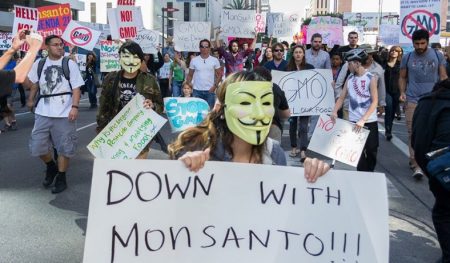
I’ve often described the anti-GMO movement on this blog site as being more anti-Monsanto than anything else. The company which is now wholly-owned by Bayer, had a heavy-handed reputation in the licensing of its GM seeds, ending up in court with farmers who found seeded by nature GM crops in their fields. Monsanto was suing the farmers for what wind had wrought. And Monsanto created GM crops that were designed specifically to not be affected by its own chemical pesticides giving the company twice the dollars when selling to farmers.
Compare the Monsanto approach to that of golden rice, developed by university researchers who made the seed available to growers for free. Or to universities working with agriculturalists in Africa to develop crops resistant to Army Worm, and other infestations that often destroy half of what is grown in fields. Or to the work being done to modify the fruits of the harvest so that they remain fresh longer and don’t get thrown away to become a source of greenhouse gas emissions from waste dump sites.
The idea of adding a chemical into drinking water is one that causes conspiracy theorists to pop out of the woodwork. The current anti-fluoride movement is a case in point.
The science behind fluoride dates back to its discovery by accident when a 1901 dental graduate named Frederick McKay set up a practice in a Colorado town and discovered fluoride in the water after trying to understand why some of his patients had badly stained teeth. He traced the stains back to drinking water sources, collected water samples from neighbouring towns, and isolated fluoride as the suspect stainer in chief. At the time he didn’t realize that the chemical was also hardening his patients’ brown-stained teeth making them more decay resistant. It was later researchers who determined that and came up with the right concentrations of fluoride to produce hardening without stains.
The first community test occurred in 1945 in Grand Rapids, Michigan. An eleven-year study showed that children born after fluoride was added to the town water had 60% less tooth decay than those prior to 1945. It was deemed by dentists to be a scientific breakthrough.
Then the politics of fear got in the way. What else were politicians and scientists concocting to put in drinking water, or in our food? In the post-war world where Communism was the ever-present evil, fluoride in the drinking water was seen by some to be the first act of a Red invasion.
A more sophisticated anti-fluoride lobby has emerged in recent times with a wide range of claims about fluoride unsupported by any scientific evidence. They claim fluoride in the water causes health risks without identifying what those risks are. They call it an industrial chemical to make it sound like pollution. They have fallback positions that state the benefits to healthy teeth are highly exaggerated, or that fluoride in toothpaste makes it no longer a requirement in drinking water. Some even state that the combination of the toothpaste and water treated with fluoride leads to overexposure. I doubt if any are aware of the brown-stained teeth of those Colorado residents which led to the discovery of fluoride’s value in preventing tooth decay.
The anti-fluoride activists are less about science than about badgering town councils anytime water is on the agenda. And politicians have succumbed bowing to the pressure of their lobby in 30 Canadian communities since 2005 whose elected officials voted to end putting fluoride in their communities’ drinking water. Today, as a result, only 32.5% of Canadian communities mandate fluoride. The story is not too dissimilar in the United States. The science loses out to loud voices spreading nonscience nonsense as facts.
Anti-climate change, anti-vaxxers, anti-GM crops, and anti-fluoride activists are largely cut from the same cloth. They feed us alarmist rhetoric. They fuel their arguments with feelings and fear. And much of the time they get their way with damaging results such as what the people of Madagascar are currently experiencing.
