The Swedish researchers began their work on transparent wood three years ago using balsa wood, the same material found in model airplane flying kits. They chemically treated the balsa to remove its lignin. Then they added acrylic to give it strength and rigidity while preserving its opacity.
Further testing with different materials introduced polyethylene glycol (PEG). PEG is the same polymer that was used to preserve the Swedish 17th-century wood-built warship, the Vasa, which sank on its maiden voyage in 1633 and raised from its watery grave in 1961. Preservation of the Vasa became a Swedish national project and received worldwide coverage (I remember reading about it in National Geographic). Today, a million visitors a year view the wreck in its own climate-controlled museum. What the use of PEG in the Vasa preservation proved in principle, could now be applied to wood for an entirely different purpose.
PEG turns out to be pretty remarkable. It is defined as a phase-change material. that is, it is resilient when exposed to cold or heat and maintains a high degree of stability and equilibrium whether a solid or liquid. In the case of the de-lignified wood, PEG combined with acrylic not only allows light to pass through it, but also proves to be a very effective insulator of both heat and cold.
The current transparent wood product is starting to look like a pretty attractive alternative to current construction materials. PEG is biodegradable. The acrylic is not. The result is the Swedish team experimenting with biodegradable alternatives to the latter. But even then, if transparent wood were to be used in construction, biodegradability is not a significant issue because the material incorporated into a building structure would effectively become a permanent carbon sink. Reinforcing this point is Mark Miodownik, Professor of Materials and Society, University College London, who talks about this in an article in The Guardian, where he states that the need for biodegradability is minimal.
Miodownik remarks, “We need construction materials to be carbon sinks and so they need to be recyclable and reusable, not biodegradable.” Timber made of transparent wood could then be infinitely recycled into new projects much the way many other construction materials today, like bricks and steel, are salvaged and reused.
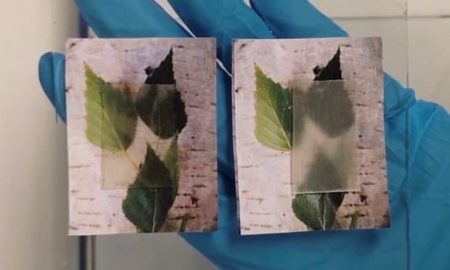
Practical usage of transparent wood in construction is still away off. But the possibilities are intriguing. One could imagine it being used to replace building materials like plastic, concrete, and glass. Transparency isn’t 100% (see image below), but certainly, it is better than the glass bricks that are used in some construction to allow light in where windows for privacy reasons aren’t appropriate (think bathrooms).
An added bonus is the thermal properties of transparent wood which allows it to absorb heat from sunlight during the day without the greenhouse effect that happens when the sun shines through a glass window. Rooms with walls of transparent wood would stay cool during the day, and at nighttime, would transfer heat from the walls to the indoor environment insulating it from the cold outdoors. Think what savings could come from that when dealing with energy costs for heating and cooling.
]]>
At the March 2012 meeting of the 243rd National Meeting & Exposition of the American Chemical Society (ACS), Professor Marek Urban from the University of Southern Mississippi reported that his team of researchers had developed plastics, that when scratched or cracked, visibly change colour at the point of the defect. And when the damage is exposed to visible light, heat or acid respond by “healing” and restoring themselves to their original colour. The plastics can repeatedly respond this way doing self-repair many times.
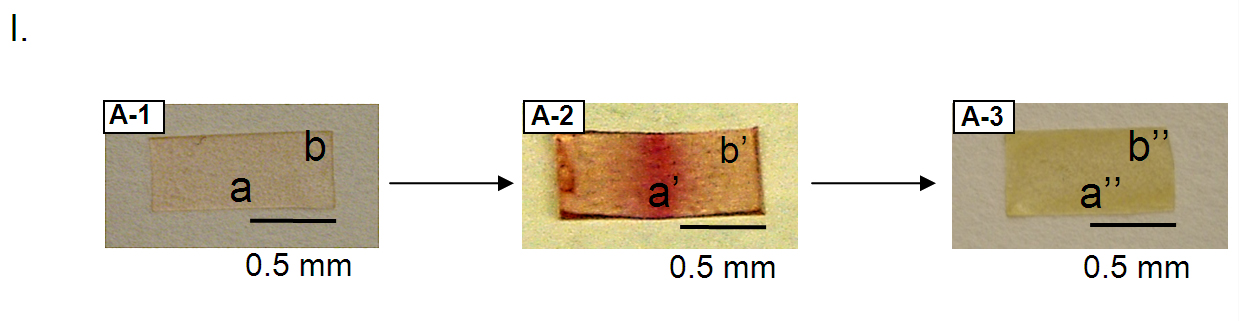
What makes this possible? The self-healing plastic contains small molecular links or bridges that span the long chemical chains within the material. When the plastic is scratched or cracked, those links break, changing shape. The change in shape alters the colour appearance of the plastic turning it red. A sample of this process is seen in the picture below.
This new plastic is water-based and contains no toxic chemicals making it even more attractive. You can imagine the wide range of industrial uses this kind of material would have because it visibly warns the manufacturer or user of damage and requires easily accessible processes for repair.
For the automobile industry plastics like this would make it easy to deal with the repair of incidental scratches to an automobile body. Just exposure to sunlight would repair the damage. In fact, the material could be used in any mission-critical structure where any damage to materials would immediately be seen and repaired by applying light, heat or acid to the defective part.
Increasingly we rely on plastics in manufacturing. Plastics have replaced steel, aluminum, glass, paper and other traditional materials. With this technology plastics will become even more appealing as the material of choice in manufacturing.
]]>