June 13, 2018 – Amyotrophic Lateral Sclerosis (ALS), better known as Lou Gehrig’s Disease, the condition that Stephen Hawking lived with for most of his adult life, causes paralysis as neurons in the brain lose their ability to communicate with the body. The disease kills 80% of those afflicted within two to five years after diagnosis. The disease is defined in three categories: sporadic, familial, and bulbar.
At the ALS Canada website, it states that more than 200,000 around the world are living with the disease. Of that total, 3,000 Canadians with 2 to 3 dying every day. The lifetime risk of getting ALS is 1 in 1,000.
Stem cell treatments for ALS are at the centre of most research seeking cures for the disease. One of these has led to the announcement of a new clinical trial focused on using human embryonic stem cells to propagate astrocytes, the most numerous cells found in the brain. Astrocytes are glial cells. The word glial is derived from the same root word for glue, and that’s exactly what astrocytes appear to be, the cells that hold together our brains and nervous system.
Astrocytes come in numerous subtypes called fibrous, protoplasmic, Layer-1, interlaminar, and varicose projection. Each serves a unique function. But all together astrocytes maintain our whole brain and neuronal metabolism providing mechanical and repair support while contributing to our neural plasticity, the ability of our brains to adapt in the face of changes. Astrocytes are also part of our human immune system acting as either pro or anti-inflammatory responders and thus are seen as key preventers of diseases of the brain.
So it would appear appropriate for researchers to look at astrocytes as a potential way to fight degenerative diseases like ALS. And that’s exactly what this clinical trial is all about.
Kadimastem is the biotechnology company that has been developing an embryonic stem cell therapy called AstroRx. In a recent study reported in the journal Stem Cell Research & Therapy researchers in Israel reported that transplanting healthy astrocytes derived from stem cells compensated for malfunctioning astrocytes in transgenic mice with ALS. The researchers manufactured large quantities of astrocyte progenitor cells from human embryonic stem cells. These were frozen and stored and then tested to see if they could produce healthy astrocytes. First, they proved it could be done in a laboratory. Then they moved on to animal studies injecting their AstroRx astrocyte cells into the spinal canals of their test mice. A regimen of two injections separated by 30 days proved to delay ALS onset while significantly improving motor performance and neurological test scores in treated mice. In a subsequent study, they administered larger dose load injections into test rats by lumbar puncture into the spinal canal. Results in the rat subjects were better than those in the test mice, delaying disease onset even further and slowing the decline in motor function. The study concluded that the method of treatment and the astrocytes derived from stem cells could be used in a human clinical trial.
That’s happening now at the Hadassah Ein-Kerem Medical Center in Israel. In the press release announcing the clinical results of the mice and rat studies, and the beginning of this new clinical trial, Michel Revel, Kadimastem’s chief scientist states, “In the research, we developed a method which enables the use of stem cells for the production of large quantities of healthy support cells, similar to those in the human brain, and the cells have been proven to possess several mechanisms of action for the protection of neuron survival.”
On the Canadian ALS website, there are a number of other clinical trials using various stem cell therapies to try and slow down or stop ALS symptoms from progressing. I’ll keep an eye on these and report back from time to time on their progress, and hopefully, their success.

RNA, or ribonucleic acid, is DNA’s right-hand man. It is referred to as the messenger turning genetic instructions into proteins responsible for healthy operations within cells. When defective the proteins it constructs lead to disease.
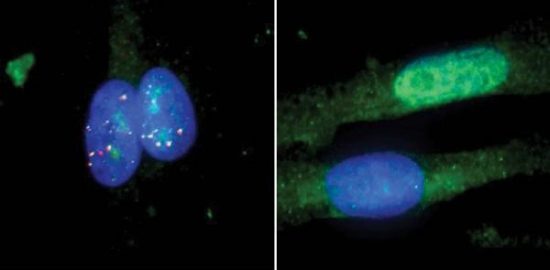
Researchers at the University of California, San Diego (UCSD), decided to use CRISPR and a modified Cas9 companion to target RNA rather than DNA. The modified Cas9 binds to aberrant RNA and destroys it. In a paper published in August of this year in the scientific journal, Cell, entitled “Elimination of Toxic Microsatellite Repeat Expansion RNA by RNA-Targeting Cas9,” UCSD researchers describe laboratory tests in which 95% of aberrant RNA from cells taken from Huntington’s Disease, and ALS patients were destroyed using CRISPR. The tool was tested as well on a form of inherited muscular dystrophy, myotonic dystrophy. Again it successfully eliminated 95% of the RNA responsible for creating defective proteins.
UCSD researchers describe laboratory tests in which 95% of aberrant RNA from cells taken from Huntington’s Disease, and ALS patients were destroyed using CRISPR. The tool was tested as well on a form of inherited muscular dystrophy, myotonic dystrophy. Again it successfully eliminated 95% of the RNA responsible for creating defective proteins.
The effects of the treatment, however, are temporary with the RNA regenerating within a few days. This is both good and bad. It means using this technology could help tackle infectious diseases with a known RNA origin. But for Huntington’s and ALS a longer term solution is needed. Even here the researchers believe they can use the technology in a lifetime treatment protocol by turning the tool into a daily capsule to keep aberrant RNA in check.
This is far removed from CRISPR/Cas9’s original purpose, but nevertheless, it illustrates the promise of this tool that is, without a doubt, revolutionizing medicine.
A new biotech startup, Locana, has been created to move the technology from the laboratory to commercial application. We should be hearing much more from Locana in the next few years.