Only the Viking landers were equipped with experiments designed to sniff out potential evidence of life signatures in samples dug from the Martian regolith. The results of the tests, when aired in the press in 1976 stated that life had not been discovered. But in April of 2012, a revisit of the data collected from Viking’s two landers and their Label Release Experiment measuring the gases emitted by soil samples heated to 160 Celsius (320 Fahrenheit) degrees, overturned that assessment.
The results, published in the International Journal of Aeronautical and Space Sciences (IASS) stated there was 99% certainty that microbial life exists on Mars. Unequivocally the results the investigators reported were not caused by any Earth-borne contaminants arriving on the landers but were unique to Mars. The results were also consistent with similar tests run on Earth in Antarctica with conditions resembling the extremes of cold and dryness found on the Red Planet. Since Viking, NASA has sent many landers and probes to Mars including Opportunity and Curiosity (the latest), but strangely the agency has never tried a Viking retest or included more advanced life detection experiments, a surprising oversight by the agency. Instead, we have looked for organic molecules, the presence of water today, and evidence of significant surface water in the Marian past. And we have found all three.
The Mars 2020 lander, which will be the successor to Curiosity, doesn’t include any onboard life detection experiments in its current configuration. One wonders why not? Is NASA deliberately avoiding the question of life on Mars? And if so, why?
There could be several reasons.
One is religious. If life is not unique to Earth then the creation myths of the world’s major faiths are called into question.
The second is the ethical dilemma that Mars presents. An inhabited Mars, even if only microorganisms, is not something to be trampled upon and suborned by alien life brought to the planet by humanity. That would be a criminal act.
The third reason is the profound implications of finding Martian life in a world seemingly inhospitable to it, and what that could mean for other places in the Solar System and beyond where conditions seem equally if not more inhospitable.
Here are just a few relatively nearby examples:
Planetary scientists today note that Titan bears similarities to Earth with liquid both on the surface and in its thick atmosphere, that falls as rain and flows through river valleys into lakes and seas. But there are differences as well. It’s not water but liquid methane in those rivers and seas. And the temperatures on Titan are so cold that water exists as ice and forms much of the land mass through which those methane rivers flow.
On Titan there is also an abundance of organic molecules bearing a resemblance to the building blocks of life we find here on Earth. And needless to say life on Titan may be organic-based but one cannot imagine it turning into anything resembling that which exists on Earth. Would a future robotic rover or human visitor even recognize life on Titan if stumbled upon?
Considering the Viking experiments and the controversy associated with detecting or not detecting life on Mars, it is pretty clear that recognizing life we find elsewhere in the near-space of the Solar System will be difficult. And when we can’t devise an experiment to recognize it or visually identify it, yet it’s there, that will certainly be problematic.
That to me makes Elon Musk’s Martian venture and the Mars One project very dangerous steps for our species to take. Establishing colonies there means permanent contamination of an alien ecosystem with the potential extermination of its native life. Or maybe that life kills us before we kill it.
In H.G. Wells, War of the Worlds, the Martians, with their superior technology, arrive on Earth and overwhelm our human defenses. Ultimately, however, it is our native microbial allies that kill them off.
Wells parable should not be taken lightly. We may not come as invaders to conquer Mars, but when we arrive there we may face the risk of being exposed to an incompatible form of life that kills us.
Yet it is clear that we, as a species, are outward bound to go beyond Earth this century. Why does that mean we need to find alien ground to colonize?
We have the potential to engineer communities in space, to make them self-sustaining habitats capable of duplicating conditions on Earth. A Deep Space habitat would use resources mined from lifeless asteroids and comets to provide the material, fuel, water and breathable air needed to be self-sustaining. Such habitats could draw upon the continuous energy of the Sun and move around on the solar wind. Habitats could even simulate Earth gravity, and if and when we want to feel like we are on the Moon, Mars, or elsewhere, we could create habitats that simulate those bodies’ conditions.
To me, this is a far better way for us to establish our off-world presence than what Musk and others are proposing, and certainly, one that is less fraught with risk to both our species and to life that may already exist on nearby alien worlds.

When Juno arrived at Jupiter in the last week we were told that the mission to the Solar System’s largest planet was designed to avoid crashing into Europa because scientists didn’t want to contaminate that moon potentially introducing Earth microorganisms into an alien ecology. NASA hopes in a future mission to Europa to uncover the mysteries of its subsurface ocean and hopefully identify alien life there.
Evidence for life on Mars remains a question mark. Tangential evidence from the early Viking biochemistry experiments, the discovery of water ice by the Phoenix lander, evidence of water both in the past and present detected by orbiters and the two working rovers, Opportunity and Curiosity, and occasional whiffs of methane point to a likely biological source. But we won’t know for certain until we send further robotic landers and eventually human crews to the planet’s surface.
Most intriguing are two recent reports gleaned from the Cassini spacecraft continuing to study Saturn and its mini-solar system of moons. Cassini discoveries have included a subsurface water source under the icy crust of Enceladus. Cassini has flown through the icy particles ejected from the moon’s surface spewing water into space. The existence of a subsurface ocean similar to Europa is highly likely on Enceladus. And where there is water here on Earth we have life. So why not elsewhere in the solar system?
On the issue of how life could exist on Enceladus, Chris McKay, planetary scientist at NASA, states “You’re not just searching for life, you’re searching for an understanding of the nature of that life, and how it compares to life on Earth.” For example if we find life on Enceladus and it resembles Earth life then we may surmise that life originated in the Universe elsewhere and has spread to lots of places. But if the life we may find on Enceladus differs biochemically from Earth then we are looking at separate and independent life origins which has entirely different implications.
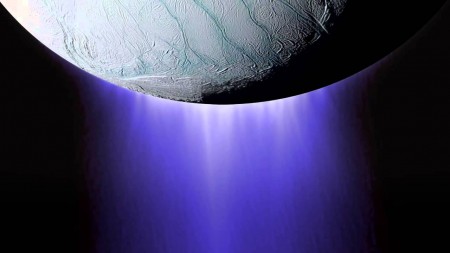
Today we know that Enceladus has more than 90 geysers (see image above) spewing salty water containing organic compounds into space. A mission to the moon doesn’t need to land there to discover if life exists. It just needs to fly through the geyser plumes and sample what it finds. The theory is that the geysers may produce bubbles of organic material including exotic biology that concentrate on the surface and get ejected when the subsurface water erupts. Any probe sent to Enceladus would have to include a biological laboratory capable of discerning proteins, amino acids and lipids in water samples. In finding this kind of evidence it would be definitive proof that Enceladus supports living organisms. Most scientists believe it would much harder to find the actual organisms themselves although some hope to devise technology that will capture images of Enceladus’ microbes.
Even more exotic would be the discovery of life on Titan, Saturn’s largest moon. Ever since Cassini and the Huygens lander gave us images of the landscape and lakes of Titan scientists have been speculating on whether a very different type of life could exist there in the extreme cold. A new study has focused on the presence of hydrogen cyanide (HCN) molecules in Titan’s atmosphere as evidence of life formed from polymers.
One of those polymers, polyimine is capable of creating complex molecules in the presence of light in a low temperature environment. Now consider that Titan’s surface is covered by lakes, rivers and substantial seas of methane (see image below) and you have an exotic chemistry for a different type of life, not water based as here on Earth, and capable of thriving at -180 Celsius (-292 Fahrenheit) degrees.
A probe landing on Titan would carry on board a chemistry lab that would be seeking evidence of a very different type of biology. And should it discover the building blocks of that life it will tell us that the Universe is far richer and more diverse in life than we ever imagined.

]]>
In any event here are the stories that made middle-page headlines in the last week.
Voyage to Pluto
New Horizons, the spacecraft launched eight years ago is exactly one year away from rendezvous with Pluto. No longer one of the big nine of the Solar System (now the big eight), Pluto is deemed a dwarf planet along with a series of other recently discovered objects in the Kuiper Belt that stretches beyond its orbit.
Rendezvous with Pluto is next July 15th. Ten weeks before New Horizons will transmit the best images of the dwarf planet ever seen. The one below is the best to-date and was taken by the Hubble Space Telescope. Four weeks before rendezvous we will see daily images of Pluto, Charon and the recently discovered four other moons. We may even find a few more moonlets. And after the fly by it will take nine months before all the data New Horizons collects is downloaded to computers here on Earth for scientists to view and analyze.
What happens after that? NASA and the Jet Propulsion Laboratory are having the Hubble Space Telescope look for new Kuiper Belt targets for New Horizons to visit. After all if we are already out there why not take a look around and see what other new discoveries we can make.
This is much more than a picture taking event. New Horizons is packed with a pallet of scientific instruments including an ultraviolet image spectrometer to analyze Pluto’s tenuous atmosphere and how it interacts with the Solar Wind.

More NASA Scientists Speculate on Finding Alien Life Very Soon on Exoplanets
The more Goldilocks Zone exoplanets discovered the more the talk turns to finding alien life around neighboring stars. Why are NASA scientists so hyped up about life elsewhere? Because Kepler has uncovered a treasure trove of candidate planets and the new space telescopes like the James Webb (2018), (see image below), the Wide Field Infrared Survey Telescope (2017) and the Transiting Exoplanet Surveying satellite (2017) should make Kepler discoveries look like a popgun.
When asked to comment on finding a New Earth in light of what is being deployed before the decade is out, Sara Seager, a planetary scientist at Massachusetts Institute of Technology, stated, “Sometime in the near future, people will be able to point to a star and say, that star has a planet like Earth.” But it is more than just a planet like Earth. The new telescopes are expected to find evidence of life through the examination of atmospheric signatures from these exoplanets. That’s why NASA scientists believe the next 20 years will end our isolation as the only known planet with life on it.
SETI has been all about the search for intelligent life by listening for radio signals. But the kind of life that the NASA scientists are talking about may not fit that category. What makes a planet a candidate for life is if it has sufficient mass and gravity to retain an atmosphere. Detect an atmosphere and you may find life. What in the atmosphere do you look for? Compounds not normally found in nature. These could be simple or complicated. Simple would be produced by the lifecycle of living things. If we found oxygen it would be a pretty good indicator. If we found methane it too would be a promising sign. If we found something as complicated as chlorofluorocarbons we could pretty well conclude that the planet we were looking at had a lifeform with sophisticated technology.
Of the exoplanets found to date, many are very hot and, therefore, they throw off too much radiation for us to examine the detailed components in their atmospheres. But a Goldilocks Zone planet with an atmosphere can be studied as starlight passes along the planetary edge and through its atmosphere. With the instruments we soon will have in near-Earth space we’ll be ready to take a much closer look.

European Partners Combine on Space Launch Technology to Compete with SpaceX
How flattering for SpaceX to have Airbus Group and Safran joining together to push back against the growing presence of Elon Musk’s company. The two see the Ariane, Europe’s primary launch vehicle, as a counter to the Falcon9 and the future Falcon Heavy.
The current Ariane 5 continues to enjoy a significant market share in commercial satellite launches. But SpaceX can launch satellites for 30% less cost. And with re-usability of Falcon launchers becoming a reality, the price will continue to drop. That puts 16,000 Ariane jobs at risk in France.
A mid-life new version of the Ariane 5 is expected to be available in 2018. It features a new upper stage engine technology that is capable of re-ignition while in orbit. This is something SpaceX and its Falcon launchers, can already do.
Ariane 6, the next generation of European space launcher, is still seven years away from market entry and the European developers are still tying to come up with a final design. At present it appears to have some of the features of the Falcon Heavy but it remains a throw away launcher which means cost per launch may prove uneconomical as SpaceX further develops reuse capability.

New Exoplanet Life Detection Model Developed by Researchers
It seems that detecting the presence of methane in spectral analysis of exoplanet atmospheres may be the key indicator for finding life elsewhere in the Universe. Researchers at University College London and University of New South Wales can now detect methane molecules in remote planets by analyzing the way their atmospheres absorb starlight. They then compare the output to a spectrum they have modeled. The breakthrough has only been made possible because of new supercomputer processing power which provides the ability to analyze enormous amounts of data from a range of astronomical and satellite sources.
To discover life on exoplanets, the astronomers believe that methane levels hold the key. So does that mean Titan, Saturn’s largest moon, awash in methane lakes and with a hydrocarbon laced atmosphere, may also harbor life? It appears that evidence of life hunting covers methane molecules from cold to hot. How hot? Up to temperatures of 1,220 Celsius (2,228 Fahrenheit) degrees, an environment more like the planet illustrated below, a depiction of HD 189733b, a recently discovered exoplanet 63 light-years away.
That certainly isn’t the case with Titan with surface temperatures of -179 Celsius (-290 Fahrenheit) degrees and whose nitrogen rich atmosphere is ten times the density of Earth’s with 1.6% composed of methane.

United States Starting to End Reliance on Russia for Access to Space
In the post-Crimea world the American space program is seeking more domestic content in its space launch capability.United Launch Alliance, the consortium of U.S. companies responsible for the bulk of military satellite deployments recently signed contracts with a number of private companies to help it develop a new rocket engine to replace the RD-180, built by Russia’s NPO Energomash. This is the rocket that has been used to power the Atlas V launch vehicle, deconstructed in the image below.
ULA was created by Lockheed Martin and Boeing to service the American space program. It is not alone in creating an independent launch capability for American satellites and human space flight. SpaceX and Orbital Sciences Corporation are also in the running although the latter relies on Russian engines for its Antares first stage.

New Horizons Mission to Pluto Searches for Additional Kuiper Belt Object to Visit
In a little over a year from now, New Horizons will make its flyby of Pluto and its five known moons. Pluto, now a sub-planet, is considered a large Kuiper Belt object. But to have flown all this distance and visit only one world seems like such a wasted opportunity. That’s why the Hubble telescope is being tasked to find a second Kuper Belt object to visit after passing Pluto.
How will Hubble make its discovery? First it has to observe and catalogue a number of candidates. Then the orbits of each need to be calculated to make sure that with an additional rocket engine burn after it completes its primary mission, New Horizons can be sent on a rendezvous trajectory.
So far from ground based observation the New Horizons team has discovered 50 Kuiper Belt objects but none of these have the right orbit. Adding Hubble to the search gives the scientists 90% assurance that they will find a suitable candidate and give us not only our first view of Pluto but also of an even more remote body here in the Solar System.


