Detected by radio telescopes, the signals give no advance warning. They just happen without explanation. Since first discovered 17 incidents of FRBs have been noted. Previous theories ascribed FRBs to cataclysmic natural events such as a star collapsing in on itself, or two black holes merging. But in 2016 astronomers discovered a repeat FRB of 3-millisecond bursts. That means the physical source couldn’t be a collapsing star or black holes merging. These would only produce a one time FRB. In the last few months, a repeating FRB was observed coming from a dwarf galaxy three billion light years away. The astronomers who made this discovery theorize that a neutron star with a large magnetic field may have been the source of the repeating bursts, something they called a magnetar. Another theory posited was the FRB came from the nucleus of the dwarf galaxy.
But now a new theory of a non-physical nature has been proposed. Scientists are asking if FRBs could be produced by technology. The idea is that these powerful beams could be propelling alien ships through space. Imagine a light-sail powered spacecraft being pushed from close proximity to its planet as a propulsive force.
That’s a hypothesis proposed by Avi Loeb and Manasvi Lingam, both at the Harvard-Smithsonian Center for Astrophysics. Their paper which is to be published in the Astophysical Journ Letters, is entitled, “Fast Radio Bursts From Extragalactic Light Sails.” In it, they state, “Our analysis shows that beams used for powering large light sails could yield parameters that are consistent with FRBs. The characteristic diameter of the beam emitter is estimated through a combination of energetic and engineering constraints, and both approaches intriguingly yield a similar result which is on the scale of a large rocky planet. Moreover, the optimal frequency for powering the light sail is shown to be similar to the detected FRB frequencies.”
FRBs are weird. They don’t fit with other astrophysical phenomena. They are tens of billions of times brighter than any pulsar. The amount of microwave radiation coming from them doesn’t relate to any known physical cause. And they appear to be concentrated at a particular frequency, unlike pulsars which vary dramatically. States Loeb, “these clues are consistent with an artificial origin.”
Loeb and Lingan speculated on the purpose of the FRBs if artificial. Could they be beacons broadcasting “the presence of an alien civilization?” They then ask why a civilization would do this. Why expend so much effort to produce energy contained within these beams, just to say “we are here.” They conclude this doesn’t make a lot of sense unless you are addicted to massive self-promotion, sort of like a Donald Trump on steroids.
So they looked elsewhere. Could the beams be used for space transportation, to push a light sail to near-light speeds? In calculating the energy requirements to produce FSBs, and considering that a single beam could power many light sails, it seemed possible that broadcasting from a planet, the energy produced would drive a ship designed to voyage between the stars, a so-called “interstellar ark” or “world ship.” They further did the math to show that the energy generated could move a mass as large as a million tons to near light speed. Stated Lingam, “That’s big enough to carry living passengers across interstellar or even intergalactic distances.”
So what size of power source could generate an FRB?
Loeb and Lingam calculate that a planet twice the diameter of Earth could serve as the emitter. Such a source could power a light sail of enormous size, or many smaller light sails that would presently undetectable.
In their conclusions both Loeb and Lingam note that “the possibility that FRBs are produced by extragalactic civilizations is more speculative than an astrophysical origin.” But they further state that by doing the math to calculate an artificial origin they can at least give other astronomers the means to test the hypothesis against future data collected from FRBs.
Of course, the world press, when they caught wind of the paper, made no mention of the final point Loeb and Lingam noted. So the two astrophysicists have put the idea out there and caught the imagination of those who speculate about space aliens.

]]>
If you are not familiar with Planet Hunters, it is an initiative to enlist the public to search data from Kepler to identify stars exhibiting a pattern suggesting a transiting planet. Kepler has spawned so much data that astronomers cannot possibly catch all the light dips that the space telescope observes. But the public can, at leisure, discern patterns in the data looking for repeated planetary transits in front of distant stars. The result, just under 300,000 people to date from all around the world have helped to identify almost one hundred new planets.

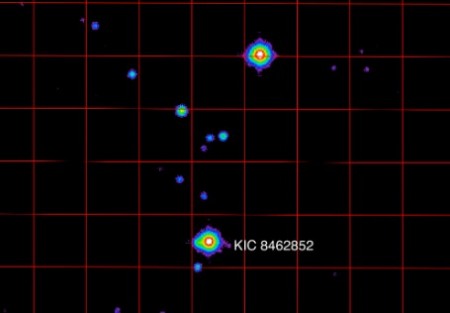
Among them is KIC 8462852 is presenting a mystery. It doesn’t exhibit the normal light dip of a transiting planet. Described as “bizarre,” Planet Hunters have studied four years of Kepler data as well ground and space observations. The star is classified an M-dwarf. It has no visible companion star which could explain the light-blocking observations. The star, seen in the image below, is displays a distinct protrusion on its left side. The light signature indicates no excess infrared associated with newly formed stars that have clumpy dust clouds accompanying them. And yet it appears to have clumpy objects in orbit around it.
So what could explain what is being observed? A few natural explanations described in the paper mentioned above include:
The problem with all these scenarios is they don’t adequately explain the phenomenon being observed. But SETI, the Search for Extra-Terrestrial Intelligence, may have an answer – an advanced technical civilization.
SETI researchers have proposed that extraterrestrial civilizations more advanced than ours might place massive objects in orbit around a star to harvest as much of its energy and light as possible. Jason Wright, an astronomer at Penn State University, argues that KIC 8462852 may be the home of such a civilization placing a “swarm of megastructures” around the star. Interestingly three astronomers including Boyajian and Wright have put together a proposal to point a large radio telescope at the star to try and capture radio wave frequencies which would indicate the presence of a technological civilization. If that study detects radio waves then they would request the use of the Very Large Array in New Mexico to further their investigation.
Can you imagine capturing the first radio waves of the alien equivalent of an “I Love Lucy“ episode? Now that would be something.
]]>