
Alexa – Techso Mogro https://techsomogro.com/ Science, Technology and the Future Tue, 07 Aug 2018 14:36:19 +0000 en-US hourly 1 https://wordpress.org/?v=6.8.1 Three Ways Voice Control Systems Like Alexa Are Shaping the Future of Smart Home Automation https://techsomogro.com/ways-voice-control-systems-alexa-shaping-future-smart-home-automation/?utm_source=rss&utm_medium=rss&utm_campaign=ways-voice-control-systems-alexa-shaping-future-smart-home-automation https://techsomogro.com/ways-voice-control-systems-alexa-shaping-future-smart-home-automation/#respond Tue, 07 Aug 2018 14:36:19 +0000 http://www.21stcentech.com/?p=26083 August 7, 2018 – Roy Rasmussen, coauthor of Publishing for Publicity, is a freelance writer who has contributed seven previous postings to Techso Mogro blog covering medical manufacturing, robotics, 3D printing, drones, and more. Roy’s clients include Fortune 500 companies and bestselling authors. He is the co-author of Publishing for Publicity. Recent projects include books on cloud computing, small business management, sales, business coaching, social media marketing, and career planning. As always your comments on contributions like this as well as any other postings to this website are welcome. And if you like what you find at Techso Mogro blog, please tell your friends to come and visit the site.


Voice-controlled digital assistants have become one of the most popular ways to interface with electronic devices. Voice-activated artificial intelligence (AI) digital assistants such as Google Assistant states Verto Analytics, are being used in 71 million American homes, representing 42% of all U.S. smartphone users. And Voicebot.ai states that voice-controlled smart speakers like Amazon Alexa are used by over 47 million Americans representing 20% of the adult population in the country. [Editor’s note: In Canada, the adoption of voice-controlled smart speakers hasn’t been as quick with an Edison Research and Triton report showing an uptake of 8% in the population 18 years of age or older.]

The popularity of voice-controlled interfaces is making them an increasingly common way for homeowners to control smart home devices. A Coldwell Banker survey has found that 48% of smart home owners already use voice controls, and 72% have expressed a desire to add it. .

The following describes three ways voice control systems are shaping the future of smart homes.

Integrating Entertainment Centers With Smart Home Control

For many smart home users, entertainment applications such as smart speakers and smart TVs are the gateway to home automation, a trend which is making entertainment centers the focal point of the smart home revolution. Smart speakers are often purchased for listening to music initially, but they provide a convenient, wireless method for connecting other devices to smart home systems.

Smart TVs, now found in 70 million U.S. homes, can serve as a convenient foundation for a smart home system, with TV screens doubling as a tool for monitoring the remaining smart devices. At this year’s Consumer Electronics Show (CES), industry presenters predicted that smart TVs would become the hub of smart homes in the near future. Consumers support this idea, with Parks Associates research showing two-thirds of smart homeowners and shoppers say they want devices that integrate with their home entertainment systems.

Enabling Voice-Controlled Security Systems

Parks Associates in polling smart homeowners has found that one of the most popular reasons to integrate entertainment centers is to use their smart TVs for home security monitoring. Security is the fastest-growing segment of the smart home market, as well as the smart home feature states Coldwell Banker, that consumers most respond to in marketing surveys. Today’s best security cameras and security camera systems have been designed to integrate with popular digital assistant systems to allow homeowners to use their voices in order to monitor and control home security.

For instance, you can use your smart TV or smartphone screen to view a video feed from security camera systems placed outside your home. You can then use your voice to control what is being viewed, telling the system which camera to view or which security footage to review. You can also issue voice commands. For instance, you can tell the system to turn your cameras to privacy mode, or use voice commands to open the front door remotely to allow in a visitor you have identified over the security camera. To ensure your applications remain secure and robust suppliers of these systems advise users to activate voice recognition features so smart home systems can distinguish who is an authorized user from who is not.

Providing Voice-Powered Appliance and Home Robot Control

Another emerging trend is to use voice control for managing smart home appliances. For instance, appliance manufacturers such as Frigidaire and Jenn-Air have introduced voice-controlled smart home appliances, ranging from thermostats and air conditioners to washing machines and ovens. In the future, you may be able to prepare a meal remotely from your living room or even from your car by issuing commands to a smart refrigerator and stove.

An extension of this trend is the use of voice control for managing smart home robots. For instance, Google has introduced a voice-controlled vacuum cleaner. Voice-controlled robots could conceivably be used for other chores such as cleaning bathrooms, folding clothes and mowing the lawn.

From entertainment centers to security camera systems to home appliances and robots, voice control is making it easier for smart home users to enjoy the advantages of home automation. And as voice control technology continues to gain popularity, users will be able to perform an increasing range of home tasks at the sound of their voices.

[Editor’s Note: We recently purchased a Google Mini and have found the experience interesting. We have yet to hook up our smart TV and lighting systems to it but I am sure in time I will get around to it. Our biggest challenge was getting our Mini to remember our dog’s name, Maya, after a neighbour told it a different name. We had to turn it off and start it over again until it now knows that Jello is not the name of our dog. If you have experiences using voice-control devices like Alexa and Google Assistant, please write to us here at Techso Mogro blog and we promise to publish your stories. Thanks again, Roy, for sending us this posting.]


]]>
https://techsomogro.com/ways-voice-control-systems-alexa-shaping-future-smart-home-automation/feed/ 0
Voice and Speech Recognition Go Mainstream Among Computer Interfaces https://techsomogro.com/voice-speech-recognition-mainstream-computer-interfaces/?utm_source=rss&utm_medium=rss&utm_campaign=voice-speech-recognition-mainstream-computer-interfaces https://techsomogro.com/voice-speech-recognition-mainstream-computer-interfaces/#comments Sun, 22 Jan 2017 20:06:33 +0000 http://www.21stcentech.com/?p=22127 January 22, 2017 – Based on the Consumer Electronics Show (CES) in Las Vegas this month, speech and voice recognition have passed a critical point with word error rates of 6.3%. That’s an improvement over the last 4 years from 23% and approximates human error rates. Stated Shawn DuBravac, Chief economist for the Consumer Technology Association (CTA) “We’ve seen more progress in this technology in the last 30 months than we saw in the last 30 years….Ultimately vocal computing is replacing the traditional graphical user interface.”


                                           Photo credit: ALamy


CTA estimates current usage at about 5 million voice-activated digital assistants such as, OK Google, Siri, Cortana and Echo. DuBravac expects the number to double in 2017. This is consistent with a move away from the traditional model of what is a computer. Today voice and speech can be built into not just smart phones, but all kinds of technology from wearables to vacuum cleaners. We can talk to machines and they can talk to us and say more than, “I don’t understand. Please repeat the question.”

I grew up with voice recognition technology. My first experiences were with DragonDictate, a speech-to-text interface that required me to train the software to recognize how I spoke. This was the early 1990s and if you wanted to talk to your computer you needed to install a dedicated digital signal processor. Even then speaking was concatenated. You had to separate each word, or you could teach the voice system to recognize a phrase and type it using word processing software like WordPerfect and Microsoft Word. Recognition accuracy after about 6 months of use was better than 90%. Macros within WordPerfect gave users the ability to voice move and formatting commands such as “next page” or “bold sentence.” It was a great leap forward but hardly a product for mass use.

Phone interfaces using voice recognition with carefully constructed menus and scripts got introduced in the first decade of this century. Some were very sophisticated but just as many were annoying as hell, making you want to press “0” to talk to a real human. They have been much improved. Today I can call a number and talk to an automaton that understands when I want to halt home delivery of my newspaper. It seems pressing “0” isn’t needed as much anymore.

And now that we are in the second decade of the century central processors are powerful and tiny. Voice and speech in smartphones is almost a no brainer. And sensory-laden smart devices can discern continuous speech with high degrees of accuracy, and they can talk back to you as well.  There are very few visual interfaces found in the smart technology that uses voice principally, things like wearable computing, (i.e., clothes), home assistants and robots, smart appliances, and smart devices. An entire home can be voice enabled with the latest built-in Internet-of-Things (IoT) sensory and device technology.

On full display at CES this year, Amazon’s Alexa stole the show. Google Home came a close second. Show goers could interact with Amazon’s home helper doing such mundane and daily activities as dictating a shopping list, making a voice request to turn off an appliance, dimming the room’s lights, lowering or opening window blinds, checking on restaurant reservations, doctor’s appointments, finding out what movies are playing locally, or the lowest airfare to book a holiday flight.


Interacting by voice with equipment on the factory floor is a new hot area of development. AT&T has starter kits, application program interfaces (APIs) designed to voice enable industrial equipment. Stated Mobeen Khan, Associate VP for IoT Solutions at AT&T “If I’m an engineer maintaining a machine with voice abilities, I could talk to it and run diagnostics just by speaking to it.”

Automobile manufacturers have bought into voice interfaces as an effective way to interact with the technologies available in today’s cars and trucks. Besides using smartphone voice apps like OK Google and Siri, speech and natural-language recognition is expected to be common in new vehicles by 2019 with the majority  featuring the interface. Nvidia, the graphic card manufacturer, demonstrated DriveWorks and AI-CoPilot, sophisticated artificial intelligence and voice recognition technology for automobiles at CES. The technology is capable of discerning the difference between an ongoing phone conversation in the car and a command request. It also can alert drivers to hazards ahead using signals, speech and even respond to a threat when the operator seems distracted. It can even read lips.
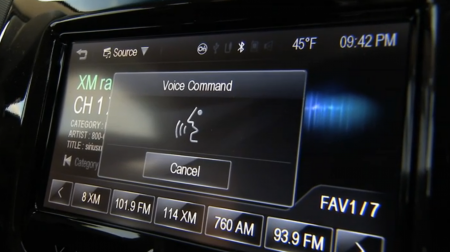
 

                               Image credit: Tradewatch Media
]]>
https://techsomogro.com/voice-speech-recognition-mainstream-computer-interfaces/feed/ 7