
The aircraft measures 72.5 meters (238 feet) in length and 15.2 meters (50 feet) in height. It is the world’s largest aircraft. A comparison illustration seen below positions it next to a Boeing 747-800, the second largest commercial passenger jet in use today.

Paul Allen, who along with Bill Gates, founded Microsoft, has spent a portion of his personal fortune chasing a childhood dream to be a part of the space programme. He has written, “After Apollo, NASA shifted to unmanned probes. Space lost its cachet, but it never lost my interest.” Now he intends to be part of the space race, and he has done this over the last four years, deconstructing two Boeing 747-400 aircraft and adapting six of their Pratt-Whitney jet engines to a new composite twin-fuselage combination wing and spar system.
Allen calls his creation, Stratolaunch, a reusable aircraft designed to put satellites into low-Earth orbit. The dual fuselages are made of composite materials. the right fuselage houses the flight crew. The left contains the flight data systems. The center wing and spar provide flight stability and the attachment point for one or more launch vehicles with payloads. Maximum launch capacity is 250,000 kilograms (500,000 pounds). Maximum weight for Stratolaunch at take-off is 590,000 kilograms (1.3 million pounds).
The aircraft can fly from standard jet-length runways. If it can handle a Boeing 747 it can handle Stratolaunch. Cruising altitude and launch point is approximately 9,000 meters (30,000 feet). At that height, much of the thick lower atmosphere lies below making launching and getting to orbit much easier.
Stratolaunch can be positioned anywhere a commercial jetway exists. Its flying radius, is 1,850 kilometers (1,150 miles), making it possible to move away from inclement weather to ensure safer launches.
With the rollout this week expect extensive ground tests before the first maiden flight. The first demonstration launch is scheduled for early in 2019. The launch will carry less than maximum payload, probably one or more Orbital ATK Pegasus XLs, a proven air-launch rocket that has previously put multiple Cyclone Global Navigation Satellite Systems into orbit.
Allen has a history of building spaceplanes. He teamed up with Burt Rutan at Scaled Composites to build SpaceShipOne which helped the two of them win the Ansari XPrize. SpaceShipOne was a smaller prototype for what is today’s Stratolaunch.
SpaceShipTwo, the successor to Allen’s first project, is now owned by Richard Branson. Branson hopes to launch an edge-of-space tourism business with it. And Branson also plans to put air launched satellites into low-Earth orbit in competition with Allen. Not to be outdone, DARPA has contracted Boeing and Aerojet Rocketdyne to build a multi-use spaceplane able to deploy payloads of 1,360 kilograms (3,000 pounds) to low-Earth orbit. These three should be in business before the end of the decade, dramatically driving down the cost to get to space.

The rocket used was the Pegasus XL and it was carried to a height of 11,900 meters (39,000 feet) by a jet before being released. After 5 seconds the rocket’s first stage motor fired, followed by a second and then a third. On board Pegasus XL was a satellite called IRIS, short for Interface Region Imaging Spectograph, part of NASA’s Small Explorer program and weighing 181 kilograms (400 pounds).
Pegasus XL’s third stage reached orbit and then was jettisoned. The IRIS satellite then unfurled its solar panels to begin its mission to study an area of the Sun’s atmosphere existing between the surface and the corona. This region between 4,800 and 9,600 kilometers (3,000 to 6,000 miles) above the Sun sees temperatures jump from 5,500 Celsius (10,000 Fahrenheit) to 1 million Celsius (1.8 million Fahrenheit) degrees and scientists as of yet cannot explain why this happens.
But it is the launch vehicle that intrigued me as another way for us to send payloads into low-Earth orbit. Orbital’s mated pair includes a 39-year old Lockheed L100 TriStar aircraft called Stargazer, after the fictional ship featured in a Star Trek: The Next Generation episode. The Pegasus XL was attached to Stargazer’s belly as seen in the image below.
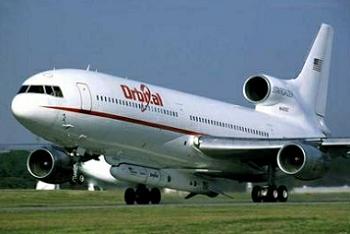
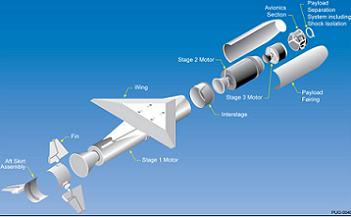
Pegasus has a chequered history. The first Pegasus was launched in 1990 mated to a B-52 bomber. Several launches followed, some ending in failure. The rocket then underwent several redesigns (see the rocket deconstructed in the image below) and this latest iteration called Pegasus XL may find itself used for other small payload launches.
But should Pegasus XL not get any more work, Orbital has a next generation version of the rocket up its sleeve. It is called Pegasus II, capable of putting payloads up to 6,100 kilograms (13,500 pounds) into low-Earth orbit. NASA may not be an immediate customer but two commercial space companies, Stratolaunch Systems (seen in the image below in flight with a Pegasus II dropping before igniting) and Scaled Composites‘ White Knight Two, Richard Branson’s launch vehicle for SpaceShip Two are looking to offer air-launch to low-Earth orbit services.
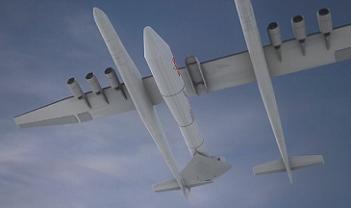
If Stratolaunch succeeds with its air-launch technology it hopes to not just send payloads but humans into low-Earth orbit, and a future version of an Orbital Pegasus may be what puts them there.
And why do we want to do this rather than use ground-launch systems. Because air-launch technology is cheaper which means the cost per kilogram of payload deployed in low-Earth orbit drops dramatically.
]]>