Recently, at a meeting of African forest conservation experts and researchers held in Nairobi, Kenya, workshops were held with 70 stakeholders and 18 countries attending. This was the latest meeting of the African Forest Forum (AFF), a pan-African non-governmental organization headquartered in Nairobi, Kenya. The AFF is an association of individuals both in and outside Africa who share a commitment to the sustainable management, use and conservation of the forest and tree resources of Africa for the socioeconomic well-being of its people and the stability and improvement of its environment. The forum meets regularly to focus on ongoing research, knowledge sharing, and innovation, looking at how to manage forest environments and capitalize on sustainable economic practices while at the same time addressing climate change.
Agroforestry provides a significant source of income for many African countries whether the sub-Saharan Sahel, the tropical and highland rainforests of Central Africa, coastal mangrove forests or the woodland forests of East and Southern Africa.
Forest agriculture sustains many national economies. Forest-harvested products include cacao, coffee, different fruits, lumber, gums and resins. The world market for many of these products is subject to price fluctuations, poor infrastructure, and export restrictions to countries that are the main buyers.
Focusing on forest sustainability including managing freshwater resources and soil improvements let alone carbon sequestration to make these ecosystems more robust is not front of mind.
Joshua Cheboiwo, Chief Research Officer and Director of the Kenya Forestry Research Institute who spoke at the July AFF workshop in Nairobi argued for a greater focus on forest sustainability to help create viable goods and services, jobs, alleviate poverty and fight climate change in Africa. He stated, “Africa needs a huge investment in forest production, processing and trade” arguing for more investments in paper, construction materials, furniture, packaging, printing, and textile production coming from Africa’s forests.
One of the biggest challenges for Africa is population growth. The current population of the continent is 1.46 billion. The projections indicate a population of 2.5 billion by 2050. That means an additional 1 billion more mouths to feed. For African nations, the challenge is to find the land upon which to grow the additional food crops that will be needed. And the demand goes beyond food with lumber needed to meet housing requirements. Wood harvested from African forests equalled 75 million cubic metres per year in 2020. It is expected to grow to 250 million cubic metres by 2030. The result of this population growth pressure will lead to increasing deforestation and degradation without considering other adverse effects caused by extreme weather events and climate change with growing evidence showing up in forest ecosystems. Livelihoods dependent on forest products are being negatively impacted.
As has been occurring here in North America, Africa’s forests are increasingly being subject to wildfires, insect infestations, and the spread of plant diseases as climate zones shift. Rainfall patterns are changing with prolonged droughts and rising temperatures contributing to water scarcity. Food security risks are growing. All of these climate changes are jeopardizing the environmental stability of the continent and making it harder for the countries of Africa to meet national net-zero and sustainability goals.
Recently, the AFF has become involved with campaigns to plant trees. The Greater Green Project in Zimbabwe plans to plant a billion trees in the country by 2030. Afforestation and reforestation projects are seen as vital to sustaining Africa’s forests to support ecosystems and many countries’ tree-based economies.
In addition, some Global North countries and businesses see sustaining African forests as a way to offset their carbon emissions. Among these is Norway which is paying Gabon to maintain its forests. And Volkswagen’s ClimatePartner program is funding afforestation and agroforestry projects in African countries. These Volkswagen carbon offset projects aren’t just about afforestation. They also have a strong focus on social co-benefits.
]]>
This is a relatively new idea for places like Europe and the United States. But for Global South countries, parametric insurance policies resonate. A policy can provide a farmer with crop coverage at a pre-determined price per hectare in case of loss or damage arising from extreme weather events.
The industry today is producing parametric policies not just for individuals but for governments where coverage includes damage payments caused to coastal areas and offshore reefs from hurricanes based on storm category thresholds exceeding agreed levels. The payments from these policies are immediate and can be used for restoration and recovery efforts.
Parametric insurance has been around for about two decades. In Africa, the offering, however, is recent. The World Economic Forum notes that parametric policies work well there because rather than indemnifying actual losses provide predetermined payouts. the advantages include claims getting settled quickly, and policies being customizable and scalable to specific circumstances.
Nidia Martinez, Director of Climate Risk Analytics at WTW, an insurance broker and consultancy, recently told the National Academies of Science Engineering and Medicine the following about the industry’s challenges in creating new types of insurance:
“One of the biggest challenges is designing insurance products that can be profitably offered by the private sector against potentially catastrophic risks …offered at a price point that people can afford and are willing to pay…that’s a real challenge, especially because we know that the people who need the financial protection of insurance the most are the least able to afford it.”
This is particularly true for the national governments of the Global South. Parametric insurance policies work well in this part of the world because these countries don’t have the deep pockets to pay for climate catastrophes. Policies that use metrics based on historical data to determine index thresholds make climate risk manageable for both the insured and insurer. If thresholds are exceeded payments to the insured are automatic.
To a degree, this removes the burden of climate risk for these national governments and makes extreme weather events and the response to them more manageable. At the same time, for the policy providers, it gives them an opportunity to plan for contingencies should a disaster occur making sure that money can be directed to areas most affected in a timely manner. This pre-approved planning saves lives and speeds up recovery.
African countries have taken to parametric insurance policies. Why? Because the continent has 17% of the world’s population, only produces 3% of global greenhouse gas emissions, and experiences the impacts of climate change and extreme weather events more than any other continent (Australia may be equally impacted but has deeper pockets to address its weather and climate crises).
In 2021, the United Nations reported 490 million people in Africa or about 40% of the continent’s population were living in poverty and most vulnerable to extreme weather events. The African Economic Outlook for 2022 reported that 5% to 15% of the continent’s gross domestic product annually was being lost to climate change and extreme weather events.
So where in Africa has parametric insurance worked?
These examples stand out when compared to many other areas within Africa facing similar climate, weather-related and other extreme crises. The United Nations Office for the Coordination of Humanitarian Affairs, for example, recently called for $1.8 billion to deal with drought-causing crop failures in Somalia, Northern Kenya, Djibouti and Ethiopia. These countries had no parametric insurance in place to help with relief. And they are not alone. Insurance for natural disasters and climate change across Africa is virtually non-existent.
The recent Sharm el Sheikh COP conference in Egypt agreed to a Loss and Damage fund with contributions from countries in the Global North to compensate countries most vulnerable to climate disasters. The terms and amounts still need to be worked out at next year’s COP. That doesn’t solve Africa’s immediate needs. But parametric insurance can help while Africa and other countries of the Global South wait upon the countries of the Global North to fork over much-needed compensation. It is the immediacy of this type of insurance that makes it a game-changer.
Subsaharan Africa saw a tripling in drought conditions after 1970. Extreme rainfall and weather impacted many nations in Southern Africa. Disease vectors rose dramatically with increases in malaria, dengue, Lassa and Rift Valley fever, Lyme disease, Ebola, West Nile Virus and others. Diarrhoeal diseases including incidents of cholera contributed to rising senior and infant deaths, particularly in areas where extreme weather caused extensive prolonged flooding. Those same areas experienced crop failures with food insecurity, malnutrition and famine responsible for an additional 1.7 million annual deaths across the continent. All of these conditions contributed to a 20% decline in the gross domestic product (GDP) in affected countries.
The sad tale of Africa is made even worse when you consider that its countries contributed far fewer greenhouse gas (GHG) emissions than the rest of the globe. So the least responsible have become the most imperilled.
Africa, today, is at the frontline of the climate crisis. The solution to its many challenges lies both within the continent but also elsewhere. Only the rapid reduction in GHG emissions from the largest contributors of these global warming gasses can begin to reverse the damage already done. But that alone will not be enough. African countries need financial and human resources to mitigate and adapt to ongoing climate changes. The longer Africa descends the spiral, the more destabilizing the continent will become with implications for the rest of the planet.
Today nations like Russia and China are exploiting the downward spiral. Russia is doing it with military assistance feeding growing conflicts. China is offering to build infrastructure like coal-fired thermal power plants that contribute even more GHGs to the air and financing them with loans that these countries cannot afford.
The Paris Climate Agreement of 2015 saw almost every nation on the planet agree to enact policies targeting the limiting of atmospheric warming to an ideal 1.5 Celsius (2.7 Fahrenheit) with an upper limit of 2 Celsius (3.6 Fahrenheit). At the time it was agreed that beyond these upper limits the world would experience environmental tipping points with catastrophic global consequences for humanity and all living things on the planet. Part of the Paris Agreement was a commitment by rich polluting nations to finance the nations most imperilled and least responsible for climate change to the tune of USD 100 billion annually. These were to be loaned to countries to finance adaptation and mitigation projects.
The money has yet to flow to these countries seven years later. This lack of execution of promises made is appalling. But it isn’t just the breaking of commitments to imperilled nations that is fallout from the Paris Agreement. Most of the biggest GHG-contributing polluters are not close to meeting targets despite all their public declarations. Canada is no exception with its attempts to counterbalance carbon pricing and fossil-fuel-production policies.
Russia is a pariah state with its war in Ukraine destabilizing global energy supplies and causing us to take our eyes off the existential challenges we face.
Brazil and Indonesia continue to destroy their rainforests. A megadrought dominates the American southwest causing the Colorado and Rio Grande Rivers to go dry. Extreme weather causes a third of Pakistan to be submerged. Meanwhile, rising sea levels increasingly erode coastlines and contaminate coastal freshwater aquifers with salt.
Depletion of the oceans continues with coral deaths and declines in fish populations. We read about ice sheets of doom in Antarctica, Greenland ice melt, and the disappearance of alpine glaciers that feed many of the major rivers where the largest concentrations of human populations live. It is our comeuppance for the lack of focus we are demonstrating in addressing the existential issue of modern times.
And then we remain amid a global COVID-19 pandemic that continues to test the limits of our technological, political and social competence. Despite the assertions of politicians and some medical “experts,” the pandemic is not over. We don’t have global herd immunity. What we have is growing pandemic fatigue leaving us more susceptible to the virus as we reduce our vigilance and the virus incubates and evolves in large numbers of us.
COP27 convenes in November in Sharm El-Sheikh, Egypt. It seems fitting that the conference is taking place in Africa. Among its many objectives is to see the disbursement of $100 billion annually to the most at-risk nations, identifying where, when and how much each country needs.
The original language related to the $100 billion described the money as loans to nations in need. One of COP27’s objectives should be to change the commitment from loans to grants. That would speak to the need to compensate those at risk who contribute least to global warming from those with money that also produce the majority of emissions.
COP27 should also continue to build on Glasgow’s COP26 focus on getting the private sector to participate as equal stakeholders in global climate outcomes. Industrial, financial, and other commercial partners should commit to delivering scaleable solutions to mitigate and adapt to climate change and provide the technology and expertise to African countries and elsewhere.
The atmosphere has already warmed more than 1 Celsius (1.8 Fahrenheit) and the warming is accelerating. We could blow past 1.5 Celsius (2.7 Fahrenheit) early in the next decade. Back in 2000, very few if any climatologists would have predicted that rate of increase. That’s why we can’t slacken our resolve even in the face of other geopolitical issues. Political and business leaders have to act now.
]]>
Professor René Pellissier, Program Manager for Climate Change and Sustainable Development from the Southern African Regional Universities Association (SARUA), described the need for alliances and partnerships across the continent to tackle local challenges. She called for incorporating the advanced technologies of the Fourth Industrial Revolution (4IR) as well as Indigenous knowledge to fight global warming. Pellisier pointed to the application of artificial intelligence (AI) in applied research to deal with migration, agriculture, and environmental issues. She sees a critical role for SARUA in the development of the curriculum for Africa’s youth as week as for the creation of programs to help governments implement climate mitigation and adaptation. She urged universities across the continent to embrace the United Nations Sustainable Development Goals 13 (SDG13) guidelines to help with climate change capacity building.
In a University World interview, Pellissier is quoted stating,
“The African region needs more effective use of the SDG framework as a guideline to adaptation and building resilient communities as well as ecosystem-based strategies to protect and restore ecological infrastructure in adaptation approaches. In other words, we need local solutions to local climate change problems.”
Pellissier says that Africa faces inequities in this fight. The continent is currently the smallest contributor to global greenhouse gas emissions. Yet because of its location is likely to be impacted the most from atmospheric warming and weather extremes. And Africa, being the youngest continent, with a median age of 19.7 years, has the most to gain from educating the current generation to start now because the majority will grow up with the climate change crisis unfolding around them even though they have done the least to contribute to it.
At the present pace of atmospheric warming, the planet’s mean temperature will increase by 1.5 Celsius over pre-Industrial Revolution levels within the next few decades. Each 0.1 Celsius increase above that United Nations target will make matters worse. Based on the current effort by nations around the world, we are more likely to see a 3 Celsius rise by 2100.
The International Panel on Climate Change (IPCC) in its most recent report indicates that all of Sub-saharan Africa will experience significant changes. The climate models show the Western Sahel experiencing longer dry spells. Central Africa will see its rainy season shorten but precipitation when it occurs will be heavier. West Africa will be hotter and will experience greater food insecurity as crop yields decline. And Southern Africa will see declines in precipitation of 20%, and water volumes in rivers and lakes will be reduced by up to 10%.
If the planet’s mean temperature reaches 2 Celsius higher, Southern Africa will see many more heatwaves. And the Sahel with a population of over 300 million, will continue to dry out. Why is this significant? Because the Sahel has Africa’s fastest-growing population, which was growing at an annual growth rate of 2.8% per year in 2019.
In the last three years, the Sahel has experienced drought and floods. Lake Chad, the largest body of water in the Sahel has almost completely vanished as climate change has increased evaporation and reduced precipitation. The Sahel has also experienced more armed conflict than anywhere else on the continent with the exception of Ethiopia. In 2019 conflict and climate change displaced 4.9 million people, and 24 million people required humanitarian assistance.
African universities and countries will need to see the rich countries of the world, the Global North, meet the $100 billion annual pledge to poor countries to help with climate change adaptation that was first promised at the Copenhagen COP in 2009. In the last month, John Kerry, the American climate envoy spoke at the United Nations indicating that the money first promised for 2020 will finally be a reality in 2023. Kerry noted that $100 billion a year is insufficient for the planet to keep the worst from happening with temperatures rising well past 2 Celsius. That annual amount won’t even cover the needs of African countries. That’s why Africans, like Pellissier, are calling for universities in Africa to band together to build local responses to climate change incorporating Indigenous best practices as well as 21st-century science and technology solutions.
]]>
African country’s agricultural policies are focused on increasing land under cultivation and crop yields. But the continent is facing the existential threat of climate change in ways far more severe than more temperate zones of the planet. African farmers are dealing with crop failures, drought, floods, locusts, armyworm invasions and other deprivations of a physical nature. What they don’t need is EU anti-GMO neo-colonial policies making things worse.
In the EU today, nineteen of its 27 member countries either partially or fully ban GMOs. The European Commission since 2010 has treated GMOs as new or novel foods that are subject to evaluation by the European Food Safety Authority (EFSA). This deliberative body not only looks at GMO crops grown in Europe but also those grown elsewhere that get imported into EU member states.
The organic farming movement within the EU sees anything GMO as a danger. And the organic movement’s lobbyists have been effective. Government aid programs and non-government organizations (NGOs) offering grants to African farmers are also anti-GMO. What this means for African farmers who want to increase yields to not only meet local food demand but also to create bumper crops for export, face not just environmental challenges but also regulatory ones. That’s because many African countries, in order to conform to EU regulations around food, also put anti-GMO roadblocks in the way.
The GLP describes these phenomena as neo-colonial anti-technology practices hyped up by “utopian visions of peasant African farmers working in the fields.” And because the EU and Africa are in close proximity, the two continents are natural markets for what each produces. Hence, African food exports are more likely to find their way into European supply chains and onto European dining tables than crops from other parts of the planet. For African farmers to meet both domestic and export opportunities, therefore, requires them to embrace advanced scientific agricultural practices in which GMOs increasingly play a part.
Agroecology conferences in Africa, largely sponsored by big European companies and NGOs, however, are often dominated by anti-GMO rhetoric. At such events, European presenters blame GMO enhancements of food staples as potentially dangerous leading to increases in cancer, birth defects, HIV/AIDs and more.
For example, a Germany-funded NGO, the Route to Food Initiative (RTFI), sponsored by the Heinrich Boll Foundation, states that its aim is to promote innovative solutions to the problem of chronic food insecurity in Africa. In Kenya where it operates, RTFI literature and practices demonstrate both anti-pesticide and anti-GMO bias. RTFI has been instrumental in getting Kenya’s government to ban the use of 160 globally approved, safe agricultural pesticides. The results of RTFI’s influence can best be seen in the devastation caused by recent locust and armyworm infestations. And the same is occurring where African farmers have sought GMO drought-resistant and salt-tolerant crops. These too are being targeted by anti-GMO propagandists to the detriment of farmers trying to deal with deteriorating environmental conditions.
Europe isn’t alone in contributing to the neo-colonial mindset when it comes to Africa. American-based NGOs and charities also are putting money into agricultural initiatives on the continent with anti-GMO strings attached. These “investors” in Africa’s agricultural viability include the Christensen Fund, Swift Foundation, Rockefeller Brothers Fund, Schmidt Family Foundation, and others. All have little understanding of the challenges African farmers face without using advances in science and technology to help meet local food demand, let alone yield bumper crops for export. The GLP describes the investors as “crusading white-knights riding to save Africans they believe are incapable of judging the science and technologies of modern agriculture on their own.”
A 2020 McKinsey report states, “Agriculture is critical to Africa’s growth and development, but climate change could destabilize local markets, curb economic growth, and heighten risk.” The last point about heightened risk refers to investor risk. But that’s not the risk about which I am concerned. The real risk for African farming is the decline in the physical environment because of climate change. With as much as 20 to 30% of African countries’ GDP coming from agricultural production today, this is where Africa’s risk lies. Higher day and nighttime temperatures disrupt plant growth, changes in patterns of precipitation swing from droughts to floods, and pest infestations like armyworms and locusts are linked to climate change.
Meanwhile, a lack of access to affordable capital sources for small entrepreneurs (I invest in microloans to African entrepreneurs including small farms through Kiva.org) which pretty much categorizes the plight of many African farmers, creates a greater dependency on charitable foundations and their handouts like the ones mentioned above, with many of the latter coming with strings attached that feel very much like neo-colonialism.
]]>Dominating the world’s banana market is the Cavendish variety. That wasn’t always the case. Before the Cavendish, there was the Gros Michel, or Big Mike, considered a sweeter variety that succumbed to a global fungal infestation wiping the plant off the face of the Earth. That’s because commercial banana farming is a monoculture growing a single variety exclusively even though there are more than 1,000 different types including the banana’s bigger brother, the plantain (also a banana). Not only is commercial banana farming a monoculture, but also the bananas are all clones of the originally developed Cavendish variety.
In 2015 I wrote that 85% of bananas grown in Africa are consumed locally. That makes the banana, whose origin is Africa, even more popular than corn, millet and cassava on the continent. A distant cousin of ginger, bananas in Africa and elsewhere, have seen numerous diseases wipe out billions of dollars of crops in the past decade. Joining Fusarium, a fungal infection also known as Panama Disease, is the latest, Banana Xanthomonas Wilt or BXW, a bacterium that infects the entire plant. Once BXW takes hold, farmers have to cut down, uproot, and burn the entire plant.
The threat to the banana represents a food security issue for much of the Developing World where the crop is consumed locally and serves as a vital source of nutrition. In 2017, 5.6 million hectares (13.8 million acres) of land was dedicated to banana production globally. The biggest producers grown for domestic consumption exclusively were India and China, the former producing an average of 29 million tons per year from 2010 to 2017, and the latter, 11 million tons. Other large producers during the same period were the Philippines, Ecuador, and Brazil, again almost exclusively to meet domestic demand. In Africa, Angola has been the largest producer of bananas. Ivory Coast and Cameroon grow bananas for commercial export to the European Union. Just as do Honduras, Costa Rica, and Colombia in Central and South America, for the North American market.
Bananas are an African food staple, an important source of nutrition. A threat to the crop from disease could lead to local famines. That’s why scientists in Kenya at the International Institute of Tropical Agriculture are working with CRISPR/Cas9, a tool derived from a natural process within bacteria that combines RNA and the Cas9 protein to become a DNA editor capable of slicing out bad genes and replacing them with healthy ones.
The Institute’s focus has been on two particular genes, one called the Downy Mildew Resistance 6 gene or DMR6, and the other, the DMR6-Like Oxygenase (DLO1) which is expressed and activated when a plant is infected. The researchers successfully identified replacement genes from non-susceptible barley plants and removed the defective ones, splicing in healthy replacements into recipients, hopefully, to produce a mutated variety that was bacteria resistant.
The Institute’s most recent work, published in the May 2021 issue of the Plant Biotechnology Journal, So far shows that in greenhouse conditions, the recipient plants have demonstrated normal growth even when exposed to BXW. The next step is a field study. If successful banana farmers will once more see their crop flourish.
States lead author of the published paper, Dr. Leena Tripathi, “Investment in the genetic improvement of banana holds excellent prospects for improving food security as these crops feed more people per unit area of production than other staple crops.”
]]> The many blank spaces indicate that grid-distributed energy is a luxury for much of the continent. But does Africa have to build a power grid infrastructure similar to those found in Europe and North America? Or can the continent develop an electricity distribution model that is a true reflection of the 21st century?
Think how much of Africa has implemented telephone infrastructure. Instead of telephone poles and landlines, the continent has been able to deploy mobile cellular networks with more than 650 million users on the continent. That number is greater than the number of cellphone users in either the United States or Europe. How has Africa created its cellular network without a parallel electricity grid provides clues as to how the continent should move forward on the issue of power.
Why not dispense with a grid entirely? I look at the picture below and see an interesting juxtaposition of old and new: a thatched-roof hut powered by a solar panel. Consider this a metaphor for how Africa can move ahead with electrical infrastructure different from Old and New World paradigms.

What Africa needs today is reliable electrical power. For much of the Sub-Saharan part of the continent, there is little to no electricity. According to United Nations-collected data, as of 2014, this has impacted 62% of the population.
Africa can leapfrog transmission towers and power lines, and go off-grid to a large extent by developing local distribution clusters powered by wind, solar, geothermal, and micro-nuclear while keeping the existing utility infrastructure of hydroelectric and thermal power plants without a larger investment. To go beyond local distribution of electricity, Africa may consider developing technologies such as microwave-energy transmission.
Today in Sub-Saharan Africa, off-the-grid small villages are connected to the Internet by standalone telecommunications installations like Clear Blue Technologies, a Toronto-based company. Each installation is powered by solar and battery backup and provides communities with WiFi Internet connectivity and phone service. The same technology is also delivering electrical power to villages, lighting homes and powering refrigerators and other appliances. So we know that off-grid can work.
But what about energy distribution clusters? In 2016, a building in Bloomington, Minnesota installed a microgrid, a distributed energy generation decentralized technology that no longer required hookups to long-distance transmission lines. In other words, it was grid-independent. The building was powered by a combination of natural gas turbines, a solar array, wind turbines, battery storage, a diesel backup generator and in the event of all the others failing, a utility connection to the local grid provider.
The city of Adelaide in South Australia has clusters of buildings in its downtown all powered through a series of microgrids, each with solar panels supplemented by battery backup and more conventional energy generation.
Then there is transmitting energy without wires. Emrod, a New Zealand-based company has developed a method of wirelessly transmitting electricity over long distances safely. Powerco, New Zealand’s second-largest energy provider, is its first customer.
And a quick note about microreactors. Earlier this week I posted a story about this emerging technology. These are small output modular reactors for use individually or conjoined where more energy capacity is needed. They can be dropped into almost any community to power a village or a cluster of companies independent of the power grid.
So does Africa need to fill the map above with more transmission lines? Not with what is available to them here in the 21st century.
]]>The federal-state experiment that first formed the United States was a confederation of thirteen separate colonial governments. The later Confederate States followed a similar constitutional structure during its short-lived existence. But the United States, Version 2.0, that emerged in 1789 was truly a federal state.
What’s the difference between confederation and a federation?
A confederation is a joining together of partner states in a mutually beneficial arrangement in which power is shared equally between the smaller jurisdictions with the central government.
A federation, on the other hand, places greater power in the hands of a central authority with the partner states having a diminished role. When the Confederate States attempted secession, the federal government in the United States began by passively resisting which ultimately lead to Confederate forces firing on Fort Sumter and the beginning of the Civil War.
The federal-state experiment that arose ninety years after the United States was borne, was a confederation of four British North American colonies. One had unique linguistic and cultural characteristics, Lower Canada known to today as Quebec. Only a confederation could make this union work and it came about because of the threat of conquest by the United States after the American Civil War.
The Dominion of Canada, a self-governing colony of the British Empire and a confederation may never have come about if there had never been a U.S. Civil War. By 1865, America had a battle-tested standing army fresh from the defeat of the Confederacy with the entire western hinterland open to it. In 1867, the same year as Canada’s Confederation, the United States acquired Alaska from Russia. British North America was now being squeezed from both the south and northwest. And Fenian sympathizing troops of the triumphant Union Army were staging raids into British North American territory.
The external threat was a great motivator for a union of four of the British colonies in North America followed by a fifth, sixth, and seventh joining shortly thereafter, and the acquisition of the lands of the Hudson Bay Company. Canada became a continent-wide confederation even larger than the United States. Within a few years, a transcontinental railway bound the confederation for good.
As I stated in a recent posting, one of the great failures of both federal systems was the unwillingness to recognize the land rights, languages, and cultures of native North Americans who were the original inhabitants of North America before European colonization. This remains an existing challenge to this day for both federal states.
Which is better in the 21st century? A confederation or a federation?
When Winston Churchill proposed a United States of Europe in 1946, did he have in mind a federation or confederation? In Europe, a union of its many cultures, legal systems, languages, and religions, seemed next to impossible. Years of war between nations and religions and left permanent scars. But after two World Wars in the 20th century, the idea of uniting Europeans into a single entity was seen as a way to end internecine strife for good.
Today the European Parliament, Council, and Commission provide a semblance of political unity for its 27 sovereign member states. But they do not exert authority over individual countries that form the Union. The central authority binds the nation members together. National identities remain the principal way citizens identify themselves. European Union citizens are French, German, Spanish, Portuguese, etc. Much of the power and decision-making of the Union are decentralized. Although citizens of the 27 member states vote to elect members to the European Parliament, voter turnout tends to be very low, and there appears within member states to be little interest in what happens there.
So Europe is more a confederation than a federation, less than Canada in terms of citizens identifying with the concept, and certainly far removed from the United States as a model of governance. Where Canada has a singular presence in dealing with other nations around the world, Europe’s 27 member states still deal individually with each other and with foreign countries.
Where the European Union has succeeded is in coming together with increasingly shared interests, continent-wide war has been prevented.
I give you two examples that you may think are unlikely. The first one may be the better bet. The second, however, could end a conflict that has been going on for more than seventy years.
The political divisions of Africa were largely determined by European colonizers and conquerors in the 19th century. They cut across tribal, religious, and ethnic lines, and served the European states’ desires to exploit African resources.
The independence of African states that began in earnest in the mid-1950s ending with South Africa emerging with the end of apartheid in the 1990s, has not led to an African renaissance as was hoped. Instead, the countries of Africa have struggled in their attempts to modernize infrastructure, raise the quality of governance, and the health and education of their citizens to meet the challenges of the 21st century.
Africa, today, is the fastest-growing continent by population. But in all other measures, it trails the rest of the planet.
Would a confederation help? Some Africans believe so. Beginning with regional associations of different independent states, Africa is slowly moving towards a common economic market and free trade zone. This is exactly how the European Union began starting in the 1950s.
Within Africa today there are already federal states: Nigeria, and South Africa to name two. But for Africa to harness the continent’s potential, a confederation would make a great deal of sense. In recent years the countries of East Africa have explored on numerous occasions a loose confederation. Similar ideas have emerged in the past for West and Southern Africa. All, so far, have petered out in time. But the example of Canada remains.
The Canadian union formed because external threats imposed a sense of urgency to join together for safety. In Canada’s case the threat was military. In Africa’s case, climate change may be the decisive impetus for a future confederation.
There are several outcomes for the more than 70-year conflict over what was the British Palestine Mandate established after World War One. The first would see Israeli dominion over the entire territory in a unitarian state and likely future wars with Arab-state neighbours. The second would see Palestine assisted by other Middle Eastern states forcing the surrender of Israel to what would become a Palestinian unitarian state. Then there is the two-state solution that no longer seems feasible since the failure of the Oslo Accords and the off-and-on-again peace process with the intransigence of political leaders on both sides. And then there is a fourth, confederation or a federal state that recognizes the identity of the two disputing parties within their own statelets.
Canada formed a confederation between English and French entities cohabiting the same land. Can Israelis and Palestinians do the same?
A confederation would establish sovereignty for each while creating a central authority for the purpose of achieving common interests. As crazy as this sounds, Muammar Al Qadhafi, the former dictator of Libya, back in 2003 proposed such a federal union of the two which he called Isratine. He noted that the name was only a placeholder.
His notion was that Israel and Palestine would be intertwined demographically and geographically in a unitarian federation. Qadhafi concluded the two would be better off together than apart.
He didn’t envision a confederation, but rather a federal system with a strong central authority combined with regional governments for the founding members, Israelis, and Palestinians. He argued that such a state comprising Muslims and Jews, Arabs and Israelis, would never be threatened by Arab neighbours and the long conflict would finally come to an end.
As much as Qadhafi was a rogue actor in the Middle East and on the world stage, the idea he proposed with some adjustments to implement a confederation conjoined by a central government to serve and provide common defense, healthcare, and other essential services, had merit.
An even grander vision of a common market combining Israelis, Palestinians, Lebanese, and Jordanians could come about in time with goods and services crossing borders and reducing the levels of mistrust that continue in this, the current world’s most intractable conflict. The common market was the first step to the European Union we see today and perennial enemies, France, and Germany, today increasingly cooperate for a common purpose. If it could work in Europe, why not the Middle East?
]]>
Futurists shouldn’t be talking about war but indeed, it appears that more effort and money is going into military invention and action than at any time since the lead up to World War Two.
The United States, with the largest armed forces and a bloated military budget, has been given through the last few administrations more money than reasonably needed to defend the country. And now an additional plus $50 billion is being thrown at the Pentagon with announcements that America is about to create the next generation of nuclear weapons and refurbish its existing deterrent.
In admonishing NATO countries about their lack of contribution to the collective defense of Europe, President Trump has goaded the nations of the European Union to up their military expenditures over the next few years. At the same time, the President has cast doubt on the concept of collective defense which has further pushed Europe into accelerating its rearmament. Recently Germany’s Angela Merkel declared to Germans and the rest of Europe that the continent was on its own. Over seventy years after World War Two, Germans are being asked to support an expanded military as a contribution to European defense.
China’s efforts to reassert itself as The Middle Kingdom by the mid-21st century has turned into not just an economic effort at expansionist outreach, but also a massive growth in military capacity including the establishment of hegemony over the South China Sea. The end result of these moves by China is producing an overall arms buildup in the western Pacific. Not only is the United States increasing its naval presence on, over, and under Pacific waters, Japan is ending its pacifist constitution to build a much large military regional presence.
And then there are all the regional conflicts on the go that, in some cases, could lead to an incident that sparks a much wider war. Here are just a few:
The Korean Peninsula
The country since the end of World War Two has been partitioned. Since 1950 the South and North have been at war although a ceasefire has been in place since 1953. The South and North have been pawns in the Cold War that dominated from the 1950s to the fall of the Soviet Union. China and Russia have been patrons of the North. The United States and an alliance of western countries have been patrons of the South. North Korea has developed intercontinental ballistic missiles. North Korea has developed nuclear bombs. The combination is seen as a direct threat to the South, Japan, and the United States. The Americans have a significant number of troops stationed in the South and keep the Pacific fleet nearby.
Strategy to contain the nuclear and missile threat from the North has included the trading of insults by the North’s leader and the U.S. President. It has included economic sanctions, trade restrictions, joint military training exercises in the South, and attempts to sever the relationships the North has with its Russian and Chinese patrons.
Of all the conflict zones on the planet, this one has the makings to become a global war pulling China and Russia in on one side while the United States, Japan, and other western countries attempt to neutralize the North’s nuclear and missile capacity.
The Middle East
There are so many points of conflict in this part of the world it is almost impossible to sort them all out. You have Shia Iran facing off against the Sunni Arab world, supporting a Syrian government that has been fighting against an uprising increasingly backed by different global powers. Russia has allied with Iran and the Syrian government to save the regime from collapsing. The United States and its Sunni Arab state allies have promoted Arab and Kurdish forces to fight the Syrian government.
Turkey, a non-Arab Muslim country, has entered the conflict carving out a buffer along its border with a separate goal to stop the Kurds from establishing a Kurdistan state which could ultimately cause war to break out within the Turkish nation itself. Turkey appears to be fighting everybody in this conflict, shooting down Russian warplanes, getting into battles with American troops supporting Syrian rebels, and launching an offensive against Kurdish controlled areas.
And increasingly Israel has been drawn into the Syrian abyss. Israel fears a future nuclear-armed Iran, and Iran’s client, Hezbollah, a militant Lebanese based group that has been fighting alongside the Syrian government forces and has been armed by the Iranians. Israel and Hezbollah have a history of wars fought on the former’s northern border. Hezbollah has fired missiles at Israeli domestic targets in these battles. Israel has bombed, and occupied southern Lebanon from time to time and has armed and trained Lebanese surrogates to create a buffer on its border. Hezbollah has supported the Palestinian cause in the latter’s bid to establish independence and end the Israeli 50+ year occupation of the West Bank.
But the Sunni-Shia confrontation goes beyond Syria. In Yemen, the Saudis and Iranians are fighting on opposite sides of a civil war that has devastated that nation.
Meanwhile, the Afghan conflict that began post-9/11, to wipe out Al Qaeda and its Taliban supporters appears to have no end in sight. That war has destabilized Pakistan in the process, a nuclear-armed country on the verge of chaos. And in the most ill-conceived post-9/11 strategy, has led to the conflict and collapse of the Iraqi nation-state, the rise, and the recent demise of the new caliphate, the so-called Islamic State.
So many flashpoints, so little diplomatic maneuvering room, so much bad blood based on centuries of religious and tribal hate, is there a bigger mess anywhere else on the planet than the one in the Middle East today? I’d say no and it is a wonder to me that a global conflict has not happened from the chaos that dominates this region of the planet today.
Post-Colonial Africa
The legacy of colonialism lingers in Africa to this day. Whether talking about Saharan, Sahel, Central, East or South African nations, this continent is in need of a restart. Probably the most significant flashpoint lies in the area of the Congo River where the Democratic Republic of the Congo, Uganda, Rwanda, and non-state actors in the form of guerrilla armies, continue to destabilize and disrupt the people of the region.
There are political and economic issues at stake here. The Congo’s government is in free fall because of a constitutional crisis. There are violent protests. The Congo’s mineral resources have brought non-state actors as well as Western governments and China into the mix. Parts of the eastern Congo have experienced interventions from neighbouring Uganda and Rwanda.
Meanwhile, the nations of Central and East Africa are being confronted by a plague of armyworms that are devastating food crops with no end in sight.
In the Sahel and Sahara al Qaeda affiliates and other jihadist militants are a threat to the populations of many countries from Mauritania, to Mali, to Nigeria.
The newest nation in Africa, South Sudan is in a state of perpetual civil war.
Libya, after the fall of Muammar Gaddafi, has its own civil war on the go.
Can Africa’s flashpoints be the spark that lights a global war? If the confrontation comes it may be sparked by China’s increasing economic and now military presence in Africa, and that nation becoming embroiled in a regional conflict. That could draw the former European states that still have interests and alliances with African countries in the post-colonial era.
Ukraine-NATO-Russia
Since Ukraine became an independent state, Russia has sought a “special” relationship with its neighbour. What started off as a civil partnership of equals has descended over the years into Russian efforts to dominate and coerce Ukraine through political interference, cyberattacks, economic threats, and direct and indirect military intervention.
Russia occupied the Crimean Peninsula just a few years ago. And then Russia supported an insurrection in eastern Ukraine that has led to more than 10,000 deaths. It is a wonder that Ukraine has survived the Russian assault. The way it has achieved this is by using the NATO card to keep its neighbour from swallowing it whole.
At one point Russian-supported rebels shot down a Malaysian commercial airliner as it flew close to zone controlled by the separatists. The fear in time is that another stupid move by a local rebel leader in the field could spark an international incident and bring Europe and the United States into a more direct involvement on behalf of Ukraine. Today Canada is training Ukrainian troops and security forces. It isn’t a great leap to go from training to collaboration in the field against a rebel force.
Russia denies its involvement in eastern Ukraine and yet it is its equipment and soldiers that are often seen conducting operations. If NATO forces act similarly with Ukraine then a shooting war in this area of the world could join those already on the brink of taking place in Syria today.
Other Flashpoints
I have not described the continuing India-Pakistan confrontation in Kashmir. Nor have I dwelled on the Rohingya, African, Syrian and Venezuelan refugee crises. Nor have I talked about climate change’s contributions to current and future flashpoints such as battles for water resources in the Nile, Mekong, and other Asian river basins.
Humanity faces enough challenges in the 21st century without having to worry about the potential of a worldwide conflict. Leadership is wanting. Saner heads need to prevail in many countries.
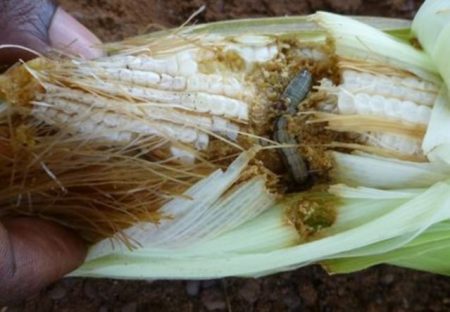
Armyworms are the caterpillar or larvae stage of a moth. They grow to about 4 centimeters (1.5 inches) in length during the three-week larval stage. Two weeks after they pupate they emerge as adult moths to start the cycle over again. The adult moths measure about 5 centimeters (2 inches) in wingspan and can lay up to 2,000 eggs before dying.
A species of armyworm is native to Africa. The African variety is slightly smaller than its American cousin and is partial to eating cereal crops like corn, wheat, sorghum, millet and rice, as well as pasture forage such as alfalfa. The American variety, known as the fall armyworm, has less discriminating tastes attacking about to 100 different plant species including important crops such as cotton, soybeans, peanuts and other groundnuts, potatoes, sweet potatoes, spinach, tomatoes, sweet peppers, cabbage and tobacco.
When armyworms infest a field you understand why they have been given their name. They literally march through a farm devouring everything in their path. They even consume each other when they run out of plants to eat.
What is their impact on Africa so far?
They first appeared in Nigeria and neighbouring West African states in January of 2016. Beginning last December they spread rapidly into Zambia and from there southward to South Africa. Eight countries have been infested with the biggest damage to corn (the principle staple crop of southern Africa). In Zambia, losses in corn could amount to 40% of the total crop. In Zimbabwe, seven of eight corn-producing areas are infested. In one South African farm, the owners report 80% of their corn crop damaged. The owner, Jacques Prinsloo, states, “these worms are eating everything they touch…last year the drought, this year the worms, what next year?”
The Prinsloo farm is not alone. Crops like corn, wheat, millet and rice are all under attack. When combined with the two-year drought, food availability in Africa’s richest country is expected to decrease by as much as 15%.
So what controls exist to stop them?
The most commonly used insecticides are pyrethroids. Another control is the introduction of genetically modified (GMO) corn which is resistant to armyworms. The problem with the latter is a general lack of enthusiasm on the part of African states to introduce GMO varieties. Why this is so has much to do with the relationship of African agriculture to the European Union, the latter whose prohibitions on importing GMO produce impact policy.
In the Americas, where the fall armyworm is being attacked by a combination of GMO crops and non-chemical solutions that introduce natural biological controls such as viruses, fungi and bacteria, crop damage has been lessened.
Another choice for Africa could be using local plant extracts as toxins or introducing sand dusting in corn fields during early plant growth as the leaves unfurl to act as an inhibitor. Armyworms don’t like sand.
]]>