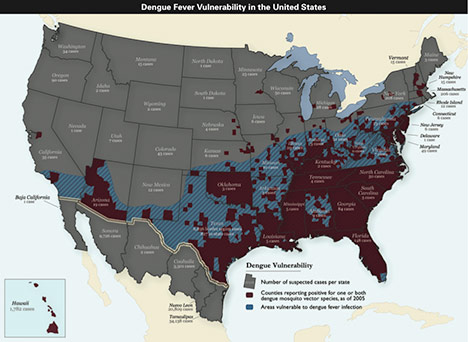
For example, the modelling showed that mosquitoes responsible for spreading malaria would gain between 1 and 6 additional months in the tropical highlands of Africa, the Eastern Mediterranean, and the Americas. And dengue would enjoy up to 4 additional months in the lowlands of the Western Pacific and Eastern Mediterranean.
The study concluded that the two mosquito-borne diseases would expand into more temperate areas putting an additional 4 to 7 billion people at risk by 2070. Densely populated urban areas in Africa, Southeast Asia, and the Americas would be most adversely affected.
The study noted that today, malaria and dengue are the greatest threat to human health globally with rising temperatures, changes in rainfall patterns, and increased humidity in formerly temperate regions of the planet the greatest influencers on the spread and transmission of both.
The study concludes with the following statement:
“The predicted increases in climatic suitability and population at risk of malaria and dengue highlight the importance of emission reductions to limit climate change and increased surveillance in potential hotspot areas to monitor disease occurrence and plan adaptation interventions in a warmer and more urbanized world. These actions are particularly important in transmission fringes, where public health systems might be unprepared to control and prevent these diseases.”
Global warming has reversed a trend that saw the spatial range of malaria decrease throughout the 20th century. Global incidences of the disease over the past five decades had seen a steep decline. But rising atmospheric temperatures are suddenly reversing the progress we had made in eradicating the disease’s presence.
Meanwhile, dengue has become the fastest-growing mosquito-borne viral disease over the last 60 years. Today it is endemic in more than 120 countries. And what makes dengue so dangerous is that its host, the Aedes aegypti mosquito is found in urban environments during a period when more people are living in cities found in these countries. Rising precipitation in some areas is creating standing water breeding opportunities for the disease’s mosquito hosts. And in rural areas in conditions of drought, the other dengue host, Aedes albopictus, seeks out water storage sites created by humans producing concentrated disease sources.
The study also points out that the spread of both malaria and dengue are horizontal and vertical. Horizontal, because the growth of the geographic area of coverage is expanding (see dengue world map above). And vertical, because the mosquitoes are finding a warming atmosphere makes it possible for them to find a habitat at higher altitudes.
There are three ways to stop this spread.
Currently, we are doing more about points 1 and 2, and failing miserably at point 3.
]]>
January 19, 2020 – For many the idea of modifying the genetics of anything is anathema. Genetically modified organisms (GMOs) are seen as one step too far in human engineering of plants and animals, going beyond selective breeding of plants and animals. But GMOs are increasingly offering us opportunities to apply the technology to fighting diseases.
In this case, Dengue, a disease spread by mosquitoes that causes fever, rash, extreme pain, and even death, is being targeted by researchers at UC San Diego and the Australian Animal Health Laboratory in Geelong, Australia, who are modifying mosquitoes.
Dengue is spread through mosquito bites, so what if they can be modified to resist the viruses responsible for the disease? Such a strategy would mean Dengue would no longer be transmitted by the insect and that would effectively impede the disease from spreading.
It is a mosquito-spread viral disease that is transmitted by female Aedes Aegypti and Aedes Albopictus mosquitoes. The viruses involved are of four types from the Flaviviridae family. A person who is infected by one of the viruses does not acquire immunity to the other three making them still susceptible to the disease. The mosquito hosts are the same as those that spread Chikungunya, Yellow Fever and Zika. Dengue, like other mosquito-borne diseases, predominantly inhabits the tropics although it has been migrating poleward as the Earth’s atmosphere warms.
Those infected by Dengue can be asymptomatic (showing no signs or symptoms), but the majority report severe flu-like symptoms. Severe cases include symptoms of internal bleeding, organ failure, and sometimes death. The Dengue found in much of South Asia and Central and South America is more often the severe version and has become a leading cause of hospitalization and death among children and adults in these regions of the world.
Dengue has expanded its range not just because the mosquito habitat is being expanded by climate change, but also because of travel with those infected taking the disease to new locales. As a result the incidence of Dengue is growing even though the disease is under-reported because of those who have it and are asymptomatic, and because it can be confused with influenza. But World Health Organization statistics estimate that 390 million get infected with Dengue annually with 96 million developing mild to severe symptoms. And because the mosquito habitat is widespread and growing, 3.9 billion humans are today at risk of infection.
Dengue is spreading fast. Before 1970, only 9 countries reported outbreaks of Dengue. Today the disease can be found in more than 100 countries with North America and Europe the latest parts of the world to report severe cases. Of the half-million annually who experience the most severe version of Dengue, 2.5% suffer mortality. Greater recognition of Dengue symptoms during early onset is seeing that percentage being to decline.
In an article published on January 16, 2020, entitled “Broad dengue neutralization in mosquitoes expressing an engineered antibody,” the authors describe their work to genetically modify mosquitoes to resist all four variants of the Dengue virus. They modified the insects by introducing an antibody that activates when the mosquito bites and ingests blood from a human or another animal host. The antibody blocks the virus from replicating effectively causing it to die. The researchers note that Dengue is only one of the diseases they intend to address using this method of genetic modification.

This is, states the authors, “the first example of an engineered transgene capable of rendering Aedes Aegypti mosquitoes 100% refractory to all four serotypes of Dengue.” They contemplate pairing their discovery with a gene drive to spread it through an entire disease-transmitting mosquito population. They believe the transgene approach should allow for similar GMO strategies om reducing the incidence and threat of other mosquito-borne diseases including Zika, Yellow Fever, and Chikungunya.
]]>
In this month’s Nature Biotechnology, scientists reported two successful trials using GMO mosquitoes, one in the Cayman Islands, the other in Brazil. The mosquitoes that spread the disease are Aedes aegypti and Aedes albopictus. Both are the main carriers of the virus responsible for the infection.
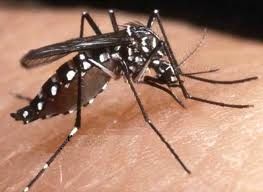
Today more than 2.5 billion on the planet are at risk to get dengue fever. Annual infections are estimated to be between 50 and 100 million. By 2085, researchers believe more than 5 billion on the planet will be at risk as global warming expands the range of the insects that spread dengue. That means a doubling of the number of potential cases without mosquito population control.
Dengue causes flu-like symptoms. In its mild form the fever runs its course over about two weeks. Severe cases (formerly called Dengue Hemorrhagic Fever) lead to hospitalization. In 2010, a half million severe dengue cases were reported to the World Health Organization. Of those 2.5% died from the disease.
How is the disease transmitted? By female mosquitoes who absorb the virus from infected humans and incubate it before transmitting it to anyone else they bite during their lifetime. Uninfected mosquitoes, therefore, become infected through human contact. Humans are infectious from about the 4th day until the fever resolves usually around the 12th day.
Where Aedes aegypti largely lives in tropical and semi-tropical climates, Aedes albopictus is capable of surviving in cooler climates. And it is the primary spreader of the disease into temperate climate zones in Europe and North America where cases of dengue are increasing. Dengue is potentially lethal when it is not detected and turns into the hemorrhagic version of the disease. It can cause severe bleeding and organ impairment accompanied by high fever and vomiting. There is no vaccine for dengue fever.
Up until now the method of control involved preventing mosquitoes from depositing eggs in standing water by applying insecticide through spraying programs. GMO is a new strategy for fighting the disease. In the Cayman Islands, a British biotech firm, Oxitec has introduced a GMO male mosquito containing a gene that causes offspring to die before maturing. The trial involved the release of 3.3 million GMO Aedes aegypti. The result, an 80% reduction in the mosquito population in the released area.
In Brazil, the program is being managed by Fiocruz Pernambuco, a Brazilian research institute, working with Oxitec. GMO mosquitoes have been released with results even more impressive than those in the Cayman Islands, a 90% reduction in the insect population.
Currently GMO mosquito programs have been approved for use to combat dengue in three countries: the Cayman Islands, Brazil and Malaysia. Proponents of GMO argue that the mosquitoes are sterile and that the genetic alteration, as a result, cannot remain in the environment. Those opposed raise concerns that even a small percentage of GMO mosquitoes might survive and propagate, arguing that there are too many unknowns when dealing with genetically modified animals, even mosquitoes. What would be the reaction of the general public if one of these GMO mosquitoes turned into a super bug and started to spread other insect-borne diseases such as malaria?