Subsaharan Africa saw a tripling in drought conditions after 1970. Extreme rainfall and weather impacted many nations in Southern Africa. Disease vectors rose dramatically with increases in malaria, dengue, Lassa and Rift Valley fever, Lyme disease, Ebola, West Nile Virus and others. Diarrhoeal diseases including incidents of cholera contributed to rising senior and infant deaths, particularly in areas where extreme weather caused extensive prolonged flooding. Those same areas experienced crop failures with food insecurity, malnutrition and famine responsible for an additional 1.7 million annual deaths across the continent. All of these conditions contributed to a 20% decline in the gross domestic product (GDP) in affected countries.
The sad tale of Africa is made even worse when you consider that its countries contributed far fewer greenhouse gas (GHG) emissions than the rest of the globe. So the least responsible have become the most imperilled.
Africa, today, is at the frontline of the climate crisis. The solution to its many challenges lies both within the continent but also elsewhere. Only the rapid reduction in GHG emissions from the largest contributors of these global warming gasses can begin to reverse the damage already done. But that alone will not be enough. African countries need financial and human resources to mitigate and adapt to ongoing climate changes. The longer Africa descends the spiral, the more destabilizing the continent will become with implications for the rest of the planet.
Today nations like Russia and China are exploiting the downward spiral. Russia is doing it with military assistance feeding growing conflicts. China is offering to build infrastructure like coal-fired thermal power plants that contribute even more GHGs to the air and financing them with loans that these countries cannot afford.
The Paris Climate Agreement of 2015 saw almost every nation on the planet agree to enact policies targeting the limiting of atmospheric warming to an ideal 1.5 Celsius (2.7 Fahrenheit) with an upper limit of 2 Celsius (3.6 Fahrenheit). At the time it was agreed that beyond these upper limits the world would experience environmental tipping points with catastrophic global consequences for humanity and all living things on the planet. Part of the Paris Agreement was a commitment by rich polluting nations to finance the nations most imperilled and least responsible for climate change to the tune of USD 100 billion annually. These were to be loaned to countries to finance adaptation and mitigation projects.
The money has yet to flow to these countries seven years later. This lack of execution of promises made is appalling. But it isn’t just the breaking of commitments to imperilled nations that is fallout from the Paris Agreement. Most of the biggest GHG-contributing polluters are not close to meeting targets despite all their public declarations. Canada is no exception with its attempts to counterbalance carbon pricing and fossil-fuel-production policies.
Russia is a pariah state with its war in Ukraine destabilizing global energy supplies and causing us to take our eyes off the existential challenges we face.
Brazil and Indonesia continue to destroy their rainforests. A megadrought dominates the American southwest causing the Colorado and Rio Grande Rivers to go dry. Extreme weather causes a third of Pakistan to be submerged. Meanwhile, rising sea levels increasingly erode coastlines and contaminate coastal freshwater aquifers with salt.
Depletion of the oceans continues with coral deaths and declines in fish populations. We read about ice sheets of doom in Antarctica, Greenland ice melt, and the disappearance of alpine glaciers that feed many of the major rivers where the largest concentrations of human populations live. It is our comeuppance for the lack of focus we are demonstrating in addressing the existential issue of modern times.
And then we remain amid a global COVID-19 pandemic that continues to test the limits of our technological, political and social competence. Despite the assertions of politicians and some medical “experts,” the pandemic is not over. We don’t have global herd immunity. What we have is growing pandemic fatigue leaving us more susceptible to the virus as we reduce our vigilance and the virus incubates and evolves in large numbers of us.
COP27 convenes in November in Sharm El-Sheikh, Egypt. It seems fitting that the conference is taking place in Africa. Among its many objectives is to see the disbursement of $100 billion annually to the most at-risk nations, identifying where, when and how much each country needs.
The original language related to the $100 billion described the money as loans to nations in need. One of COP27’s objectives should be to change the commitment from loans to grants. That would speak to the need to compensate those at risk who contribute least to global warming from those with money that also produce the majority of emissions.
COP27 should also continue to build on Glasgow’s COP26 focus on getting the private sector to participate as equal stakeholders in global climate outcomes. Industrial, financial, and other commercial partners should commit to delivering scaleable solutions to mitigate and adapt to climate change and provide the technology and expertise to African countries and elsewhere.
The atmosphere has already warmed more than 1 Celsius (1.8 Fahrenheit) and the warming is accelerating. We could blow past 1.5 Celsius (2.7 Fahrenheit) early in the next decade. Back in 2000, very few if any climatologists would have predicted that rate of increase. That’s why we can’t slacken our resolve even in the face of other geopolitical issues. Political and business leaders have to act now.
]]>
I thought it would be useful to borrow the Climate Council’s words and share them with you.
Taking action to address climate change is easier when you know and understand what information is out there from credible sources. One of those sources is this blog site. I have been researching the climate file for more than 12 years and a search request using words and phrases such as “climate change,” “global warming,” “carbon emissions,” “carbon pricing,” “greenhouse gas emissions” and “IPCC” will get you a treasure trove of reading and study material. Try it with the first phrase “climate change” and you’ll find over 1,020 articles. As you read them, don’t ignore the links to source documents from which the information comes.
Other great sources for information on climate change include NASA, NOAA, the American EPA now that Trump is no longer in charge, the United Nations and many university sites around the world
Contacting municipal, county, state, provincial, and federal representatives to voice your concerns about climate change and to ask for action by these various levels of government will convey to them that you and others are serious about reducing greenhouse gas emissions to mitigate the climate crisis. The more people who do this, the higher the profile for this issue. If you need help drafting a letter, let me know and I can supply a number of templates.
In the current pandemic environment, getting together to protest the lack of action by leaders in government is not safe. But using the powerful tools of the online world is an acceptable alternative. Politicians pay attention to social media whether it be Twitter, Instagram, Facebook, YouTube, or other applications. So share what you learn from legitimate, science-based sources. And share what you discover about net-zero climate solutions by spreading the word as widely as possible.
When talking with friends and family, don’t be shy about the subject of climate change, impacts, and solutions. As an informed person, the more people you engage in this discussion, the more valid knowledge you spread. So use your newfound climate knowledge to chat about where we are, and where we have to go to fight the climate crisis.
Australia has its citizen-based Climate Council. What do you have in your country that is similar? In Canada, we have the Citizens’ Climate Lobby. Around the planet, you can find 591 similar chapters of this growing grassroots citizens’ advocacy organization focused on national policies to address climate change. United States chapters are organizing to promote the passage of the Energy Innovation and Carbon Dividend Act through Congress, aimed at pricing carbon emissions to help achieve net-zero by 2050.
]]>In the last week we watched Canadian leaders gather from provinces, First Nations and the federal government, with a goal to establish a carbon reduction strategy starting with a carbon tax. There was little progress as some premiers facing elections put their interests ahead of the common good. In the end the agreement was to hold further talks in the fall with the idea of carbon pricing as something to do in the future. Not nearly good enough in light of what climate science, climate models and emissions tracking are indicating.
In similar fashion the U.S. Supreme Court decided to put a hold on the U.S. Government’s attempt to implement an Environmental Protection Agency initiative nationwide focused on reducing greenhouse gases and accelerating the closure of coal-fired power plants. The reason for blocking the EPA in a 5-4 vote was one of states’ rights with the belief that the agency was exceeding federal government authority under the American Constitution.
All of this hooey is a symptom of a much larger global malaise in addressing climate change. The European Union in the last week acknowledged that it cannot possibly under current policies achieve its carbon reduction targets by 2030.
It’s as if the goodwill and hope of COP21 have evaporated. And that is dangerous. Why?
The Reality Check of Climate Change
In a TED Talk by Alice Bows-Larkin, Professor in Climate Science and Energy Policy, University of Manchester, given in June of last year, she stated that current slow-to-act carbon reduction policies will lead to a global average rise in temperature of 4 Celsius (over 7 Fahrenheit) at the low end by the end of the century. And because temperature rises differ over continental land masses than oceans, that 4 Celsius rise will translate to urban temperature spikes as high as 10 to 12 Celsius (18 to almost 22 Fahrenheit) in years to come. Temperatures this extreme will make urban living conditions hell. That’s straight talk from a climate scientist who feels she has nothing to lose in telling it like it is. She is basing her insights on scientific evidence, not political expedience.

Bows-Larkin argues that economic progress in the Developing World to raise people out of poverty will put further pressure on Developed World countries because more greenhouse gases will get emitted for those countries to catch up. More greenhouse gas accumulation means higher temperatures.
The implications for global policy should be transparent. If Developing World countries emit more than Developed World countries must emit less. Have you heard any politician in the Developed World stating this? Of course not. After all what government wants to tell its citizens “sorry folks, for the next two decades we offer you austerity with all that implies or else we literally will be toasting and roasting.”
Bows-Larkin in her TED Talk quotes from a paper she co-authored in 2011 in which she states, “to avoid the 2-degree framing of dangerous climate change, economic growth needs to be exchanged at least temporarily for a period of planned austerity in wealthy nations.” She goes on, “This is a really difficult message to take, because what it suggests is that we really need to do things differently. This is not about just incremental change. This is about…..whole system change, and sometimes it’s about doing less things. And this applies to all of us, whatever sphere of influence we have.”
So what is the cumulative emissions issue leading to this dire prediction and what is the solution?
Carbon dioxide, methane and other greenhouse gases going into the atmosphere today remain in our atmosphere, some for decades, some for a century or more. Every day we burn more fossil fuel whether it be gasoline and diesel used by trucks and cars, bunker fuels in ships, aviation fuel in jets, coal in thermal power plants, and natural gas in homes, the emissions continue to accumulate. And even if we burn less of them now than in previous years we continue to add more cumulatively. That means the greenhouse gases aren’t going away in the immediate future and may linger for centuries.
Radical emission reductions represent the only way to avoid the high carbon future of extreme temperatures and weather for which our current infrastructure and society is ill prepared. No dialogue among nations at COP21, Developed or Developing, suggests we are dealing with the reality of the future we face. The science in climate models doesn’t point to the 1.5 or 2 Celsius limit talked about at COP21. Instead we face a 4 Celsius curve based on current policy and the pace of action by governments to address the climate file.
The graph below shows two diverging paths for our world’s climate. Current climate reduction actions by government is represented in the upper curve and the troubling trend it represents. The lower curve, the needed course correction, requires policy and actions to reduce carbon emissions by two-thirds between now and 2032 and to achieve zero net emissions from that year onward. That’s a tall order for governments who appear to be sleep walking about implementing climate change policies with any meat.

Whether it is Supreme Court intervention in the United States or stone walling by provincial premiers in Canada to withhold action on carbon pricing, we are being poorly served by those who hold the collective interest of nations in their hands.
So what actions have to happen?
Roberto Mangabeira Unger, Brazilian philosopher, politician and Harvard Law School professor, once stated, “At every level the greatest obstacle to transforming the world is that we lack the clarity and imagination to conceive that it could be different.”
Governments take heed. Innovation, imagination and action are needed to meet the climate challenge now. Anything less will mean collectively we have failed and the climate consequences for our children in a 4 Celsius warmer world will be dire.
]]>
Apparently, the elitist scientists’ conspiracy is working because China and the United States in the last two days, in a meeting of heads of state, came to agreement on tackling CO2 and other greenhouse gases setting specific targets for capping and then reducing human produced emissions.

The two countries produce 40% of the greenhouse gases we humans contribute to the planet. So having them agree to cooperatively attack the problem represents a huge step in obtaining global agreement on carbon reductions. I can imagine all the climate change deniers freaking out about now, worried about bankrupting their countries in pursuit of a problem that, in their eyes, doesn’t exist.
For example we have Stephen Harper, Prime Minister of Canada, who in the last couple of weeks, in front of the President of France, on a state visit, and in the presence of the House of Commons, baldly lied, stating that Canada was achieving sectorial carbon reductions on target to meet its United Nations obligations. More recently the Prime Minister has stated that there will be no action on climate change if it comes at the expense of Canadian jobs. But Harper’s focus is increasingly fixated on extractive production and the petrodollars it produces for the Canadian treasury as he pursues a balanced budget and the showering of political largesse on those constituents who have voted for him.
Then there is Tony Abbott, the Prime Minister of Australia, who has stated that “coal is good for humanity” and that any meeting of heads of state such as this weekend’s G20 summit, should be focused on job creation, not climate change. The response from 400 Australians today, on Sydney’s Bondi Beach, can be seen in a picture taken by Tim Cole, AFP, Getty Images, mocking the Prime Minister and his government for not putting climate change at the forefront his agenda.

So with the U.S. and China making their announcement this week we may have the breakthrough needed to develop a successor to the Kyoto Protocol that has some teeth. It cannot come soon enough. Yesterday, the International Energy Agency (IEA) released its annual outlook report forecasting demand and consumption tending to 2040.
If you don’t know the IEA, it is an independent agency composed from 29 member countries, most of them fossil fuel producers. Its focus is on energy security and production. Only recently has it moved from looking at supply and development to the implications of fossil fuel consumption and climate change.
Based on current trends the IEA predicts world energy demand to grow by 37% from today’s levels by 2040. Coal energy will plateau in the 2020s. Oil will reach peak energy usage much closer to the 2040 date. Throughout the period leading to 2040 renewables will gain ground rapidly while nuclear, although much diminished, will remain an important contributor to low-carbon energy productio.
The IEA report sees, in 2040, energy supply equally divided between low-carbon options (nuclear, wind, solar, geothermal, tidal, wave and biomass), and fossil fuels (oil, natural gas and coal). Of the fossil fuels, natural gas will be the most significant segment. Its contribution to CO2 emissions will not be offset enough by renewables to keep global mean temperatures from rising only 2 Celsius (3.6 Fahrenheit) degrees. Instead the IEA is forecasting based on current trends a rise of 3.6 Celsius (6.5 Fahrenheit) degrees. That has devastating implications for humanity and biodiversity. The IEA, therefore, is calling for “urgent action to steer the energy system on to a safer path.”
The United States and China may have just kick started the world in the right direction. They are not alone. Over the past five years an “A-list” team in Canada has been gathering to work on developing practical policies that reconcile environmental and economic goals. They call themselves the Ecofiscal Commission. From their website comes the following explanation of what is meant by ecofiscal:
An ecofiscal policy corrects market price signals to encourage the economic activities we do want (job creation, investment, and innovation) while reducing those we don’t want (greenhouse gas emissions and the pollution of our land, air, and water).
Ecofiscal policies offer real incentives for investment in innovative technologies so that we can continue benefiting economically from our natural wealth while also providing better protection to the environment.
The revenue generated from ecofiscal policies can create further economic benefits; for example, by reducing income and payroll taxes or investing in new technologies or critical infrastructure.
Who is behind the Ecofiscal Commission? If you are Canadian you may immediately recognize some of the faces in the picture below. Started by Christopher Ragan, a well-published economics professor at McGill University and former Research Fellow at the C.D. Howe Institute, he took three years to assemble his team. Those who he recruited include members of Canada’s who’s who, former prime ministers and premiers, cabinet ministers, political party leaders, chairpersons of not-for-profits and corporations, and current and former CEOs. He gave them the following challenge: create practical and smart policies for a fairer, more productive and greener economy.

On November 4th they issued their first report. It includes: putting a price on road congestion, air and water pollution, carbon and environmental risk. It recommends giving cities better fiscal tools. And it proposes removing subsidies from those industries that contribute to greenhouse gas emissions, water and air pollution.
For those on this planet witnessing the announcements and reports issued this week we should be both alarmed and grateful. Alarmed because it is clear that the current path will lead us to global mean temperatures considered dangerous by the Intergovernmental Panel on Climate Change (IPCC). And grateful because we are finally seeing leadership in action from the two heads of state of the countries currently responsible for 40% of the CO2 going into the atmosphere today.
Is the agreement satisfactory to those on the frontline of the environmental movement such as 350.org? Probably not. China will cap its emissions but not until 2030. The United States will reduce emissions by 2025, by 28% from levels in 2005. Both leaders have set these targets and both have indicated that exceeding them in a positive way is the real goal, not just meeting them. Both face domestic opposition. But this new and friendly competition between China and the United States is an important race to run because without it we will give our descendants a harsher place in which to live based on the current forecast of the IEA. They should know. There the ones producing the energy and the CO2.
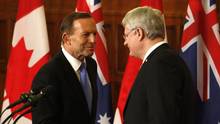
I read that the Prime Ministers of Canada and Australia in a joint news conference stated that they recognized that climate change is an important issue but not one to be dealt with if it sacrifices jobs and damages the economy. The Australian Prime Minister went on to state that his reasons for eliminating the carbon tax of the previous administration was for that purpose. Both commented on President Obama’s executive initiatives to address reducing carbon from coal-fired power plants in the United States.
Australia, we were told, is taking similar action even though it has gutted its budget for tracking the evidence of climate change on the nation.
And Canada, proclaimed the Prime Minister, has already taken even more significant action in that sector of its economy than the United States even with these new initiatives, while at the same time stifling and cutting budgets to national research on the issue of climate change.
The Canadian Prime Minister went on to state that no country will sacrifice jobs and its economy in an effort to fight climate change and that Canada is willing to be more frank about this than others.
His exact words: “It’s not that we don’t seek to deal with climate change, but we seek to deal with it in a way that will protect and enhance our ability to create jobs and growth, not destroy jobs and growth.”
Should I describe this as delusional thinking?
Or is the Prime Minister a realist for the age?
I would argue the former rather than the latter because living in the present and only dealing with the present is what has got us into the current mess that is playing out before the entire world:
These are just some of the obvious trends tracked by scientists who in both Australia and Canada are finding their voices being stifled by budgets withdrawn and “political facts.”
What the Australian Prime Minister was really saying is we want to continue mining coal and exporting it to Asia because that creates and keeps the jobs Australia has now. What he doesn’t want to admit is that coal extraction creates more carbon and when burned in Asian power plants further exacerbates global warming. But that warming he believes is not something of concern if only looking four years into the future.

What Canada’s Prime Minister is really saying is he wants to unlock the oil sands full potential by creating outlets to world markets through pipelines and increased production because that creates and keeps the jobs in Canada now. So what if oil sands extraction is carbon intensive? So what if right now it produces more CO2 than all other sources within the Canadian economy and is yet to be regulated in the same way President Obama is regulating emissions from the power sector, the U.S. largest source of emissions? So what if it expands even further and becomes an even greater source of greenhouse gases? National elections are a year away. Warming of significance may be decades away. And who can say that the next extreme weather event is really evidence of climate change? Prove it!

So let’s look at what can unseat this short-term thinking, the obsession of today’s national governments. What forces are at work to do this? The Internet, mobile communication, private enterprise initiatives, fund managers, social media, and think tanks have the means to bring the future into focus. As do local governments, those of states, provinces, counties and cities, who can do what is needed in the absence of national government resolve.
Conservatives argue that upsetting the applecart, the status quo, destroys an economy. Those addressing climate change need to counter status quo thinking through demonstrating policies and vision that stimulate economies through green initiatives.
Evidence abounds. In the Summer 2014 issue of “Corporate Knights,” the Green Provinces and States Report Card for 2014 looks at Canadian and U.S. jurisdictions measuring 10 key performance indicators that include the following among them:
In addition these governments are assessed for initiatives such as:
Conservatives say that whatever success these “green policies” have had to date will soon end up with debt. They will counter the successes achieved by local governments with the kind of “logic” expressed by the Australian Prime Minister who killed a national carbon tax instituted by the previous government arguing it was a job killer. Yet British Columbia, in Western Canada, where a carbon tax has been in operation for several years provides evidence of the contrary. The Province has seen job growth while reducing its carbon footprint.
But there are environmental spanners in the works of the global economy today very much focused on sustainability and the future.
Fund managers are asking important questions about their investments in the energy sector asking CEOs and boards to address the impact of climate change. For them it’s about the money and unburnable assets reflected on balance sheets. They are asking fossil fuel companies to come clean about the future.
Universities and colleges are divesting themselves of shares in fossil fuel and other companies not focused on green initiatives and a sustainable future.
Social networks are becoming the voice for a growing segment of global citizenry concerned about environmental consequences from bad policy and practices by governments to companies that don’t take responsibility for dealing with climate change and the future.
Is this a revolution in the making, a successor to the antiwar protest movements of a past age?
In the 1970s, when I was a younger man, the anti-Vietnam War movement was all about the youth of the day demonstrating against a U.S. government enacting policy that did not reflect their ideals and values. The anti-war protests spilled over into countries beyond the borders of the United States to become a global movement.
In the budding social movements of 350.org, Avaaz.org, the occupy movement, and others, the same holds true today. These are successors to the anti-war protesters of the past. And governments that forge ahead with policy not reflecting the reality of climate change, a reality of critical importance to youth, do so without recognizing the future consequences of their acts in light of these organizing bodies. Today 350.org offers a virtual curriculum on organizing and acting against those in power and in corporate head offices that don’t address climate change and the future.
Finally, inaction about the future and climate change, shouldn’t be left to the struggle of young people. The elderly and the middle-aged are equally impacted by climate change happening now, something that President Obama spoke about at length recently. I know the President gets it but others in the U.S., at the national level, appear unable or unwilling to act to alter the future in a positive way. Let’s hope that the groundswell from below keeps its eyes firmly set on the future, organizing and acting on climate change to acclimate and mediate the changes the future will bring in the 21st century and beyond. We can ill afford to be led by the “more frank” Prime Ministers of this world.
]]>
One of them, Miguel Veiga-Pestana, Vice President Sustainability Strategy and Global Advocacy at Unilever, in a recent comment urged all companies to “future proof their operations…..step off the sidelines and move into action.”
What was his subject? Climate change. He went further and stated, “if every major company affected by climate change – not only in the food and beverage sector, but other impacted sectors such as tourism, insurance and transport – were to address the issue as one of business survival, and step change their efforts for delivery, we could together make a significant impact.”
These comments by a senior manager of one of the top ten food companies in the world has implications for us all. Unilever is taking the subject of climate change and improving its ability to mitigate the risks throughout its entire organization and supply chain. It is, therefore, influencing the many other companies with which it does business.
At a recent meeting held in Abu Dhabi, the CEO of the company, Paul Polman spoke of t he growing support among businesses worldwide for action on climate change. He mentioned a groundswell of support with thousands of businesses representing 10% of global GDP who:
In his speech he stated that evidence is apparent to business that “the cost of inaction is now greater than the cost of action,” citing the $2.7 trillion U.S. spent in the last decade to deal with natural disasters, a much larger number than in past decades and much of the increase attributed to a warming atmosphere.
Words of encouragement included the following:
Why is business on board? It’s about survival. It’s about future proofing. Polman’s entire speech is well worth the read. It should be sent to the in-box of every CEO in every business on the planet. It should be sent to every government leader and representative. It should be a conversation in which we are all engaged with singular purpose. When Polman speaks of the things business needs from government, he is speaking for all of us when he says, “Business needs three things from the political community: Clarity, Confidence and perhaps most of all, Courage.”


