In December, I wrote about Make Sunsets, a company that took it upon itself to dump aerosols into the upper atmosphere to reflect sunlight and cool the planet. Well, it turns out that other non-state actors are getting into the act according to an article that appeared in on December 16, 2022, in Science. Paul Voosen, a reporter for the magazine, describes a University of Notre Dame experiment carried out in May 2022 in the Apalachicola Estuary in Florida. Researchers released an alkaline powder, a material used in cement, into the water and then tracked its impact on pH levels, and the local shellfish population’s health. The experiment was designed as a field demonstration for a technique called ocean liming that has been proposed by geoengineering advocates.
What’s the environmental problem that ocean geoengineering is meant to address? Because of rising levels of carbon dioxide (CO2) in the atmosphere from human activity, and because the ocean is a carbon sponge, carbonic acid is changing the pH levels of the water. This is threatening corals and shellfish.
We’ve seen geoengineering water stories before. Acid rain from sulphur dioxide (SO2) chimney-stack emissions caused the pH in lakes and streams to fall until governments imposed regulations to force polluters to curb smokestack emissions. Well, CO2 is doing what SO2 was doing to lakes and streams, but this time the former is making the oceans more acidic. Because the volume of water is significantly larger, however, the decline in pH has been incrementally slower than what happened with acid rain. Back then, a number of lakes were limed to try and neutralize acidity with inconclusive results.
Efforts to combat acid rain may have inspired a rogue actor, Russ George, in July 2012, to dump 100 tons of iron sulphate into the Pacific Ocean causing a massive algae bloom that at one point extended 10,000 square kilometres. George chose iron sulphate while others have proposed dumping crushed limestone as a way to neutralize carbonic acid that forms when the ocean absorbs CO2.
Scientists have recognized there could be unintended consequences to ocean geoengineering. This includes oxygen depletion when the algae bloom dies off, formations of toxic algae blooms like red tide, and unintended changes to the water column as added acid-neutralizing materials sink and impact ocean biodiversity.
And now we can add the University of Notre Dame experiment to trial geoengineering being conducted with no more than local approval from officials at the Apalachicola National Estuarine Research Reserve who signed off to give permission with little understanding of the potential disruption that could occur to local marine life. Fortunately, the alkaline enhancements didn’t produce any noticeable negative environmental impacts. Small perturbations in CO2 levels for a short period of time were noted with drops of 70 parts per million (ppm) to an average reading of 200 ppm where the dumps occurred, less than half of the level of CO2 readings in the atmosphere.
The reason for picking the Apalachicola Reserve for this experiment was that oyster populations there were in decline. So the experiment included monitoring oyster health and measuring microbial water content throughout to note any changes. It was impossible to draw any conclusions on whether liming of the water had any long-term impact although no red flags in the short term were noted.
Similar experiments have been done in other locales. Sodium hydroxide (found in lye, soaps and detergents) has been dumped into the ocean off Australia’s Great Barrier Reef in recent years. And iron-coated rice husks have been distributed in the Arabian Sea. In both cases like the one in Apalachicola, research has been inconclusive.
A flaw in all of these geoengineering dumping experiments is the lack of understanding of the CO2 produced to make the materials being dumped. For example, lime requires the heating of limestone which releases as much CO2 in the atmosphere as would be taken up by the oceans when the lime is dumped.
A researcher involved in the Apalachicola experiment acknowledged that if we are collectively to go the geoengineering route to mitigate climate change impacts, altering the chemistry of seawater is more controllable than adding aerosols to the atmosphere. That’s because adding chemistry to seawater has only a short-term impact whereas adding aerosols to the stratosphere can have consequences that last many years.
A much better strategy to reduce ocean acidification would be to use nature to sequester the CO2 humans are putting into the atmosphere and ocean. An initiative off the coast of Namibia is cultivating giant kelp forests. Similar efforts are being made to grow seagrass in coastal areas. Unlike dumping, these approaches don’t involve chemically manipulating seawater. And both encourage increases in biodiversity.
]]>I would gather my investigational tools, sampling bottles, nets and waders and head off in search of tadpoles, dragonfly nymphs and all kinds of other aquatic life. With bottles filled I would return home and populate my freshwater aquariums so that I could study my finds.
Amon the specimens I collected were daphnia, the common water flea. It was fascinating under magnification to watch them as they swam. Eventually my tadpoles turned into frogs and my dragonfly nymphs emerged to fly away. I think the neighbours must have wondered often what kind of menagerie was going to hatch next. It amazes me to this day that my parents tolerated all of this.
But what brought back these memories was an article that appeared in a local paper a couple of days ago entitled, “Acid rain leaves ‘jellification’ in Muskoka, Haliburton lakes.” The author, Kate Allen, talked about the disappearing of daphnia from lakes in Ontario, and the reasons hypothesized by freshwater biologists for this phenomenon. It also talked about what was replacing daphnia in abundance because of their decline, a spcies called holopedium. That’s daphnia on the left and holopedium on the right in the picture below.

They don’t look significantly different but they are. Daphnia are an important part of the food chain of freshwater lakes. They are symptomatic of healthy, nutrient-rich freshwater systems. And they are food for a chain of water creatures from salamanders and newts to small fish. And daphnia require calcium rich water to ensure their health.
But declining calcium is the unforeseen consequence I refer to in the title of this posting. It appears that it has been leached from the lakes accelerated by the legacy of acid rain and forestry. Acid rain was an environmental crisis fought in the 1970s and 80s by environmentalists who were able to get legislation passed for the installation of pollution abatement technology to remove sulphur from smokestack effluent. That sulphur was causing sulphuric acid fallout as it combined with water vapour in the atmosphere. As the acidic rain fell on lakes and rivers it lowered pH levels and leached out the calcium. The cutting of timber near freshwater lakes also reduces calcium levels in water as the byproducts of cutting wash into rivers and lakes lowering pH levels.
And although forestry practices remain the post-acid rain era was supposed to restore lakes to normal pH balance. But alas, not calcium levels and the poor daphnia with depleted stores are being pushed out by holopedium, a competitor who appears to be less fussy about low levels of the mineral in freshwater. Apparently holopedium’s carapace is thinner than daphnia and not as susceptible to low calcium in the freshwater environment. Hence holopedium is on the increase.
The evidence gathered by freshwater biologists and published in The Royal Society Proceedings B is entitled “The jellification of north temperate lakes.” The authors of the study note the phenomenon of daphnia decline and holopedium increase observed in aquatic ecosystems from eastern North America to northern Europe. Lakes once dominated by daphnia are now seeing the growth of holopedium and this is impacting other wildlife. It turns out fish and freshwater life that fed on daphnia are not too keen about holopedium as a substitute. For those who do eat the holopedium it is proving to be a poor nutritional substitute because of its lower calcium levels. So as holopedium populations grow, native wildlife higher in the food chain is compromised,, an unforeseen legacy of acid rain.
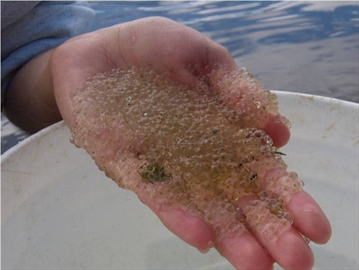
And why do the scientists refer to this as the jellifcation of the lakes? That’s because a handful of holopedium is very jelly-like. The picture below was taken by Ron Ingram of the Ontario Ministry of the Environment. That’s holopedium in hand with the look and feel of jelly.
“Dumping Iron in the Ocean Violates UN Agreements”
Headlines similar to the one above appeared in newspapers throughout the world. The articles spoke of violations of United Nations’ agreements, of a rogue engineer experimenting on the living ocean without consultation, of the violation of Canadian sovereignty. Why?
An American businessman, Russ George (seen below), dumped 100 tons of iron sulphate in the Pacific Ocean off the British Columbia coast in July. Apparently he did this without the knowledge and consent of the Canadian government. The end result was an algae bloom covering more than 10,000 square kilometers (3,861 square miles) of ocean surface, an area twice the size of the state of Delaware.

Geoengineering the Ocean to Reduce Carbon in the Atmosphere
Iron and lime ocean fertilization have been proposed as a way of dealing with atmospheric carbon dioxide. The idea behind lime has been looked at by an open source organization, Cquestrate, set up a few years ago to carry out an experiment similar to that which happened this past July with iron. But to-date know liming of the ocean has happened although lime was experimentally applied to lakes back in the latter part of the 20th century to counter the impact of acid rain.
So what is the big deal? There may be unintended consequences to Mr. George’s experiment. Oceanographers point out that it is impossible to know the long term impact of iron or lime seeding activities. They have expressed concerns such as:

Apparently Mr. George convinced the chiefs of the Haida nation living on the islands of Haida Gwaii, off British Columbia’s West Coast, that his seeding experiment would benefit the local ocean to help restore salmon populations. It is reported that $1 million sealed the deal.
In an article that appeared in Nature in July of this year, and that was prominently listed on the Haida Salmon Restoration Corporation news site, the Haida espoused the theoretical benefits of iron seeding the ocean based on research from the European Iron Fertilization Experiment (EIFEX) conducted in 2004 on 167 square kilometers of ocean water in the Southern Hemisphere. That study was led by marine biologists at the Wegener Institute for Polar and Marine Research in Bremerhaven, Germany.
With the postings on the the Haida website it is hard to believe that the Canadian government was unaware of what Mr. George was doing. It would seem, therefore, that the subsequent uproar is a bit of a public relations effort to distance the government from any potential fallout.
Mr. George may be in violation of the United Nations’ convention on biological diversity and be prosecuted for illegal dumping in the open ocean, but no one in the United Nations or in the Canadian government can claim that his experiment caught them unaware. After all Mr. George has been advocating for iron seeding the ocean for a number of years through the company he has created.

]]>
What’s a megacity? By definition it is a city with a population greater than 10 million. On the planet today there are 23. By 2025 we will have 37. By 2050 6.3 billion of us will live in cities.
Between 1995 and 2005, the urban population of the Developing World grew at an average of 1.2 million humans per week. By 2050 the World Health Organization estimates that the urban population of the Developing World will have more than doubled, increasing to almost 5.2 billion.
Why Megacities Represent a Health Challenge
Cities are intensive. Megacities are even more so with high population densities, high energy consumption, high levels of pollution, significant heat islands, and large amounts of emitted greenhouse gases.
Megacities can impact climate locally or regionally. Depending on their location megacities can in large concentration be more impactful on weather than megacities spaced over larger geography. And when you look at the spacing of megacities today and tomorrow you note that most can be found along coastlines.
Coastal megacities and marine environments create an interesting chemical mix. Sulphur and carbon emissions, ground level ozone, nitrogen, smoke and other urban particulate matter interact with seawater and freshwater to produce smog containing lead, carbon monoxide (CO), sulfur dioxide (SO20, nitrogen dioxide (N2O) and ozone (O3). Power plants, necessary for keeping the lights on and homes heated and cooled, are big contributors of sulfur and nitrogen that leads to acidified rain. This effects the biodiversity of adjacent marine and freshwater environments.
Ground level ozone also called tropospheric ozone, to distinguish it from the ozone layer in the high atmosphere, accumulates as a byproduct of nitrogen oxide and sunlight and is an even greater human health hazard than smog. Internal combustion engines are the biggest ozone contributors.
Megacities are notorious for airborne particulate matter from dust to smoke to soot. They like ozone contribute to respiratory illness and impact climate by effecting cloud formation. Industry, energy production and transportation are the major particulate matter contributors.
The Net Health Impact
Megacity pollutants in developing countries cannot be underestimated. In a recent World Health Organization study, 42% of all respiratory diseases in the Developing World were attributed to poor air quality, particulate matter and ozone being the primary culprits. Children were most often the victims with pneumonia, bronchiolitis and bronchitis causing 20% of the 10.6 million child deaths under the age of 5. And when it comes to human illness pollutants don’t stop at the lungs. Research has shown that they impact other body systems including the heart and circulatory system. Pollution can affect heart function, blood pressure, blood coagulation and be a trigger for strokes.
Megacities and Climate
Because megacities are major sources of air and heat pollution even though they only occupy a small percentage of the total land mass of the planet, they play a role in climate change.

The heat island effect of cities with limited forest canopy with concrete and asphalt absorbing solar radiation has a local net temperature increase within megacities and in their immediate hinterland.
Which Cities Are Most at Risk?
Although there are many megacities in the Developed World, they are no longer in high growth mode. It is the cities of the Developing World cities that are about to go “mega” or have already gotten there that are most at risk. The following is a list of some of those cities that are experiencing the issues raised in this blog. Governments at both the national and municipal level in these cities will need to find solutions that mitigate these risks.
Megacities of the Developing World
Abidjan – currently the sixth largest city in Africa, capital of Ivory Coast, with a population of 8.9 million in 2006.
Accra – currently with a population of 5.7 million and the capital of Ghana.
Bangkok -capital of Thailand with a population of 9 million in 2010, growing to 10.1 million by 2015.
Beijing – capital of China with a population of 16.3 million in 2008.
Buenos Aires – capital of Argentina with a population of 13 million in 2010, growing to 13.7 million by 2025.
Bogota – capital of Colombia with a population of 8.5 million in 2010 and projected to grow to 10.5 million by 2025.
Cairo – capital of Egypt with a population of 12.7 million in 2010 and expected to reach 13.75 million by 2015.
Calcutta – in India with a population of 15.6 million in 2010 growing to 17.25 million by 2015.
Delhi – capital of India with a population of 15.1 million in 2010 growing to 16.8 million by 2015.
Dhaka -capital of Bangladesh with a population of 18.3 million in 2010 and growing to 21.1 million by 2015.
Guangzhou – in China with a current population that exceeds 25 million. This city has passed Mexico City to become the second most populous in the world.
Hyderabad – in India with a 2010 population of 9.3 million and growing to 10.5 million by 2015.
Jakarta – capital of Indonesia with a 2010 population of 15.3 million and expected to reach 17.2 million by 2015.
Karachi – Pakistan’s economic capital with a population of 16.6 million in 2010 and growing to 19.2 million by 2015.
Kinshasa – in the Congo with a population of 7.6 million in 2010 and expected to reached 9.4 million by 2015.
Lagos – federal capital of Nigeria with a population surpassing 20 million today and expected to increase to 25 million by 2025.
Lahore – Pakistan’s second largest city with a population of 8.5 million in 2010, growing to 9.96 million by 2015.
Lima – capital of Peru with a population of 8.8 million in 2010, growing to 9.4 million by 2015.
Madras – in India with a 2010 population of 8.2 million growing to 9.14 million by 2015.
Manila – capital of the Philippines with 11.56 million in population based on 2007 data.
Mexico City – the Western Hemisphere’s largest city today and the capital of Mexico with a current population of 21.2 million.
Mumbai – India’s economic capital with a population of 23.6 million in 2010 and growing to 26.1 million by 2015.
Pearl River Delta – a conurbation that includes Hong Kong and outlying cities with a total population of 47.9 million as of 2009.
Rio de Janeiro – grew to 11.9 million in 2010 and is expected to level off at 12.6 million by 2025.
Sao Paulo – the business capital of Brazil with a population of 20.3 million in 2010 and expected to grow to 21.6 million by 2025.
Seoul – the capital of South Korea with a population of 23.9 million in 2008.
Shanghai – China’s financial capital with a population of 19.2 million in 2009.

One way the country is achieving this goal is through incineration with recycling programs feeding waste-to-energy power plants of which, currently there are eight throughout the country.

Today in Sweden only 4% of household waste goes to landfill. The remainder is managed as follows:
The 49% consumed by incinerators gets used to generate heat and electricity for buildings and homes throughout the country. Today in Sweden 20% of all homes are heated by hot water and 250,000 homes their electricity, both from burning garbage. As a result Sweden finds itself with not enough garbage from domestic sources to meet energy and heating demand and has started to import waste from other countries. Currently, Norway is the principal supplier, exporting 800,000 tons of its trash to Sweden annually.
Globally waste-to-energy power plants are showing up in a number of countries. But in Europe, Sweden is the only country that consumes other countries garbage to meet its energy demands. Here in North America, where I live, burning garbage for power has not won a large audience. Statistics show there are 459 waste-to-energy power plants in the United States although most are not burning municipal waste. Instead they are dealing with waste from industrial output converting it to energy and heat to supplement manufacturing and mining processes. For those burning municipal waste, many state and municipal governments are not involved having passed the burden along to waste management companies who own private landfill sites and who are contracted to collect and process the waste. These private contractors are finding it harder to develop new landfill sites because of nimby (not-in-my-backyard) opposition. It, therefore, becomes more urgent for them to find alternatives to new landfill sites. Hence they are exploring and in some locations developing incineration or mining of existing waste.
Last week I wrote about the City of Vancouver in British Columbia, Canada, and its announcement to turn 370,000 tons of trash per year into an energy source. It joins a few other municipalities across the the country, most much smaller than Vancouver, using landfill waste to generate energy. Other large Canadian municipalities such as Toronto, Calgary, Edmonton and Montreal continue to baulk at proposals to incinerate municipal waste. Toronto, for many years, has transported and dumped its municipal waste in landfill sites in Michigan, hundreds of kilometers from the city. New York City sends 10,500 tons of its residential waste to landfill sites as far away as Ohio and South Carolina. Sounds ridiculous, doesn’t it?
You would think that with all the waste humans produce that incineration would be a preferred method of managing garbage but that is not the case. Why? Because of effluent concerns — the amount of ash, heavy metals, dioxin, sulphur dioxide, hydrogen chloride, carbon dioxide and other trace gases that burning undifferentiated garbage can produce. These byproducts of incineration are linked to climate change, acid rain, and human illness.

So how is Sweden handling the byproducts of incineration? The country’s incinerators have been designed to collect the pollutants that are the byproducts of burning waste. Residual heavy metals are collected and buried in landfill. Gases going up the smokestack are scrubbed to remove dangerous chemicals. Sulphur dioxide gets converted to sulphuric acid for commercial resale. Ash is collected and exported back to Norway where it gets used for roads and building materials. The goal is to make incineration a green energy source and Sweden is well along the way to achieve this.
Sweden isn’t alone in its pursuit of reducing its landfill to net zero by using garbage as an energy source. Denmark has been in the incineration business much longer and boasts 29 waste-to-energy plants serving 98 municipalities and its 5.5 million inhabitants across the country. Germany and the Netherlands are also in the business of developing incineration plants to convert garbage to energy. For Europe, with far less available land for dumping municipal waste, incineration is seen today as a practical way to achieve two objectives – minimizing the garbage produced and generating the energy needed to heat and light communities while ensuring the process is green.

Some of the biggest resistance to waste-to-energy initiatives comes from environmentalists who want to achieve zero landfill by 100% recycling. This is a noble objective but even in municipalities with high recycling and composting rates garbage continues to be thrown into landfill sites. And legacy landfill sites remain a ticking time bomb – a source of greenhouse gas emissions, and an ongoing environmental hazard.
In the 21st century, how we handle garbage as the population in the Developing World acquires the same material quality of life of those in the Developed World, the problem of municipal waste will get that much larger. Waste-to-energy power plants represent a viable and responsible way to handle what will be an even larger garbage crisis.
]]>

