Here are just a few examples from some recent press clippings:
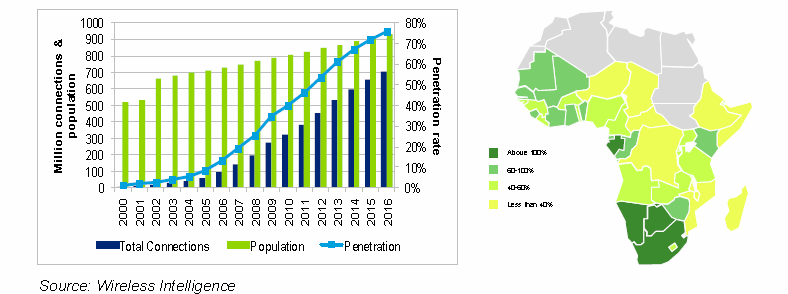
Of course there remain pockets where 21st century technology has yet to make a significant impression. In Bangladesh, one of the poorest countries on the planet, Internet usage has only reached 5% of the population of its 160 million citizens. And in places like North Korea the 24 million of its people remain isolated from the global conversation.
Another dark side is the propagation of 21st century technology without safeguards. China is the one country where this phenomenon is quite visible. A good example can be seen in the transportation sector where there is a rising demand for automobiles. The Chinese have caught the North American and European bug about cars. Beijing, Guangzhou and Shanghai are the hottest markets and have had to resort to a lottery to allocate vehicle registrations. To service this demand, the country has added 32,000 kilometers (almost 20,000 miles) of new paved highway in the last 5 years, a rate 4 times faster than the speed with which the United States built out its Interstate highway system. The bicycle, once the principal means of transport for so many in China, has receded as automobiles have taken over. Where 60% of trips taken in Beijing back in 1986 were by bicycle, today that number is 17% today. The result for China is 300 traffic fatalities per day, the highest rate in the world, and smog in its urban centres caused by automobile tailpipe emissions.

The 21st Century Electricity Capacity Challenge
Today 1.3 billion of us have no energy security and 2.7 billion lack clean cooking facilities. Electricity consumption in Sub-Saharan Africa, excluding the Republic of South Africa, is about equal to that used by the State of New York. That means 20 million New Yorkers consume the same amount of electricity as 850 million Africans. To deal with this challenge the International Energy Agency estimates we need to invest $48 billion U.S. annually to achieve 100% penetration by 2030. Interestingly, money spent by governments on fossil fuel subsidies is nearly ten times this amount.
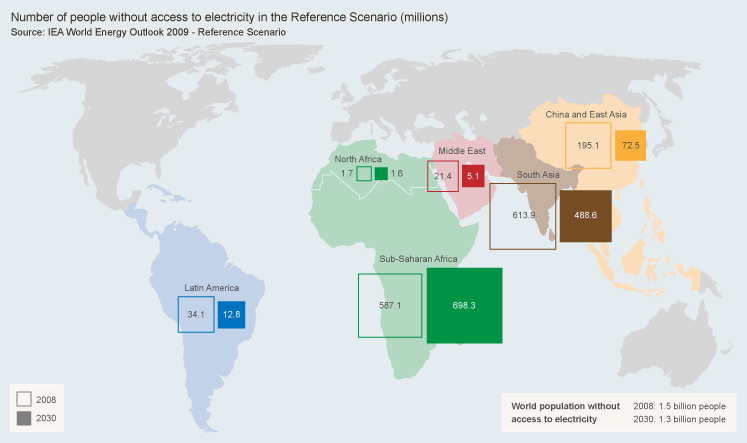
What would universal access to electricity mean for the world’s population? Less burning of carbon, not more, as poorer countries move away from cooking fires to cleaner energy sources.
What will it take to get to universal accessibility? Global political will that includes building financial capacity in the Developing World to ensure investment are made in energy projects and in urban and rural infrastructure to deliver energy everywhere.
Mobile phone penetration and Internet growth are leading the way and showing us just how hungry the Developing World is for 21st century technology. If we can duplicate the 21st century revolution happening in communications by making electrical power accessible and ubiquitous we can involve the entire planet in collective progress. Wouldn’t that be a great New Year’s Resolution?
]]>