So I’m back to posting new articles on the blog site and today am sharing content from an email I received from Peter Diamandis of Singularity University, the XPrize, and Planetary Resources. Diamandis is the author of Abundance: The Future is Better Than You Think, a book I reviewed some time ago on this blog site. In his email, Diamandis states that we are consumers of negative news at a ratio of 10:1 over good news stories. And because of this, our perspective of the human condition is inhibited. Diamandis believes this is a false view and shares what he believes are the positives that have occurred in 2017 so far.
Diamandis wants everyone to see the world as it is, one that is improving and he provides data to back up this claim. This is what he has written. If you or those near to you are negative-minded about the world we are in, then you need to read and share what follows.
Over the last 200 years, the world’s GDP has *skyrocketed* 100-fold. Humankind has never been more prosperous and productive.
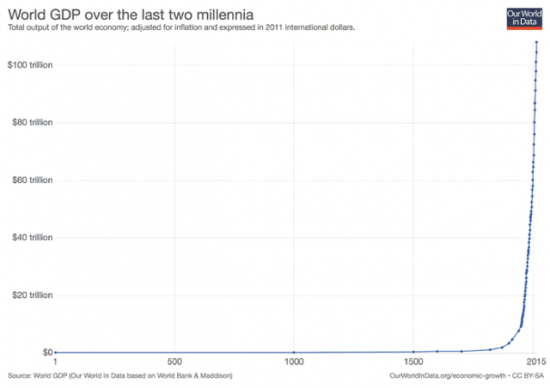
The graph above depicts the economic output per person around the world over the last 2,000 years. Here we see exponential growth independent of war, famine or disease. Technology has driven much of this economic growth, and there are no signs of slowing.
Banking the Unbanked: One especially promising area of economic growth involves empowering the “unbanked,” the 2 billion people worldwide who lack access to a bank account or financial institution via a digital device. In September 2017, the government of Finland announced a partnership with MONI to create a digital money system for refugees. The system effectively eliminates some of the logistical barriers to financial transactions, enabling displaced people to participate in the economy and rebuild their lives. Refugees will be able to loan money to friends, receive paychecks and access funds using prepaid debit cards linked to digital identities on the blockchain without a bank.
Blockchain & Government: Governments are investing aggressively in digitization themselves. The small country of Estonia, for example, already has an e-Residency program. The digital citizenship lets residents get government services and even start companies in the EU without ever traveling or living there. In late August 2017, Kaspar Korjus, who heads up that e-Residency program, revealed the Estonian government’s exploration of creating an initial coin offering (ICO) and issuing crypto tokens to citizens to raise government funds. That same month, the Chinese government announced its intent to use blockchain technology for collecting taxes and issuing invoices. This builds on previous experiments China’s central bank is conducting with its own cryptocurrency.
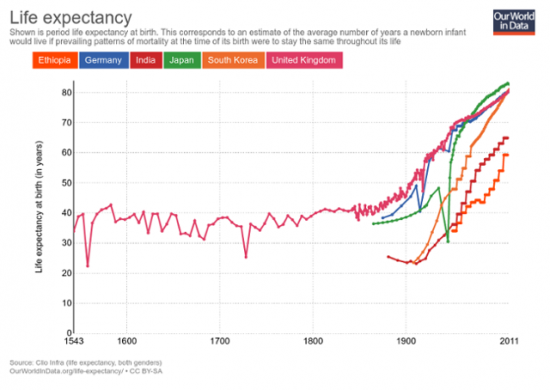
No matter where in the world you live, mortality rates have dropped precipitously in the last 300 years. In the following chart we life expectancy at birth in various countries. Just 100 years ago, a child born in India or South Korea was only expected to live to 23. Fast forward to today, and India’s life expectancy has tripled. South Korea’s life expectancy has quadrupled and now is higher than in the United Kingdom.
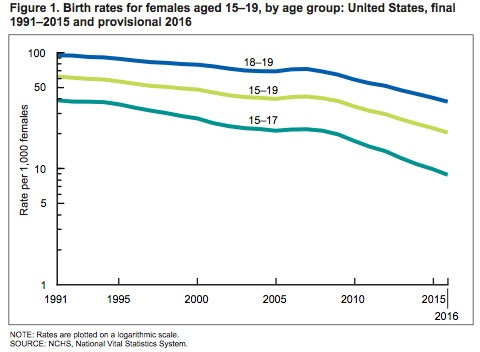
Plummeting Teen Births: Another measure of a nation’s health is how it responds to preventable public health issues. In the United States, teen births are down an impressive 51% over the last decade, going from from 41.5 births per 1,000 teenage girls in 2007 to 20.3 births per 1,000 teenage girls in 2016, and are down 67% since these statistics were first tracked back in 1991. I share the following graph because, by the numbers, teen girls who have babies will have a harder life than their peers who delay motherhood. As the U.S. Department of Health & Human Services notes, teen mothers are more likely to drop out of high school, rely on public assistance, and have children with “poorer educational, behavioral and health outcomes over the course of their life than kids born to older parents.”
As exponential technologies continue to advance, we’ll see even more healthcare breakthroughs. Here’s a sampling from this year:
Thirty years ago, the world signed the Montreal Protocol to prevent the depletion of the Ozone Layer. Today, the U.S. Environmental Protection Agency (EPA) credits that agreement with preventing 280 million additional cases of skin cancer, 45 million cataracts, and 1.5 million skin cancer deaths between its signing in 1987 and the year 2050. Without the agreement the planet, it is estimated, would have been 2.2 Celsius (4 Fahrenheit) degrees warmer by 2050 resulting in more extreme weather events like droughts, floods, and hurricanes.
As the graph below clearly depicts, the global annual death rate from natural disasters has plummeted over the past century.
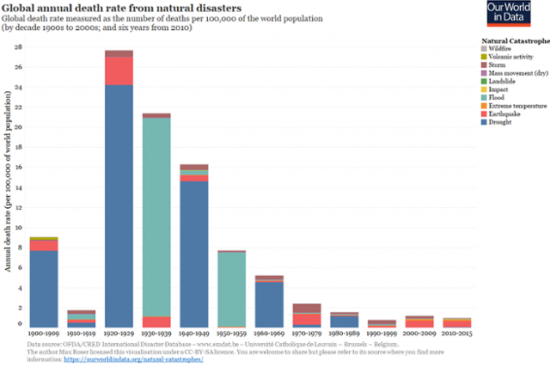
Why has this happened? It’s the impact of exponential technologies (satellites, sensors, networks, machine learning), which has enabled us to better image, predict, and model disasters. The models provide an early warning system, enabling citizens to flee to safety. First responders can react faster, sending supplies and food to remote areas in time. [It doesn’t always work out as evidenced by Hurricane Harvey, Irma, and Maria, as has become far too evident in the last few days.]
Drone technology is making it easier to count wildlife. Previously, animals were counted manually by researchers who spotted them from helicopters or prepositioned cameras to capture images for tabulation. Now drones capture footage, machine learning systems count different types of animals, and human volunteers develop algorithms to verify detections.
In Bengaluru, researchers at the Indian Institute of Science fight deforestation with camera-equipped drones that drop seeds in areas they otherwise wouldn’t be able to explore. The goal is to seed 10,000 acres within the region. What becomes possible when thousands of us participate in projects like the one in Bengaluru?
A key measure of economic growth, living standards, and poverty alleviation is access to electricity. The graph below uses data from the World Bank and the International Energy Agency to illustrate access to electrical power based on delivery and use of at least 250 kilowatt-hours per year in rural households and 500 kilowatt-hours per year in urban households. It shows that more people around the world have access to power than ever before and that the absolute number of those without access is dropping despite global population growth.
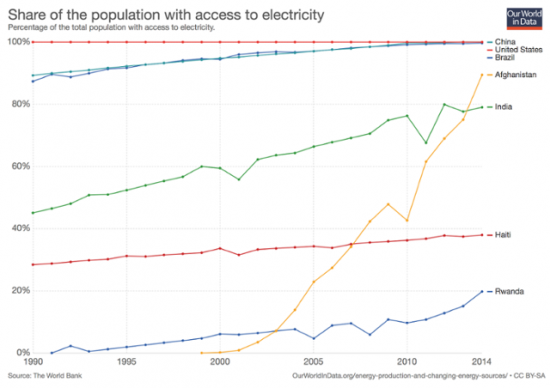
As you can see above, India has gone from 45% of the population with access to electricity in 1990, to nearly 80% in 2014. Afghanistan has even more dramatically improved, from 0.16% in 2000 to 89.5% of the population in 2014.
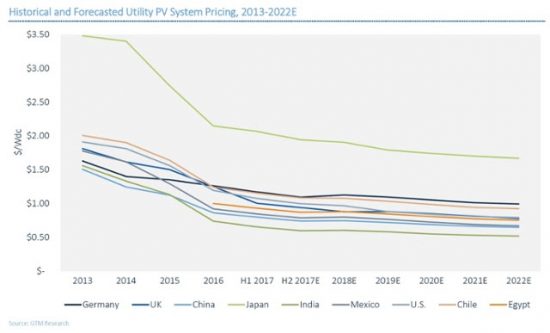
Renewable energy sources will make electricity even more accessible and cheaper until the entire world’s population will have access. In 2016, solar power grew faster than any other energy source. Around the world, prices for solar power continue to drop. The latest forecast from GTM Research reports prices of $2.07 US per watt in Japan to $0.65 per watt in India.
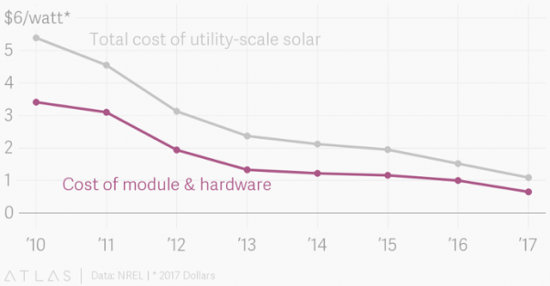
In 2017 alone, wind power became cheaper than nuclear energy in the United Kingdom with the cost of subsidies slashed in half since 2015. As the BBC reported, during the 2015 subsidy auction, “offshore wind farm projects won subsidies between £114 and £120 per megawatt hour.” Just two years later, in 2017, two firms committed to a guaranteed price of £57.50 per megawatt hour, more than 50% less. In the United States, the Department of Energy announced in September 2017 that utility-scale solar had officially hit its 2020 cost targets three years early with generation costs of $1 per watt and energy consumption costs of $0.06 per kilowatt-hour.
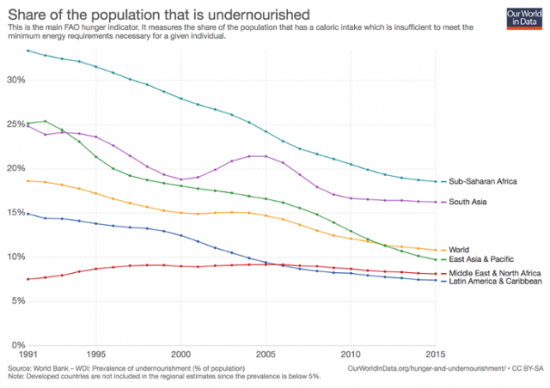
Despite headlines, we’re making steady progress in the realm of conquering food scarcity and hunger. The graph below comes from World Bank data and shows the percentage of world population that has an inadequate caloric intake. Globally, 18.6% were undernourished in 1991. By 2015, that number dropped to 10.8%.
Time and again, technology is making scarce resources more abundant. Two examples from 2017 so far include:
Diamandis believes a positive mindset turns problems into opportunities. He remarks that the data shows we live in a most exciting time to be alive and that the future will be even more exciting than the present.
So what’s missing from all this positivity? Diamandis talks about the Montreal Protocols but doesn’t address the bigger issue of carbon and climate change. How much of his positive expectations are built on humanity and its governing bodies resolving global warming?
]]>
———-
What’s more scarce than perfect diamonds, right?
Wrong.
This week, a new company called Diamond Foundry announced it is able to “grow” hundreds of perfect, “real” diamonds (up to nine carats) in just two weeks in a lab. “Above the line of super credibility,” with the backing of Leonardo DiCaprio and 10 billionaires, my friend Martin Roscheisen is about to disrupt an industry that has been built on the premise of scarcity impacting price for centuries.
More details on Diamond Foundry in a second… but in the meantime, this audacious company really begs the question: what is truly scarce? Ponder that question, and realize that technological advances are a force that convert the seemingly scarce to abundant.

The Lesson of Aluminum
Thousands of years ago, a goldsmith brought an unusual dinner plate to the court of the Roman Emperor Tiberius. The plate was a stunner: made from a new metal, very light, shiny and almost as bright as silver. The goldsmith claimed he had extracted it from plain clay, using a secret technique, a formula known only to him and the gods. Tiberius, though, was a little concerned (and perhaps jealous). Instead of giving the goldsmith a reward he ordered him beheaded.
What the goldsmith had found was aluminum, and his beheading marked a loss to the world for nearly two millennia. Aluminum reappeared during the early 1800s, still rare enough to be considered the most valuable metal in the world. In the mid 1800s, Napoleon III threw a banquet for the King of Siam where the honored guests were given aluminum utensils while others had to make do with gold.
Aluminum’s rarity came down to chemistry. Technically, behind oxygen and silicon, aluminum is actually the third most abundant element in the Earth’s crust making up 8.3%. But you can’t dig up chunks of pure aluminum because all of it is tightly bound as oxides and silicates in a brown clay-like materials called bauxite. Historically aluminum was difficult to separate from bauxite making it more valuable than gold and platinum.
But with the creation of a new breakthrough technology known as electrolysis, discovered in 1886, everything changed. The Hall-Héroult process, as it is now known, liberated the aluminum from bauxite. Suddenly everyone on the planet had access to ridiculous amounts of this light, pliable and now cheap metal.
Technology Transforms Scarcity to Abundance
There are countless examples of technology transforming scarcity into abundance. (Peter coauthored a book by that name.)
Technology is a resource-liberating mechanism.
Speaking of which….now Diamonds are Abundant
Raw diamonds account for roughly $15 billion in sales each year. But a Bain report points out that value is increased downstream “as $15 billion in rough diamonds becomes $24 billion in polished diamonds, which in turn goes into diamond jewelry with a resulting retail value of $71 billion.”
The biggest problem, the diamond mining process is expensive and difficult and the industry has been rife with conflict, violence and corruption.
Enter the Diamond Foundry now culturing diamonds in a California lab, rather than mining them from the Earth. It’s clean, ethical, scalable and significantly cheaper than traditional mining.
How does it work? The process doesn’t yield traditional synthetic diamonds, but instead 100% pure diamonds with the same molecular imperfections of diamonds you find in a mine. That’s because the laboratory diamonds start off as natural diamond.
A recent Forbes article describes the process as similar to growing a plant. You need a seed from another plant to grow a new one. In this case, a small slice of a natural diamond is the base, or seed to grow new layers on top of the crystal until new diamonds are produced. Then the seed base is scraped off and used to grow more new diamonds. All this takes place inside a very hot reactor reaching temperatures of 4,426 Celsius (8,000 Fahrenheit) degrees.
The diamonds are born through the creation of a plasma of unprecedented energy density. That plasma allows atoms to attach themselves to the thin slice of Earth-extracted diamond. The atoms then stack layer by layer on the natural diamond until a pure, jewelry-grade diamond forms. Hundreds of these diamonds can be formed at once in just a few weeks. So far the largest produced weighs nine carats. Diamonds, once a scarce resource, suddenly can become abundant.

So what is truly scarce?
There are lots of things that still are scarce – but, as I wrote in my book, Abundance: The Future is Better Than You Think, it’s only a matter of time before what is scarce becomes abundant. Health, access to the best education, labor, energy, water… even time. Scarcity is contextual, and with the accelerating rate of technological innovation and the convergence of key exponential technologies, I believe we are rapidly approaching a world where nothing is scarce and everything, to some degree, can become abundant.
]]>
The authors acknowledge we live in “turbulent times” but the book focuses not on hand wringing, dire predictions, but on a positive future driven by rapid innovation leading to abundance. As I have stated in earlier blogs we are bombarded with warnings about sustainability and a bleak future. But we are the authors of our own defeat, as well as the inventors of our future success.
Here are some examples of what I mean:
In the 1970s it was predicted by experts that we would run out of oil in the early decades of the 21st century. Yet today we are awash in the stuff with no limit in sight.
In 1900 the average human life span globally was about 40. Today we are approaching 80, a doubling.
In the 1980s I was involved with a company that was documenting 90-baud transmission rates over land lines for countries in Africa. This technology represented the best we could do for Sub-Saharan countries that lacked modern telecommunications infrastructure. Yet today Africa has skipped land line infrastructure entirely and moved to mobile phones and mobile data networks. The growth has been astronomical since 2000, when mobile users represented 2% of Africa’s population. By 2009 penetration had grown to 28%, a growth factor of 14. And by next year, 2013, forecasters predict that 70% of Africa’s population will have access to mobile technology.
In the 1980s no one had heard of micro loans. Banks didn’t loan money to small business in places like Africa, Central and South America or South Asia. But today we have organizations like Kiva.org providing micro-funding for tens of thousands of Developing World entrepreneurs in increments of $25.
Techno-philanthropists didn’t exist in the 1980s either. But today people like Bill and Melinda Gates are pouring billions into projects to end diseases like malaria, or provide new educational models that use the power of the Internet and mobile devices to personalize learning beyond bricks and mortar classrooms.
For the authors of this book abundance is just around the corner. They see a world in 2050 with nine billion of us having access to clean water and clean air, nutritious food, affordable housing, personalized education, best practice medical care, and energy that comes from non-polluting sources capable of meeting our needs for centuries to come.
How will we get there?
The authors see us already rapidly ascending an accelerating path to achieve abundance for all humans on the planet. And much of what I write at this blog site speaks to this progress in so many fields of science and technology. For both the authors of “Abundance” and I believe that we have within our means the ability to create a very bright future for humanity and the rest of life on this planet.
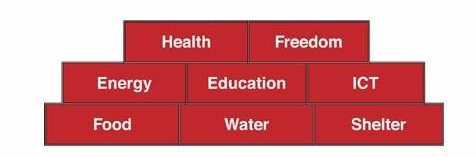
Diamandis and Kotler set the stage with their modified Maslow hierarchy called the Abundance Pyramid (see below) and then go on to illustrate the advances we are making in all of these areas through technological innovation.
The Story of the Spirit of St. Louis
Diamandis, as I mentioned earlier, organized the Ansari X Prize that led to Burt Rutan’s sub-orbital SpaceShipOne achievement. He and Kotler write about the inspiration behind the X Prize. It’s an interesting story. Diamandis was inspired by the story behind Charles Lindbergh’s solo flight across the Atlantic Ocean in 1927. It begins with a French shepherd, Raymond Orteig, who emigrated to America before the First World War. He started as a waiter and worked his way up to eventually become a hotelier in New York City. Orteig’s hotel hosted aviators after the war and the stories they told inspired him to propose an idea to the Aero Club of America in 1919. His offer, a $25,000 prize for the first aviator to cross the Atlantic Ocean, non-stop, either from Paris to New York or the other way. He put an expiry date on the prize – five years. But with no takers after five years, he extended his offer for another five.
What you may not know is that Lindbergh, a fairly novice aviator when compared to others who attempted to win the $25,000, was preceded by several who failed in their attempts. Two perished taking off in overweight airplanes in 1926. In 1927 four more died making the attempt. Lindbergh, “the flying fool” according to the media of the time, succeeded where these others failed. And in winning Orteig’s prize launched trans-Atlantic air travel, the modern era of commercial aviation, and an industry worth today $300 billion dollars annually.

The Spirit of Competition Has No Limits
The lesson of Lindbergh is the inspiration that today is providing the fuel for solving all kinds of technological challenges. We have seen an eruption of incentive prizes to challenge individuals and companies to find new ways of doing things.
When I finished the book I started thinking about all the problems and challenges we face that through a prize might lead to novel solutions. Here’s a list of some of my prize ideas:
I invite you, my readers, to come up with and share lists of your own. Who knows, maybe this exercise in crowdsourcing will lead to some amazing breakthroughs here in the 21st century.
]]>