The post Can We 3D Print an Entire Community? appeared first on Techso Mogro.
]]>There are many reasons to use this method to build homes. Here are a few:
The 3D printer you may have purchased for the home most often uses plastic filament spools that get extruded through the printer nozzle to build projects.
On the other hand, the 3D printers that build houses use cement. It isn’t the normal Portland cement that often contains coarse gravel that would jam up hoses and nozzles. Coarse gravel mixed into cement makes sense when using it to build roads, sidewalks, foundations and other traditional construction.
With fluidity the primary requirement for 3D printers to lay down walls, sand, finely crushed pre-used concrete, brick powder, waste glass, microfibres, limestone powder, fly ash, and silica are used instead. These are combined with geopolymer binders and accelerators, the latter introduced at the printer nozzle to allow for quick setting as the walls get poured layer on layer. Common brands for printing 3D homes include Lavacrete, Sikacrete 3D, evoBuild 3D, Quikrete, CyBe Mortar, and Ultimatecrete. Even modified Portland cement can be used sans the gravel.
A 3D printer cannot print an entire house. The material components making up the plumbing, wiring, roofing, fixtures and finishes cannot be printed by current 3D-printer technology. Instead, these get added after the walls are printed using traditional construction methods.
Some 3D-printing contractors can install electrical outlet boxes and sleeves for cables and HVAC, while the walls are drying. This minimizes cutting, nails and staples.
This is not a complete list by any means. I am sure I have missed several sites. But the narrative shows how large-scale 3D printing technology is establishing itself in home and building construction.
If any company can be described as the pioneer in 3D-printed housing, it is WinSun. This Chinese-based company designed and built its first project in 2014: 10 single-storey homes in the Shanghai area. A second project in 2015 followed: the tallest 3D-printed building in the world, a five-storey apartment block.
In both projects, WinSun constructed the exterior and interior walls in a factory using the world’s largest continuous 3D house printer. Then it shipped the walls to their respective locations for building assembly. Plumbing, electrical insulation, windows, doors, roofing and structural reinforcement were added afterwards. It used a mixture of recycled construction waste, glass fibre, cement, and additives for its “ink.”
Using its factory-based 3D printing model, WinSun claimed considerable savings. It estimated savings of between 30 and 60% on building materials, shortened production times by 50 to 70%, and decreased labour costs from 50 to 80%.
Since these first two projects, WinSun has gone on to make 3D-printed large-scale structures a standard. In 2017, it built a 3D-printed 432-metre flood defence wall near Shanghai as well as several riverbank restoration projects.
In 2017, it signed an agreement with Saudi Arabia to build and deliver 100 3D printers for a project to 3D print 1.5 million homes. The work has yet to begin.
During the COVID-19 pandemic in 2020, WinSun was contracted by the Chinese government to build a four-storey emergency building to quarantine patients infected with the virus. That same year, WinSun signed an agreement with Dallas-based AECOM, an engineering consulting firm. The agreement was to partner on building 3D-printed commercial buildings and engineering projects. Nothing has come of it so far.
In 2024, WinSun reached out to another U.S.-based company, Gaudi Tech, with a project to build seven 3D-printed homes in Hesperia, California. As of today, nothing has been built.
WinSun has been called the pioneer of large-format, prefabricated concrete buildings. Since its inception, however, the WinSun factory-based model has been supplanted by smaller 3D printers that build on-site.
Some of these and their projects are described below.
A 3D-printed community housing project, the first outside of China, was announced in 2019. Its location was Nacajuca, Tabasco, Mexico. The project was to build 50 to 100 3D-printed homes for poor families, replacing those destroyed by floods and earthquakes.
An ICON Vulcan II printer created each home’s exterior and interior walls within 24 hours. Prior to the printing, each house foundation was laid. Then the printer did its job. Several more days were needed to install roofing, utilities, windows and interior finishes.
This was the first large-scale 3D-printed homes-in-situ project of its kind. Although the initial plan called for 50 homes, in the end, only 10 were 3D-printed. Later, the project added 90 units built using conventional cinder block construction. I sought an explanation for the change from the original 3D-printed building plans, but none was available at the time of writing.
The image seen at the top of this article is from a community called Wolf Ranch, located near Austin, Texas. It is a 100-home, 3D-printed subdivision that has been constructed using ICON’s large-scale 3D printers.
In addition to the 3D-printed components, construction has involved pouring foundations on site before beginning the print build. Roofing, windows, doors, plumbing, electrical, HVAC, solar panels and interior finishes were done using conventional construction techniques after the walls were laid. Completion occurred in 2025.
A 106 3D-printed home community in Salida, Colorado, is being built using RIC Robotics 3D printers. Seven homes have been completed and sold as of this month. Salida is a planned subdivision project incorporating community-scale infrastructure including wastewater, water and energy.
The RIC 3D printer follows a pre-programmed digital custom design for each home as it prints the walls and structural shell.
The site has provided challenges because of its variable mountainous terrain and environment. The community deals with extremes of heat and cold, heavy rains, prolonged droughts, and wildfire risks. The walls are being built to provide greater resistance to such environmental hazards.
A new housing project in 2025, a two-storey family home located in Tapping near Perth, Australia, had its exterior walls printed in under 18 hours. The construction used a CyBE 3D printer built in the Netherlands.
The concrete mixture used included materials described as three times stronger than standard brickwork, cyclone-rated, fire- and water-resistant, and termite-proof. Unlike previous 3D-printed home builds, this one is the first in-situ multi-storey construction.
ITACA is a 3D-printed building designed to be self-sufficient and environmentally sustainable. The home is located near Imola in northern Italy.
Built using the Italian-designed Crane WASP 3D printer, the house was completed in February 2026. During construction, the builders used a web app to upload files and control the printer’s operations. Modifications could be made on the fly, impacting printing speeds and material flow.
The ink was lime-based. A previous WASP project built a 3D-printed structure using raw earth and water as building material. In ITACA, however, the purpose of the build was to meet Italian certification standards. Raw earth was not deemed acceptable even though it worked.
The 3D Crane WASP printer is very different from those previously described here. It features four arms working in tandem. This allows a coordinated multi-nozzle material delivery and eliminates the need to move the printer at any time during the building of the home’s 710-layered walls.
ITACA uses a unique design. The walls contain reinforcing hollow columns. When dry and cured, the hollows are filled with rice husks sourced from agricultural waste. The rice acts to insulate and thermally regulate the home, minimizing the need for heating or cooling. In addition, the wall design provides enhanced structural integrity in a region that often experiences earthquakes. Other features include a green roof, rainwater collection basins and solar panels.
The result: ITACA is a passive energy 3D-printed home that achieves a negative CO₂ emissions balance and is state-of-the-art for the construction industry.
The post Can We 3D Print an Entire Community? appeared first on Techso Mogro.
]]>The post Manufacturing And 3D Printing At A Crossroads appeared first on Techso Mogro.
]]>Where else can you find 3D printers in use?
Industrial 3D printers can be pretty big. Just how big?
The University of Maine’s Advanced Structures and Composites Center (ASCC) recently announced a 3D printer it calls the Factory of the Future 1.0 (FoF 1.0). The ink it uses comes from biomaterial waste produced by Maine’s sawmills, an estimated feedstock of 1.6 million tons annually that is 100% recyclable.
An article written by Nate Berg for Fast Company describes the FoF 1.0. It is currently housed in a large warehouse and appears as a supersized structure with a distended nozzle attached to “a maze of wires that hang down from a long steel chassis near the ceiling.” The picture accompanying this posting gives you a better understanding of just how supersized the printer is. The FoF 1.0 is capable of rendering objects 29.261 metres (96 feet) long, 9.7536 metres (32 feet) wide, and 5.486 metres (18 feet) tall. Print output is 226.8 kilograms (500 pounds) of ink per hour. It can build a 55.7 square metre (600 square foot) building in as little as four days.
Future upgrades will increase output to produce that same build in 48 hours at a rate of 453.6 kilograms (1,000 pounds) of biomaterial ink laid down per hour. A demonstration of the FoF 1.0 in the field is planned for next year in a project that will render a nine-unit neighbourhood of affordable homes.
The printer doesn’t just lay down biomaterial ink. It also does subtractive manufacturing like milling. It can add different fibres to a print job to create stronger structures that can be stretched to be larger than its bed limits. Subtractive manufacturing allows the printer to integrate wiring, plumbing, and even the finishes within a structure. Imagine using this printer not only to create a home but all the wiring, plumbing and kitchen detailing too. Habib Dagher, Executive Director of the ASCC told Fast Company:
“Calling it a printer is really a misnomer. It’s a hybrid digital manufacturing cell that allows us to bring multiple manufacturing processes together to produce different things.”
The FoF 1.0 has integrated sensors and artificial intelligence software with self-correcting capability so that it can make adjustments during a print job to keep the build fully aligned particularly when stretching beyond the dimensions of its bed.
Dagher sees the printer being used to change “the way we manufacture things in general.” It is no wonder that the U.S. Department of Defense, Department of Energy, Army Corps of Engineers, and the Maine Housing Authority are looking at the FoF 1.0 and its successors as a way to manufacture affordable housing, bridges, wind turbines and ships. The age of 3D print manufacturing is upon us.
The post Manufacturing And 3D Printing At A Crossroads appeared first on Techso Mogro.
]]>The post 3D-Printed Homes Get Boost From Montana appeared first on Techso Mogro.
]]>The first time I encountered Apis Cor was when I wrote about the state of 3D-printed buildings back in 2016. Then Apis Cor was Russia-based and was working with a U.S. company. The website links in my posting back then for both the Russian and U.S. company no longer work. So I am guessing that the Apis Cor of today represents the evolution of both the technology platform as well as the business.
The current version of Apis Cor has constructed a number of pilot homes in the U.S. and the biggest 3D-printed building in the world in the United Arab Emirates. The technology has complied with some international building code standards but not yet in the U.S. Getting regulatory approval from the state of Montana, however, will likely open the door to seeing 3D printers being used more extensively here in North America, and can help lower the cost of home builds and solve growing demand.
Frank is the name Apis Cor has bestowed on its 3D printer. It is accompanied by a supporting cast of machines and systems that go by the name Gary, a mobile mixing and pumping unit, and Mary, a 3D-print material delivery platform.
Of the three, Frank is the show stealer. Here are some of its key features and capabilities:
Frank can print any infill wall design with greater precision than any worker constructing a wall using traditional methods. It extrudes smooth layers of concrete with consistency in what Apis Cor calls an “aesthetically pleasing” pattern if that is even possible when describing layered concrete.
Because walls are the most intensive part of home construction and where many mistakes are made. Frank eliminates mistakes, is fast, and lowers construction costs. Walls get laid down to allow for traditional fitting of plumbing and electrical. Traditional construction methods complete the installation of windows, doors, and the roof.
Stark filed for approval in the State of Montana where he lives and works. He is quoted in TheRealDeal, a real estate online magazine, stating, “In so many states, regulations are getting in the way of building more homes.” So will this open the door for the 3D printing of homes in the rest of the U.S. and elsewhere?
The state regulators in Montana before approving the technology looked at independent testing to ensure the method, materials, and other issues met with all state and national standards even fire protection.
Contractors who wanted to adopt the technology had complained about a lack of government regulation around structural integrity, materials, electrical, plumbing and safety. But with Montana approving the Apis Cor technology a much-needed precedent has been established.
All that’s left is for architects and engineers to get on board. At the moment very few understand how to integrate 3D-printing technology in both design as well as project execution. One of the reasons is architects render a design that turns into blueprints for engineers to use in executing a project. 3D-printed buildings don’t need blueprints.
Considering the shortage of affordable housing which seems to be a universal issue as our human population on the planet continues to grow, there should be few limits in the future as to where and how this technology gets deployed.
The post 3D-Printed Homes Get Boost From Montana appeared first on Techso Mogro.
]]>The post Thinking of Investing in a 3D Printer? Know Why and What You Are Buying appeared first on Techso Mogro.
]]>Picking the right 3D printer for your needs and budget is a bit of a challenge because these devices come in a wide array of sizes, prices, and capabilities. And the printers also incorporate some different technologies. So if you are contemplating purchasing a 3D printer the following may prove helpful.
I hope these tips help before you decide to invest in a 3D printer. From industrial to personal use, it’s important not to overspend, and it is equally important to know that the printer you choose will have the right features to produce the end result you seek.
The post Thinking of Investing in a 3D Printer? Know Why and What You Are Buying appeared first on Techso Mogro.
]]>The post Gizmos & Gadgets: Time-Saving Tech and What it Means for the Future appeared first on Techso Mogro.
]]>———-
According to Pew Research, hyper-connectivity and expanding technology leads to a need for instant gratification and loss of patience. Some experts speculate that it will make humans unable to address complex challenges. While this may be true, you also can argue that it may make people more innovative to find quick solutions that make them more productive and save them time. Whichever way you look at it, it’s unlikely anyone will turn down the offer to streamline their daily tasks with the help of the latest gadget.
Here’s some of the best technology of 2015 that could change your life.
Wireless Furniture
In 2015, IKEA launched a line of furniture that charges your smartphone wirelessly. There’s no need to go hunting for your charger and find a spot to plug in. Designated spots on IKEA’s bedside tables and lamps make it easy to charge your devices while you hang out with friends or catch up on work.
Skip packing your charger altogether and head out for a cup of coffee. Starbucks started offering wireless charging stations in their coffee shops last year. However, in 10 years, this technology will probably seem antiquated as devices will probably be charged without ever having to take it out of your bag or place it on a wireless spot. As soon as you walk into an establishment with an electrical hotspot, your device will start charging.
Smartphones make day-to-day tasks like taking videos, navigating new cities and keeping tabs on friends easier than ever before. But, with all that activity, it can take a few hours to fully recharge your device. However, the new Google Nexus 6 houses a supersized 3220 mAh battery that makes it possible to go longer and charge faster. In just 15 minutes, you receive up to six hours of battery life.
3-D Printers
3-D printers are no longer a fantasy of the future or limited to medical supplies and heavy manufacturing. The New Matter MOD-t 3-D printer offers everyday consumers the chance to make small 3-D objects about six inches in size. Once you load up the device and set up a few options, you’re ready to print with the help of poly-lactic acid plastic filament. Just pick a product from the New Matter store and click print.
It’s likely that 3-D printers will offer consumers more flexibility and control over their purchases in the future. You won’t need to argue about producing products overseas or rush out to the store to pick up a last-minute gift or household necessity. Instead, you’ll just load up your 3-D printer and hit print.
Pocket Printer
Instead of hunting down a printer at the office or copy center or trying to set up your home office, carry a pocket-sized printer with you. The Zuta Labs Pocket Printer swiftly moves across a document and prints it. You can connect it directly to your tablet, laptop or smartphone, or you can connect wirelessly to any device. Then, all you have to do is lay any-sized piece of paper flat on a table and watch the pocket printer go.
Smart Wallet
Eliminate the need for carrying around a wallet stuffed with cards that are difficult to access when you need them. The Wocket Smart Wallet houses a Wocket Card to replace all of your credit and membership reward cards in one place. Just swipe it at any retailer and select whichever card you want it to be. You can even house your voter registration card in your Wocket Wallet with its card reader or enter it manually.

The post Gizmos & Gadgets: Time-Saving Tech and What it Means for the Future appeared first on Techso Mogro.
]]>The post Headlines: Two Approaches to Printing Houses in the Age of 3D appeared first on Techso Mogro.
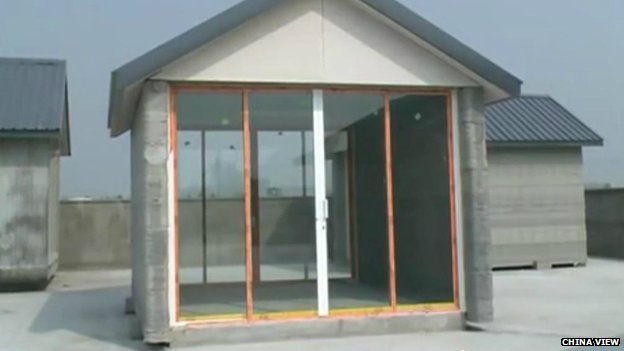
]]>The Chinese houses use recycled construction waste materials mixed with cement which is sprayed by the four 10 meter by 6.6 meter printers. The spray is multi-directional and the material is quick drying. The 3D printers were not deployed at the building site. Instead they built the walls in a factory setting and these were then carted to the construction site for final building assembly. It took 24 hours to complete all ten units.
Walls are designed so that wiring and plumbing can easily be inserted. From the picture below you can see that the homes are functional but not aesthetic.
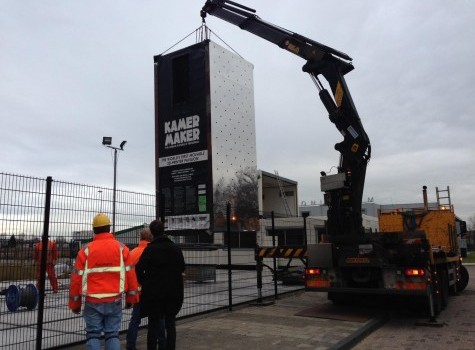
For aesthetics, however, consider the Dutch Canal House being built by Dus Architects. The house is being printed using a giant 3D printer called KamerMaker (see image below). It stands 6 meters tall (20 feet) and does all its printing on the construction site using bio-plastic materials. It can print both small and large objects.
Canal houses are commonly found lining the many canals of Amsterdam. The houses are characteristically narrow, tall and deep. Many date back to the 17th century. The architects in choosing to build a house in this style are demonstrating the versatility of 3D print technology. The rooms are individually printed and can then be stacked and assembled. Rooms can even be disconnected for relocation depending on design changes. All walls are arrayed with smart sensors to provide climate information such as temperature, and humidity. Walls can even be made to vary opacity to alter the amount of outside light entering the living space.
The architects intend the construction of Canal House to be a three-year project. So unlike the Chinese 3D homes described above, speed is not the focus.
What will Canal House look like? In the two pictures below, you can see what canal houses look like in Amsterdam today and how the architects envision their canal house to look upon completion. It should fit in quite nicely.
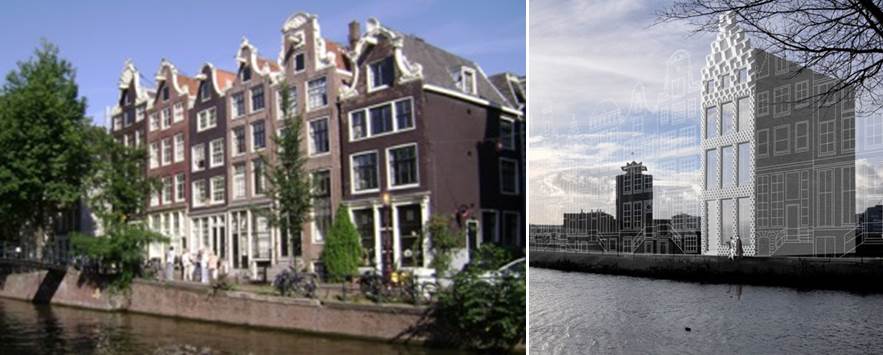
Dus Architects hope, in building Canal House, to demonstrate the current state of digital fabrication and 3D-printing technology as applied to building design and assembly. They also hope to demonstrate new sustainable building materials for home construction.
They have turned the building site into more than a place of construction so that it more resembles a research and development project. Visitors to the site pay a 2.50 Euros entrance fee for a guided audio tour. The fee will in part go to help fund the project.
For those of you who cannot make it to Amsterdam to see Canal House as it is printed, follow its progress at the link provided here.
The post Headlines: Two Approaches to Printing Houses in the Age of 3D appeared first on Techso Mogro.
]]>The post Gizmos & Gadgets: The World’s First Colour Multi-Material 3D Printer appeared first on Techso Mogro.
]]>

Beta tested by a Wisconsin company, Trex Bicycle, the printer manufactured bike chain guards and handlebar grips. The developer, Stratasys, hopes to see the printer used by a number of industries including sport, fashion and automotive.
Printer capabilities include:
And the printer is now commercially available. You can fill out an online form to get a pricing quote.

The post Gizmos & Gadgets: The World’s First Colour Multi-Material 3D Printer appeared first on Techso Mogro.
]]>The post Headlines at Techso Mogro for November 23, 2012 appeared first on Techso Mogro.
]]>
The U.S. Army Deploys 3D Printers in Afghanistan for Rapid Prototyping
When the British entered the first two world wars they began with an expeditionary force. That meant organizing men and supplying all the materials of war and deploying them remotely, in their case across the English Channel in the fields of Northern France. Today when the U.S. army deploys to wars in remote locales the exercise is somewhat the same. Everything the army needs is put on ships and airplanes and transported to places like Afghanistan. And when you consider that the American military has its members serving in more than 100 countries around the planet, that means providing material support on a significant scale.
What if some of the material supply could be managed differently? Complex technology like guns, tanks, and aircraft can breakdown but if you could locally manufacture replacement parts you can maintain these technologies in the field. Enter 3D printers and the Expeditionary Lab, a 6 meter (20 feet) container containing 3D printers, plasma cutters and industrial computer numerical control (CNC) machines. The first two have been deployed in Afghanistan. A third is deployed in the United States for use during natural disasters. The benefit, the ability to manufacture replacement parts from computer-generated schematics. The process is being called direct digital manufacturing and it is hoped that even custom prostheses can be made on site to replace a soldier’s lost limb.
And the army is not alone in pursuing 3D printing. The US Navy is looking at micro-robots with 3D printing capability for manufacturing what they refer to as “novel materials and structures.” And the US Air Force is using 3D printers to create prototypes for airframe components and spare parts.

A Device with a Nose Like a Dog
Bomb and drug detection sniffing is something dogs do very well. You see them at airports and customs checking out luggage, containers, packages and people. Security companies consider them the gold standard, particularly for detecting explosives, better than any technology we humans have created to date. So it has remained a dauntless challenge for engineers to come up with a detector as capable.
A team of mechanical and chemical engineers from the Santa Barbara campus of University of California may have come up with something, a detector the uses microfluidic nanotechnology. They describe their patented device as a mechanical bomb sniffer even more precise than the nose of a dog. Published results of their work recently appeared in the Journal of Analytical Chemistry.
The technology designed to replace man’s best friend combines a microchannel 20 times thinner than a human hair with a surface-enhanced Raman spectrometer powered by a laser to capture and identify molecules of gas given off by ingredients in explosive devices. The device can be modified to detect molecular levels of narcotics, smoke, gases given off by food spoilage, or even disease detection through analysis of someone’s breath.

Microsoft to Power a New Wyoming Data Center Using Methane from Waste
One report referred to this announcement as “mixing computing with crap,” but Microsoft’s latest data center plans to use off-grid power derived from methane gas from decomposing sewage. That methane will be extracted from the Dry Creek Water Reclamation Facility in Cheyenne, Wyoming.
Microsoft calls its zero-carbon technology, the Data Plant, combining the virtues of a power plant with the energy demands of a data center.The design filters out trace contaminants. Then a Molten Carbonate Fuel Cell converts the methane and CO2 into electricity without combustion. Finally the energy created powers the data servers. Electricity surpluses get shared with the wastewater treatment facility. The heat generated by the server farms is also recycled to keep the micro flora used in waste water treatment nice and warm without having to use additional energy.

Is Mars Hazardous to Your Health?
Not according to the latest findings from Curiosity, the latest Martian Rover, and from what we have learned from other spacecraft and robots studying the planet. Sampling of radiation levels at Gale Crater indicate that levels are no worse than that experienced by astronauts on the International Space Station. That means concerns about radiation exposure have been somewhat alleviated although solar storms will still present a problem.
The answer to how human explorers of Mars can cope with that potential hazard is also being investigated by orbiting spacecraft from the European Space Agency and NASA. What they have discovered is a landscape that may have potential caves which could be used for human habitation permanently or as temporary shelters during solar storms. Surface materials could also be used to build shelters capable of withstanding cosmic radiation as well.
And what have they discovered? Significant amounts of water present in the form of permafrost, subsurface frozen water and polar ice, more than was ever thought previously to exist. In the map of Mars below the blue areas show the presence of hydrogen with the deepest blue containing 20 to 50% ice by mass.
The existence of water solves many problems. Hydrogen can be extracted to make rocket fuel for the return home, and it can also be used as an energy source while on the planet surface. Oxygen from the water can be breathed. Water plus atmospheric carbon dioxide can be used to grow plants for food.
Of course none of these discoveries answers the challenge of what to do about radiation shielding on the long voyage to and from Mars. Nor have we yet to overcome the challenge of developing a working closed model for a self-sustaining environment that would keep humans alive throughout a potential 6-month journey to and from the planet.

Biorefineries Could Power Towns in Developing World Countries
In a paper presented at the International Mechanical Engineering Congress in Houston, Texas this month, researchers proposed a design for expandable biorefineries that would use marine macro algae as a feedstock for creating biofuel. Each biorefinery would cultivate the macro algae over an area of 30 hectares (almost 75 acres). This presents a problem in the Developing World where land that could be growing crops becomes ponds for algae generation. So the researchers have looked at farming the algae at sea.
They have developed a model for a pilot project providing sufficient power for a coastal community of 20,000. They see macro algae as a better biofuel candidate than corn, sugar cane or switch grass because the algae lacks lignin, a complex polymer that gives these other plants their toughness and makes the process of conversion much more difficult. At the same time macro algae answers the issue of lower biofuel conversion rates than experienced currently from containment pond production.

A Postscript
Is there a field of technology that we have yet to cover that interests you? Let me know because this blog site is focused on the contribution that technology can make to help humanity and our planet get through the 21st century and beyond. Thank you for continuing to read my postings and for sending in your questions and comments.
– Len Rosen
The post Headlines at Techso Mogro for November 23, 2012 appeared first on Techso Mogro.
]]>The post Headlines at Techso Mogro for August 3, 2012 appeared first on Techso Mogro.
]]>This week I look at technology headlines in the fields of biomedicine, climate change science, energy, manufacturing, and transportation. Enjoy the read.
Biomedicine: Synthesizing Human Parts Using Nano-materials and Stem Cells
From Russia with love, a story about doctors at the Krasnodar Regional Hospital who recently provided two patients who had lost their larynx and trachea in car crashes with laryngotracheal implants. First the Russian doctors used a nano composite synthetic scaffold developed by Nanofiber Solutions, a U.S. manufacturer. The scaffolds were shaped to fit each patients larynx and trachea. Then they were seeded with stem cells extracted from each patient’s bone marrow. Each scaffold was placed in a bio-reactor and rotated to assist in the regrowth of the tissue using the stem cells. The new tissue was then transplanted into each patient with no threat of immune-suppression.
Research is showing that bone marrow derived stem cells are extremely useful when developing other tissue types. Harvesting bone marrow stem cells is far less invasive than harvesting other stem cell types.

Climate Change Update: The Earth is Absorbing CO2 at Double the Rate since 1960
In the journal Nature this month researchers at NOAA, the National Oceanic and Atmospheric Administration in the United States, reported CO2 uptake by land and ocean is not a constant or declining as previously thought. In fact, net global carbon uptake has increased. Since 1960 human activity has produced 350 billion tons of atmospheric carbon. Of that total 55% has been absorbed by the Earth’s land masses and ocean waters. What’s more interesting is the rate of uptake goes up and down. In the 1990s scientists observed decreased CO2 uptake. In the first decade of the 21st century CO2 uptake increased. What this tells us is we really don’t have a full understanding of the planet’s carbon cycle.

Energy Update: Australia Sees Most Potential with Solar Energy
The Australian Bureau of Resources and Energy Economics predicts by 2030 that solar photovoltaics will provide the lowest cost among 40 different energy producing technologies that it assessed. The study looked at coal (Australia is a world leading producer of brown and bituminous coal), coal gasification, natural gas, solar thermal, solar photovoltaic, wind, wave, geothermal, landfill gas, biomass, and nuclear in coming up with its conclusions.
The study took into consideration the reduction in cost and improvement in efficiency of photovoltaic arrays and concluded that the technology is becoming cost competitive with a payback within 5 to 10 years and system lifetimes of 25 years. For Australia the solar revolution is about to arrive. It makes sense for the driest and sunniest continent on Earth.
Current installed capacity has grown 1000% from 2009 to 2011 with 1031.1 Megawatts online as of August 2011.

Manufacturing Update: Unintended Consequences of 3D Printing
Mass customization is the promise of 3D printing technology. It can be used to produce drugs that help alleviate pain. It can be used to make human body parts that won’t be rejected. It can be used in space to manufacture technology for space. It can be used to create one-off products using computer-aided design software. But this week we learned about the dark side of 3D printing. You can make guns.
I keep seeing the image of John Malkovich, an ex-CIA employee, assembling a gun from some kind of plastic or polymer in the 1993 movie, In the Line of Fire, while sitting at a Presidential fundraiser. Well reality is catching up with fiction. You can see a picture of a 75% prototype and the finished full-scale lower half of a gun in the picture below. Both were created using a 3D printer. Apparently the designer is having ammunition feed and extraction issues and reports with a little oil and lubrication, and switching to brass cartridges, the gun successfully fires. Isn’t technological progress sometimes inspiring?

Transportation Update: Elon Musk Predicts 50% of New Cars will be electric by 2032
When recently interviewed, the CEO of Tesla Motors and SpaceX bravely predicted that within 20 years, and more probably in the next 12 to 15 years more than half of all new cars manufactured will be purely electric. Compare that to other automobile manufacturers who are much more conservative in their estimates. GTM Research, a consulting firm that studies the industry predicts by 2016 a 500% increase in electric vehicles (EVs) to 3.8 million in the United States. Compare that to the more than 250 million cars on U.S. roads today.
With electric vehicles on the road in increasing numbers, another challenge is emerging. Where, when and with what will we recharge all of these new EVs? An EV infrastructure will be needed. Among the contenders for public charging stations are GE with the WattStation, ECOtality with its Blink Charger, and the Coulomb ChargePoint. Utilities will also find themselves having to support this sudden increase in electrical demand. This means building a smarter grid with upgraded voltage regulation and high-voltage capacitors.
What would be a fair rate to charge your EV? The jury is still out on that but $1.00 an hour seems to be a benchmark.

A Postscript
Find an interesting technology story, an innovation that can really make a difference for humanity and the planet in the 21st century- let me know. Readership has hit the 3,000 mark as we begin August. I thank all of you for visiting and am encouraged to see how many of you are repeatedly coming back. – Len Rosen
The post Headlines at Techso Mogro for August 3, 2012 appeared first on Techso Mogro.
]]>The post Headlines at Techso Mogro for July 27, 2012 appeared first on Techso Mogro.
]]>This week I look at technology headlines in the fields of agriculture, biomedicine, climate change, energy, and space. Enjoy the read.
Agriculture Update: “Urbanana” Brings Tropical Vertical Farms to Paris
Greenhouse vertical urban farms are making a fashion statement in the fashion capital of the world, Paris. A French architectural company, SOA, has designed a six-storey annex-styled greenhouse that can fit between existing buildings on the main thoroughfares of the City. Called Urbanana, a combination of urban and banana, the building is designed to grow tropical fruit year round. This is not SOA’s first urban farming concept. The company has developed an Agricultural Urbanism Lab to create facilities for growing local produce in urban settings.
With over 3.5 billion of us living in cities today vertical farming is no longer an idea but a necessity, a practical solution to supplementing the feeding of urban populations.
Urbanana has been designed to be highly mechanized with plants grown in pots and rotated on moving belts to maximize light requirements. In the concept drawing below you can see how the greenhouse has been integrated into the urban landscape. Nice curb appeal!

Biomedicine Update: Developing A Drug Chemistry Replicator
Two headlines on 3D printing technology caught my eye this week. This one involves using 3D printing to create complex chemistry. The other you’ll read about a little further down.
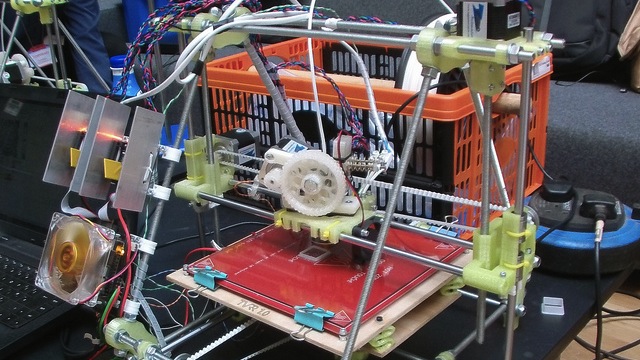
The 3D printing research being done here is by the Cronin Group, headed by University of Glasgow’s, Lee Cronin, a chemistry professor who is adapting 3D printers to become what he calls “chemputers.”
Cronin’s goal is to use 3D printing to build complex molecular chemistry. The chemputer is a prototype that can be programmed to build complex chemicals. Most pharmaceuticals are complexes of carbon, hydrogen and oxygen along with vegetable oils and paraffin. With the chemputer, drugs can be assembled from inks that reflect the chemistry of the pharmaceutical recipe. The chemputer lays down the molecules with reliable precision. The current goal is to successfully fabricate ibuprofen. Ultimately the goal is to manufacture almost any drug using a combination of a larder of chemical-based inks with an electronic recipe book for guidance.
Climate Change Update: Will Global Warming Also Damage the Ozone Layer?
In a report published in the journal Science, Harvard University researchers are studying increased atmospheric turbulence and its impact on ozone. What they are finding is violent summer thunderstorms pull large amounts of water vapour into the stratosphere causing chemical reactions with residual atmospheric pollutants. The pollutants are the legacy of CFC (chlorofluorocarbon) prior use, the refrigerant and spray can gas containing carbon, chlorine, hydrogen and fluorine, that was banned in the 1980s because it was blamed for ozone depletion in the upper atmosphere. It was CFC use that led to today’s UV weather reports with admonishments for us to all use sun screen.
The scientists who wrote this recent report were led by Dr. James G. Anderson. They looked at risks to the ozone layer from increasing storm frequency and intensity and studied a process called convective injection where water vapour rises as high as 19 kilometers (approximately 12 miles) into the stratosphere.
The IPCC (Intergovernmental Panel on Climate Change) in its reports notes that storm frequency and intensity are byproducts of rising temperatures globally. Storms over oceans such as hurricanes and typhoons have been forecasted to become more frequent and more intense. The same is true for storms over land. Although these are not equal in intensity to hurricanes and typhoons, nevertheless they create large upwellings of moist air to rise and mix in the bone dry stratosphere.

Energy Update: Trash to Energy on the Upswing
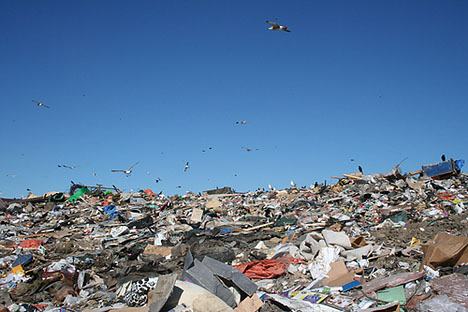
When is urban trash a good news story? Well according to Pike Research the trash we currently dump into landfill is becoming an important energy resource. The report states that more than 800 thermal trash-to-energy facilities operate today in 40 nations. The trash to operate these facilities, however, amounts to only 11% of the total municipal waste we generate annually worldwide.
By 2022 forecasters indicate that we will be converting between 260 and 396 million tons of waste each year to produce 429 Terawatt-hours of power and heat. That will represent between 10-13% of total municipal waste.
Urban trash will reach 3 billion tons by 2022. Our trash is an untapped energy resource and represents an increasingly attractive option for cities that find landfill sites reaching capacity or closing and NIMBYism (not-in-my-backyard) push back on creating new municipal landfill sites.
The largest growth for trash-to-energy is expected in the Asia-Pacific region which is forecast to account for 54% of these projects by 2022.
Space Update: 3D Printers to Fuel Made in Space Manufacturing
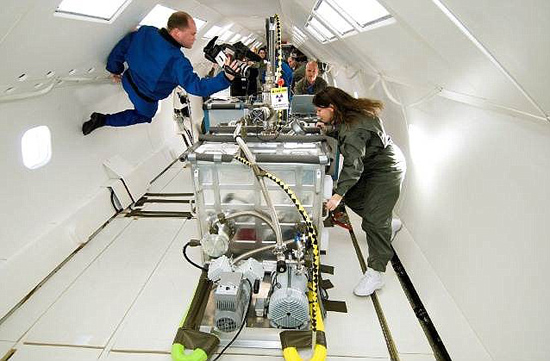
Check out Made in Space, a company in the business of creating manufacturing in space for in-space consumption. The plan is – build spacecraft and habitation components in space. Do this by using 3D printers and a wide range of space compatible materials. NASA has even developed a supergoo that can be used with a prototype electron beam fabricator, seen in the picture below.
The materials of space construction include plastics, aluminium and titanium. Building for in space for use in space is different than building for space here on Earth. When we manufacture on the planet surface we have to send the finished product into space. To do that we have to construct it to withstand the forces of gravity and the stresses of a launch. When we manufacture in space for consumption in space, however, we don’t have to deal with gravity and launch stresses. As a result we can reduce mass dramatically.
A 3D printer on board with base feedstock and a CAD program could begin to manufacture almost anything needed. A 3D printer delivered to Mars wouldn’t even need feedstock. It could use the local materials to fabricate habitations for the planet’s surface.
Currently Made in Space 3D printers are being tested on parabolic flights to simulate microgravity. The next step will place a 3D printer on the International Space Station along with some supergoo and the recipe book.
A Postscript
Find an interesting technology story, an innovation that can really make a difference for humanity and the planet in the 21st century- let me know. Currently with over 2,200 readers visiting each month it is encouraging to see the growing traffic, up 300% in the last 90 days. I thank all of you for visiting and hope you keep coming back. If you like what you read here then let others know. My personal goal is to have 10,000 visitors each month by year’s end. I’m hoping you can help me get there. – Len Rosen
The post Headlines at Techso Mogro for July 27, 2012 appeared first on Techso Mogro.
]]>


