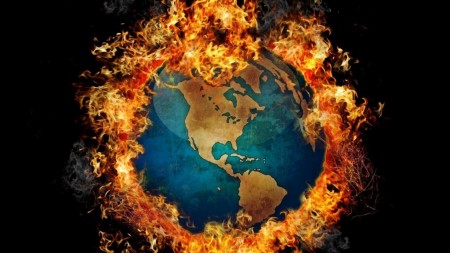
A mean average rise means many days significantly hotter with the greatest extremes felt in cities where pavement and lack of forest cover exacerbate temperatures to the extreme. Even today mean temperatures, now 1.0 Celsius higher than the beginning of the Industrial Revolution, are making those places where the majority of humanity live and work, hotter and more uncomfortable.

What does a 1.5 Celsius temperature rise mean in reality?
Here are two examples. A 1.5 rise globally projects to an average rise of 4.4 Celsius (7.9 Fahrenheit) in the Arctic and 2.2 (approximately 4 Fahrenheit) in the Mediterranean basin according to the latest climate models.
What does a 2.0 Celsius temperature rise mean?
For the Arctic it translates to a rise of between 5.5 and 8 Celsius (9.9 and 14.4 Fahrenheit). And in the Mediterranean it increases average temperatures by 3.0 Celsius (5.4 Fahrenheit).
Climatologists point out that the current 1.0 Celsius rise since the Industrial Revolution has already produced temperatures 2+ Celsius higher in the Arctic just in the last 15 years.
But that is only the half of it. Consider that mean temperatures get measured over both land and ocean. So the mean temperature rise of 2 Celsius translates to land temperature rises of as much as 6 Celsius (10.8 Fahrenheit). Imagine what that mean for those heat islands, the large urban cities I mentioned above? And all we are talking about so far is temperature changes. Along with the warmth other weather related phenomena will change. Think wind, precipitation, extreme weather events, storm surges.

No climate model to date is perfect.
Projections, such as those described above, may contain error factors. And current climate models don’t anticipate “tipping points” which could dramatically exacerbate the impact of rising temperatures.
If unfamiliar with the term tipping point popularized by Malcolm Gladwell in a recent book, it refers to a point in an evolving situation that leads to a change or new equilibrium. Climate change tipping points have happened in Earth’s geological past. The most recent example is the Ice Age of geological period known as the Pleistocene which began 2 to 3 million years ago and came to an inter-glacial warming period only in the last 20,000. Some climatologists believe that the warming we have added through human activity may push any potential Ice Age recurrence into a future as much as 100,000 years away.
Today the new tipping may be happening in the Arctic as sea ice declines and Greenland glaciers experience rapid melting.
In a study published in Proceedings of the National Academy of Sciences last year, scientists identified 37 other cases of potential tipping points all happening within the 2 Celsius climate model scenario. The scientists state that the question isn’t “if these things will occur” it is more “when they will occur.” The triggers include ocean, sea ice, alpine and continental glaciers, permafrost zones and land mass flora and fauna. One that we may see sooner than later is a shut down of the existing North Atlantic Ocean circulation pattern as Arctic and Greenland ice melt cools the waters off Europe. That’s just one abrupt change that could lead to a cascade of others.
All of the above points to the fact that we may be underestimating the amount of carbon dioxide emission reductions needed to keep the planet more accommodating to our present existence as well as that of the flora and fauna. Professor Andy Pitman, Director of ARCCSS, the Australian Research Centre for Climate System Science, states, “To keep extreme temperature changes over the Mediterranean below a 2 Celsius threshold, the cumulative emissions of CO2 would have to be restricted to 600 gigatons rather than the 850 gigatons currently estimated to keep global average temperatures increase below 2 Celsius.”
The image below states “1.5 C to stay alive.” Although life here on Earth can withstand a mean average temperature rise within that limit, the truth is the quality of that life will be far different from today. Humanity is at a tipping point where procrastination will lead to unforeseen consequences because as bad as the climate models predict the future, the reality may prove to be far less palatable.
If you are reading this I encourage you to circulate the contents, to show it to political leaders and business decision makers, and to consider the role you can play in reducing the carbon emissions that are impacting our present and the near future.

The 2 Celsius target has been a part of the conversation since global warming became a recognizable challenge in the 1960s and 70s. At that time a doubling of atmospheric CO2 was equated with a temperature rise of 2 Celsius. No one was looking at the risks associated with the temperature rise. It was purely a mathematical construct.
But in the 1990s scientists began to assess what a world 2 Celsius warmer would be like and soon concluded that it represented the tolerable maximum allowable rise in global temperatures above pre-industrial times. It equated anything above 2 Celsius as disastrous for world ecosystems. Eventually the 2 Celsius maximum became ingrained in climate conferences and reports.
But 2 Celsius is not a safe threshold. More than 100 countries considered most vulnerable to climate change would be seriously disrupted with temperatures climbing to that level. Low-lying states, low and middle income countries of the Developing World would be devastated with that kind of temperature rise.
Tschakert argues that the 2 Celsius upper threshold should be abandoned and she is supported by many others with a “ditch the 2” movement emerging as a result.
Remember the 2 Celsius target is a global average. For countries closer to the poles that 2 translates to between 5 and 9 Celsius. And the 2 in Sub-Saharan Africa is the difference between livable and being cooked. The world today is 0.8 Celsius warmer than it was at the beginning of the Industrial Revolution. It would seem that conditions are already becoming difficult for many Developing World countries and low-lying island nations have already experienced the consequences of warming through sea level rise. We have seen the increased frequency of extreme weather events in recent years.
The insurance industry reports new record breaking payouts for claims related to weather and climate almost every year.
A Category 5 hurricane is about to make landfall on Mexico’s Pacific coast. The last decade has seen record Category 5 storms. So what was once rare is becoming more common. This Category 5 storm is packing winds of 320 kilometers per hour (200 mph), the most powerful ever recorded, breaking Hurricane Ethel‘s September 1960 record of 260 kilometers per hour (150 mph).
In arguing for a 1.5 Celsius cap Tschakert and her allies, the island nations, stress the need to stay below thresholds that are seen as producing significant risk. A global mean temperature rise of 1.5 Celsius will not evenly distribute its benign effect. As I have described in a previous posting there are many suspected tipping points along the way that will produce devastating impacts. It is therefore better to set a lower temperature target “to prevent severe, pervasive, and potentially irreversible impacts while allowing ecosystems to adapt naturally, ensuing food production and security, and enabling economic development to proceed in a sustainable manner.”
A final observation. Is 1.5 Celsius achievable based on the amount of carbon dioxide and other greenhouse gases being emitted today? Some climate scientists argue that the course is already set to a 2 or higher Celsius rise based on legacy and lack of progress in decarbonization. Tschakert observes, “negative impacts of climate change under a 0.8 Celsius temperature increase are already widespread, across the globe, and that danger, risk, and harm would be utterly unacceptable in a 2 Celsius warmer world, largely for ‘them” – the mollusks, and coral reefs, and the poor and marginalized populations, not only in poor countries – even if this danger has not quite hit home yet for ‘us’.”