The special report measures just how ineffective governments have been. The condemning evidence is undeniable:
The report also states that regardless of what actions we take starting today, what we have presently put into the atmosphere to increase mean global temperatures will continue to persist for centuries and millennia.
The difference between 1.5 and 2.0 Celsius is seen as significant in terms of the level of mitigation and adaptation that will need to occur for a significant portion of the planet.
As for warming over continental land masses, the difference between a 1.5 and 2.0 Celsius rise translates to temperatures much higher than these two means. Extreme hot days in mid-latitude locales at 1.5 Celsius as the global mean translates to 3.0 Celsius. And at 2.0 Celsius as the global mean, to 4.0 Celsius. Meanwhile, in polar locales, nighttime low temperatures could increase by 4.5 Celsius in the 1.5 scenario, and 6.0 Celsius at 2.0. In tropical zones the number of extreme hot days will grow regardless of the rise in the global mean temperature.
Drought risk and precipitation deficits will be worse at 2.0 Celsius compared to 1.5. And so will extreme precipitation events including tropical storms like hurricanes and typhoons. Higher incidents of flooding will occur at 2.0 Celsius compared to 1.5.
Sea level rise will also vary based on the mean temperature rise. Total average rise by 2100 will be 0.1 meters lower if the mean temperature can be contained to 1.5 Celsius as opposed to 2.0. The slower rate of sea level rise will give coastal populations and low lying islands greater opportunity to adapt. The 0.1 meters less of sea level rise will spare at least 10 million of us around the world from seeing our homes vanish under water.
Even if we cap the temperature rise at 1.5 Celsius, sea level rise will not abate. The report states the instability already evident in Greenland’s ice sheets, and the Antarctic Peninsula, as well as changes to sea ice will have long-term implications leading to sea level rises in the multi-meter category.
The impact on biodiversity and ecosystems on land will be less at 1.5 Celsius than at 2.0. Nonetheless, the 1.5 Celsius rise will impact 105,000 species including 6% of insects, 8% of plants, and 4% of vertebrates who will see their natural habitats shrink by half. But at 2.0 Celsius the impacts on that same number of species will rise to 18% for insects, 16% for plants, and 8% of vertebrates. Polar tundra and boreal forest habitats will be most at risk.
Keeping the difference to 1.5 versus 2.0 Celsius will mean a reduction in the threat to permafrost areas affecting between 1.5 and 2.5 million square kilometers.
As for the oceans which will be impacted not only by temperature rise but also by increased acidity, the delta between 1.5 Celsius and 2.0 is significant with the lower mean rise reducing the risk to marine biodiversity, fisheries, coral reef ecosystems, and Arctic sea ice. As for the latter if the temperature can be held to a mean rise of 1.5 Celsius it is unlikely that the Arctic Ocean will see one sea-ice free summer within this century. But at 2.0 rise the one sea-ice free summer will happen once a decade.
The global fishery will see declines in annual catch of 1.5 million tons at 1.5 Celsius, and 3 million tons at 2.0. Acidification will be bad regardless of whether the rise is 1.5 or 2, but the problem will be amplified more with the latter rather than the former. For marine life requiring calcification for survival, global warming will have adverse to catastrophic effects.
And then there is human health. Food security, freshwater, work, and economic opportunity will be affected regardless of the rise being 1.5 or 2.0 Celsius. But the higher temperature will have greater negative consequences. Heat-related morbidity and mortality will rise. Urban heat islands will further amplify the average rise over land. Diseases such as malaria and dengue fever will see geographic shifts in range. And limiting warming to 1.5 Celsius versus 2.0 will mean smaller net reductions in cereal crops particularly in sub-Saharan Africa, Southeast Asia, and Central and South America where human population growth has been highest in the last half-century and where food security today is at greatest risk.
The report sets the target to limit global warming to 1.5 Celsius. It involves staying within the CO2 emissions cap by reducing our current contributions by 2,200 Gigatons or 42 Gigatons per year. Greenhouse gas reductions of 35% from 2010 levels to 2050 for methane (CH4) and black carbon aerosols will also be needed. Similar targeted reductions are necessary for nitrous oxide (NO2) and CH4 from agricultural and waste sources. Further adjustments to these reductions will be needed to offset increases in atmospheric CH4 from permafrost melt and wetland releases.
Probably the most troubling issue of this 2018 report is the willingness to embrace geoengineering solutions to remove CO2 as well as consideration for solar radiation management to offset the effects of greenhouse gases rather than remove them. Geoengineering involves applying laboratory experiments on a planetary scale. To describe it as the Hail Mary option for dealing with climate change seems appropriate. For those of you unfamiliar with the term, Hail Mary, it is associated with the game of North American football, where, in the dying seconds, a quarterback throws the ball 50 plus yards down the field in desperation hoping that one of his receivers will catch it in the opposing team’s endzone to grab victory from the jaws of defeat. On rare occasion, the Hail Mary strategy succeeds. But most of the time the outcomes from the effort don’t end well.
Solar radiation modification would be a Hail Mary. By putting aerosols into the stratosphere we would reduce the energy from the sun reaching the troposphere (where we live and breathe) to create cooling. We would have to do this continuously without knowing if there would be unintended consequences such as shifting precipitation patterns, or changes in extreme weather frequency. The risk of termination shock should we suddenly stop doing this form of geoengineering could be more significant with global temperatures rebounding dramatically over a short period of time.
On the other hand, removing CO2, a practice already being done at various locations around the planet, would be a form of geoengineering with fewer risks. CO2 can be captured at emission sources which is currently being done at a few sites today. CO2 can be directly captured from ambient air. There are a few projects like this on the go today. And CO2 can be captured through natural processes such as changing agricultural practices to sequester it in soils, or afforestation.
Capturing and sequestering CO2 on an industrial scale has yet to be fully implemented. But if it were, the planet might be able to keep mean temperatures from rising beyond 1.5 Celsius. At the same time, we could achieve a negative emissions turning point and begin rolling back the levels of greenhouse gases our industrial society puts into the atmosphere watching the parts per million of CO2 and other global warming instigators decline. Maybe that can keep anthropogenic climate change to no more than a millennia.
If this report doesn’t alarm you then you are in denial about climate change and will face the consequences with the rest of us who recognize the crisis at hand. The human ability to deal with challenges is one of our great strengths as a species. And because we know the cause of the warming, carbon emissions, we should be able to come up with solutions in terms of government policies, personal lifestyle and behavioural changes, and in technology fixes that can help us make the best of a bad situation. One certainty arises out of the 2018 IPCC report. We must act now. To not do it would be anti-planet, anti-human, and criminal.
In a video statement made after the release of the IPCC Report, Catherine McKenna, Canada’s Federal Environment Minister stated, “We are the first generation to feel the impacts of climate change and we are the last generation [who can] do anything about it.” She’s right but increasingly, the message she is relating is falling on deaf ears.

The statistics that follow have few positives and overall reflect the failings of many governments to address climate change and commitments made at the Paris COP21 Climate Conference.
In the Developed World, several nations reported declines. These included the United States, United Kingdom, Mexico, and Japan. Surprisingly, the United States produced the largest decline of 0.5%, equal to 25 Megatons, because of new renewable energy sources coming online. This was the third year in which the United States saw CO2 emissions decline. The United Kingdom reported a 3.8% drop in emissions equal to 15 Megatons. Mexico’s drop was 4%, and Japan’s 0.5%.
The biggest contributor to increased emissions occurred in Asia led by China whose economy grew 7% contributing to emissions increases of 1.7% or 150 Megatons.
Emissions in the European Union were also up by 1.5% or 50 Megatons.
And Canada, where the federal government has committed to a 30% reduction in emissions from 2005 levels by 2030, continues to fall further behind in stopping the rise in its own emissions. Back in November 2017, Angel Gurria, Secretary-General of the Organization for Economic Co-operation and Development, remarked that despite an environmentally activist government in Canada, the country is falling behind the United States, a country that has announced its intention to pull out of the Paris COP21 agreement. Gurria noted that by now Canada should have seen a 17% drop in its annual CO2 emissions rather than the actual drop of a mere 2%.
The overall increase in global CO2 emissions was equal to adding to the world’s roads 170 million fossil-fuel burning vehicles. That’s going in the opposite direction from where we need to be. Gurria talks about an intergenerational responsibility not being met by the majority of countries today, and a growing worldwide problem.
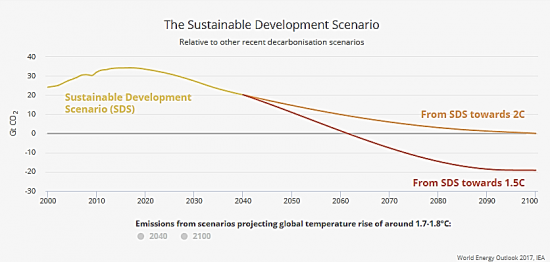
Paris set a lower and upper target in terms of mean temperature rise by the end of the century. The lower one was 1.5 Celsius (2.7 Fahrenheit). The upper was 2.0 Celsius (3.6 Fahrenheit). Based on the latest Intergovernmental Panel on Climate Change (IPCC) paper analyzing emissions data, that 1.5 rise will happen by 2040, sixty years ahead of the target date.
This is a political failure of global proportions and demonstrates the absence of leadership around the world in tackling climate change through implementing emission reduction policies and practices.
At best climate scientists talk about us having a 5% chance of reigning in emissions so that we don’t see temperatures rise by 2.0 Celsius before century end. But as you can see decarbonization to achieve 1.5 or a 2 Celsius rise requires a far more aggressive tack to lower the emission curve.
]]>
“The decision on whether to increase the ambition of climate change mitigation efforts to stabilize temperatures at 1.5 C rather than 2 C above pre-industrial levels is arguably one of the most momentous to be made in the coming decade…”
Why is that?
Because when COP21 convened in Paris in late November of last year, the nations of the world came together committed to a 2 Celsius limit. But the meeting also invited the scientific community to prepare a report by 2018 to look at a scenario where 1.5 Celsius was the target warming limit. A plea from Pacific Ocean island nations argued for the lower limit stating that at 2.0 Celsius sea level rises would seriously imperil their existence.
In the commentary which appears in Nature Climate Change, the authors argue that research on a 2 Celsius and even 4 Celsius upper warming limit has been done, but “scientific questions around 1.5 C” remain. They state “it is our job as scientists” to explain to policy makers what the 1.5 C versus 2.0 C scenario means. As they state in their conclusions “for once, we have been asked a very specific question, so we need a very good reason indeed not to step up and answer it.”
Today, policymakers cannot fathom the difference, and therefore, research needs to be done on “the relative impacts of different temperature outcomes before updating their decision on the overall goal in 2020.” That 2020 reference is a milestone date established by COP21 in which all signatories are to provide revised carbon reduction targets.
The authors are calling for “scientifically robust” studies to look at 1.5 Celsius impacts. The examples given include studying the mean global precipitation response to 1.5 Celsius including looking at changes in distribution and timing. This means building simulations that realistically capture a 1.5 Celsius scenario. They call for further experiments and modeling to assess the risk of increasing extreme weather events. They propose high atmospheric studies to understand the equilibrium changes in the atmospheric engine. They propose looking at sea level models in a 1.5 Celsius scenario. At the same time they ask the scientific community to run in parallel similar for 2.0 Celsius.
They argue this is “a matter of urgency….that the 2018 special report will present all the negative economic constraints of achieving 1.5 C but with insufficient evidence to distinguish between impacts at 1.5 C and 2 C of warming.”
The ditch the 2.0 Celsius movement for a 1.5 Celsius limit began well before COP21. In fact the 2.0 upper limit has always been an artificial construct that got first mention in the 1960s and 70s. At that time a doubling of atmospheric CO2 was equated with a temperature rise of 2.0 Celsius. And as the United Nations and its members began to look at the serious implications of climate change and global warming the 2.0 Celsius limit got embedded in the conversation.
But in 2013 15 Pacific Ocean states including Australia and New Zealand signed the Majuro Declaration that pointed to the survival risk for many of the declaration’s signatories based on inaction by governments across the planet. The Maldive Islands in the Indian Ocean, prior to COP21, reflected a common concern with the Pacific Majuro signatories.
Nowhere in the opinion piece described above is there a reference to tipping point deltas under a 1.5 or 2.0 Celsius future. This appears to be an oversight. Because tipping points represent the unknown factor associated with global warming and there are many places on the planet where local impacts may differ dramatically when the difference is 0.5 Celsius.
I refer to a recent published paper appearing in the journal Earth System Dynamics which I wrote about back in April of this year. The authors of this research provide a infographic comparing the two scenarios on a global scale. But they also specifically describe the impact of the 0.5 Celsius difference on specific regions of the planet.
This is only one paper and the call for many more research projects like this is very much needed. In that I concur with this latest opinion and commentary.
What should be studied?
In a paper that appeared in PNAS last year discussing the implications of a 2.0 Celsius rise, 37 tipping points were identified of which 18 were expected to happen at less than 2.0 Celsius. These 18 include studies of particular interest to Canada, Alaska, the Scandinavian countries and Russia, countries which will feel the exaggerated impact of the 0.5 Celsius delta when translated to polar regions.
