Here are just a few of the many Metrolinx projects that have turned into colossal snafus:
I haven’t delved into the many other Metrolinx projects, cost overruns, cancellations, and other nonsense, but I am betting there is a good argument to be made that this government-sponsored agency is out-of-touch with the goals of creating sustainable, environmentally friendly transportation infrastructure, and hasn’t a clue on how to bring to market technology solutions that don’t end up costing taxpayers far more than what has been budgeted.
Which brings me to the purpose of this posting regarding hydrogen. In a headline this week, Metrolinx announced that after 4 years and $7 million spent on feasibility studies, it pulled the plug on hydrail, a hydrogen-powered technology for the regional rail network serving the GTA and other parts of Ontario. The reason given was that the technology wasn’t feasible because it couldn’t be implemented in the immediate future, the issues being no plan for adequate fuel production, storage, and refueling infrastructure. One would have thought with hydrogen, Metrolinx would jump on the greenhouse gas emissions reduction bandwagon to help the province and country meet its carbon emissions reduction goals. But no.
Slow on the uptake and clueless appears to be the mantra of this Crown agency. Did no one at Metrolinx look at the federal governments’ planned hydrogen strategy, described as an ambitious framework to use hydrogen energy as an alternative to fossil fuels for transportation? Did Metrolinx not know that Canada was and is one of the top 10 hydrogen-producing countries in the world? Did they not look at the federal strategy as an opportunity to create the infrastructure and resources they considered to be inadequate presently, to spur investment, new jobs, and potential exports, all while reducing greenhouse gas emissions?
The federal government strategy states “the time to act is now.” Too bad Metrolinx didn’t spend any of the assigned money on studying the federal government strategy which included a plan to modernize hydrogen supply and distribution infrastructure beginning as early as 2025 with a goal to build it out to meet the nation’s needs by 2030. I would think, considering how many missed Metrolinx project milestones have occurred in the past that dates a few years away would be no deterrent in looking at hydrogen-powered light and heavy rail infrastructure.
Ontario, with its heavy reliance on hydro, nuclear, and wind power for electricity generation would be an ideal environment for producing green hydrogen. This is hydrogen produced through electrolysis, the splitting of water into hydrogen and oxygen with zero emissions. With Ontario’s abundant water sources, and low usage periods in the daily electricity requirements of homes and industry, there would sufficient energy reserves to make hydrogen in high volume.
And the benefit of green hydrogen as a fuel source compared to diesel for light and heavy rail would yield significant reductions in greenhouse gas emissions at the point of use. Considering Canada is on a quest to transform its economy to a net-zero future by 2050, making the investment in hydrogen-powered engines for transportation would have seemed to be an act of nation-building. I guess the decision-makers at Metrolinx didn’t put a lot of thought or effort into Hydrail and the end result will be a missed opportunity and another snafu.
]]>
Here are some of the challenges:
To deal with these challenges do new builds and rehabs need as of yet uninvented technologies?
No. There are a number of buildings already incorporating materials and technologies that make zero-carbon a reality.
It is estimated that in 2030 more than 50% of all buildings in cities will have been built before green building standards for net-zero emissions were conceived. How, then can these buildings be retrofitted to be low-carbon. Remember, the goal here is to achieve carbon reductions. Here are some of the ways:
The above plus many of the solutions that are being applied to new builds are all feasible for older construction.
The World Green Building Council defines green buildings to include:
For more information on achieving net-zero results visit the Canada Green Building Council.

Prior to going, I had read a Reuters report dated February 25, 2019, in which the president, Carlos Alvarado, announced an economy-wide plan to decarbonize the entire country by 2050. The initiative is being driven by the First Lady of the country, Claudia Dobles. An urban planner by profession, Dobles wants the focus of Costa Rica’s next green strides to be on transportation.

Having visited Costa Rica over the last four years, and having seen the state of transportation in the country I am convinced Dobles is right. The country can make great strides toward zero emissions if it can make improvements to its transportation infrastructure.
One way would be to wean Costa Ricans from their automobiles. They love their cars with the average age of a vehicle topping 17 years. Everywhere your drive there is traffic and little attention seems to be paid to the rules of the road. When we visited San Jose last year, at times the traffic was as congested as the streets of New York, Chicago, Los Angeles or Toronto during the daily commutes. Only in San Jose, with the majority of vehicles appearing to be pretty old, the fumes from cars, buses, and trucks, created a smoggy haze which we could view when we looked back on the city from a nearby volcanic peak.
As for mass transit, Costa Rica has both a bus and railway network. The latter today operates using diesel locomotives with limited coverage. The last significant railway company suspended operations in 1995.
The road network like the railway is seriously deficient. Stray from the Pan-American Highway and driving turns into a harrowing road adventure. Secondary and tertiary roads go from asphalt-topped, to gravel, to nothing. When we visited four years we traveled to a spectacular waterfall just a few kilometers from Liberia, the capital of Guanacaste province. A road of a mere couple of kilometers took a considerable amount of time to negotiate. It was more a field of boulders interspersed with clay, sand, and gravel. On another trip to the interior of the country just two years ago, our drive took us several hours to cover no more than 10 to 15 kilometers, leaving us exhausted as we attempted to avoid numerous road obstacles large and deep enough to break an axle or puncture a tire.
So not only does Costa Rica have to make infrastructure improvements to both its road and rail networks it also has to get its citizens to give up driving their pollution-spewing clunkers in exchange for electric vehicles (EVs) and mass transit alternatives. It also means building a fast charge network, all of which is an ambitious undertaking for this nation of 5 million people.
The initial amount of money needed to achieve these ambitious plans is pegged at $6.5 billion over the next 11 years according to a March 12, 2019 article in the New York Times. For a Developing World country as small and as poor as Costa Rica, is the plan too ambitious?
Today Costa Rica has weaned itself off the use of fossil fuels for power generation relying heavily on hydroelectric, wind and geothermal power. Solar and power from biomass remain in their infancy. In its efforts to be fully off fossil fuels for electricity the country is First World. Even the most remote and humble Costa Rican homes have electric lighting.
But now comes a much tougher next step. Dobles envisions a new transportation network with a fully electrified rail system, a biking infrastructure, and country-wide fast charge stations on all major roads. It will certainly take more than $6.5 billion to achieve the 2050 goal of being the first zero-carbon nation. And that means the government needs to get a buy-in from Costa Ricans who will be asked to pay higher value-added, property, and income taxes. In a country that is pretty loosey-goosey about enforcing its regulations and collecting taxes owed, and where tax avoidance is commonly practiced by its citizenry, it will mean a behaviour change for the entire nation.
One potential source of funding could come from abroad. Today forest conservancy in Costa Rica is partially funded by wealthy nations and companies who are offsetting their carbon emissions by purchasing carbon credits through the preservation and expansion of the country’s dry and tropical rainforests. But with a land mass no bigger than the state of West Virginia, there is only so much money to be made from afforestation, reforestation, and preservation.
For Dobles, Costa Rica’s First Lady, she hopes to show the world that even a small nation can provide global-sized answers and overcome the negativity and chaos that surrounds the climate change issue and what can be done to mitigate it.

Pneumatic waste systems, pollution sensors, robots, drones, and self-driving cars are among the technologies we expect to be in our future. These features may be coming to a city near you. Why? Because they represent the tools and technologies that could make our cities more sustainable and eco-friendly as our world population continues to grow. Expect new cities to emerge that may help us achieve balance within our planet. Here are five that may become part of the urban landscape by mid-century.

Location: Capas, Tarlac, Philippines
Start Date: December 2016
Completion Date: December 2050
Developer: BCDA Group
Key Features: Disaster-Proof, Green-Friendly
Population: 1.12 Million Residents and 800 thousand workers
Area Total: 94.50 square kilometers (36.5 square miles)
Cost: $14 Billion
Minimum Elevation: 184 meters (604 feet) above sea level
Green Spaces: Two-Thirds of the City will be Green Areas, Farmlands and Parks
Green Tech: Buildings will be equipped with technology that will reduce energy and water consumption
New Philippines City Located to Minimize Natural Disaster Threats
One of the coolest parts of New Clark City is its ability to overcome the worst Mother Nature can throw at it. The Philippines gets earthquakes. In this past year the country had experienced 157 of them as of August 14, 2018. What doesn’t help is that the capital lies on a major fault line making Manila the 4th most city on the planet at risk for such a disaster. The location of New Clark City, therefore, is not near any fault lines. Its location surrounded by mountains also will protect it from Pacific typhoons and floods. Developers believe the combination will save the country more than $101 billion USD in damages.
The city plans to use a building material called Lahar. Uniquely sourced locally, Lahar, is a type of mudstone formed by volcanoes. Using it as a substitute for concrete will eliminate a considerable amount of carbon pollution.
New Clark City will largely be pedestrian friendly with mass transit to minimize use of cars. Compared to Manila, which is known for its traffic jams and smog that affects 98% of its residents, New Clark City’s air will be near pollution free.

Location: China
Area Size: 200,000 square kilometers (over 77,200 square miles)
Population: Around 100 Million – larger than a third of the United States
Start Date: 2013
Completion Date: 2050
Key Features: Economic Powerhouse, Megacity
Cost: $36 Billion
New Transport Routes: By 2050, 24 intercity railways are planned for completion.
Who would have thought that a city could be the same size as England and Scotland put together. Well that’s the plan for Jing-Jin-Ji. Beijing’s hinterland today includes Tianjin and Hebei provinces. The centre of Tianjin includes Tianjin city. Today these three localities are separate and distinct. But this is about to change as the two neighbouring provinces share the capital’s future. A mega project started in 2013 aims to create a single megalopolis tied together by a road and high-speed rail system with no more than a one-hour commute to anywhere within the area’s boundaries.
 For current Beijing, it will mean a short commute to Tianjin City covering 150 kilometers (92.6 miles) in an hour. For comparison to travel from London to Felixstowe in the U.K., approximately 170 kilometers or 105 miles it takes 2.5 hours by train.
Creating this new megalopolis will also allow China to redistribute the population of the region and limit Beijing proper to no more than a target 23 million by 2020.

Location: Portlands of Toronto
Start Date: Still in the planning stage
Cost: $1.02 Billion
Area: 4.85 hectares (12 acres)
Key Features: Weather Tech, Robots
Green Qualities: Half of the area’s roofs will be Solar Panels with 10% of power requirements generated within the community itself
A Google company, Sidewalk Labs, plans to transform Toronto’s Quayside into a futuristic mini city. Toronto’s lack of affordable housing, an ongoing problem, may find a solution in the new construction methods developed for this city within a city. Construction methods will lead to flexible buildings that can serve multiple purposes. Even the roadways will be transformable from pedestrian rights of way to become vehicle friendly depending on time of day. Within Quayside the residents will have access to autonomous electric-powered transit.
The city will employ weather tech to heat pathways to remove snow and ice. Retractable canopies will turn internal structures into outdoor spaces in good weather. Underground robots will provide service delivery dealing with waste management and maintenance functions.
Quayside is to be an Internet of Things (IoT) hotbed collecting data continuously on every aspect of the living conditions of its residents. Who will own the data collected is currently what’s holding back shovels in the ground. With all these intelligent sensors and algorithms planned to operate the city, Quayside critics fear how the mountains of data collected get used. Sidewalk Labs and the city have held numerous workshops and town halls to iron out privacy policies and intellectual property concerns.

Start Date: 28 September 2008
Completion Date: 2020
Area: 30 square kilometers (11.6 square miles)
Population: 350,000
Cost: $6.5 Billion
Jobs: At least 50% of the residents will have jobs within the city
Key Features: Green-Friendly, Green-Spaces, Pneumatic Waste Tunnels
What was once a dumping ground for toxic waste, is soon to become the world’s largest eco-city. Sino-Singapore Tianjin Eco-city, China, is purposely being built on former wasteland according to Ho Tong Yen who states “In the past, so-called ecocities have been built in ecologically important areas or on useful arable land. We wanted to show that it’s possible to clean up a polluted area and make it useful and liveable.”
Renewable energy will account for at least 20% of the energy used with solar, wind and geothermal sources. Another focus is to eliminate cars with nearly all traffic in the area public transit. Pathways for cycling and walking will be extensively used. Pneumatic waste collection tunnels will remove the trash. The city will feature a significant amount of green space including reed beds in lakes. The emphasis is on creating a place where humans and animals can co-exist.

Location: Denver, Colorado
Area Size: 1.6 square kilometers (0.62 square miles)
Start Date: 2016
Completion Date: 2026
Cost: $500 million
Key Features: Health Tech, Smart Roads
After Panasonic’s success with a smart city project in Fujisawa, Japan, the company is now taking its ideas to Denver, Colorado. According to Panasonic Enterprise Solutions President, Jim Doyle, they are not building a copycat of the Fujisawa project but rather creating a town unique to Denver. The developers are aware there are massive cultural differences, and what works in Japan may not work in the U.S. One thing they will take from Fujisawa though is a wellness centre, facilities to encourage inhabitants to live a healthier life. Panasonic wants to use smart scales and smart blood pressure monitors, so if you can’t make it to the doctor’s office they can remotely check on you.
The project includes smart roads it calls Road X. The technology lets vehicles and roads communicate. The goal to have fewer accidents and better traffic management. Road X suggests to drivers best routes to take based on real-time traffic.
Taking advantage of Colorado’s sun the plan is to build rooftop solar capacity. A microgrid will both deliver and store excess solar energy. Panasonic plans to move its North American headquarters into the smart city, a 10,400 square meter (112,000 square foot) facility complete with a solar roof. The site is four minutes from the train station for an easy pedestrian commute. States Doyle “We really want this to be a true transit-oriented development. And if everyone is getting in a car and driving, that’s a huge failure.”
If you know of a new city being developed that fits within the criteria of eco-friendly, sustainable, and taking full advantage of IoT and smart systems, write to us here and we will share the information with our readers.
]]>What does the latter mean? More parks, more trees, more bicycle paths, and restricted roads where only electric or fuel-cell vehicles will have the right of way. it means buildings with green roofs and solar panels.
In my city, Toronto, not a current party to this latest C40 pledge, the urban innovation division of Alphabet, Google’s parent company, called Sidewalk Labs has entered into a partnership with Waterfront Toronto to create a people-centered neighbourhood focused on urban innovation. The mission of this new urban oasis, called Quayside, is to create a community where sustainability, mobility, affordability, and economic opportunity drive development. Quayside covers 325 hectares (800 acres) of an area of underdeveloped urban land near the waterfront. It is next to a much larger parcel of waterfront land in Toronto known as the Port Lands, and if successful will become the model for the redevelopment of the latter.
Quayside will include Google’s Canadian headquarters. It will feature adaptable modular buildings that combine housing and retail space. And underlying the entire community will be digital infrastructure to provide democratic participation in development decision making. Alphabet intends to provide much of the digital infrastructure and has pledged to provide connectivity that also guarantees privacy and security. The data collected from Quayside will be studied and analyzed so that the community can continuously adjust to the needs of its residents and businesses while fulfilling its environmental sustainability mission. A self-driving test shuttle will be a Google featured service, described as the next-generation transit system that will replace private car ownership. Renewable energy, new materials, and design will focus on creating climate-positive buildings that it is hoped will serve as a blueprint for cities around the world.
This will not be a wealthy, high-tech enclave. Affordability, accessibility, and diversity are part of the Quayside mission statement. In an opinion piece that appeared in the October 17, 2017, issue of The Globe and Mail, the Chair of Sidewalk Labs and the Executive Chair of Alphabet write, “we don’t claim to understand local needs, as well as Torontonians…..Our ideas are only the beginning of the conversation. In the end, it will be the people of Toronto who decide if the vision we’ve put forth is compelling enough….Working together…on this great site….we can demonstrate….that a cleaner planet is our future.”
On climate change and sustainability it shouldn’t be a surprise that cities are attempting to lead the way where other levels of government are failing.


The vehicles or pods are autonomous and operate in all kinds of weather conditions. The Singapore technology is described as 3rd Generation Group Rapid Transit (GRT). Each pod can carry up to 24 passengers per trip with the goal to handle 8,000 passengers per hour.
For SMRT Services the use of 2Getthere pods represents an integral part of what is a multi-modal transit strategy for Singapore. Fully automated driverless vehicles operate along dedicated networks of roads with high frequency service. The technology uses artificial landmark beacons to manage selected Singapore road networks.
2Getthere has been developing the technology since 1984 and installed its first people movers in 2002 at the Floriade horticultural exposition held in Haarlemmermeer, Netherlands (see image below). Since then the company has moved a 3rd generation of autonomously driven pod technology. A smaller version of the pods to be used in Singapore have been running in Abu Dhabi‘s Masdar City since 2010 over a 1.5 kilometer netowrk with 10 vehicles providing thousands of commutes daily. Unlike Floriade, the Masdar City installation is the first urban public GRT.

Although the GRTs implemented to date run on exclusive rights-of-way, the Singapore technology will operate in a network configuration providing both scheduled and on-demand options. Colin Lim, Managing Director for SMRT Services describes the 2Getthere technology as meeting first and last-mile connectivity in Singapore.
]]>Of course the much larger challenge of climate change and greenhouse gas emissions is one needing many planks in a platform for which 21st century transportation represents just one. And that is the subject of today’s posting.
To address transportation for the 21st century back in December 2015 the U.S. Department of Transportation (DOT) launched the Smart City Challenge. Stated Secretary of Transportation Anthony Foxx at the time, “Our national vision is still very much constrained by 20th century thinking about the integration of technology.”

Creating the Challenge to break out of this old way of thinking, DOT asked for submissions from cities with populations between 200,000 and 850,000 by February 4, 2016. The submissions were to address ways to facilitate improvements to transportation including solutions to gridlock, use of autonomous vehicles and vehicle-to-vehicle communication. In a 55 second video posted to YouTube, DOT described the Smart City as one “where transportation just works. Gridlock is a thing of the past. Lights turn green as you approach. Traffic flows smoothly as your car talks to other cars to avoid crashes. It even talks to pedestrians and bicycles. Your driverless taxi shows up just as your train pulls into the station. You arrive home from work and your automated grocery list is delivered just in time for dinner, from the farm to your table.”
The winning city is to receive $40 million from DOT and an additional $10 million from to companies, Paul Allen’s Vulcan Inc., and Rick Clemmer’s NXP Semiconductors. In the last week at the South by Southwest conference in Austin, Texas, seven finalists were announced from 77 city submissions supported by 300 different companies. The cities still competing for the $50 million appear on the map seen below:

In announcing the contest, Foxx had stated, “The 21st century will be dominated by urbanization…The entire world is….having a conversation about smart cities and what they should look like.”
Each finalist is to receive $100,000 to help put its final proposal together with the winner to be announced in June of this year. Although aimed at mid-sized American cities it is believed that all urban centres, both large and small, will benefit from the range of solutions that get presented.
Alphabet (the name of the new Google) has a subsidiary, Sidewalk Labs. The company, launched in June 2015, is building an integrated platform that combines an understanding of big data, technology, and best practices looking at urban transportation, social services, health and public safety. One of its products is FLOW, a transportation coordination platform.
FLOW is an open platform (capable of working with multiple data sources and software interfaces) that uses analytics (a systematic analysis of huge amounts of data by computers) to look at road use, infrastructure, and policy. The data, both structured and unstructured, includes information gleaned from mobile communications, sensors, cameras and other digital sources to create a real-time transportation picture.
FLOW analyzes selective road segments to better understand neighbourhoods and traffic flow.
FLOW simulates how changes to urban transportation impacts these flows.
FLOW allows smart city planners to deploy and test new technologies to determine overall system impact.
FLOW can route drivers to parking spaces and provide through mobile apps directions, pricing, and availability at the beginning and throughout a drive. It can enable and optimize the use of curb space to help logistics companies to deliver vital goods and services to city businesses.
FLOW can adjust transit routes and time in real-time advising would be and existing riders through their mobile phones.
FLOW can minimize conflicts between automobiles, bicycles and pedestrians by keeping all of them informed about changing surface conditions.
FLOW is the DOT proffered tool that will be given at no cost to the winning city in the Smart City Challenge. In addition Sidewalk is giving the winner its on-street Link kiosks. These kiosks (see illustration below) are being installed today in New York City under the city’s PlanNYC program. Designed to replace 6,500 antiquated public pay phones with a network of 7,500 data communication hubs, each Link features free Gigabit Wi-FI, video and voice calling, and access to emergency and other city services.
The revenue model for LinkNYC is designed around a 50/50 split between the city and the company and mobile system providers. New York City estimates its share of the income over 12 years at $500 million. So not only will the winning city get $50 million to help implement 21st century transportation solutions, it will also gain a new source of ongoing revenue. Now that’s a Smart City.

]]>
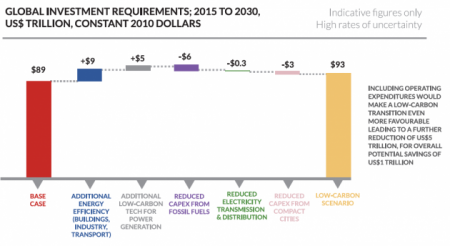
By making this global investment the world would gain the benefit of operating in a new paradigm, a low-carbon infrastructure costing far less than our current fossil-fuel energy paradigm. In the end there would be winners and losers. Holding back the seas for countries threatened today would not be possible. Relocation of citizens would be the only answer. And the other losers, the fossil fuel companies, would find themselves stuck with significant stranded assets. For them “business as usual” would no longer be possible.
The one thing those attending the joint meeting agreed upon was a low-carbon transition would only be financially viable if a price were put on carbon globally and if fossil fuel subsidies were ended. The money saved frome one and the revenue raised from the other would be sufficient to help those immediate victims of climate change adapt to changing circumstances. It certainly wouldn’t be sufficient to meet the larger investment target of $89 trillion. But it would be a good start.
For our planet “an ordered transition to a well-functioning, low-carbon economy” will require investments in improving the energy efficiency of existing infrastructure everywhere. It will require a significant investment in renewable energy, in nuclear and also in carbon capture and storage (CCS) where the latter would offset our need to continue to use coal and natural gas in this century. By 2100 that need would end with the full low carbon transition complete.
Our method of energy distribution would change not only in the way we produce it but where and how it is delivered and consumed. A good amount of the trillions we spend would go into urban investment to produce more compact and connected cities with better mass transit, reduced congestion and far less pollution.
But right now our current business models, accounting and investment rules are not designed to encourage the kind of investment we are talking about. Investment today is all about the short-term. Take for example the way my portfolio is built. I have mutual funds managed by a financial adviser who constantly does short-term reviews and adjustments to my assets. The holding period, therefore, for one or a group of stocks is watched and measured against a series of parameters. Not necessarily liquid but certainly not illiquid these investments are not the kind that are designed to benefit future generations. And they seldom are focused on infrastructure.
So the first thing that needs to be done is creating new ways to entice the financial industry into longer-term, illiquid, low-carbon investments that take into consideration social and environmental risks. Banks need to become early-stage risk takers on emerging technologies that are oriented to getting us greener. Capital pools need to be established for municipal governments to fund individual clean energy, urban intensification and energy efficiency building projects. In addition we need to see a significant expansion of high-yield green and infrastructure bonds to create sufficient capital for large-scale projects like mass transit.
And as for the funding of low-carbon initiatives in the Developing World, loans from richer nations should be denominated in the local currency to minimize the potential for default should the currency’s value fall against that of the loan provider.
And since cities will be where 70% of us will live by mid-century it would seem that reform of municipal financial structures is imperative.
For example, I wrote recently about Miami Beach funding its climate mitigation projects by issuing new building permits to condominium developers on the beach. The reason, the city only has property taxes and development fees from which to get revenue. This type of restrictive revenue model makes no sense in an urban world. Cities need to have the authority and financial resources to make the critical investments that align with the goals of a low-carbon end result.
Another example, in Toronto, where I live, traffic congestion and pollution combined with an antiquated and inadequate mass transit system has produced gridlock. But the city largely raises revenue from rate payers and their property taxes. So for projects that go beyond the daily operation of the city and all its services it goes cap in hand to provincial and federal levels of government in its search for capital needed to fund projects to end the congestion. It has limited taxing authority and thus other than a levee on homeowners must find creative means to fund infrastructure.
The same holds true for investment in energy infrastructure. The models of the past, large utilities and massively integrated power grids, must undergo a dramatic change. A low-carbon energy future includes small-scale power generation using renewables, modular nuclear, smart grids, micro grids, and off grid energy production and distribution. The costs to continue to operate current carbon-based energy production technology can only continue with incremental investment in CCS. If not then the carbon-based energy source must be shut down to be replaced through more investment in the aforementioned new sources. Green climate funds dedicated to energy production and distribution will be essential over the next decade-and-a-half to capitalize the transition.
It is true that in this mix of new financial policy the problem of stranded holdings will at some point require a write-down in the book value of companies today deemed to be energy giants whether fossil fuel producers or operators of coal-fired power plants. For Exxon-Mobil, BP, Royal Dutch Shell, and coal mining companies, no longer able extract fossil fuels from asset holdings will mean hundreds of billions in potential investor losses. Ultimately once assets are declared stranded the hit investors will take will be a one-time thing but its impact cannot be underestimated. The recourse for a world instituting a low-carbon outcome is to match the loss investors take from the stranding of assets with opportunities to invest in the new high-yielding financial instruments of the low-carbon transition.
None of this will be easy, but all is necessary. $89 trillion is a daunting number. Over 15 years it amounts to a little less than $6 trillion a year which equates to $16 billion per day. The sooner we get started the smaller the total bill and the closer we will be to minimizing global warming’s impact. Any delay will add trillions of dollars to the cost.
And according to those at the World Bank, International Monetary Fund and United Nations member countries, “the good news is that between public and private sources there is sufficient capital available globally to finance an energy transition.”

My wife and I spent four plus hours there last week and could have taken in another full day. From bio-engineering and genomics, agriculture, transportation, energy and space, the museum overwhelms you with its wealth of exhibits and subject matter. You experience an American coal mine and descend into it. You can marvel at a scale model of Chicago with a working model train display that would set any hobbyist’s heart aflutter.

Tour a World War II U-boat, totally complete, and so large that they had to build the museum walls around it to incorporate it as an exhibit. Listen and watch the story of the U-505’s capture as presented with all the energy and excitement to make you feel like you are there.

What surprised me was the scale of the exhibits themselves: entire trains encased within the walls, one with 420 plus meters (1,400 feet) of track; Craig Breedlove‘s jet-powered car on exhibit, the one that set the world land speed record. See the picture below. That’s it right next to the steam locomotive and coal car.

In that same hall an entire Boeing 737 is suspended overhead surrounded by vintage aircraft from the two world wars of the 20th century. You can see the wing jet engine to the left in the picture below. Note the Stuka and Spitfire behind the biplanes. Technologically displayed this way adds an extra dimension to our technological achievement.

Almost lost among the exhibits is a full-scale model of the Martian rover, Curiosity. I cannot believe how big it is, about the size of large dune buggy. And now having physically seen it I marvel at the engineering and technology that NASA and the Jet Propulsion Laboratory folks deployed to successfully land the robot on Mars, truly an astounding achievement.

So you would think a museum dedicated to science and industry would be looking far ahead into the future. There is a Fast Forward exhibit but it doesn’t have the same monumental scale as the exhibits of past achievement. You see snatches of the future in the genetics exhibit where you can read and learn about designer babies and epigenetics. The future gets covered in the agriculture section under genetically modified crops. And a spectacular globe of the world, suspended in a darkened amphitheater, provides a narrative of future trends on climate, population, communication, and transportation.

I shouldn’t be surprised that our future doesn’t have prominence here. After all a museum tends to be a narrative of the past supported by exhibits. Therefore it is seldom about the present or the future. And although the future may have little play in what we saw there is no doubt that this is one of the great museums to visit on the planet.
Take aways from our time spent in this museum and in Chicago in general.
Chicago is all about renewal and inventiveness. This is a city that burned to the ground in October of 1871 and a little more than two decades later hosted a world’s fair. It is the place where the skyscraper was invented, where Fermi conducted the first controlled nuclear chain reaction. It is a premier educational hub featuring more than 30 universities and 18 graduate schools. It is home to magnificent architecture, an effective transportation system (even though some of it over a century old and still operating). It has an inclusive waterfront, numerous parks and many recreational facilities. It’s diverse, urbane and dynamic and yes, it has problems with economic disparity and gun violence. But overall it is a great urban success story.
You know sometimes you need a trip away from home to renew your faith in the spirit and ingenuity of humanity. For my wife and I Chicago certainly has done that. In the picture below that’s her reflected in Cloud Gate with me in blue stripes and a red cap in the background.
Cloud Gate is a mirror-like bean-shaped immense sculpture that draws thousands each day to Millennium Park to interact with its curving surfaces. Through it you can see the Chicago skyline reflected in new and exotic ways. It is a reflection of the city in which it resides. A place of ingenuity and inventiveness, and an urban environment that demonstrates just how creative we humans have been and can be as we tackle the biggest challenges of the 21st century.

Proterra buses today operate in San Antonio, Worcester, Reno, Stockton, Pomona and Tallahassee. The company has orders from Nashville, Louisville and other U.S. cities. This performance should help fill the order book.
The EcoRide bus produces no exhaust emissions and therefore is a truly green technology as long as the source of its electricity isn’t coming from a coal-fired or other petroleum-based power source. And even if the source of the electric charge is generated by a fossil fuel burning plant EcoRide produces 44% less carbon than hybrid gas-electric, natural gas and diesel buses.

The EcoRide stretches 10.7 meters (35 feet). It features a composite body providing up to 40% weight reduction from conventional steel or aluminum buses. The battery, a proprietary TerraVolt (TM) Energy Storage System, can be charged in 5 to 10 minutes and fits within the floor structure of the bus to create a low centre of gravity. The motor is a single UQM PowerPhase (R) 150 permanent magnet motor that is rated at 150 Kilowatts continuous power, generating 650 Newton meters of torque and featuring a 3-speed transmission. Regenerative braking helps recapture energy during operation.
So how did the bus get recharged while driving the 1,100 kilometers? Proterra have developed an en-route charging system they call FastFill (TM). The bus pulls into a terminal where it automatically can connect overhead (see picture below) while passengers are leaving and getting on for the next leg of the route. FastFill can go from zero to 95% charge in as little as six minutes without any exceptional connection or boost in power from the local grid.
Cost for this technology is about the same for a city as a diesel-hybrid bus. And over the operational life (estimated at 12 years) would save a transit authority more than $430,000 U.S. in fuel and maintenance costs. And those saving don’t include the reduced carbon emissions and the incalculable value that provides.


