In pursuit of a net-zero emissions future, ammonia is seen as an important compound. Ammonia produced from green energy sources serves as an energy storage medium. It is easily transported in liquid form and can be cracked to produce green hydrogen which is a zero-emission fuel. It also can be burned to produce energy without emitting greenhouse gasses (GHGs).
Toyota is the world’s largest maker of automobiles. It developed the first hybrids. (Full disclosure, my current car is a Toyota Venza running on gasoline and lithium-ion batteries.)
Toyota has been a skeptic when putting all its eggs into the electric vehicle (EV) basket. It has had limited success with the Mirai, the first commercial hydrogen fuel cell car. Its vehicle lineup is dominated by internal combustion engine (ICE) cars and trucks that use gasoline and diesel fuels. It also has well-established expertise with hybrid-powered vehicles that combine batteries and small ICE powerplants.
It, therefore, shouldn’t be too surprising for the company to explore new fuel sources for ICE vehicles. With no carbon atoms in ammonia (NH3), using it to fuel vehicles means no carbon emissions. So heavily invested in ICE technology, the company may see green ammonia fuel as a stay of execution. Ammonia-powered vehicles when compared to EVs could be easier to support within the transportation industry and supply chain and, as a result, cheaper to build and maintain. And green ammonia would make these cars as eco-friendly as EVs.
Toyota owns 50% of a Chinese vehicle manufacturer, the GAC Group. This year it launched its first ammonia-powered model, a four-cylinder car that produces 161 horsepower and a very small carbon footprint.
Vehicle challenges using ammonia as fuel include that it is harder to ignite than gasoline or diesel and it burns slower. Pure ammonia requires high boost pressure and compression to compensate for the ignition issue. Blending hydrogen with ammonia corrects the problem.
Today, ammonia is produced for industrial uses using the Haber-Bosch process, a method invented early in the 20th century to synthesize the chemical compound using hydrogen and nitrogen. The process uses high pressure (200 to 400 atmospheres) and 400 to 650 Celsius (750 to 1,200 Fahrenheit) temperatures with natural gas, coal or oil providing the heat and the resulting high carbon footprint.
Just how high? According to the International Energy Agency (IEA), direct emissions from ammonia production produce 450 Megatons of CO2 annually with indirect emissions amounting to 170 Megatons. The main sources of these emissions come from the production for use in fertilizers. Compared to steel and cement, that is twice the amount or 2.4 tons of CO2 per ton produced.
To convert ammonia production to make it green means using renewable energy sources to provide sufficient heat and pressure. Siemens is working with the University of Oxford to take electricity produced from wind to do hydrogen electrolysis to synthesize ammonia. The Siemens Green Ammonia Demonstrator at the Rutherford Appleton Laboratory in the United Kingdom uses water electrolysis powered by a wind turbine to extract hydrogen which is then combined with nitrogen from the air to produce ammonia for energy storage.
The same distribution challenges faced by EVs is one that Toyota’s ammonia-powered cars will face. Where do you fuel up? For EVs, it has involved creating a fast-charging network as pervasive as the current distribution infrastructure that serves gasoline and diesel vehicles.
How large is the fossil fuel distribution network? In the United States today, there are 168,000 stations. In Europe, 140,000. In Canada, 12,000. In China, more than 22,000, Russia, 25,000, Australia, 6,500, the United Kingdom, more than 8,300, and Japan with 29,000.
For ammonia-powered cars, Toyota will have to find room in the fossil-fuel inn to make a go of its venture or face the same challenges that its Mirai model has faced and hydrogen-powered vehicles in general that have attempted to break into the mainstream of the green-vehicle revolution.
The comparison between hydrogen and fossil-fuel infrastructure is stark. At the beginning of this year, the Green Car Congress noted that hydrogen fuel stations had finally surpassed the 1,000 mark globally. In the United States, the number of places to fuel up with hydrogen amounted to less than 100. How can you compete with a hydrogen-fuel-cell-powered vehicle like the Mirai with so few places to fuel up?
]]>
It was estimated that more than 169 million ICE vehicles were on the world’s roads in 2021 and that over 2 billion ICE were being used globally, many in non-transportation applications. For comparison, 2021 numbers for battery and fuel-cell-powered vehicles climbed to approximately 11 million, or in other words, a very small fraction.
Current ICE technology has lifespans that range between 10 and 30 years depending on the application. What this means for the planet is that emissions-producing ICE technology is to remain with us well past the 2050 net-zero emission date unless governments around the world legislate them into oblivion.
What if ICE engines could be converted to run on green hydrogen? There are many challenges in answering this question.
Currently, hydrogen produced from green sources involves the use of renewable energy technologies or fossil-fuel burning thermal energy with CC. That makes the hydrogen pretty expensive. Nevertheless, research by automotive companies is ongoing to produce a hydrogen-powered ICE.
One of the companies is Toyota which has built an experimental hydrogen-burning ICE-powered car. Toyota’s work with hydrogen has produced the first commercial hydrogen fuel-cell-powered car, the Mirai. Comparing the efficiencies and practicalities of both technologies leads to the immediate conclusion that hydrogen fuel cells are a much better option.
Why? Because injecting hydrogen gas into an ICE requires modifications to improve both the efficiency and power yield. Hydrogen is less efficient than gasoline or diesel when burned. A burn byproduct is nitrogen oxides which can be removed using catalytic converters, an added expense. Then there is fuel efficiency. To get the same mileage as a comparable ICE-powered vehicle, a hydrogen ICE would require a heavy and large pressurized tank to contain the gas making the vehicle somewhat impractical. In comparison, a hydrogen fuel-cell-powered vehicle would require a manageable hydrogen tank to feed the fuel cell stack to generate electricity. The only emission would be water.
Having said all of this, this week a British inventor, Steve Berrow, in a press release states he and his colleagues have invented a hydrogen-burning fuel system which could be a means to convert existing ICE vehicles.
Called the Berrow-Zeice System, Berrow states it can be adapted for any ICE, big or small, burning diesel or gasoline. In the release, he states his patent-pending technology “is truly a global gamechanger for the fight against climate change,” and adds, “our technology can…reduce the damaging impact of toxic emissions and have a significant positive impact on public health and the environment at large.”
The Berrow-Zeice System features no air intake and no exhaust. It emits only water. Berrow is looking for investors to put his invention into commercial production. He can be reached at [email protected].
Just how complicated is the process of converting ICE technology to burn hydrogen? I watched a video to get a better idea of the complexity. I’m sending this posting to Steve Berrow by email with access to the video link to get him to comment.
]]>The European market is still in the EV early stage. In 2018 Europeans could choose from 60 EV, plug-in hybrids, and fuel-cell models. In 2020 that number is expected to grow to 176. By 2021 it will be 214, and by 2025, 333. Around 60% of the total European EV production in 2025 will be battery-based. And this growth aligns with Europe’s carbon emission reduction goals over the same period.
Transportation in Europe is the single largest contributor of airborne carbon on the continent amounting to 27% of total emissions. Of the 27%, 44% comes from automobiles with the number keeping on rising.
At the 2015 Paris Climate Agreement, the EU committed itself to net-zero emissions by 2050 and new-car sales to be net-zero by the mid-2030s. European manufacturers are required to reduce carbon emissions on new vehicle sales by 15% in 2025, and 37.5% in 2030.
EV sales in 2018 were relatively small in numbers accounting for 2.5% of the total European market. The top country, Norway (technically not an EU member) was responsible for 49% of EV sales. A distant second was Sweden at 8%, followed by the Netherlands, 6.7%, Finland, 4.7%, and Portugal, 3.4%.
Production, however, is ramping up with 2019 seeing three-quarters of a million built and sold. By 2025 the number is expected to grow to 4 million with a big decline in diesel-powered cars. The combined sales of diesel and gasoline-powered vehicles will decline by 2.7 million by that same year. Among domestic EU makers of EV cars will be Volvo, Volkswagen, BMW, and Daimler. Japanese, Korean, and Chinese EV carmakers, and some joint-ventures with European producers will make up the balance.
The EV cars built by European companies will largely stay in Europe. Why is that?
A potential inhibitor to achieving these forecasted volumes will be the production of lithium-ion battery packs. A recently formed European Battery Alliance has set a benchmark for manufacturing capacity with a goal of 131 Gigawatt-hours (GWh) by 2023, and 274 GWh by 2028. Comparisons with global capacity forecasts of 964.8 GWh in 2023 and 1,594 GWh by 2028 show that the EU will increase its world market share from 6.6% in 2019 to 1.7.2% by 2028. This will leave a capacity storage problem which will require European carmakers to rely on battery packs built in China. But by 2028 Europe will more than meet its battery pack capacity requirements for the EV cars it will produce. If you want to learn more please visit a detailed breakdown of Europe’s EV vehicle forecasts.
American demand for EVs including hybrids is forecasted to rise to 1.28 million by 2026, a much smaller sales volume than Europe. The North American market will continue to be dominated by Tesla, the company that created the modern EV phenomenon. General Motors and Ford Motor Company will be distant competitors. But Tesla’s numbers are small. It sold 240,000 EVs in the global market in 2018 and expects to close this year with unit sales of between 360,000 and 400,000. On the battery pack side, capacity largely Tesla-built is expected to reach 130 GWh by 2023.
What’s holding America back and the spillover to Canada and Mexico, tied together by the North American automotive marketplace through a free trade agreement? It is the anti-climate change policies of the U.S. federal government that continues to support the status quo in the automotive industry, the internal combustion engine. In the last week the Democratic Party held a town hall event on climate change, and should one of the people running for president get to the White House in 2020, it is likely that North America will suddenly awaken to the EV market potential as the country tackles carbon emission reductions as a climate change mitigation policy.
The case of China, however, is quite different. The Chinese government is hell-bent on not putting many more diesel and gasoline-powered cars on its roads because of its smog-laden cities. In 2018, China recorded 1.1 million in EV and hybrid sales. Its 2019 forecast will surpass 2 million by year’s end. And by 2025 forecasters are estimating a market growth to 12.7 million EVs annually.
China’s battery pack capacity which reached 286 GWh last year is forecast to grow to just under 800 GWh by 2025, and 1,549 GWh by 2028. That will make China the largest manufacturer of battery packs on the planet and will allow them to meet domestic and foreign demand.

]]>
Ford Motor Company in November notified the world that it was getting into the self-driving taxi business with plans to launch the service in 2021. For Ford the transition to becoming a transportation-as-a-service company is well underway. The company is buying into first-and-last-mile services using a wide range of autonomous and semi-autonomous vehicles providing transit for a number of cities and university campuses.
In both cases, we are witnessing disruptive innovation leading to these multi-billion dollar enterprises making dramatic right-hand turns in the hope that they can avoid being dinosaurs in the 21st century.
The advent of Tesla was just a minor inconvenience to the major automotive manufacturers when Elon Musk began manufacturing electric vehicles (EVs). Musk’s venture was never profitable yet investors put money in to help him realize his EV dream. Today the company produces three different EV models and in its last quarter turned a profit. Tesla is scaling up to build a half-million EVs per year. It is building a recharging infrastructure to support a U.S.-wide network, and it is at the forefront of developing battery technology to eliminate any remaining range anxiety.
Whether Tesla ends up being a long-term success or not, the company is reflective of an industry in disruptive transition for many reasons. The major automotive manufacturers have been remarkably unaware of the implications of climate change to their existing business. They haven’t fully realized the implications of their adoption of artificial intelligence (AI) and autonomy on their business. They have been slow to react to the changing demographics of buyer behaviour.
To describe all of these as the arrival of a perfect storm may appear to be hyperbole, but in fact, it is not. Ford, GM, and certainly Fiat-Chrysler, are facing market dynamics far different than those experienced in the 20th century.
The North American automotive industry was hit by a wave of disruptions in the latter half of the 20th century. First came inexpensive Japanese cars that negatively impacted sales for more than a decade. In their effort to compete the North American Big Three failed to produce products of equal quality at the bottom end of the market. And while they were fighting off competition for lower-priced product, European manufacturers attacked at the high end with very competitive products.
The second 20th-century shock came with the politicization of oil globally followed by concerns about tail-pipe pollution and the growing concern about climate change. Conserving oil and reducing pollution and greenhouse gas (GHG) emissions became major policy initiatives in North America. The price for new vehicles climbed as a variety of new technologies were introduced to deal with rising government regulation in the industry. Higher pricing required the industry to rethink its selling strategies as vehicles became the second largest expenditure for North American families. Overall the number of vehicle units sold or leased by North American manufacturers has slid as prices have risen. Profitability has taken a hit and the industry has reduced its workforce as a result.
The third disruption is one which the industry is experiencing now. The rise of AI in vehicles is leading to partial to fully autonomous transportation. And with autonomy, the old personal transportation model is making way to vehicle sharing. Changing buyer behaviour, pollution, climate change, and AI are all taking at least two of the Big Three down a new road. Hence GM’s ending a number of its name-brand products, the closing of existing factories, and investments in software and service companies.
Julia Steyn, VP of Urban Mobility at GM recently spoke at a technology conference describing society’s move to shareable assets. “People don’t want anymore, to have the dream that their parents had, which is they don’t want half of their paycheque to go to housing and transportation. And so that’s just fundamentally what’s happening in the world.” She continued, “The wasted assets that the car represents when it sits there 95% of the time, idle, is ridiculous. So you want to be able to monetize it.” Steyn and others at GM see car-sharing services as the mainstream future for the company.
And we know GM is not alone because Ford has announced the launching of a car-sharing service involving tens of thousands of vehicles by 2021. The company is making investments in the new vehicle models, software, and services needed to turn this into a brand new for-profit business. That means developing dispatch, routing and payment systems that fit in any city, and for a diverse range of transportation applications. To test the concept Ford is operating an autonomous vehicle delivery service in Miami for Domino and Postmates, and have announced an agreement with Walmart. Ford sees the market for autonomous vehicles providing transportation-as-a-service at more than $330 billion by 2026.
Both GM and Ford intend to launch new model vehicles to fit a number of micro-business service scenarios. And both companies will look very different before the middle of the next decade.

But that’s not the picture today. GM is a shell of what it once was and with yesterday’s announcement of the future closing of 5 of its assembly plants in North America, eliminating 14,700 jobs, the company demonstrated that disruptions in the 21st century come as sudden shocks to those impacted by them. In a carefully worded press release entitled “General Motors Accelerates Transformation,” the company announced its vision to transform itself into a “zero crashes, zero emissions, zero congestion” technology deliverer while saving $6 billion by 2020. The word “proactive” is featured in the announcement as are the words “highly agile, resilient and profitable” to describe the company that will emerge from this restructuring.
Just to the east of Toronto, the city of Oshawa, a home to GM for more than a century, will see the closing of its assembly plant putting close to 3,000 out of work. The Oshawa plant assembled Chevrolet Impalas, a sedan with a declining market share. The company has no plan to replace the model with something that is zero emission or autonomous and hence will jettison a more than one hundred year legacy.
GM’s announcement is the face of 21st-century disruption. It describes its transformation as a fundamental change to its significantly diminished global workforce “to ensure it has the right skill sets for today and the future.” It seems the 21st century has caught up with GM and to survive and keep its onhand cash from being depleted, it needs a new workforce rather than the one that has contributed to its 20th-century success. And it also has given the finger to the governments of the United States and Canada, which saved GM in 2009, bailing out the cash-starved company.
Interestingly, after the company announcement, its publicly traded shares rose in value by 5%.
So what are the right skill sets GM is talking about? There is no hint in the press release largely because the company is still trying to figure out why it no longer makes the vehicles consumers readily want to buy. One of them the Chevrolet Volt was supposedly the face of the company’s future investment in hybrid-electric vehicles. With the closing of the Volt assembly line, it appears that GM’s future vision was either mistimed or mistaken. It’s not the first time, nor the last. Back in the late 20th century, GM produced an electric car that didn’t roll out of showrooms in any kind of quantity to justify continuing to build the model. Mistiming the market on that occasion proved not to be a good thing for business.
GM right now still makes its money from vehicle sales. But for how much longer? Uber, Lyft and other vehicle-as-a-service models are changing consumer habits. As more people move into urban centers where owning a car or truck is less important than having access to one on demand, buying one is less compelling than in the past. The price of vehicles has risen to the point where they represent the second largest investment, after housing, that most people will make in a lifetime. But unlike a home, a car doesn’t last forever and so people cycle through new models every few years. The new car sale cycle that was once every 3 to 5 years is now becoming every 5 to 10 years. Younger people, many in the gig economy, are not buying cars. Add to this the anticipated arrival of autonomous vehicles on urban streets and you have a lifestyle destructive paradigm shift that is not just impacting GM, but also all other vehicle suppliers.
GM’s plant closures are all about conserving cash so that the company can place a series of new bets on the future. But it still doesn’t seem to know where the automobile industry will be in five, ten or twenty years. Will the electric vehicle finally become the standard as climate change and government regulations and policy force consumers out the doors of their internal combustion engine cars? Today in their announcement it appears that GM is betting on a pure electric play with fewer lines of vehicles planned for the next decade. But is that the right bet?
Maybe the hydrogen fuel cell will finally come of age and give the electric car a run for its money? Does GM have any skin in that game?
Or will it be better for GM to become a fleet operator of cars it builds rather than trying to sell them to consumers through a dealer network? Then GM would be a transportation-as-a-service company and could unload another overhead, its dealers.
Inevitably will the transportation-as-a-service business end GM’s need to be a manufacturer of anything? Any route the company takes will no longer equate the U.S. and GM’s interests as one and the same. That era is over.
Disruptive change in the 21st century is following an accelerating curve state futurists like Peter Diamandis. Keeping up with the pace of this creative destruction is leaving all kinds of name-recognizable businesses in the dust. Think Sears for one.
But the impact of disruptive change on labour is its most damaging consequence. In this case, creativity in the destruction is hardly positive at the beginning. But for those empty factories that will soon dot parts of the American and Canadian landscape, would it be too surprising to find a company like Tesla or one of the Chinese electric vehicle manufacturers picking up these properties for a dime on the dollar and turning the assembly lines and lights back on?
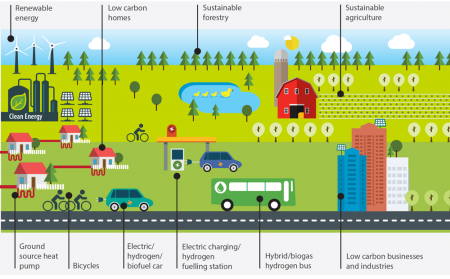
Turner isn’t the only believer that a zero-carbon economy is doable. The European Commission has developed a low-carbon economy roadmap for its members and hopefully the rest of the planet. Here are some of its projected milestones:
The European Union intends to share its expertise with other countries so that this can become a planetary-wide collective goal. Where will it find emission reductions?
Turner states that all of this is feasible if our governments have the political will, and industry and consumers buy into the program. Turner works with the UK’s Energy Transitions Commission, which recently introduced a report entitled “Mission Possible” focusing on decarbonizing the global economy. This report includes contributions from more than 200 industry experts and shows that full decarbonization is technically feasible with the technologies we have today. It states that the transition would cost the global economy less than 0.5% of GDP by 2050. And even this prediction, it states, could be improved if we were to get better at using carbon-intensive materials through recycling and other efficiencies and if we limited carbon-burning transportation choices at a faster rate.
Turner opines that a mere 1.5% of the global land surface could produce all the renewable energy the world needs, and that grids relying on renewable energy could operate at 90% efficiency in delivering power whenever needed through applications of storage technology, building hydrogen energy infrastructure, tapping into bio-energy, and developing new nuclear energy technology models. The cost to achieve this requires a 500% increase in renewable capacity over the next 40 years.
Here are some of his zero-carbon economy predictions should we have the courage to follow this path:
Turner states that “charging for carbon emissions is essential but must be designed to avoid unfair competition.” That means international agreements are essential for uniform carbon pollution pricing, as will be the imposition of carbon-tariffs on non-cooperating countries. Carbon-intensive industrial sectors such as the cement industry will need to have an established carbon pricing model. And to address the transition to biofuels for jet airplanes it will be necessary to impose a transitional strategy that ups the use of zero carbon and synthetic fuel substitutes.
Turner concedes that none of this is easy to do, but knowing that a zero-carbon economy is achievable should give politicians, industry, and consumers the wherewithal to go about making the transition a reality.

But south of the border, the Trump administration has been attempting to rollback emission and fuel economy standards for manufacturers of automobiles and trucks. These are standards adopted by the former Obama administration. The Trump regime has gone even further by challenging the State of California and its zero-emission vehicle policies.
California has for the last fifty years demonstrated the most environmentally conscious policies regarding vehicle mileage and emission standards. Responding to the Los Angeles smog conditions prevalent in the 1950s and 60s, governments in California have advanced the agenda for the development of low emission technology through a combination of carrot and stick policies. The state has raised mileage standards progressively and demanded all vehicles sold there be equipped with pollution abatement technology such as catalytic converters.
As California has gone, so has the United States over time with 18 other states, and the District of Columbia joining them in accepting tougher emission, mileage and safety standards. But Trump regulators are trying to end California’s influence regarding automobile standards.
You would think, therefore, that the automakers would be cheering the federal administration for its efforts. Precisely the opposite, two of the world’s largest automakers, General Motors, and Honda are taking California’s side in promoting EVs and increasing mileage standards for vehicle fleets.
General Motors wants to see 7 million long-range EVs on U.S. roads by 2030 which would reduce carbon dioxide emissions (CO2) by 375 million tons annually. And Honda sees the Trump attempt to rollback emission and mileage standards as creating uncertainty in the industry. Honda is also urging a national program acceptable to all automakers.
The Trump administration’s recommendations want to keep fuel economy requirements to 37 miles per gallon (6.35 liters per 100 kilometers) in the period between 2020 and 2026. The Obama administration had called for a fleet standard of 47 miles per gallon (5 liters per 100 kilometers) by 2025. The government of California sees the Trump rollback as a benefit to the oil companies exclusively, and certainly doing nothing to fight climate change. It means that oil consumption by 2030 will be a half-million barrels more per day than if the Obama standards were met.
For General Motors there is a further concern if emission standards are rolled back, and if zero-emission policies such as those adopted in California, are overturned by the federal government. The company sees the chief beneficiary of such acts to be China where its government has adopted aggressive policies to replace gasoline and diesel vehicles with EVs. China may not be alone in this windfall produced by backward-thinking policy. German and Japanese automobile manufacturers, along with their governments, are fully vested in replacing fossil-fuel burning vehicles with EVs and other zero-emission technologies by the end of the next decade.
If Trump succeeds in rolling back emission and mileage standards nationally while California, its 18 state supporters and the District of Columbia adopt their own path, it means manufacturers of vehicles sold in the United States will have to deal with two very different markets. That will raise production, distribution and point-of-sale costs. And it doesn’t help automakers if California and its partner states fight endless court battles with the federal government to determine a jurisdictional winner. The uncertainty this brings will stifle investment. In General Motors and Honda’s support of the California position they are telling the Trump administration they would rather have a common national standard that promotes a move to cleaner, greener vehicles which will make them globally more competitive.

In a 57-page document, entitled Climate Change Action Plan, it outlines 80 policies linked to 32 actions, each with a specific price tag and emission reduction estimate. The $7 billion is to come from the cap-and-trade marketplace that Ontario is joining along with Quebec and California. The Premier describes the plan as transformational, to “forever change how we live, work, play and move.”
The Government of Ontario has incorporated some of the ideas pioneered in New York State to combat climate change. The U.S. state recently launched a $5 billion clean energy fund to advance renewable energy and clean tech industries.
The $7 billion budget breaks down as follows:
The Plan is not yet official but a formal announcement is expected in June. The reaction of automakers has been of concern leading to a concerted behind-the-scenes effort to reach out to the sector for consultation and in advance of the Plan’s release.
To put the the challenge into perspective it will require the industry to deliver 200,000 hybrid and EV units to Ontario customers every year between now and 2024. For General Motors, Ford, Fiat-Chrysler, Toyota and Honda, all manufacturers within the Province, this amounts to a major sea change, a retooling of assembly lines, and a significant investment in new technology. The targets are far removed from the present reality which amounted to 6,933 total EV sales for all of Canada last year up from 5,235 in 2014. And in Ontario where the companies are being asked to promote EV and hybrid vehicles, to-date the numbers have represented a paltry 2% of all units sold annually.
Strangely missing from what has been shared with the public to date is a strategy to lower carbon emissions in mining, agriculture, forestry and Great Lakes shipping, all significant contributors of greenhouse gas emissions.

The report also predicts that by 2025 EVs will be competitively priced with gasoline and diesel automobiles. Total cost of ownership of EVs will become comparable to internal combustion engines by the mid-2020s even if gasoline-powered vehicles improve mileage efficiency at a rate of 3.5% per year.
What does the Bloomberg report believe will lead to this growth?
It is this latter point that is key. The drop in cost of EV batteries from $350 to $120 per kilowatt hour by 2030 will drive adoption by more consumers. There are two types of EVs on the market today: battery driven only vehicles, and plug-in hybrids. Technology leaders include Tesla, Chevy and Nissan. All three along with other manufacturers plan to launch longer-range, mid-priced vehicles within the next year-and-a-half. So what has driven the market up until now, early adopters, people who like to buy new technology, will become displaced by a much larger number of consumers who will buy based on performance and economy.

The early adopters grew EV unit sales in 2015 by 60% even in the face of falling gasoline and diesel pump prices. But as carbon pricing takes hold fossil fuel prices will creep upward while EVs will extend their range on a single charge to approximate internal combustion and diesel vehicles.
Impediments remain. They include:
One other fly in the oil. If autonomous vehicles catch on and ride-sharing services become the norm, EVs will more than likely experience an enormous surge in sales. The Bloomberg report believes the EV market share by 2040 with adoption of these two disruptive technologies could then reach 50% of new vehicles sold.
What does this mean for oil producers?
For every 1 million EVs sold there is a commensurate drop in demand for gasoline and diesel to fuel carbon-burning vehicles they replace. In the Bloomberg report it paints a number of scenarios. One is built on a continued increase in EV sales at a rate of 60% per year. If this were to happen EVs would displace demand for up to 2 million barrels of oil per day as early as 2023. That 2 million number equals the current glut of oil on world markets triggering the steep decline in oil prices we are witnessing today and the glut of oil on world markets. But analysts believe a growth rate of 60% in EV sales per year is probably unsustainable. In the second scenario they use 45% annual growth in EV unit sales. That puts off the next oil glut crisis to 2028. Now add carbon pricing on a global scale to the mix and all in all the outlook for oil producers will leave them “holding the barrel.”

A final note, nowhere in the Bloomberg report did I see reference to hydrogen-based fuel cell technologies. This may be an oversight since this technology is likely to see growing demand as more manufacturers such as Toyota enter the market and eventually drive down the unit cost to consumers.
]]>Hybrid vehicles were originally developed to use less fuel and lower vehicle emissions. However, they have some disadvantages: they cost more, weigh more, have a limited charging infrastructure and have a lower electric-only operating range in cold temperatures. The battery size and weight, in particular, has been a problem. Fortunately, automakers have allies at universities and government think tanks who are developing new battery technology. USA Today senior auto writer James R. Healey predicts that within 10 years or so, the vehicles on American streets will be very different from today’s cars.
Early hybrids were very expensive and available only to a small percentage of new car buyers. Now, they’re a common option in dealerships and discussed regularly on social media such as on DriveTime’s Facebook page.
Alternative fuel vehicles include electric vehicles (EVs), hybrid electric vehicles (HEVs), plug-in hybrid electric vehicles (PHEVs) and micro-hybrids (also called stop-start vehicles). EVs run on electric motors and use charging stations and regenerative braking systems to power their batteries. HEVs run on gasoline-powered engines with an electric motor as a complementary power source. PHEVs run on battery-powered electric motors with gasoline engines as a complementary power source and plug into charging stations to charge their batteries. Micro-hybrids have combustion engines with regenerative braking technology that cuts the flow of gas to the engine when the vehicle stops.
Hybrid technology is evolving and much of the advances are in the form of battery improvements, reports Popular Mechanics. Massachusetts Institute of Technology, Colorado State University, and Stanford are all working on different battery prototypes, but it looks like the future of EV batteries will come out of IBM in the form of air cathode energy storage.
The greatest problem with all electric cars is the cyclic issue of battery weight. To move the mass of the car, you need the energy from the battery. To deliver that quantity of energy, you need a bigger battery that increases the mass of the car. Traditional batteries are heavy because they are filled with metal and liquid; however, the new metal-air design removes the liquids and decreases the distance between the anode and cathode. This makes the battery weigh less and increases the energy output by an order of magnitude.
USA Today describes the future streetscape as having more EVs and hybrids, far fewer gas-powered vehicles and smaller vehicles with oval bodies and better aerodynamics. Where engineers are working on the energy to weight ratios, businesspeople are looking for the balance between the green of technology and the green of the dollar. Ray LaHood, United States Secretary of Transportation from 2009 to 2013, expects new technologies to cost more but also to be offset by fuel savings over the lifetime of the vehicle.
To support the growth of hybrid technology, an infrastructure needs to be developed. For short trips, AC Level 1 or Level 2 charging is sufficient. In essence, this form of charging allows you to plug your car into a home electrical socket, but it is slow, adding between 2 and 20 miles per hour of charge. Longer trips require intermediate charging stations that deliver a fast charge, usually less than 20 minutes for a full charge. Many states have already set up incentives for businesses that implement electric charging stations at job sites. Google, Apple, Netflix, and Ikea are just a few of the big names that are getting onboard the EV technology trend.
Unanticipated Market Forces
What can delay the move from gasoline and diesel-powered vehicles to hybrids and EVs? Market forces surrounding the price of fossil fuel. In the last couple of months we have seen this happening in world markets as oil pricing and therefore the price of gasoline and diesel have dropped well below past pricing highs. Suddenly a public looking at plug-in and hybrid technology is once more considering traditional powered vehicles.
Is this a long-term trend and could it end our great experiment with hybrids and EVs? Conceivably if oil prices remain depressed. But more than likely this is a temporary blip and those manufacturers like Tesla who are fully committed to ending dependence on fossil fuel energy for motor transport will continue to make vehicles that will be less expensive, lighter in weight, and provide competitive value for buyers.


