The post UFO-ology Gains Traction with New U.S. Report appeared first on Techso Mogro.
]]>In the modern era, UFOs have been with us since 1947. The first report came from an amateur pilot flying over Washington state who described witnessing a number of objects, flying in formation at high speed with flashing lights and maneuvering unlike any known airplane of the time. He called the objects “unidentified” and soon the moniker was extended including the words “flying objects” coined by a reporter. Hence UFOs were born. UFOs soon morphed into “flying saucers” again based on the editorial enthusiasm of the media taking the descriptions given by the pilot of the way the objects flew like a saucer thrown across a water surface, skipping up and down. If he had said like skipping stones, would the press have described UFOs as “flying stones?”
In 1947 alone, there were 853 sightings after the initial story broke. The U.S. Air Force opened an investigation which became Project Blue Book. Blue Book may have been inspired by the report of a “flying saucer” crashing in New Mexico, near the town of Roswell. Blue Book finally ended in 1969 after a University of Colorado study reinforced these conclusions:
And yet regardless of the U.S. Air Force discounting thousands of sightings flying saucers became part of popular culture and extraterrestrial invasions of our planet were glorified in film and books. Probably the most riveting effort, Steven Spielberg’s “Close Encounters of the Third Kind,” left this writer looking up at the night sky after leaving the theatre.
The origins of UFO-ology are well described in a piece written by Megan Garber, appearing in The Atlantic back in 2014. It’s a great read. But it’s not the origin story that made headlines in the last couple of weeks. Instead, it is a report from The New York Times of an upcoming presentation to the U.S. Congress followed by a government document release on June 25, 2021, that has the media in a new tizzy. A recent segment on “60 Minutes” featured interviews with U.S. Navy pilots describing unidentified aerial phenomena or UAPs, the new term being entered into UFO-ology, describing these objects as real and inexplicable.
So what does the report that will be released on June 25th contain? An examination of 120 incidents spanning over two decades describes a number of objects exhibiting hypersonic capabilities. That is, the UAPs fly at speeds no current known aircraft can achieve. Nor do these objects maneuver in a manner similar to any existing aircraft. And finally, many of the reports suggest there are no visible means of propulsion powering them. In one observed report aired on “60 Minutes,” two Navy pilots in 2019 described witnessing their own close encounter with a spherical object hovering over the ocean in midair, moving back and forth like a game of Pong, and then diving into the water, all of it captured on video.
As one Pentagon investigator of UAPs described the phenomena: what U.S. military personnel were witnessing was technology capable of withstanding up to 700 G-forces (astronauts experience 3 to 4 Gs during ascent and re-entry), speeds of more than 21,000 kilometres (13,000 miles) per hour (the fastest aircraft today is the Lockheed SR-71 which clocks at 3,500 kilometres (2,100 miles) per hour), with the ability to hover, change direction instantaneously horizontally or vertically, evade radar, and fly in the air, water, and probably space, and do all of this with no visible engine, no wings, and no avionic controls.
When the U.S. Senate convenes on June 25th to hear the report they supposedly will get the whole picture. What gets released to the public will be redacted (lots of black ink hiding whole sections).
I cannot even speculate on what UFOs or UAPs are. Could they be experimental technology from some military skunkworks either domestic or foreign? Could they be natural phenomena? Could our planet harbour a species we have never met that has advanced technology and is generally shy? The June 25th reveal has science-fiction aficionados salivating.
The post UFO-ology Gains Traction with New U.S. Report appeared first on Techso Mogro.
]]>The post The Shape of Aviation and Aerospace in the 2020s appeared first on Techso Mogro.
]]>Among them was the Boeing 737 Max 8 grounding after two accidents which killed 189 and 157 respectively. Boeing tried to blame pilot error until it was revealed that the redesign of the 737 airframe to accommodate larger, more fuel-efficient engines changed the airplane’s aerodynamics requiring compensating automatic pilot software called MCAS, for which human pilots were never trained.
Then there was environmental activist pressure on the aviation industry to accelerate decarbonization.
Among new technologies being introduced was the first electric-powered commercial aircraft.
While passenger volumes continued to increase with more commercial aircraft in the air than at any time in the past, accountability and sustainability concerns became part of the conversation in the boardrooms of avionics and airline companies.
Aerial taxis and in and intercity autonomous air vehicles appeared in trials of an entirely new type of air passenger service.
Drones continued to make aviators nervous as these tiny airborne robots grew in numbers explosively.
Commercial supersonic air travel was once again in the headlines with NASA promising a silent successor to the ill-fated Concorde sometime in 2021. No more sonic booms meant these aircraft could fly over land without restriction.
Scramjet hypersonic transport was in the planning stages with companies like Airbus working on prototypes.
Sabre, Reaction Engines hybrid hydrogen-air rocket plane moved one step closer to becoming the first powered space plane to fly both in the atmosphere and space using a combination air-breathing jet and rocket engine.
And in the regulatory environment, significant problems emerged in light of the two Max 8 crashes and what rot was exposed subsequently in the fallout at the U.S. Federal Aviation Administration (FAA). In what in hindsight is seen as a mistake, the FAA had given Boeing a larger role in overseeing the safety of its aircraft, passing along its own engineering reports to the regulatory body which then provided a rubber stamp. Many countries’ aviation authorities took FAA recommendations in good faith. A big mistake!
On the military side of avionics, the rise in autonomous aircraft represented the early evolution of robotics replacing human fighter pilots.
Rather than confined to speculation and science fiction, weaponized drone swarms came closer to becoming a reality in 2019.
New fighter jet models revealed and in planning stages from the United States, Europe, Japan, and China featured more autonomy, more firepower, and more stealth.
Russia introduced a hypersonic weapon designed to evade any existing anti-ballistic missile system, potentially ushering in a new space arms race.
The United States launched its new military arm, the Space Force, increasing the likelihood that the United Nations’ conventions agreed to by most nations on the planet about the peaceful use of outer space would soon end.
And in the world of commercial rockets and satellites, a burgeoning industry continued to reveal that national space programs were overpriced and under deliverers when it came to getting satellites aloft.
The NASA commercial space crew program continued to lag behind the timetable originally established to put Americans into low-Earth orbit and on the International Space Station. Instead, NASA continued to purchase seats on Soyuz rockets and capsules, a technology some 5o-years old and showing signs of aging with a near disaster in one launch.
And junk continued to fill near-Earth space with no solution to begin the cleanup available until the mid-2020s. How bad has the space junk problem become? Several times in 2019, the International Space Station needed to move its orbit to avoid collision with pieces of debris from past missions and moribund satellites still circling the planet.

The post The Shape of Aviation and Aerospace in the 2020s appeared first on Techso Mogro.
]]>The post Updated: SABRE Hybrid Hydrogen-Air Rocket Engine Takes One Step Closer to Becoming a Reality appeared first on Techso Mogro.
]]>The European Space Agency, ESA, and the United Kingdom Space Agency, UKSA, are jointly invested in SABRE technology development. The current three-year program backed up by money from both space agencies who have committed to continue working together even in the face of Brexit.
SABRE is an acronym standing for Synergetic Air-Breathing Rocket Engine. Truly a hybrid technology, it is complex and designed to handle the extreme heat built up during operation.

The engine is the propulsion system of the Skylon, the sleek black spaceplane that resembles the American-built SR-71, a jet aircraft used for high altitude surveillance that was retired from service a few years ago.
The Skylon, unlike the SR-71, is both a jet and rocket. The combination in a single engine has never been attempted before.
For a period of time during the development of the U.S. Shuttle, the plan was to include two propulsion systems, a rocket, and jet engine. For weight reasons, the latter mode of propulsion was dropped.
The Russian Buran space shuttle, on the other hand, a copy of the Shuttle, retained both modes of propulsion. But Buran flew unmanned only once before being mothballed while the Shuttle became NASA’s main vehicle for getting to and from space.
The Shuttle when de-orbiting and returning to the atmosphere flew as a glider. Skylon doesn’t because its SABRE engine makes switching between a rocket and jet engine seamless.
Skylon isn’t a reality as of yet, but its inventors believe it will be the first totally reusable spaceplane capable of flying cargo to destinations like the International Space Station, or for putting satellites into low-Earth orbit. It could be used for hypersonic flight in the atmosphere and in sub-orbital space to transport passengers and cargo around the planet in a fraction of the time commercial aircraft take today.
Development of different Skylon airframes all powered by SABRE technology could make plans for supersonic commercial aircraft redundant. And Reaction Engines, like SpaceX, has committed itself to reusability and sees the Skylon spaceplane powered by SABRE technology as the route to go to make access to space far cheaper than today while transforming spaceflight into something as routine as commercial airline service today.

Funding for the Skylon has dried up. The engineering research firm, Reaction Engines, has not been able to raise money to continue its operations.
SABRE was an air-breathing rocket engine that could take off from runways before switching into becoming a spaceplane running on liquid oxygen and travelling beyond the atmosphere into orbit.
It underwent extensive testing through to 2021. The UK Space Agency had given the company a £3.9 million ($5 million US) grant that year. The company was seeking £20 million ($25 million) from previous investors. But when asked to further fund the company the investors and the Space Agency declined.
The post Updated: SABRE Hybrid Hydrogen-Air Rocket Engine Takes One Step Closer to Becoming a Reality appeared first on Techso Mogro.
]]>The post The Fear of AI-Controlled and Other New Weapons Technology Leads Germany to Call for Global Disarmament appeared first on Techso Mogro.
]]>In an interview with the Neue Osnabrücker Zeitung, the Minister stated in reference to weapon systems, “for a long time now it’s not just about conventional rockets and bombs, but also about bits and bytes.” His concern includes autonomous weapons that kill without human control.
Maas called for a global rethink on disarmament that closes the loopholes currently allowing for more sophisticated weapon system development. He also wanted China to be included in the development of a global “rethinking of disarmament policy.”
For Maas, this is about the survival of humanity and comes after Donald Trump announced his plans to terminate the Intermediate-Range Nuclear Forces (INF) Treaty with the former Soviet Union and today’s Russia. The Americans have pointed to Russian new weapons development in this classification as the justification for Trump’s announcement. But the action may yield a very different result, opening a Pandora’s Box of new deadly weapons capable of flying at hypersonic speeds, armed with nuclear explosives, and able to choose targets to attack.
The status of the INF treaty is to be discussed this week at a NATO foreign ministers’ meeting in Brussels. Maas wants to use this meeting to begin working on a new global arms control treaty so that Europe doesn’t find itself in the middle of a nuclear confrontation between U.S. and Russian forces armed to the teeth with INF-banned as well as other weapons. Maas also wants China in the discussion because that country is building sophisticated intermediate and long-range missiles with similar capability.
About the INF Treaty
The treaty was an agreement between the U.S. and Soviet Union to eliminate permanently all land-based and cruise missiles with targeting ranges from 50o to 5,500 kilometers (310 to 3,400 miles). It was the first treaty between the two superpowers to reduce their nuclear arsenals and it led to the two countries destroying almost 2,700 short, medium, and intermediate-range missiles in 1991.
But in the last decade, the U.S. has accused Russia of violating INF treaty a number of times having discovered new Russian cruise missiles that fit the INF descriptions and that are undetectable by enemy radar. A few months ago Vladimir Putin bragged about a number of these new Russian weapon systems.
Neither country is totally honest about INF compliance. Using the glaring loophole that applied only to land-based missiles, both countries have developed sea and air-based missiles within the range limits described in the treaty. And now both countries, along with China, are developing new types of weapon systems that are self-guided, that use railguns and electromagnetic launchers, and that can attack targets deemed to be within the INF defined ranges.
The latest U.S. move involves the authorization of $58 million USD to fund active defenses to counter INF-range missiles and to develop countervailing strike capabilities. One of the projects is a giant cannon designed to hurl a smart shell over 1,600 kilometers (1,000 miles). The ordinance being considered for this cannon is nuclear and capable of yielding the equivalent of a 100-tons of conventional explosive. The U.S. has also developed a 499-kilometer Precision Strike Missile to stay one kilometer under the INF treaty limits. It should be no surprise, therefore, that Russia is making counterclaims that the U.S. is also in violation of the INF treaty.
That’s why German Foreign Minister Maas has declared it is time for all nations of the world to sit down and hammer out a new disarmament agreement and do it quickly before new missile, artillery, and battlefield weapon systems become more lethal, and even learn to kill without human intervention or oversight. I don’t think anyone hearing about this announcement today, coming from the mouth of a German government minister, can not see the irony of it considering Germany’s 20th-century history.

The post The Fear of AI-Controlled and Other New Weapons Technology Leads Germany to Call for Global Disarmament appeared first on Techso Mogro.
]]>The post 3D Printing Materials Advancements Point to a Revolution in Manufacturing appeared first on Techso Mogro.
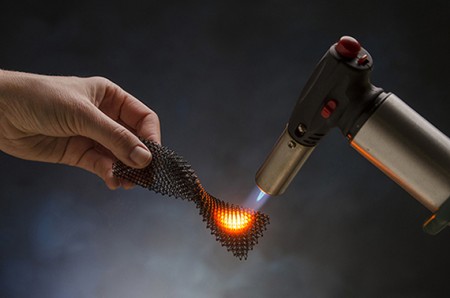
]]>The latest innovation uses a polymer resin “ink” to print customized ceramic parts and components for use in complex manufacturing. HRL Laboratories, LLC, announced this week that they had achieved a new breakthrough, “an approach to additive manufacture ceramics that overcomes the limits of traditional ceramic processing and enables high temperature, high strength ceramic components.” HRL has published its technology findings in the January 1, 2016 edition of the journal Science. HRL states that the challenge in using ceramics in additive manufacturing is that “ceramics cannot be cast or machined easily” unlike polymers and metals.
So how is HRL managing to produce finished ceramics using 3D printing?
They have invented a printable resin made from pre-ceramic polymers. They then use stereo lithography to construct structures layer by layer. They have demonstrated using laser beams and ultraviolet light guidance, the polymer resin and stereo lithography with a 3D printer an ability to build complex structures at rates 100 to 1,000 times faster than conventional manufacturing with stereo lithography. The finished products are then cooked in a kiln at temperatures exceeding 1,700 degrees Celsius (3,100 Fahrenheit) which overnight converts the resin to a high quality ceramic.
What are the kinds of 3D-printed products that this technology can produce?
The potential high density lattices produced using HRL’s techniques provide an alternative to today’s ceramic foams such as the material used to produce the heat shield for the Space Shuttle. Consisting of thousands of individually custom crafted ceramic foam tiles, over several flights the material proved extremely fragile when exposed to the stresses of launch, spaceflight and re-entry. Between missions a big cost component in the refit of the Space Shuttle fleet was the replacement of thousands of these tiles.
With the technology developed by HRL, new ceramic lattices and foams can be 10 times stronger than current commercial products. Ceramic lattices aren’t meant to be load bearing but with the added strength of HRL’s new method and material, parts created should prove to be far more durable and a key advancement for a space industry going through a paradigm shift to reusability.
The post 3D Printing Materials Advancements Point to a Revolution in Manufacturing appeared first on Techso Mogro.
]]>The post Headlines: U.S. Navy to Test Electromagnetic Railgun appeared first on Techso Mogro.
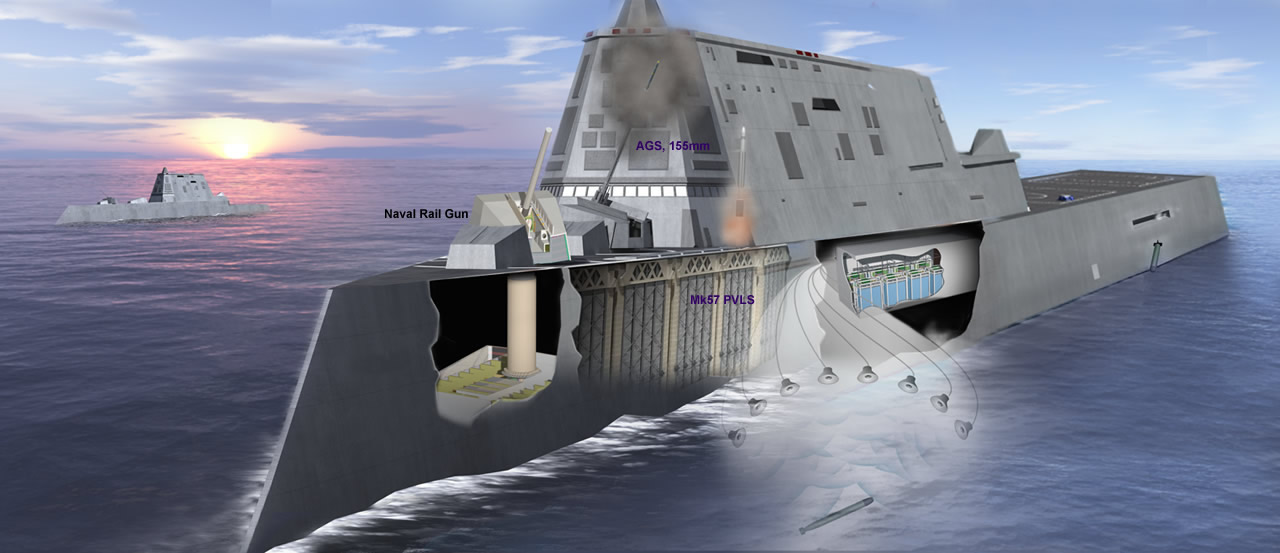
]]>A railgun consists of a three-part structure, a power source, a pair of parallel rails and a projectile platform on which is housed anything from an artillery shell to a rocket. A high-powered million-amp electric current runs from the positive rail across the projectile platform to the negative rail and then back to the power source. In the case of the navy, that power comes from the ships engines. The two rails act like wires and the current running through them creates two magnetic fields one running counterclockwise around the positive rail and the other clockwise around the negative rail. The combination of the two magnetic fields creates the energy to drive the platform along the rails. Depending on the rail length and the amount of power a projectile can be launched at speeds of Mach 5 or more. That’s over 6,000 kilometers (3,730 miles) per hour. Extend the length of the rail gun and increase the amperage and you have a gun that can put a satellite in orbit.

When air power ended the age of battleships no one envisioned their revival, but railgun technology represents a new level of lethality for naval ships to use against threats from the air, land or ocean, a new era for a new kind of battleship. And compared to other projectile weapon systems such as missiles, it turns out that railguns are far less expensive to operate. So I expect that the United States will in building ships with EM guns begin a process we have seen before in history.
At the beginning of the 20th century the British brought out a revolutionary, heavily armored battleship, HMS Dreadnought. It made all previous warships obsolete and led to a global arms race that inevitably contributed to the eruption of the First World War.
Could we consider using railguns for another purpose or is it inevitable that we always begin by exploiting the science to build a weapon? Can Lorentz Force power transportation? Imagine trains and suborbital commercial transportation using this type of technology. It seems almost certain that this is a path worth exploring.
Can what Lorentz discovered help us to develop other types of magnetic force technologies such as shields to protect humans from cosmic rays in space habitats? If so then maybe this military invention will spawn a range of peaceful applications.
The post Headlines: U.S. Navy to Test Electromagnetic Railgun appeared first on Techso Mogro.
]]>The post Transportation Update: Latest Scramjet Test Deemed a Success appeared first on Techso Mogro.
]]>

The U.S. Air Force had built four X-51As to test the viability of scramjet technology. The previous tests including the last in August 2012 had largely been disappointing. But this time the craft performed as expected traveling over 425 kilometers in 6 minutes pulling off the longest flight by a scramjet to date. With only four minutes of fuel on board the end result, a crash into the Pacific, was totally expected. The Air Force was able to harvest 370 seconds of flight data.
The X-51A uses a hydrocarbon-based fuel making it more compatible with other aviation technology managed by the Air Force. The aircraft was built by Boeing, the engines designed by Pratt & Whitney.
With the completion of this last flight the X-51A program comes to an end but it wasn’t the only hypersonic technology game in town. Defense Advanced Research Project Agency (DARPA) has tested two prototype hypersonic bombers with one achieving Mach 20 in an August 2011 test flight that lasted nine minutes. But the DARPA craft was a glider and not an air-breathing scramjet.
Scramjets may prove to be a useful mode of transport for future sub-orbital flights cutting down the time it would take to fly from Sydney, Australia to Toronto, Canada from almost 20 hours to a mere 3.

The post Transportation Update: Latest Scramjet Test Deemed a Success appeared first on Techso Mogro.
]]>The post Technology and War – Part 3: War’s Impact on Transportation Technology appeared first on Techso Mogro.
]]>
In World War One, motorized transport and railroads lent logistical support to all major combatants. For Germany, at the outset of the war, its extensive railroad network built for both commercial and military logistical purposes, gave them significant advantages in carrying out the initial offensive on the Western Front. Trucks and automobiles increasingly appeared behind the front lines although horse-drawn transport from the rail head remained the principal way armies received supplies. The perfection of caterpillar track drives combined with the internal combustion engine led to the development of the tank, the most significant mechanized mobile innovation of the war. Ironclad surface fleets and submarines prowled the sea lanes. And overhead we saw the development of airships, bombers and fighter aircraft.

World War Two further advanced mechanized transport with all of the technologies of World War One undergoing dramatic enhancements. Tanks and trucks provided the means by which the German, British, Soviet and American armies moved massive numbers of troops and material across thousands of kilometers in Europe, North Africa and Asia. The development of synthetic rubber greatly contributed to the fielding of vast fleets of trucks. On the water the aircraft carrier replaced the battleship as the dominant surface vessel while submarines increasingly improved over the course of the war. By the end the Germans introduced jet fighter aircraft and the first ballistic missile but in insufficient quantity to alter the war’s end result. World War Two also brought us the helicopter, a technology that was to play a much larger role in subsequent wars fought in the 20th and now in the 21st century.

At the end of World War Two the world entered the atomic age and U.S. military research discovered a way to create nuclear propulsion systems that could be deployed on warships. The first of these was the USS Nautilus, a nuclear-powered submarine launched in 1955. Today’s American aircraft carrier fleet is nuclear powered and so is the submarine fleet. The power plants are small nuclear reactors that generate heat to drive turbines which generate electricity. Nuclear powered ships have remained largely in the military domain although a number of merchant cargo ships and icebreakers have been built to operate using the same technology. And the United States isn’t alone in operating nuclear power in ships. It was quickly joined by the Soviet Union and now Russia. Russia’s ice breaker fleet includes nuclear powered vessels. It’s submarine fleet also includes nuclear powered vessels. The United Kingdom and France have both built a fleet of nuclear powered submarines. As of August 2012 there were 140 ships operating using nuclear marine propulsion around the globe.

But nuclear has not translated to land and air transportation. There are no nuclear powered tanks, automobiles, trains or trucks. There are no nuclear powered aircraft. This is largely because of the necessary safeguards associated with the technology. Nuclear technology requires protective encasement to ensure no radiation leakages or potential for accidents. On a nuclear-powered aircraft carrier with multiple power plants, the infrastructure of the ship easily handles the load, and because the ships are at sea any accident can be localized to the surrounding marine environment. Such would not be the case if a nuclear-powered train derailed in or near a city, or if a nuclear-powered airplane crashed, or nuclear powered automobiles and trucks were to crash.
So where is the military having the greatest impact on transportation innovation today? A look at the Defense Advanced Research Projects Agency in the United States and its funded projects to give you an idea of what the future holds. A collage of new project ideas appear in the images below.

The post Technology and War – Part 3: War’s Impact on Transportation Technology appeared first on Techso Mogro.
]]>The post Headlines at Techso Mogro for September 7, 2012 appeared first on Techso Mogro.
]]>Agriculture Update: Netafim Irrigation Technology – A Scarce Water Solution
A leaky water pipe and a flourishing tree revolutionized irrigation over 50 years ago and what was discovered by accident has led to the development of micro-irrigation products by a company in Israel called Netafim. Its micro-drip technology adapts to operational and environmental conditions maintaining directed water flow to field or greenhouse crops. Today the company is providing training and assistance to farmers in 110 countries developing micro-irrigation solutions that increase water use efficiency to 95%. In April Netafim opened a new facility in India to assist more than 50,000 farms in the country. India, a country with 1.2 billion people , 17% of the world’s population, contains only 4% of its fresh water. With 77% of that water designated for agriculture, maximizing water use is critical to increasing crop yields. Crops under micro-drip irrigation include cotton, sugarcane, potatoes and bananas grown in open fields as well as green houses.

Biomedicine Updates
Hey Doc – You May Soon Be Replaced by a Machine
At the Health Innovation Summit in late August in San Francisco, Vinod Khosla, a co-founder of Sun Microsystems and a partner in a health venture capital firm, described a future in which applications on smartphones would replace 80% of physicians. Khosla demonstrated AliveCor’s ECG Heart Monitor, a low-cost mobile device that enables a patient to monitor his or her heart health anywhere, anytime and that attaches to an iPhone. The monitor is one of a number of consumer-oriented medical products that Khosla’s firm is funding that allow consumers to measure and assess their own wellness. And with Watson (see last week’s headlines) learning to become a medical whiz on behalf of WellPoint Inc., machine learning systems may soon prove to be better at diagnosis than most doctors.

Using Computers to Stave off Dementia
Today dementia affects 13.3 per 1,000 population. But here is a prescription you can take if you are getting to your senior years like me. “Take one personal computer, laptop, tablet or smartphone session a day and call me in the morning because you’ll remember my number. According to a research study done by the University of Western Australia, regular computer use is a formula for lowering incidents of dementia in older males. The study followed 5,506 men between the ages of 69 and 87 for a period of up to 8 1/2 years. The results, a decrease in dementia rates of 40%. Computer usage was measured by frequency and type of activity. Follow up showed a correlation between frequency of computer use and cognitive abilities.

Environmental Technology Update: New Filter Separates Oil From Water
Imagine a filter that cleans up oil spills in the ocean or separates oil from water in fresh water treatment plants. In the past membranes separating water and oil have fouled up after a few hours. But not this technology created by engineers at University of Pittsburgh. The filtering agent consists of two compounds: POSS (fluorodecyl polyhedral oligomeric silsesquioxane) and PEGDA (polyethylene glycol diacrylate). When applied to surfaces such as wire screening, filter paper or fabric, water passed through while oil was blocked. Tests in the lab on canola oil and diesel fuel produced optimal results. Next in the plans, a field test in the ocean. Where are you BP?

Transportation Update: Is There a Supersonic Flying Wing in Your Travel Future?
NASA’s Innovative Advanced Concepts Program has awarded engineers at University of Miami $100,000 in funding to turn their bi-directional flying wing idea into a reality. The wing looks like a Ninja warrior’s star with four wings at 90 degrees to each other. When in subsonic flight the aircraft uses one set of wings. When in supersonic flight it rotates and uses its other set. The jet engines atop the aircraft re-align for the type of desired flight. For passengers on board, a 5-second rotation would create g-forces less than those experienced during commercial jet flights today.
Not to be outdone, engineers at Tohoku University in Japan have come up with a supersonic biplane concept that produces no sonic boom. Supersonic commercial air travel ended with the Concorde. Will we see it revive? Most experts believe concepts like these will take 20 years to go from the drawing board to commercial use. My bet is we will see sub-orbital commercial rocket service between New York and Tokyo before either of these two interesting airplanes ever fly.

A Postscript
Readership continues to climb every month. Thank you. You can find Techso Mogro on Facebook as well. If you go that route please “Like” the page. I’m 10 short of 30 readers. Once I reach that number I can begin to analyze reader traffic on that site. To the more than 4,000 of you who visited last month, thanks for dropping by and keep on coming back. I promise to keep you interested and intrigued about 21st century technology and our future. – Len Rosen
The post Headlines at Techso Mogro for September 7, 2012 appeared first on Techso Mogro.
]]>The post Headlines at Techso Mogronology for July 13, 2012 appeared first on Techso Mogro.
]]>Climate Change Update: Carbon Capture Technology that May Actually Work
A California based company, Codexis, announced this week that a pilot project capturing CO2 from flue gas at a power plant in Alabama produced promising results. Using carbonic anhydrase, an enzyme-based carbon capture technology, the company recovered carbon equivalent to 1,800 trees daily. This was a 2-million times improvement over previous demonstrations and showed that enzyme-based carbon capture can trap up to 90% of CO2 emissions. In the United States coal-fired power plants contribute 37% of the CO2 pumped into the atmosphere.

Energy Update: A New Nuclear Reactor that Uses Nuclear Waste as Fuel
GE-Hitachi has proposed to build a next-generation nuclear fission reactor to supply power in the United Kingdom. Called PRISM, the reactor uses plutonium as fuel and liquid-sodium as coolant. Currently the UK stockpiles spent plutonium and depleted uranium fuel rods at nuclear waste facilities throughout the country. It has accumulated enough spent fuel to provide power for half a millennium should the PRISM reactor project move ahead. PRISM can use the spent plutonium and depleted uranium left over from existing reactors to generate 600 Megawatts of continuous clean energy with zero emissions. The designers hope to have PRISM in operation within five years.

Mining Update: China to Mine the Ocean Depths
Hard to know whether to classify this story under mining or inner space but China is about to make a major foray to the ocean floor in search of resources for its expanding economy. The plan is to build a submersible for seabed mining and underwater drilling. The submersible to be built by the China Ship Scientific Research Center will measure 60.2 meters (almost 200 feet), by 15.8 meters (50 feet) and rise 9.7 meters (30 feet) from the ocean floor. It will weigh 2,600 tons and will feature on board accommodation for 33 and multiple ports for docking other submersibles. The plan is to place the station at depths between 1,000 and 8,000 meters (3,300 to almost 5 miles) in depth. A prototype to handle a crew of 12 is to be built and submerged in 2015. The full-scale submersible is planned for 2030.

Robotics Update: Artificial Intelligence Applied to Sorting the Garbage
Containers Maes is a waste logistics operator in Belgium that is about to install its first artificial intelligence based robotic recycling system called the ZenRobotics Recycler, a creation of ZenRobotics Ltd., of Helsinki, Finland. The Recycler uses a wide range of sensors to identify valuable raw materials and remove them from the waste stream for reprocessing.The sensors are tied into the ZenRobotics Brain, a control technology that learns as it is exposed to more materials. The artificial intelligence uses an algorithm that mimics the functions of the human cerebellum allowing for rapid learning about the waste material that gets conveyed through the recycler. To make an even greener statement, Containers Maes is running its robotic system solely on solar power.

Transportation Update: Hypersonic Spaceplane in the Works
Recently we reported that Virgin Galactic has plans to offer sub-orbital commercial rocket flights connecting places like New York and Hong Kong in under an hour. But a new DARPA project under the banner “Integrated Hypersonics” is building a spaceplane that will use a combination of technologies to achieve speeds of Mach 20 (24,000 kilometers or 15,000 miles per hour) while remaining within the atmosphere for time-critical air transport. Called the Hypersonic X-plane or HS, the technology will use air-breathing reusable engines and land on runways. Prior to this project the fastest scramjet achieved Mach 8. For the HX to reach Mach 20 it will use expendable rockets in addition to scramjets. A prototype is planned for launch in 2016.

The post Headlines at Techso Mogronology for July 13, 2012 appeared first on Techso Mogro.
]]>


