The post Conservation of Energy Should Be Front and Centre in Combatting Climate Change appeared first on Techso Mogro.
]]>Consumption of energy is an unequal game. North America, Asia, and Europe are disproportionately energy hogs. They consume most of the fossil fuels burned which is the cause of anthropogenic climate change. Our North American and European homes need to be heated in the winter and chilled in the summer. And then there are the technological gadgets that fill our homes and have us consuming more energy than all of Africa, South America, and Oceania combined.
That’s why energy conservation leading to reduced consumption and lower emissions is an important weapon in our arsenal to combat climate change. This means we need to look at the contributing factors to our energy-hog lifestyle. It means changing our behaviour.
Making lifestyle changes is easier if one can see the goal ahead. The problem with climate change is we likely cannot or will not see the results of our behavioural changes during our lifetimes. As a result, we walk slowly towards the change we need to make rather than run to embrace it.
Here in Canada as well as in the United States and Europe, most of us live in cities. Canadian and American cities are relatively young. European ones are older. The buildings in the Americas are largely 20th-century constructs. The buildings in Europe are a mix of old and new. Whether dealing with structures dating back to the Middle Ages, or those more contemporary, very few of the legacy buildings that dominate our cities have been designed with energy conservation in mind.
That’s why cities need to come up with smart policies and programs backed by funding both public and private to address energy conservation. Correcting the energy inefficiency in legacy buildings needs to be a high priority. Doing it will help cities to get to net-zero emissions faster than almost any other policy or program they initiate. It is, however, easier to have aspirations to achieve this, than it is to accomplish it.
For example, my home city, Toronto, has more than 450,000 legacy buildings in its inventory with the vast majority built pre-1970. These include:
The vast majority of these buildings have not been designed to conserve energy. And so far, the city, other than looking at its own inventory of 500 buildings or so, hasn’t created policies and funded programs focused on energy conservation. The city’s website refers only to federal grants for homeowners to do energy audits and retrofits.
Why should Toronto act on energy conservation for its legacy buildings? Below is a picture of the City of Vancouver taken using an infrared thermal imaging scanner. The yellow appearing in the image indicates where heat is leaking from surface areas. The biggest contributors are windows and doors, with roofs and walls coming in second. For Vancouver as in Toronto, the vast majority of buildings predate 1970 when building codes didn’t consider specifications focused on energy conservation.

Today in Canada, most energy consumed by residential and commercial properties gets used to heat spaces. And based on what we can see from infrared thermal images like the one above, a significant percentage of that energy for heating goes right out the windows, doors, roofs and walls.
Cities as environmental stewards and as the place where most of us live can do far more to mitigate climate change if they would focus on energy conservation to support residential and commercial property retrofits. That means putting in place programs to replace legacy windows and doors with energy-efficient ones. It means programs that subsidize insulating walls and ceilings.
The City of Denver and its Office of Climate Action, Sustainability and Resiliency has a five-year plan featuring a Climate Protection Fund. The money is to help improve the energy efficiency of homes, offices and industrial sites. Public seed capital of $40 million established the program which has since attracted private contributions to help increase its capacity to achieve the goal of zero emissions in all legacy buildings by 2040.
The Canadian federal government’s 2030 Climate Emissions Plan has put aside $1 billion for a green buildings strategy that includes energy retrofits. This is the money that Toronto describes on its website covering energy-efficient upgrades for new windows, doors, and insulation up to $5,000 per homeowner. There is no money for multi-residential units or condominiums. And the city isn’t adding any more funds or trying to attract money from private contributions to make the program more effective.
In the face of climate change, this lack of smart urban policy needs to change. Addressing energy conservation in legacy buildings can do more for reducing energy demand which means less burning of fossil fuels, and help in mitigating climate change. This is needed now for the sake of future generations for the overall health of the planet and the people on it.
The post Conservation of Energy Should Be Front and Centre in Combatting Climate Change appeared first on Techso Mogro.
]]>The post Rethinking The Automobile Industry in the Age of Disruption appeared first on Techso Mogro.
]]>Ford Motor Company in November notified the world that it was getting into the self-driving taxi business with plans to launch the service in 2021. For Ford the transition to becoming a transportation-as-a-service company is well underway. The company is buying into first-and-last-mile services using a wide range of autonomous and semi-autonomous vehicles providing transit for a number of cities and university campuses.
In both cases, we are witnessing disruptive innovation leading to these multi-billion dollar enterprises making dramatic right-hand turns in the hope that they can avoid being dinosaurs in the 21st century.
The advent of Tesla was just a minor inconvenience to the major automotive manufacturers when Elon Musk began manufacturing electric vehicles (EVs). Musk’s venture was never profitable yet investors put money in to help him realize his EV dream. Today the company produces three different EV models and in its last quarter turned a profit. Tesla is scaling up to build a half-million EVs per year. It is building a recharging infrastructure to support a U.S.-wide network, and it is at the forefront of developing battery technology to eliminate any remaining range anxiety.
Whether Tesla ends up being a long-term success or not, the company is reflective of an industry in disruptive transition for many reasons. The major automotive manufacturers have been remarkably unaware of the implications of climate change to their existing business. They haven’t fully realized the implications of their adoption of artificial intelligence (AI) and autonomy on their business. They have been slow to react to the changing demographics of buyer behaviour.
To describe all of these as the arrival of a perfect storm may appear to be hyperbole, but in fact, it is not. Ford, GM, and certainly Fiat-Chrysler, are facing market dynamics far different than those experienced in the 20th century.
The North American automotive industry was hit by a wave of disruptions in the latter half of the 20th century. First came inexpensive Japanese cars that negatively impacted sales for more than a decade. In their effort to compete the North American Big Three failed to produce products of equal quality at the bottom end of the market. And while they were fighting off competition for lower-priced product, European manufacturers attacked at the high end with very competitive products.
The second 20th-century shock came with the politicization of oil globally followed by concerns about tail-pipe pollution and the growing concern about climate change. Conserving oil and reducing pollution and greenhouse gas (GHG) emissions became major policy initiatives in North America. The price for new vehicles climbed as a variety of new technologies were introduced to deal with rising government regulation in the industry. Higher pricing required the industry to rethink its selling strategies as vehicles became the second largest expenditure for North American families. Overall the number of vehicle units sold or leased by North American manufacturers has slid as prices have risen. Profitability has taken a hit and the industry has reduced its workforce as a result.
The third disruption is one which the industry is experiencing now. The rise of AI in vehicles is leading to partial to fully autonomous transportation. And with autonomy, the old personal transportation model is making way to vehicle sharing. Changing buyer behaviour, pollution, climate change, and AI are all taking at least two of the Big Three down a new road. Hence GM’s ending a number of its name-brand products, the closing of existing factories, and investments in software and service companies.
Julia Steyn, VP of Urban Mobility at GM recently spoke at a technology conference describing society’s move to shareable assets. “People don’t want anymore, to have the dream that their parents had, which is they don’t want half of their paycheque to go to housing and transportation. And so that’s just fundamentally what’s happening in the world.” She continued, “The wasted assets that the car represents when it sits there 95% of the time, idle, is ridiculous. So you want to be able to monetize it.” Steyn and others at GM see car-sharing services as the mainstream future for the company.
And we know GM is not alone because Ford has announced the launching of a car-sharing service involving tens of thousands of vehicles by 2021. The company is making investments in the new vehicle models, software, and services needed to turn this into a brand new for-profit business. That means developing dispatch, routing and payment systems that fit in any city, and for a diverse range of transportation applications. To test the concept Ford is operating an autonomous vehicle delivery service in Miami for Domino and Postmates, and have announced an agreement with Walmart. Ford sees the market for autonomous vehicles providing transportation-as-a-service at more than $330 billion by 2026.
Both GM and Ford intend to launch new model vehicles to fit a number of micro-business service scenarios. And both companies will look very different before the middle of the next decade.

The post Rethinking The Automobile Industry in the Age of Disruption appeared first on Techso Mogro.
]]>The post U.K. Releases Plan to Achieve Near Zero Emissions in Transportation by Mid-Century appeared first on Techso Mogro.
]]>The government sees this strategy as core to its mission to make the United Kingdom a zero-emission centre of excellence in global markets.
Today Britain has more than 150,000 low-emission vehicles on its roads and 14,000 charge stations throughout the country. There are 38 different car and 9 different van models eligible for government plug-in incentives. In 2017, 1 in every 8 zero-emission vehicles bought in Europe was British built. Now the government wants to do much better with the goal to achieve mass adoption approaching 100% for zero-emission new car and van sales by 2040 and to have all vehicles on British roads near zero-emission by mid-century.
The government’s commitment to the funding of research and development will include battery-powered, hydrogen fuel cell, and conventional fossil fuels (diesel, gasoline, and natural gas) with the focus on the latter aimed at lowering greenhouse gas emissions from source to tailpipe output.
As much as this report is to be commended, the timelines within it, like so many other countries’ commitments that I read, are set far in the future, well beyond the mandate of current governments, and with little in the way of immediate measurable yearly reductions. Even the industry-wide targets for vehicle greenhouse gas emissions in the U.K. are voluntary and minuscule (a 15% reduction from 2015 emission levels by 2025).

The post U.K. Releases Plan to Achieve Near Zero Emissions in Transportation by Mid-Century appeared first on Techso Mogro.
]]>The post New Architecture Could Make Lithium-Ion Batteries Chargeable in Seconds appeared first on Techso Mogro.
]]>The key is shrinking the battery elements to nanoscale so that by the time you plug the recharge cable into a power outlet the charge is instantaneous. The architecture is based on block copolymer self-assembly. Joerg Werner, a lead author of the article, proposed to take work he was doing on “self-assembling filtration membranes” and applying “the same principles to carbon materials for energy storage.”
In an article appearing in the May 16, 2018 issue of the Cornell Chronicle, Tom Fleischman describes just how the nanotechnology of the battery’s architecture was conceived.
“The gyroidal thin films of carbon – the battery’s anode, generated by block copolymer self-assembly – featured thousands of periodic pores on the order of 40 nanometers wide. These pores were then coated with a 10 nanometer-thick, electronically insulating but ion-conducting separator through electropolymerization, which by the very nature of the process produced a pinhole-free separation layer.”
The nanofabrication technology currently is in proof of concept is not without potential problems. It appears that discharge and recharge cycles gradually degrade making parts of the battery inaccessible for reuse. But the promise of a lithium-ion battery that charges in seconds makes this work at Cornell exciting. So much so that the engineers involved have applied for a patent.
If the proof of concept can turn into a real product this means lithium-ion batteries because of the nanoscale architecture can decrease in size by orders of magnitude. And at the same time, the instant charge capability will alter consumer electronics, sensors, electric vehicles, the power industry, robotics, and any other industry sector where instantaneous energy from stored devices would be advantageous.

The post New Architecture Could Make Lithium-Ion Batteries Chargeable in Seconds appeared first on Techso Mogro.
]]>The post Fossil Fuel Industry Dilemmas – Part 2: When Will We Hit a Time When Pumping Oil Will No Longer Be Worthwhile? appeared first on Techso Mogro.
]]>If carbon pollution were priced at $250 per ton today, fossil fuel companies would be looking at the energy mix in their business model and adjusting it to include a significant amount of alternative energy products. A carbon tax of that size applied at the pump would negatively impact diesel and gasoline sales. Add to this progressive climate policy bans on vehicles using these fossil fuels, and the fossil fuel industry would largely have to reinvent itself. And the last straw could be the removal of the billions spent by governments to subsidize the industry, and fossil fuel companies, in the interest of their shareholders and business viability, would move away from exploring for and pumping oil.
But none of that is happening.
In Canada where I live, our federal government is considering a new subsidy to underwrite the expansion of the existing pipeline infrastructure, in particular, the Trans Mountain pipeline, aimed at giving oil sands producers, currently landlocked with only the United States as a customer, the opportunity to ship their heavy oil product overseas to Asian markets. At the same time, the federal government is implementing a $10 per ton carbon pollution price that will escalate annually to $50 by 2022. At $50 per ton for carbon, a number that ExxonMobil has used in its private accounting for risk now for more than a couple of years, there is little in the way of a disincentive to stop the company from continuing to make further investments in exploration and extraction.
In Europe, nations are passing legislation to end the use of fossil fuel burning vehicles on roads. None of the countries are banning diesel and gasoline or asking vehicle owners to stop using cars with internal combustion engines. Policy restricting new builds of fossil fuel-burning vehicles refer to dates beginning in the mid-2020s to 2040.
In the United States, the country is conflicted by a federal government attempting to deconstruct progressive energy policy in light of the evidence of climate change, while a number of states and cities forge ahead with a smattering of programs aimed at damping down fossil fuel use.
In China, a centralist government continues to use state enterprises to drive aggressive policies aimed at tipping the country away from its heavy fossil fuel dependence. But that hasn’t stopped the country from continuing to feed energy demand by building more fossil fuel intensive power plants.
The truth is there appears to be no national jurisdiction or any future date horizon for the end to the pumping of oil and gas.
Fossil fuel companies can continue to merrily drill and pump away. Fracking technology has created significant new land-based fossil fuel reserves. New techniques for offshore exploration have added to the global oil and gas reserve. And in the absence of environmental stewardship, areas of the planet once considered too fragile for fossil fuel exploration (the Arctic in particular) is on the radar screens of Russia and the United States as the next new oil and gas frontier. One can conclude that there is no end to oil and gas in terms of supply well into the next century and beyond.
Is Demand the Ultimate Inhibitor?
Demand may be the only threat to fossil fuel companies in the foreseeable future. A public fearful of rising carbon emissions may act in its own best interests by using less oil and gas. Governments may be under siege in time as public awareness leads to wholesale changes in terms of who gets elected to govern.
No doubt the energy companies will continue to pay billions to lobby existing legislators to disinhibit demand-based policies that can impact their business models.
Even heavily taxing product at the consumption level through a carbon levy is something for which current governments collectively have demonstrated little appetite. And even when a levy on carbon is applied it is done incrementally so there is no sticker shock, no moment in time when consumers and the industry are suddenly confronted by negative-impacting economics. Governments collectively would rather stay in power than create unpalatable, yet ultimately necessary policy to drive down demand.
Will Environmental Shockers be the Ultimate Inhibitor?
Not likely is the answer to that question. That’s because climate change works slowly and insidiously. Even if extreme weather event frequency increases in a warmer, more turbulent atmosphere, the changes will be marginal, a little each decade, a little each year. Humans will adjust to this and governments will count on this even as they end up spending billions annually to clean up climate change messes. As long as there is no taxpayer revolt and governments have access to debt financing, the status quo will remain.
We’ll continue to see more renewable energy. We’ll see more innovation in transportation. But mass adoption of EVs isn’t going to happen. Diesel and gasoline cars will still be on the world’s roads for many decades to come. For the fossil fuel companies that gives them lots of time to keep finding and pumping oil and gas for decades to come.

The post Fossil Fuel Industry Dilemmas – Part 2: When Will We Hit a Time When Pumping Oil Will No Longer Be Worthwhile? appeared first on Techso Mogro.
]]>The post Design Tips for a 21st Century Eco-Friendly Low Carbon Home appeared first on Techso Mogro.
]]>Most of us dream of owning our own home. But, what if you could build your own? There are so many issues to think about. Not only do you need to figure out location, and understand local laws, but today in the age of environmentalism, you also need to consider building methods that can save water, as well as other green issues.
What follows is an attempt to provide readers with the information they may need to design an eco-friendly, low-carbon home. Before you know it, you’ll be living in it and helping to contribute to a lower carbon future.
Start With The Base and Consider Eco-Friendly Materials at Every Step of the Construction
Building a new home starts literally and figuratively from the bottom up. Using natural materials like wood and stone is a sound foundation for carbon-friendly construction. Although most homes take advantage of the proximity of local building materials, for a carbon-friendlier home you should consider natural stone or granite on countertops, bamboo ceilings, and lots of wood. These materials not only look good but also cut down on the manufacturing processes that contribute to carbon pollution. Everything from roofing to the material you choose for flooring can be renewable. Consider slate shingles. Pick bamboo or cork for flooring.

Go Solar
If you live in an area where there is a reasonable amount of sunlight you should be taking advantage not only by installing rooftop panels that can dramatically reduce utility bills. And passive solar can be a great way to heat your house. Consider where you put your windows and the kind of coverings and blinds you use. You may even want to consider solar blinds.
Be Efficient With Light
Even if you can’t use direct sunlight to reduce energy costs, lighting solutions today can reduce your carbon footprint. Consider LED light bulbs which are 75% more efficient than incandescent, and more eco-friendly than fluorescent bulbs.
Be Smart With Appliances
The appliances you pick are critical to maintaining your low-carbon new home. Look for any appliance or other piece of equipment with the ENERGY STAR label. Products with this label are deemed to be energy efficient by the United States Environmental Protection Agency (EPA). They use less energy which saves money.

Program Your Heating and Cooling
Using a programmable thermostat lets you save on energy costs. Programmable thermostats allow you to set optimal indoor temperatures regardless of the season. And smart thermostats today, available from a number of vendors, have the ability to learn what temperature settings you like. Your HVAC system will work far more efficiently using these types of controls. And if you can, once you have been living in your new more carbon-friendly home, consider setting your thermostat to be one-degree cooler in the winter, and one-degree warmer in the summer. You’ll not only save money on your utility bell, but will also mean less carbon will be emitted by your energy provider.
Install Water Systems That Are Eco-Friendly
Water efficiency in a world where freshwater scarcity is a growing concern can also help to save energy and money. Factor this into your design and you can greatly reduce your carbon footprint. Choose plumbing equipment that is leak proof. Install efficient fixtures. Use high-efficiency toilets. Consider on-demand water heaters. And if you can try to recycle gray water for use in your garden.
There is no doubt that designing your eco-friendly dream home takes a lot of planning. But today it is possible to build and live in a low-carbon home. If you build it you’ll reap multiple benefits: reducing your energy consumption, and contributing to saving the planet for many generations to come.
The post Design Tips for a 21st Century Eco-Friendly Low Carbon Home appeared first on Techso Mogro.
]]>The post Creating This Blog and Our Other Internet Activities Contribute to Carbon Emissions appeared first on Techso Mogro.
]]>Credit Angel, a free credit checking and reporting web-based service located in the United Kingdom, has attempted to quantify just how big our global Internet carbon footprint really is. It is an eye-opener for me and I am sure it will be as well for you, my readers.

Take Google Search – Today more than 60,000 inquiries occur every second using Google Search. Each search produces 0.2 grams of carbon dioxide (CO2) on average. A minute of using Google Search will then produce over 750 kilograms (more than 1,650 pounds) of CO2 emissions. Multiply that over a year, and consider the number of new Internet users being added each year and you have a sizable carbon footprint just from Google Search.

Of course, Search is just one of the many applications Google makes available for free to the global Internet audience. Think of the apps you use on your Android smartphone such as Google Maps, and you can multiply the emissions by a geometric factor. No one is more aware than Google of their net carbon contribution with the company publishing its internal environmental report each year celebrating more than a decade of carbon neutrality.
Google and its parent corporation Alphabet may operate a net-zero emission business, but those of us who use the applications it has created for the Internet are not so fortunate because the data we send and receive comes over third-party providers’ networks that consume electricity for data servers, heating, air conditioning, and other operational requirements.
That’s what makes this Credit Angel effort at calculating just how much our daily Internet activity adds to our global carbon emission totals. so very important.
Here are probably the most often used Internet activities in which we almost always engage.
Sending Email – Collectively we send more than 2.5 million emails every second. Each contributes 4 grams of CO2. That doesn’t sound like a lot. But when you start running the numbers that’s over 150 million emails per minute and a contribution of more than 620,000 kilograms (just under 1.37 million pounds) of CO2 to the atmosphere each minute.
Now consider how much of the email we receive turns out to be promotional, junk, or spam (McAfee, the antivirus, and security software company, puts the number at 78%), it would seem that we can find some economies here in terms of carbon emission contributions if we can eliminate the trash.


Using Facebook – If you needed another reason to consider ending your Facebook account, the carbon footprint of this social media giant is worth a gander. Facebook has more than 2 billion active users today. The annual carbon emission calculation per user equals 299 grams of CO2. That means every minute we are on Facebook making comments, friending, and following, we add 1,100 kilograms (2,425 pounds) of CO2 emissions to the atmosphere. Maybe less of Facebook would be a good habit to consider in calculating our personal carbon footprint contributions.

Watching YouTube – If you watch YouTube videos then you know just how easily you can be suckered into watching the cute cat and dog segments, late-night talk show monologues, or endless numbers of “how-to” self-help instructional videos. Well, according to The Guardian newspaper, every viewing second contributes 0.0017 grams of CO2 emissions. And every minute we view 4 million of these videos, which means our viewing habits are producing more than 7 kilograms (15.5 pounds) of CO2.

Posting Tweets – The President of the United States is the Twitter-in-Chief and every one of his communications produces 0.02 grams of CO2 emissions. So one can say he not only contributes a Twitter storm but also adds to global warming. Of course, he is not alone. A single second on Twitter equals more than 8,000 tweets. A minute produces close to 10 kilograms (22 pounds) of CO2.

Did I tell you this is an eye-opener? We can all do something about this in calculating ways to reduce our carbon contribution and lessen our impact on the planet.
The post Creating This Blog and Our Other Internet Activities Contribute to Carbon Emissions appeared first on Techso Mogro.
]]>The post Gizmos & Gadgets: On Cold Days Does Your Smartphone Lose Its Charge? Soon That May End appeared first on Techso Mogro.
]]>I’ve noticed it particularly this year when I walk my pup, Maya (she’s not really a pup being 12 years old). I go out with a fully charged phone in my back pocket and come back 45 minutes later having made no phone calls, or checked emails, texts or Google, and yet the battery shows as much as a 25% drop.

But that battery problem may soon pass as scientists search for alternative electrolytes that can stand the cold. Two researchers at Fudan University, Shanghai, have experimented with organic-based chemical electrolytes that are showing considerable promise in retaining ionic conductivity in temperatures as low as -70 Celsius (-94 Fahrenheit). The electrolyte uses an ethyl acetate base and exhibits a capacity to retain a charge at 70% in -70 Celsius temperatures. At -40 Celsius (-40 Fahrenheit) the battery retained 83% capacity. And at 25 Celsius (77 Fahrenheit) 100% retention. The researchers are still playing around with the material composition of the anodes and cathodes to go along with their new organic electrolytes. The material for the cathode is made of polytriphenylamine. The anode is composed of naphthalene tetracarboxylic dianhydride. Talk about two real tongue twisters.
From the laboratory to commercial reality is the next big step. But don’t be surprised if the next generations of smartphones and EVs operate much better when a polar vortex descends on your locale in a future winter.
The post Gizmos & Gadgets: On Cold Days Does Your Smartphone Lose Its Charge? Soon That May End appeared first on Techso Mogro.
]]>The post Electric Vehicles are No Longer on the Margin of the Automobile Industry appeared first on Techso Mogro.
]]>Volvo isn’t Tesla. It’s not a newcomer to the automobile industry. As a result embracing the EV over gasoline and diesel-powered vehicles points to the direction all automobile companies will go. EVs are going mainstream faster than most anticipated. The infrastructure gap (charging stations) notwithstanding, is no longer an inhibitor to the transition. Range anxiety is also going away as new models from Tesla and General Motors push the limits these vehicles can go beyond the average daily commute.
Volvo notes that consumers are very much driving the changeover because of carbon, climate change, and global warming concerns. States Hakan Samuelsson, President and Chief Executive at Volvo, “This is about the customer….People increasingly demand electrified cars and we want to respond to our customers’ current and future needs.” He goes on to state, “This announcement marks the end of the solely combustion engine-powered car.” Volvo sold 534,332 cars in 2016. The company forecasts annual sales of 1 million of its new electrified models by 2025. The timing of the Volvo move to EVs, many years ahead of what industry pundits previously forecasted indicates that at least in this case, a manufacturer is moving faster to make the transition to non-fossil-fuel-powered vehicles.
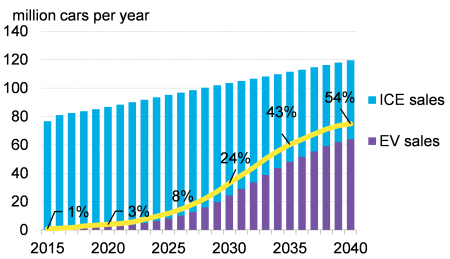
Now back to the Bloomberg New Energy Finance (BNEF) forecast. Put together by the advanced transport team, it analyzes the cost and performance trends impacting batteries as well as other factors and concludes that EVs will represent more than half of all new light vehicle sales by 2040. States Colin McKerracher, lead analyst at BNEF, “We see a momentous inflection point for the global auto industry in the second half of the 2020s. Consumers will find that upfront selling prices for EVs are comparable or lower than those for average ICE vehicles in almost all big markets by 2029.” The term ICE refers to internal combustion engines.
EV sales are growing steadily. In 2016, consumers purchased 700,000. That number is expected to reach 3 million by 2021. For Europe that represents 5% of all new light-vehicle sales; for the United States and China, 4%. But it is from the mid-2020s that BNEF sees EVs taking off because they will be cheaper to own and operate than ICE-powered vehicles.
Today lithium-ion batteries represent the standard in powering EVs. There are other battery technologies out there. For example, my new Toyota RAV4 Hybrid uses nickel-metal-hydride batteries. Toyota has made nickel-metal-hydride its standard since its first Prius hybrids were introduced. Lithium-ion produces more energy per kilogram than nickel-metal-hydride, but the material’s potential volatility has always been a concern. Consider how lithium-ion battery packs on some cell phone models caught fire in the last couple of years. At some point in the near future, current batteries will be replaced by lighter and safer technologies; for example, batteries that draw on ambient air rather than onboard oxidizers, or that use material less volatile than lithium to store electricity.
I encourage you to read about aluminum-air, sodium-air, potassium ion, and lithium-sulfur batteries, just a few of the new technologies I have discovered in my own research. Any of these or all could become alternatives to the current lithium-ion standard, accelerating the EV growth curve.
BNEF analysts see battery price and performance as the game changer. Even in the face of low diesel and gasoline prices, EVs will represent 67% of new car sales in Europe by 2040 with Norway, France, and the United Kingdom the biggest markets. Comparably 58% of new car sales in the United States and 51% in China will be EVs. Economics and not the environment will be the prime driver, although the latter will remain an important aspect of consumer decision making.
We won’t be rid of ICE-powered vehicles despite the growth in sales of EVs. BNEF forecasts that ICE will continue to dominate with legacy product representing 67% of all vehicles on the road in 2040.
The BNEF forecast also looked at autonomous vehicles and ride sharing. The analysts concluded that the former will remain limited for at least the next decade. But by 2030 autonomous vehicles will begin to prevail in tandem with the rise in sales of low-cost, low-maintenance EVs.
The post Electric Vehicles are No Longer on the Margin of the Automobile Industry appeared first on Techso Mogro.
]]>The post Under COP21 Marine Shipping’s Contribution to Greenhouse Gases was Omitted appeared first on Techso Mogro.
]]>“One giant container ship can emit almost the same amount of cancer and asthma-causing chemicals as 50 million cars”
A scary thought when you consider that the December Paris meeting on climate change chose not to establish emission standards on marine shipping for the present. That 2009 article further stated, ” just 15 of the world’s biggest ships may now emit as much pollution as all the world’s 760 million cars.”
In 2009 world maritime shipping produced as much as 30% of atmospheric nitrogen oxide pollution and almost 4% of all climate change emissions. That was 2009 and the problem remains and in fact has grown as China has added a number of super container ships to the world’s oceans. Each of these uses diesel engines as big as land-based power stations and all run on bunker oil. But before we talk about bunker oil in greater detail we should talk about the International Maritime Organization (IMO) and its efforts to date to address global ship pollution.
The IMO has created MARPOL, an international convention for the prevention of pollution from ships. In 2010 it adopted Annex VI, a provision for shipping companies to address sulphur dioxide, nitrogen oxide and particulate matter air pollution with an agreed to emission reduction strategy to be implemented starting in 2020.
Because marine pollution was not part of COP21 it appears the industry got a “get out of jail” free 5-year pass. This is indeed unfortunate because “pollution from the world’s 90,000 cargo ships leads to 60,000 deaths a year.” Which brings us back to the cause of this pollution, the industry’s heavy reliance on bunker fuels, the dirtiest source of burnable energy in commercial use today.
At one time bunker fuel was an answer to an even dirtier marine fuel, coal. Back in the 19th century and indeed into the early 20th, coal was the marine fuel of choice. But World War One marine technology advances led to a wholesale conversion of marine fleets which now began using oil. One of the motivators behind Japan’s Pearl Harbor attack in 1941 was to ensure the country established dominance over Indonesian oil by eliminating America’s Pacific fleet, giving the Empire a buffer to continue its South Asian conquests. The gamble failed but bunker oil remained the marine fuel of choice. It was seen as far cleaner than coal and far more transportable. But as a fuel for a 21st century in a war to combat climate change, there can be nothing much worse (coal excepted).
Bunker oil is the residual oil left after refineries distill gasoline, diesel and natural gas from raw crude. Bunker oil, therefore, contains all the impurities left over after distillation including residual heavy metals, sulfur and particulate matter. It comes in many grades determined by viscosity. The dirtiest and cheapest fuels are the most viscous. When burned it produces a powerful energy punch liter per liter but along with that energy comes a high volume of airborne pollutants in the form of ash (particulate matter) and greenhouse gases.
Are there alternatives to bunker fuel?
The answer is yes.
In the past we have written about marine innovations to address the bunker fuel challenge, technologies like advanced scrubbers to clean emissions, rigid sails with integrated solar panels, hybrid diesel-electric drives and more. These have largely been one off projects with no significant impact on marine fleets.
Interim alternative fuels that could be introduced into the mix include liquid natural gas (LNG) and bio-fuel (methanol). These are preferable to bunker fuel because they produce less greenhouse gas emissions. They could be the interim answer for the industry, a bridging technology before the transition to fossil-fuel free marine transportation systems.
LNG as an Alternative to Bunker Fuel
LNG is a controversial topic in Canada right now. In British Columbia, Royal Dutch Shell in the last month put a hold on a $40 billion (CDN) project to build a LNG export terminal. The Canadian government had recently green-lighted Shell the permit to proceed but volatility in the world oil markets led to its 9-month startup postponement. The natural gas source for this project are fields in the Horn River and Montney Basins of northeast British Columbia where fracking operations have been ongoing for more than 60 years. There are existing pipelines in British Columbia to transport the gas to the west coast where it would be liquefied and put on board ships headed to South Asian markets.
LNG is currently being used as an energy source for marine shipping. Last year a United States marine carrier commissioned its first LNG-fueled container ship as well as a bulk LNG supply ship. The European Union (EU) published its own 2015 report on the environmental advantages of Using LNG to fuel marine fleets. The EU report concluded that LNG is attractive for its environmental impact but that a profitable business model had yet to be established. In light of the drop in world oil prices since that report was published, the business model for a marine LNG fleet remains dubious. To date there are 20 to 25 LNG-fuelled vessels in operation, less than 1% of the total commercial marine fleet. The advantages of LNG are this. As a fuel it meets all the environmental standards established under MARPOL’s Annex VI. The disadvantages – the marine technology implementation is expensive. Converting existing fleets to LNG will take considerable time, and LNG fuel infrastructure equivalent to current bunker fuel sources is non-existent. The LNG terminals planned for British Columbia could contribute to this infrastructure but the current plans are focused on LNG export. That is understandable considering the lack of significant marine fleet of LNG-fuelled ships.

Bio-fuel as an Alternative to Bunker Fuel
The first methanol-powered ferry made its debut in March 2015 in Europe. The EU’s efforts to reduce emissions in local shipping lanes, inspired this project. The ship, Stena Germanica, is operating between Kiel, Germany and Gothenburg, Sweden. It uses a dual fuel system capable of running totally on methanol, or marine gas oil as a backup.
The EU hopes this demonstration technology will prove an effective live test for methanol as a future marine fuel. Part of the project includes development of engine conversion kits to retrofit existing ships reliant on bunker fuel. The project also includes the building of appropriate port infrastructure for supplying methanol as well as a methanol-supply vessel.

Maersk in cooperation with the United States Navy is also experimenting with algae-based biodiesel, a two-year trial on the container ship, Maersk Kalmar.
Another bio-fuel experiment called GLEAMS, uses glycerine-based fuel, a byproduct of biodiesel production, in marine shipping.
Methanol fuel cells are being developed by a consortium of companies from Finland, Sweden, the UK, Italy and Norway.
In the United States, the Coast Guard is testing bio-butanol for its small marine craft.
Is the effort by marine operators and governments sufficient to meet the global need to reduce carbon and greenhouse gas emissions? Not yet. Let’s hope as COP21 commitments begin to take hold that this important omitted sector becomes an active participant in a global effort to transition to a low-carbon future.
The post Under COP21 Marine Shipping’s Contribution to Greenhouse Gases was Omitted appeared first on Techso Mogro.
]]>