The post Advances in Flight Technology Celebrated 25 Years After 9/11 appeared first on Techso Mogro.
]]>Flying commercial took on a whole new look after that, and this was well before the industry began paying attention to carbon footprints and new design efficiencies.
Aviation has undergone remarkable transformations over the past two decades, driven by innovations in materials science, aerodynamics, fuel alternatives, real-time data collection, environmental concerns and more.
Today’s aircraft bear little resemblance to those of even fifteen years ago, equipped with technologies designed to improve operational safety and efficiency. From cockpit automation to lightweight composite materials and structures, advances in aircraft engineering represent a cumulative effort to push the avionics boundaries.
Understanding these developments provides insight into how modern avionics continues to evolve and what operators and passengers can expect in the years ahead.
Modern aircraft rely on composite materials, providing significant advantages over traditional aluminum airframes. These materials combine carbon or glass fibre with resin matrices, providing greater strength while weighing substantially less than conventional alloys. Integrating these materials is fundamentally changing the industry, beginning with design and manufacturing, and throughout aircraft operational lives.
Composites reduce aircraft weight. One of the aircraft recently entering commercial use is the Boeing 787 Dreamliner, built using approximately 50% composite materials. By weight, composite materials are more expensive than aluminum. The advantages in using the former over the latter, however, are significant, because less weight means less jet fuel consumption. Jet fuel represents between 20 and 30% of airline operating costs in normal periods. Today, with the war in the Persian Gulf, that percentage is creeping upward and could reach 40 to 50%.
Consuming less jet fuel also translates into fewer greenhouse gas (GHG) emissions even though composite material production versus aluminum favours the latter over the former. As engineers continue to develop new composite formulations and manufacturing techniques to make these materials more affordable and easier to produce at scale, aluminum’s carbon footprint advantage should vanish.
Aerodynamic improvements represent a critical focus for manufacturers seeking to enhance fuel efficiency and performance. Computational fluid dynamics software now allows engineers to test thousands of design variations using digital twin technology before having to build physical prototypes. This is significantly accelerating the development cycle.
Winglet designs, sharklet additions, and optimized fuselage shapes are contributing to reduced drag and improving the lift characteristics of traditional wing and tube designs.
Airlines are retrofitting existing aircraft with aerodynamic enhancements such as split-scimitar winglets, reducing fuel consumption by several percent on long-haul flights.
Natural laminar flow is being enhanced by using specially designed surfaces that smooth airflow over wings and fuselage. These aerodynamic refinements are being made to new aircraft as well as being incorporated into existing fleets.
Cockpit technology has advanced dramatically with sophisticated automation systems that enhance safety and reduce pilot workload during complex flight operations.
Modern flight management systems integrate navigation, performance calculations, and autopilot functions into unified digital platforms to provide real-time decision support.
Cockpits replaced mechanical instruments with integrated digital displays several decades ago. Today, they continue to evolve using touchscreen interfaces and synthetic vision capability. System displays provide terrain awareness and warning information, weather radar imagery, and traffic collision avoidance data for pilots to easily interpret even when facing challenging conditions.
Fly-by-wire technology, which replaced mechanical control linkages with systems managed by computers, has proven a safety advantage for multiple aircraft types and as demonstrated over millions of flight hours.
The continuous refinement of digital control systems, combined with robust redundancies and pilot training, has made aviation statistically safer with each technological generation.
The industry is pursuing alternatives to today’s conventional jet fuel and modifying engine technology to burn them.
Why? Climate change is dictating a need for the industry to reduce its carbon footprint.
Alternative fuels being tested and perfected include sources like used cooking oil and agricultural waste. New synthesized fuels are being developed from CCUS (Carbon Capture Utilization and Storage) technology. Electric propulsion is another alternative, as is hybrid-electric propulsion. In the latter category, using compressed or liquid hydrogen supplemented by hydrogen fuel cells is among the candidates to replace conventional jet-fuel-powered aircraft.
Electric and hybrid-electric propulsion systems remain at an early stage, but already converted aircraft and wholly new designs are doing demonstration flights. Among the first was a converted de Havilland DHC-2 Beaver that in 2019 successfully flew a battery-powered version, the eBeaver, on a 70-kilometre (45-mile) point-to-point test flight. Since then, electric-powered aircraft have undergone flight demonstrations, some built by companies like Airbus, Rolls-Royce, Pratt & Whitney Canada, Honeywell, and GE Aerospace.
Burning hydrogen, either using compressed gas or liquid hydrogen, is also in the mix. Hydrogen fuel cells are also being tested. In 2023, H2FLY demonstrated a liquid hydrogen and hydrogen fuel cell-powered aircraft that flew 842 kilometres (over 450 nautical miles).
Before H2FLY got off the ground, Airbus was working with ElringKlinger, a German fuel-cell developer, on a hybrid-powered aircraft using a gas turbine engine and hydrogen fuel cells. The project began in 2021 but was eventually mothballed. Recently, Airbus announced it would begin in 2027 to work on a new hydrogen-powered 40- to 80-seat commercial aircraft powered using a hybrid hydrogen-based technology.
Using alternative fuels presents challenges for the industry that include retrofitting and redesigning engines to burn them. The ideal is not to have to make major design modifications or operational changes to demonstrate feasibility.
Other proposed changes to engine technology have included geared turbofan engines and open rotor designs. Some of these prototypes are demonstrating fuel consumption improvements exceeding 20% over current engines.
Today’s aircraft are supported by some of the most data-rich predictive analytics in modern engineering. Aircraft contain embedded sensors that continuously collect operational data, which is transmitted to ground-based systems for maintenance analysis. This predictive approach allows engineers to spot wear and tear failures days or weeks in advance, preventing costly and dangerous mid-flight incidents. Real-time reporting means proactive maintenance, a fundamental shift from fixed-interval servicing.
Artificial intelligence (AI) in the form of machine learning (ML) algorithms is increasingly being used to analyze patterns in all this data. The more data history, the more accurate the ML algorithms get.
Ground operations use layered positioning and surveillance aided by navigation systems, sensors, vehicle transponders, and other software to create real-time pictures of surface operations. This allows airport teams to reposition aircraft on the tarmac, relying on modern aircraft tugs to move jets safely and efficiently between gates and maintenance bays.
The post Advances in Flight Technology Celebrated 25 Years After 9/11 appeared first on Techso Mogro.
]]>The post New Fuel Cell May Solve The Electric Airplane Range Issue appeared first on Techso Mogro.
]]>Going the battery route, therefore, seems only to make sense with short-haul, smaller aircraft, a developing industry niche. Solutions exist to develop lighter batteries that don’t use a liquid oxidizer, which saves considerable weight. Air-breathing batteries that use lithium, zinc, potassium or sodium metals as the anode and a cathode fed by air represent a promising alternative. Another route to go is air-breathing fuel cells.
Researchers at the Massachusetts Institute of Technology (MIT) have not been working on a battery but rather a fuel cell that uses liquid sodium. It uses a solid ceramic layer as an interface between the sodium and an electrode exposed to air. This sodium-air fuel cell stores more than three times the energy per weight as the lithium-ion battery packs used in electric vehicles today.
The MIT team has produced two versions of cells. One uses a vertical design where liquid sodium flows down through a ceramic electrolyte to connect to a porous air electrode to generate an electrochemical reaction. The second design is horizontal with the liquid sodium positioned in a layer next to a porous air electrode. The horizontal design allows the fuel cells to be stacked in layers. They can be rolled in and out of an aircraft on a hand cart.
The research team described their invention in the May 27, 2025, edition of the journal Joule. Material Sciences Professor Yet-Ming Chiang, one of the 5 involved in the project, described the advantages of the design to MIT News, stating, “The threshold that you really need for realistic electric aviation is about 1,000 watt-hours per kilogram.” Compare that number to current lithium-ion batteries that top out at 300 watt-hours per kilogram.
The power limitations of lithium-ion, plus the weight of each battery pack, make using them impractical for flying transcontinental or trans-Atlantic routes. The MIT prototypes have been able to generate 1,500 watt-hours (Wh) per kilogram with the ambient air’s humidity precisely controlled. The result is a multilayered fuel cell stack that generates over 1,000 Wh per cell. Aircraft equipped with these fuel cells can fly 80% of the domestic routes in the United States while producing 30% less pollution.
As the sodium metal transforms through the electrochemical reaction, the cells produce sodium oxide (Na2O) that is passed into the exhaust stream. Three things are good about this.
Professor Chiang notes that using the MIT fuel cell would be far safer than lithium-ion batteries. Although liquid sodium is extremely reactive and can spontaneously ignite like lithium-based battery materials, the use of ambient air and the solid ceramic interface eliminates the danger of a runaway reaction.
Chiang states, “In this fuel cell, one side is just air, which is dilute and limited. So you don’t have two concentrated reactants right next to each other. If you’re pushing for really, really high energy density, you’d rather have a fuel cell than a battery for safety reasons.”
So, what’s the next stage for this MIT team in their fuel cell initiative? Commercialization is in the offing with the inventors forming a company called Propel Aero. Although the website is no more than a home page at present, the team plans to produce brick-sized cells to power a large drone within the next year. Each fuel cell would contain a refillable cartridge containing liquid sodium metal.
Before the advent of unleaded gasoline, the U.S. produced 200,000 tons of sodium metal annually. Sodium metal is produced from salt. Salt melts when it reaches 98 Celsius (208.4 Fahrenheit), turning into a liquid. There is no lack of salt around, unlike more rare sources of liquid metals like lithium. It shouldn’t, therefore, be a difficult step to overcome in getting back to producing sodium metal.
The post New Fuel Cell May Solve The Electric Airplane Range Issue appeared first on Techso Mogro.
]]>The post Has Climate Change Made Commercial Flight More Problematic? appeared first on Techso Mogro.
]]>Our flight was delayed and the ride was bumpy. I monitored the view from the flight deck provided by a simulation displayed on the back of the seat in front of me. It showed the flight crew changing elevations several times to search for calmer air because of ongoing turbulence. We kept moving between 9,750 and 10,700 metres (32,000 and 35,000 feet) but nothing seemed to end the shaking. Several times the flight attendants stopped providing food and beverage service over the 3-and-a-half-hour trip.
Turbulence has been in the headlines recently with many flights reporting injuries to crews and passengers because of unexpected jolts to the aircraft. The turbulence we were experiencing is a symptom of a much bigger problem. Climate change is warming the atmosphere which now holds more water vapour and is more dynamic than in the past. A dynamic atmosphere is a turbulent one.
As I caught up on email I came across an article in Aviation Week entitled “Climate Change Makes Turbulence An Increasingly Pressing Issue.” It described turbulence as the unpredictable menace that “remains aviation’s nemesis.” Turbulence comes in different guises.
The Aviation Week article I mentioned above, published by the American Geophysical Union in 2024, describes the first two types of turbulence and their cause. With thunderstorms, it is the convective air currents in cumulonimbus clouds. CAT occurs when jet planes pass through the upper atmosphere in commonly used traffic flight paths in the sky. Naturally occurring high winds in these Jet Stream zones and larger jets create turbulence that affects airplanes travelling in the same laneway.
Ven Sishtla, an engineering and radar systems engineer at Collins Aerospace, describes CAT as a significant turbulence contributor. He states, “The aircraft is flying in blue skies, and suddenly you get hit.”
Meteo France Forecast Engineer Alexandre Flouttard monitors weather forecasts associated with changes in the Jet Stream that lead to CAT. She notes that forecasters try to predict areas with high potential for Jet Stream turbulence and issue alerts “when all models predict it or based on pilot reports.”
Earth observation satellites are also used to detect the clouds associated with CAT. Cirrus clouds appear as long thin streamers in the sky. Lenticular are lens-shaped and can indicate where CAT is likely to occur. Neither when detected by satellite can determine the level of turbulence.
Where we are in Exuma has seen skies displaying an abundance of these clouds since we arrived. There have been few clear sunny days.
Weather forecasters today provide CAT forecast maps for air traffic controllers who then are tasked with spacing out airplanes to remove turbulence caused by traffic congestion. Flight crews discuss turbulence in preflight briefings. Sishtla explains, “They use SMI (Significant Meteorological Information) alerts, turbulence forecast charts, pilot reports and the graphical turbulence guidance models available in some areas. Pilots study whether they may find turbulence along their flightpath.”
Turbulence is categorized as light, moderate, severe or extreme. The Aviation Week article notes that a common metric is the strain a passenger feels from their seat belt. Airborne weather radar on commercial aircraft helps with short-term decisions like those made on our flight causing the changes in altitude.
What does the future hold for commercial flight in the age of global atmospheric warming? Turbulence incidents and severity are expected to increase with damage to aircraft and injury to passengers. To counter this growing risk, advances in weather forecasting and onboard flight technology will allow aircraft to detect turbulence and wind shear events before they can cause damage. Advanced lidar is seen as one of the technologies that will help in the future. Under development are turbulence-cancelling systems such as the one being developed by Turbulence Solutions which generates counter-turbulence on the control surfaces of the aircraft to cancel 80% of the effect.
Current studies forecast CAT frequency to increase by 200 to 300% on North Atlantic flight paths by 2050 to 2080. Similar predictions are forecasted for flights over East Asia and North Africa.
The post Has Climate Change Made Commercial Flight More Problematic? appeared first on Techso Mogro.
]]>The post Is Commercial Supersonic Passenger Flight Coming Back? appeared first on Techso Mogro.
]]>Developed in a joint venture between Britain and France, the Concorde first flew in 1969, the same year as the Apollo moon landing. But it wasn’t until 1976 that the first commercial flights began. The 2000 Air France crash caused by a Concorde hitting debris left on a Paris runway led to a flight hiatus. But Concorde did resume flying across the Atlantic and to destinations in the Middle and Far East, remaining an attractive option for transatlantic commercial passengers in a hurry.
Concorde wasn’t the only SST developed in the 1960s. The Soviet Union built the Tupolev Tu-144, nicknamed the Konkordski. Its first flight happened two months before Concorde but it was plagued with technical issues and safety concerns and after a little more than 100 flights was permanently grounded.
American airplane manufacturers like Boeing and Lockheed flirted with the idea of building an SST during this time but soon dropped out of the competition. With the Tupolev grounding, Concorde then became the fastest commercial passenger jet on the planet and the sole one in operation until 2003.
Why did Concorde flights end? Rising operational costs and the amount of air pollution it produced ended it. But these weren’t the aircraft’s only operational problems. The most limiting challenge was that when Concorde flew at heights of more than 15,000 metres (50,000 feet) it generated a downward sonic boom that could break windows and rattle homes on the ground. That meant overland flights were prohibited from going supersonic which meant no Concorde would be used on a New York to Los Angeles route. The SST was restricted to transoceanic routes where the sonic boom wasn’t perceived to be an issue. The speed of the aircraft at 2,170 kilometres per hour (kph) (1,350 miles per hour) was impressive cutting the time on flights between London and New York, and London and Paris to less than three hours. No commercial airborne technology since has matched those speeds with today’s fastest commercial passenger jets like the Boeing 747-8i attaining 1,136 kph (706 mph) and the Airbus 380, 1,020 kph (634 mph).
A decade after the last Concorde flight, in 2013, NASA began working with the U.S. Department of Defense on an SST successor. Ten years later with Lockheed Martin as a partner, a working design was developed for a low-boom SST. Low boom meant the aircraft would be at least 30% softer than the Concorde at supersonic speeds with its developers describing the sonic boom as no more than a gentle thump.
The prototype is called the X-59 QueSST and in its latest design features a long and very sharp nose with no surface interruptions to cause noise when the aircraft goes supersonic. There is no windshield or canopy. The external vision system is monitored by a pilot using cameras integrated into the fuselage (see image below).
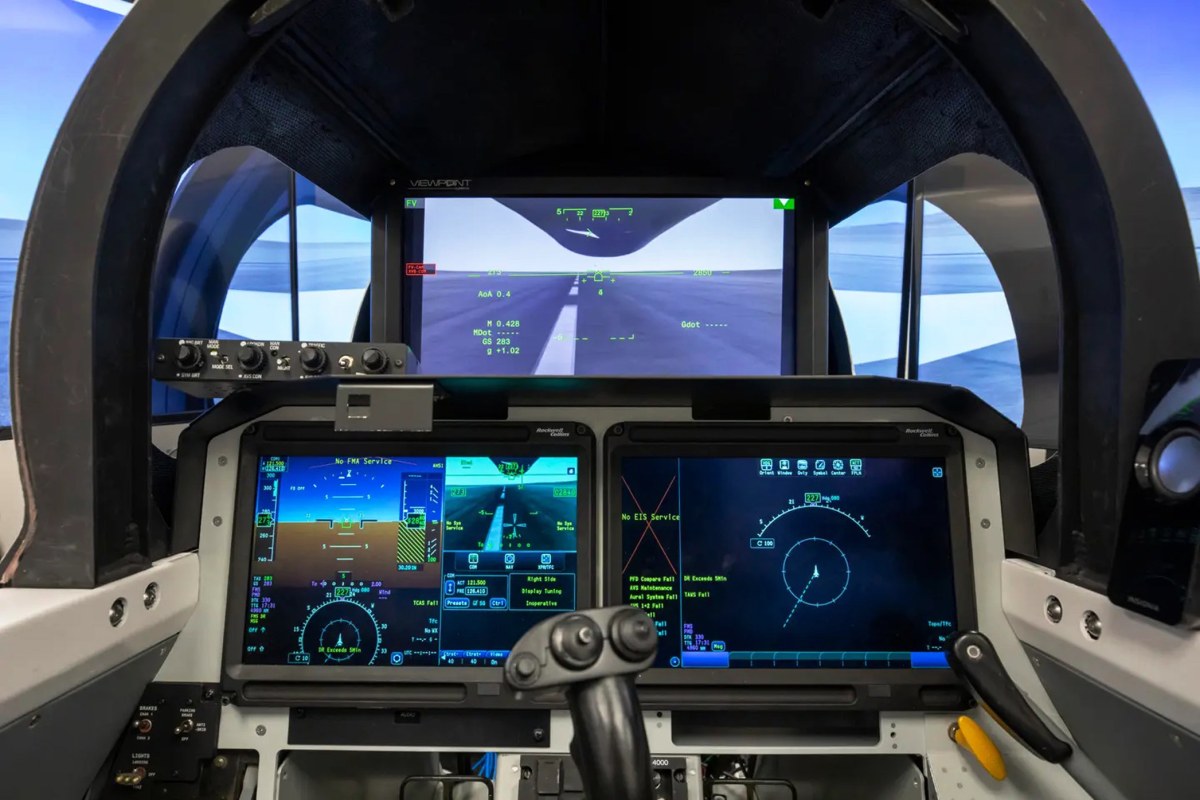
Sonic shockwaves go up rather than down because the jet engines are mounted on top. The cruising speed is 30% less than the Concorde with the X-59 attaining speeds of 1,488 kph (925 mph) which is still at least 25% faster than the fastest current commercial passenger jets.
When will the X-59 make its first test flights? The inaugural had been scheduled for December 2023 but it looks like it won’t be until early 2024 when the prototype flies. It will undergo multiple tests over urban and rural areas with teams on the ground assessing its low boom.
But the X-59 is not meant to be a commercial aircraft. It is only a prototype which becomes evident when you look at the image below where there is no evidence of a passenger cabin. Lockheed Martin, however, has plans to build a commercial version twice as long with room for 44 passengers.

How many more years will pass before we see successors to the Concorde flying out of commercial airports? I estimate it will not be earlier than 2030. But by then we may see the dawning of commercial passenger suborbital and orbital rocket flights and spaceports, a SpaceX dream. So will we need a Concorde successor?
The post Is Commercial Supersonic Passenger Flight Coming Back? appeared first on Techso Mogro.
]]>The post What’s Holding Back the Dawn of Electric-Powered Commercial Aviation? appeared first on Techso Mogro.
]]>Designers of aircraft are challenged by the amount of energy that can be harvested from batteries by weight, as well as the cooling and wiring requirements in designed electric-powered commercial airplanes. Then there is the range issue. Just how far can an electric airplane fly on a single charge?
The barrier to entry can be found in an energy density comparison between jet fuel-powered aircraft and those powered by batteries. Expressed in watt-hours or kilojoules per kilogram (Wh/kg), batteries today fall well short. A jet-fueled engine packs 12,000 Wh/kg. Current battery packs produce 250 Wh/kg. The differential in favour of liquid fuels is 48:1.
Battery packs regardless of whether they are fully charged or not remain the same weight during aircraft operations throughout a flight. Jet fuel is consumed lightening the aircraft as it flies which helps extend its range. So when considering an optimal performance range for an electric aircraft, distances are short, and weight considerations limit the passenger and payload capacity. The current thinking in aircraft design is an optimal range of 400 kilometres (250 miles) and seating capacity of 19.
NASA sees battery improvements by 2030 approaching 350 Wh/kg which would all for all-electric short-range 30-seat airplanes. By 2035 if energy densities hit between 400 and 500 Wh/kg, we could see electric and electric-hybrid models with seating capacity of 50.
In the end, hydrogen fuel cells that produce zero carbon emissions could be the game-changer. Their energy density in terms of Wh/kg today is already more than twice that of current battery packs (530 Wh/kg compared to 250). Fuel cells can be stacked and are comparatively lightweight. A hydrogen fuel source stored onboard could continuously feed the cells with the end output zero carbon emissions.
Airbus, the European aircraft manufacturer, sees a future in hybrid drive trains that combine fuel-cells with gas turbines. The company is working with ElringKlinger, a German fuel-cell developer, on ZEROe, a hybrid-powered aircraft. Several models are contemplated (see the above image), for regional short flights and longer-distance routes.
Lead ZEROe architect, Matthieu Thomas, notes that “hydrogen fuel cells could be a great alternative [to batteries] because they can generate—with zero emissions—significantly more power and energy for a given weight. This makes fuel cells an extremely interesting technology to achieve our ambitions.”
Even the gas turbine component in the Airbus ZEROe could include an electric motor for a unique hydrogen-fed fuel-cell hybrid-electric propulsion system. The remaining issue Airbus is working on is to overcome the reinforcement requirements for stored hydrogen onboard. Hydrogen tanks would be heavier and bulkier than those currently used to store jet fuel. New material composites or weight reductions found elsewhere in the airframe are contemplated. Airbus expects to have its first commercial ZEROe models flying by 2035.
The post What’s Holding Back the Dawn of Electric-Powered Commercial Aviation? appeared first on Techso Mogro.
]]>The post An Airline Takes Flight Shaming Seriously by Announcing Goal of Carbon Neutrality appeared first on Techso Mogro.
]]>For us not to travel means staying in Toronto through the winter. With both my wife and I getting older and less mobile, remaining in the winter cold is not appealing. And frankly with fewer years left to us as septuagenarians, the chance to travel while we are still able medically is not something we would willing give up. So the least we can do is pay the carbon offset.
Carbon offsetting which we personally are practicing is predicted to become a multi-billion dollar business by 2025 according to Citigroup with the costs being absorbed by airlines and passed along to customers through increased airfares. The projected amount in offsets is expected to grow to $6.2 billion annually by then,
In personally choosing to pay for carbon offsets, we hope to reduce our collective carbon footprint regardless of the actions or inaction of the airline we fly.
What’s driving us to pay for the carbon we produce may be far different from what is driving airlines to look at carbon offsets. In their case it may be flight shaming.
When Greta Thunberg chose not to fly to the United Nations conference in New York, from Europe, she made of point of shaming the airline industry for its CO2 contributions to global warming. Thunberg chose to book passage on an ocean-going zero-carb0n catamaran which sailed across the Atlantic to land her in New York.
Ideally, it would be great to get to zero carbon for every sector of the global economy including aviation. But the likelihood of getting there soon for the airline industry seems next to impossible. Fossil-fuel powered commercial aircraft would have to be replaced by models powered by hydrogen, or electricity. They would have to be capable of long-distance travel carrying passenger loads equivalent to today’s aircraft.
If you look at aviation development then, shouldn’t we see the first prototypes being built? Nary a one in sight at the moment. Instead, we have small-load, short-haul demonstration technology at present and are probably a decade or more away from zero-carbon replacements to current passenger air fleets. That’s why for the duration it appears that the offset strategy is the route to go to give airlines a bit of reprieve before non-fossil fuel alternatives can emerge.
Among the early adopters of carbon offsets is the U.S. carrier, JetBlue. The company last month told investors that carbon emissions are “a clear and present danger” not just to the aviation industry, but the planet, and announced plans to become carbon neutral to address customer concerns over commercial flying’s impact on climate change. The airline announced:
Stated Robin Hayes, CEO of the airline, “Air travel connects people and cultures and supports a global economy, yet we must act to limit this critical industry’s contributions to climate change…We reduce where we can and offset where we can’t. By offsetting all of our domestic flying we’re preparing our business for the lower-carbon economy that aviation – and all sectors – must plan for.”
The alternative to offsets as advocated by some pundits is to stop commercial aviation entirely until zero-carbon technology can be put in place. Imagine the impact that would have on tourism, and commerce across the planet. Would the vast majority of us support such a move? I think not.

The post An Airline Takes Flight Shaming Seriously by Announcing Goal of Carbon Neutrality appeared first on Techso Mogro.
]]>The post Gizmos & Gadgets: American Air Force Seeks Urban Air Taxi Technology from Commercial Partners appeared first on Techso Mogro.
]]>VTOL technology is old news in one respect. After all, we have had helicopters since the original VS-300 took flight in 1939. What’s different, however, is that both the Air Force and the space agency are looking for a hybrid technology that incorporates the fixed-wing and helicopter aircraft characteristics.
At Wright-Patterson Air Force Base, near Dayton, Ohio, the Americans have set up a research and development centre for VTOL technology. They have created this new project and combined it with an older one called Agility Prime to find manned or unmanned aircraft to do the jobs of shuttling small numbers of people or light cargo short distances. The technology may also be used for small-number troop insertions, and search and rescue missions.
Currently, the American Air Force has been using a VTOL but its nothing like what they are seeking. Instead, it is a 26-ton aircraft called the V-22 Osprey. Built by Bell Helicopter and Boeing it has been designed for much larger payload and people deployments. It has had numerous problems throughout development and operation and if it weren’t for the $29.1 billion already expended on it, the Air Force might have considered scrapping it in its entirety. The Osprey has suffered from a number of crashes in which lives were lost, and its per-unit cost of almost $84 million, when compared to Black Hawk helicopters at $20 to $40 million each, has raised many eyebrows.
But the specifications that made the V-22 attractive, maneuverability, speed, and adaptability over fixed-wing and rotor airframes is the reason the Air Force is revisiting the idea of the VTOL but this time with a new twist: developing a light aircraft with a powerplant initially that is hybrid, and later all-electric. The current requested specification from commercial developers also includes a non-electric VTOL, manned or unmanned, with a maximum takeoff weight of no more than 600 kilograms (1,320 pounds).
Often described as a flying car, light VTOLs are already out there in prototypes from various suppliers. Back in 2016, I reported on the Ehang 184, a Chinese-built single-passenger autonomous quadcopter with a top speed of 100 kilometers (60 miles) per hour, and a range distance of 16 kilometers (10 miles). Now add the following to the list which includes American and European designs:
NASA launched a four-year testing program for unmanned VTOLs last summer in an Urban Air Mobility (UAM) Grand Challenge. Developmental testing is planned for the fall of 2020 with those companies that cut the mustard entered into a full Grand Challenge with cash prizes. The Air Force plans to run similar challenges beginning in 2020 but it is unlikely there will be cash awards handed out. The winners will likely, however, win a pretty pricey procurement contract for the eVTOLs, servicing, and maintenance.
The demand for VTOL technology, according to Business Wire, the Berkshire Hathaway Company, is expected to grow to $3.58 billion by 2030 and was worth $498 million USD last year.

The post Gizmos & Gadgets: American Air Force Seeks Urban Air Taxi Technology from Commercial Partners appeared first on Techso Mogro.
]]>The post The Shape of Aviation and Aerospace in the 2020s appeared first on Techso Mogro.
]]>Among them was the Boeing 737 Max 8 grounding after two accidents which killed 189 and 157 respectively. Boeing tried to blame pilot error until it was revealed that the redesign of the 737 airframe to accommodate larger, more fuel-efficient engines changed the airplane’s aerodynamics requiring compensating automatic pilot software called MCAS, for which human pilots were never trained.
Then there was environmental activist pressure on the aviation industry to accelerate decarbonization.
Among new technologies being introduced was the first electric-powered commercial aircraft.
While passenger volumes continued to increase with more commercial aircraft in the air than at any time in the past, accountability and sustainability concerns became part of the conversation in the boardrooms of avionics and airline companies.
Aerial taxis and in and intercity autonomous air vehicles appeared in trials of an entirely new type of air passenger service.
Drones continued to make aviators nervous as these tiny airborne robots grew in numbers explosively.
Commercial supersonic air travel was once again in the headlines with NASA promising a silent successor to the ill-fated Concorde sometime in 2021. No more sonic booms meant these aircraft could fly over land without restriction.
Scramjet hypersonic transport was in the planning stages with companies like Airbus working on prototypes.
Sabre, Reaction Engines hybrid hydrogen-air rocket plane moved one step closer to becoming the first powered space plane to fly both in the atmosphere and space using a combination air-breathing jet and rocket engine.
And in the regulatory environment, significant problems emerged in light of the two Max 8 crashes and what rot was exposed subsequently in the fallout at the U.S. Federal Aviation Administration (FAA). In what in hindsight is seen as a mistake, the FAA had given Boeing a larger role in overseeing the safety of its aircraft, passing along its own engineering reports to the regulatory body which then provided a rubber stamp. Many countries’ aviation authorities took FAA recommendations in good faith. A big mistake!
On the military side of avionics, the rise in autonomous aircraft represented the early evolution of robotics replacing human fighter pilots.
Rather than confined to speculation and science fiction, weaponized drone swarms came closer to becoming a reality in 2019.
New fighter jet models revealed and in planning stages from the United States, Europe, Japan, and China featured more autonomy, more firepower, and more stealth.
Russia introduced a hypersonic weapon designed to evade any existing anti-ballistic missile system, potentially ushering in a new space arms race.
The United States launched its new military arm, the Space Force, increasing the likelihood that the United Nations’ conventions agreed to by most nations on the planet about the peaceful use of outer space would soon end.
And in the world of commercial rockets and satellites, a burgeoning industry continued to reveal that national space programs were overpriced and under deliverers when it came to getting satellites aloft.
The NASA commercial space crew program continued to lag behind the timetable originally established to put Americans into low-Earth orbit and on the International Space Station. Instead, NASA continued to purchase seats on Soyuz rockets and capsules, a technology some 5o-years old and showing signs of aging with a near disaster in one launch.
And junk continued to fill near-Earth space with no solution to begin the cleanup available until the mid-2020s. How bad has the space junk problem become? Several times in 2019, the International Space Station needed to move its orbit to avoid collision with pieces of debris from past missions and moribund satellites still circling the planet.

The post The Shape of Aviation and Aerospace in the 2020s appeared first on Techso Mogro.
]]>The post Is Hydrogen the Answer to Making Air Travel Zero-Emission? appeared first on Techso Mogro.
]]>ZeroAvia is not actually planning to build an airplane. Instead, it is making its powertrain available to aircraft manufacturers who already have the customers for the targeted market segment. The current powertrain can handle aircraft with seating between 10 and 20. Along with the powertrain, ZeroAvia will provide the infrastructure and maintenance to operate aircraft using its hydrogen-propulsion technology.
Founder and CEO, Val Miftakhov, is getting the hydrogen fuel used from local renewable energy sources. He estimates that operating costs for air transportation companies who adopt his powertrain will be half that of conventional turbine-powered aircraft, a compelling reason for the industry to adopt the technology.
Miftakhov, who emigrated from Russia to the United States in 1997, and has a doctorate in physics from Princeton University, sees hydrogen as a fuel alternative for the entire transportation sector because it is second to power-generation as the source of carbon dioxide (CO2) which is seen as the greatest contributor to atmospheric warming and our changing global climate. And the industry today produces 12% of the world’s total transportation emissions of which much gets released at high altitude where it accelerates feedback that negatively impacts our atmosphere.
In choosing hydrogen fuel cells, ZeroAvia argues that the energy density of the technology is four-times better than the most advanced battery packs on the market today. And unlike batteries which over time lose their charge capacity, a hydrogen fuel cell does not need to be replaced adding to operating costs and recycling and disposing of what is often polluting materials.
Poking under the hood, ZeroAvia uses renewable-energy sourced liquid hydrogen stored in carbon fiber cylinders to provide the fuel cells with their power. It generates an electrical output of 700 to 800 watt-hours per kilogram, four times the power of the best batteries by weight on the market today.
For those who see hydrogen as a volatile fuel source (remember the Hindenburg), the powertrain design and storage tank positioning within the air frame have met the FAA’s first-stage safety and experimental flight certification. And as of mid-August, the Piper M has undergone 10 test flights according to an article in Forbes, to confirm range, power, and the safety of the technology in normal operations.
Let’s hope the degree of rigour applied to approving the technology for widespread commercial use proves to be far better than the FAA level of inspection in the certification process that green-lighted Boeing’s 737 Max 8.
ZeroAvia sees the powertrain as not limited to commercial fixed-wing aircraft describing it is adaptable for use in rotor craft such as helicopters. When it gets the green light from the FAA it plans to start leasing the technology to manufacturers and operators in 2022, providing the fuel and maintenance as well in a power-by-the-hour business model, one that is increasingly being accepted by the industry.

The post Is Hydrogen the Answer to Making Air Travel Zero-Emission? appeared first on Techso Mogro.
]]>The post Airbus Software Glitch and Boeing 737 Max 8 Crashes Tell Us That This Industry Has Forgotten Its Purpose appeared first on Techso Mogro.
]]>That doesn’t seem to be the case with respect to Boeing considering the two 737 Max 8 crashes that killed 346 on Indonesian and Ethiopian flights, allegedly because of its artificial intelligence controller software, in attempting to interpret faulty sensor readings, overwhelmed the flying capabilities of the human pilots on board. The issue, a combination of software, and bad hardware will likely be the final verdict in the case of both crashes.
Boeing has seen its order book on the 737 Max 8 dry up and may end up being stuck with cancellations on backorders. Considering this aircraft is the meat and potatoes of the Boeing lineup, you would think greater oversight on a known software issue would have been addressed before these crashes. Apparently, not so.
Is this unique to Boeing? No, as we have just found out. It appears that the Airbus A350-941 is having its own software issues. The airplane which is a direct competitor with the Boeing 787 Dreamliner and the 777, not the smaller 737 Max 8, has to be turned off completely every 149 hours or it could experience partial to a total loss of critical avionics systems and cabin environmental controls. Now that doesn’t sound like something good.
Normally airplanes are not shut down even post-flight. So powering down and rebooting is an issue. In the A350-941, the problem was first noted when communication between some of the avionics systems and the avionics network failed including complete loss of some critical functions (see list below). So imagine you are in flight, and the aircraft passes the 149-hour threshold, what would happen? Here’s the list of what we know so far is likely to occur:
It appears Airbus has had a patch available for all A350-941 that are currently flying. But patching software on commercial aircraft constantly in use is problematic for airlines that make money by keeping the aircraft flying. The proper procedure one would think would be grounding all A350-941 aircraft that don’t have the latest software update and applying the patch. But that’s not what is happening. Today, before any of these airplanes reach 149 hours of operation they are shut off completely and rebooted. For current A350-941s coming off the production line, the software update has been applied. It’s the legacy airplanes that continue to exhibit this software bug representing hundreds of aircraft in use by commercial operators.
In the digital age we live in, software has replaced analog switches. If you have been watching the coverage of the 50th anniversary of the Apollo 11 moon landing, the space capsule and lunar lander contained a mix of analog and digital technology. The new-fangled computer guidance and landing system on the lunar lander was probably the first compact digital computer relying on integrated circuits and software programs, and without it, Neil Armstrong, Buzz Aldrin, and the astronauts that followed would probably never have stepped on the Moon’s surface. That was only 50 years ago.
Today, our reliance on software inside complex equipment is accepted as the norm. We have thermostats that learn about us because the software algorithms inside are designed to recognize our lifestyle patterns. Our mobile phones, computers, and other digital devices no longer have much that is analog under the hood. If you use Microsoft Windows you have become accustomed to software updates being delivered regularly to our desktop and laptop systems. We are the test animals in the Microsoft software laboratory. And we are not immune from this experience if we use Android and Apple devices which also regularly receive operating system updates.
Now imagine if instead of it being a home, business computer or cellphone, you are operating an aircraft when you get a notification of a necessary software update that requires you to shut down and reboot. You sure wouldn’t want to be flying it when the notification arrives. But here’s the thing. The remedy as suggested, a shutdown and reboot before 149 hours of operation, doesn’t fix the A350-941 problem, and Airbus doesn’t seem to be in any particular hurry to correct the problem in existing fleets even though it has for all new airplanes rolling off its assembly lines.
A last note, the Boeing 787 has also experienced software bugs that back in 2015 led to a directive from the United States FAA, requesting the airplanes be shut down every 248 days to ensure that the fly-by-wire system, lighting, climate control, and other key functions wouldn’t shut down in flight. And as for the 737 Max 8, besides the MCAS maneuvering software and systems failure which I wrote about back in November of last year, a new safety risk, related to a microprocessor in the flight control computer has been discovered. In the last week, Boeing reported a second-quarter loss of $3.38 billion, which followed a first-quarter loss of $1.03 billion, largely attributable to the 737 Max 8 debacle.

The post Airbus Software Glitch and Boeing 737 Max 8 Crashes Tell Us That This Industry Has Forgotten Its Purpose appeared first on Techso Mogro.
]]>