Have you ever heard of liming, the dumping of crushed limestone into lakes and rivers? This became a thing in the 1970s to address acid rain. Today, liming’s repurpose is to sequester carbon dioxide (CO₂).
The Problem of Acid Rain and a Solution
In the 1970s, the environmental scourge was acid rain. The chemistry to make rain acidic included sulphur dioxide (SO₂) and nitrogen oxides (NO₂). These compounds enter the atmosphere when fossil fuels are burned. They create acid rain containing sulphuric and nitric acid, causing pH levels in lakes and rivers to drop. In the 1970s, Eastern North America, Europe, and Northern China faced an acid rain problem. Lakes and riverine ecosystems faced damage.
Acid rain, before climate change, was the recognized crisis that led to the first trans-national treaty on the environment in 1979 involving Europe, Canada and the U.S., followed by the Helsinki Protocol in 1985, and the Oslo Protocol in 1994.
The liming of lakes and rivers, which dates back to the mid-1970s acid rain crisis, was an immediate way to counter acid rain damage. Sweden and Norway were the first to practice dumping pulverized limestone into lakes to improve water quality and restore fish habitats. Liming lakes and rivers, however, did nothing for the acid rain falling on soils and making its way into aquifers. It was, at best, a temporary fix.
Reducing SO₂ and NO₂ emission sources was what was needed.
Repurposing Liming to Capture Atmospheric Carbon
The buildup of CO₂ in the atmosphere comes from the same human activities that caused acid rain. Instead of soils, aquifers, lakes and rivers becoming acidic, the build-up of CO₂ is warming the atmosphere with, currently, no end in sight.
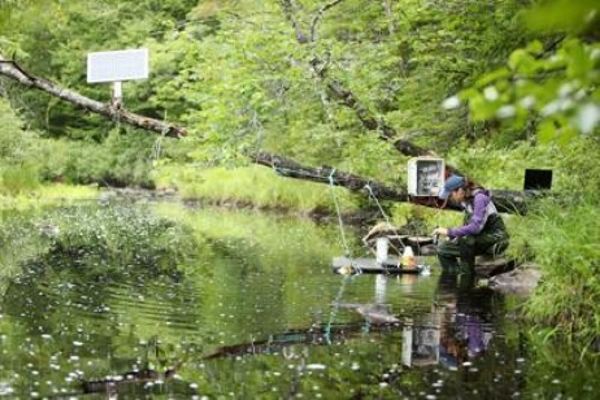
At Dalhousie University in Halifax, Nova Scotia, hydrologist Dr. Shannon Sterling, along with Dr. Edmund Halfyard, have recognized the need to address acidification of freshwater sources and, through it, mitigate climate change. Their approach adds crushed limestone to Nova Scotia’s rivers and lakes. The university has spun out a new startup called CarbonRun with its mission to deliver innovative technology to restore local ecosystems and sequester carbon to fight climate change.
CarbonRun notes that natural carbon processes are disrupted by acid rain. Introducing natural alkaline materials into rivers, however, binds CO₂ with water to form bicarbonate. Bicarbonate serves as a building material for riverine aquatic life, helping to make shells and exoskeletons. Excess bicarbonate is washed into the ocean. Marine organisms use the bicarbonate to build shells and exoskeletons, while the remainder binds with the oceans’ absorbed carbon.
A New Technology to Tackle Climate Change
Dr. Sterling’s ecosystem restoration research, involving liming of local Nova Scotia rivers, serendipitously produced a new pathway for enhanced CO₂ removal. She contacted Dr. David Beerling at the University of Sheffield with the idea of using rivers to sequester carbon. Dr. Beerling founded the Leverhulme Centre for Climate Change Mitigation shortly after the Paris Climate Agreement in 2015. The Leverhulme was sprinkling crushed limestone on soil to sequester CO₂ from the atmosphere in what was called a carbon cycle hack. Dr. Sterling suggested that using rivers could speed things up and provide better monitoring and control of the sequestration process.
Backed by a Toronto-based angel investor, Dr. Sterling received seed funding to begin measuring the impact of liming doses on Nova Scotia rivers. She noted that no one was doing CO₂ removal this way. Other sequestration projects were focused on the ocean and land. With the help of colleagues like Dr. Halfyard, she launched CarbonRun.
In September 2025, CarbonRun received a significant contract worth $25.4 million from Frontier Climate to sequester 55,442 tons of CO₂ from the atmosphere over four years. Who is Frontier? Frontier is a consortium of buyers including Google, Shopify, Meta, JP Morgan Chase, McKinsey, Salesforce, Stripe and others. They have committed to purchasing $1 billion+ of permanent atmospheric carbon removal by 2030. Frontier’s goal is to accelerate carbon removal technologies, offering buyers several ways to use the marketplace to benefit the planet and keep a lid on global warming. The price of every ton of CO₂ CarbonRun removes is $458.
Frontier is seeking technology suppliers like CarbonRun that can sequester carbon permanently, meaning in excess of 1,000 years. It is looking to suppliers who use natural carbon sinks. It is looking for suppliers who can provide rigorous methods for monitoring carbon removal. CarbonRun fits these criteria.

